Deoksugung Palace: Seoul's Most Accessible Royal Compound
Deoksugung Palace sits in the heart of Jung-gu, surrounded by modern Seoul yet preserved as a rare meeting point of Joseon tradition and early 20th-century Western architecture. At 1,000 KRW and open until 9pm (last admission at 8pm), it is one of the few palaces you can visit after work or after dinner.
Quick Facts
- Location
- 99 Sejong-daero, Jung-gu, Seoul (City Hall area)
- Getting There
- City Hall Station (Lines 1 & 2), Exit 1 — short walk
- Time Needed
- 1 to 2 hours for the grounds; add extra time for Seokjojeon art museum
- Cost
- 1,000 KRW per person (800 KRW for groups of 10+); separate ticket for the exhibition halls
- Best for
- History lovers, architecture enthusiasts, evening walks, travelers short on time
- Official website
- royal.khs.go.kr
What Is Deoksugung Palace?
Deoksugung Palace, known in Korean as 덕수궁, occupies a compact but historically loaded plot in the center of modern Seoul. It is smaller than Gyeongbokgung or Changdeokgung, but its location, its late history, and its unusual architectural mix make it one of the more thought-provoking royal sites in the city.
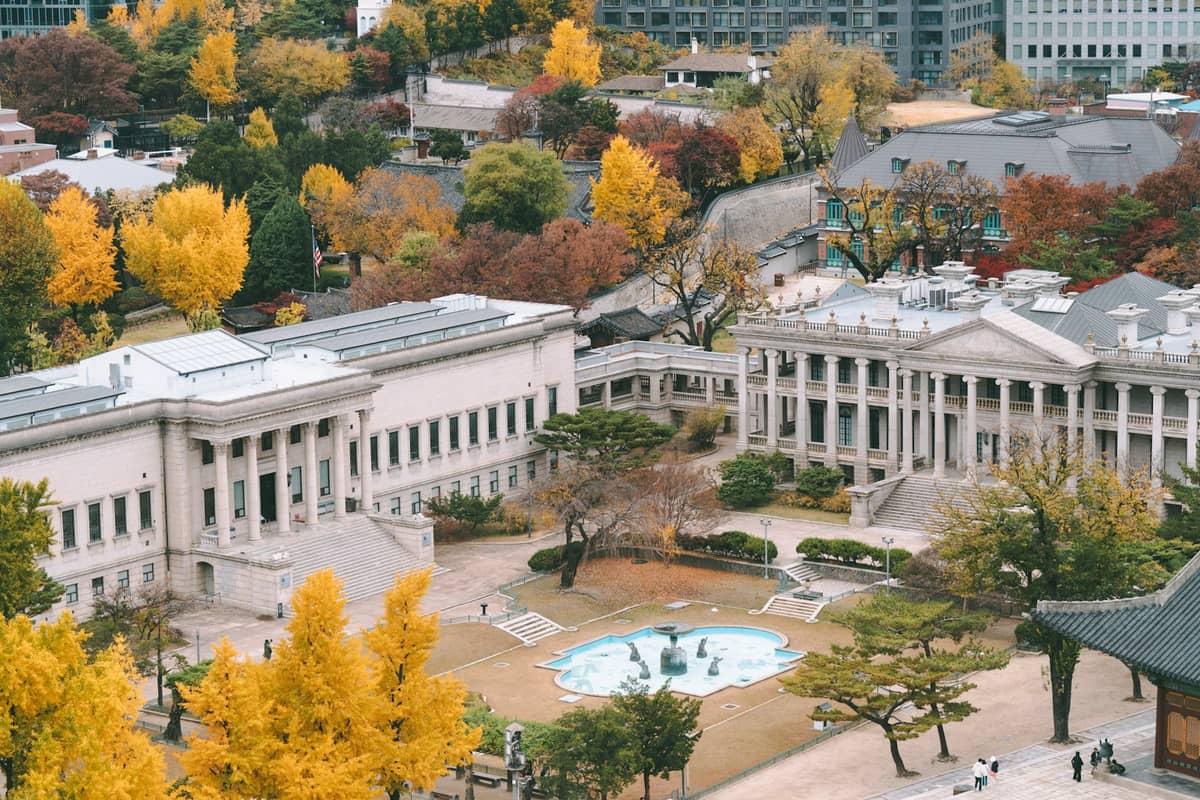
The palace began as a royal residence in the 16th century, used after the main palaces were destroyed during the Japanese invasions. It became the principal seat of power for Emperor Gojong in the late 19th and early 20th centuries, a period when Korea was navigating intense pressure from surrounding imperial powers. That political urgency shaped the palace's architecture in a way that no other royal compound in Seoul reflects: Joseon-era wooden pavilions coexist here with stone neo-classical halls built in a European style, commissioned by a court trying to signal modernity and sovereignty.
Originally called Gyeongungung, the palace was renamed Deoksugung in 1907, a name that translates roughly as 'Palace of Virtuous Longevity.' The renaming followed Emperor Gojong's forced abdication, and the complex had by then already become a symbol of a dynasty under pressure. That weight of history is still present in the stones.
ℹ️ Good to know
Deoksugung is closed on Mondays. If Monday falls on a public holiday, the closure shifts to the following business day. Hours are 09:00–21:00, with last admission at 20:00.
The Architecture: Where Joseon Meets European Classicism
The most striking thing about Deoksugung is not any single building but the visual collision between building styles within a few hundred meters of each other. The main throne hall, Junghwajeon, is a traditional Joseon structure: heavy tiled roofs, painted wooden eaves, a raised stone platform, and a wide paved courtyard of flat stone slabs. This is what most people expect from a Korean palace. It delivers.
Then, across the garden, stands Seokjojeon, a two-story Western-style stone building that looks like it was lifted from a European capital and set down in Seoul. Built between 1900 and 1910, it was commissioned by the Joseon court. Today it houses the Daehan Empire History Museum. The interior, restored to its early 20th-century appearance, includes period furnishings and ceremonial rooms that give a concrete sense of how Korean imperial life tried to adapt to and engage with Western diplomatic norms.
Nearby, Dondeokjeon is another Western-influenced hall, smaller and more intimate, used for receptions. For travelers who have spent time at Gyeongbokgung Palace or Changdeokgung Palace, Deoksugung offers something genuinely different: a site where the architectural vocabulary itself tells the story of a kingdom in transition.
Tickets & tours
Hand-picked options from our booking partner. Prices are indicative; availability and final rates are confirmed when you complete your booking.
DMZ and Lake Majang Suspension Bridge Tour from Seoul
From 57 €Instant confirmationFree cancellationHalf Day DMZ Tour from Seoul, 3rd Tunnel, Observatory and More
From 47 €Instant confirmationFree cancellationSeoul zombie city exploration game and private tour
From 10 €Instant confirmationFree cancellationLuggage Storage in Seoul
From 7 €Instant confirmationFree cancellation
What It Feels Like to Walk the Grounds
Enter through Daehanmun, the main gate on the eastern side facing the roundabout of City Hall Plaza. The gate ceremony features guards in period costume and is worth timing your arrival around if you can. The ceremony is short, colorful, and photographed heavily, so position yourself early if you want an unobstructed view.
Past the gate, the grounds open up into a walkable circuit that loops through the main ceremonial areas, the Western-style halls, and a wooded rear section that most visitors do not reach. The rear garden in particular is quieter, shaded, and holds the small pond area where the pace drops noticeably. In autumn, the trees here turn gold and orange and the light through the branches in the late afternoon is the kind of thing people come back specifically to photograph.
Sound is part of the experience in a way it is not at larger palaces. Deoksugung is surrounded on all sides by city traffic, and from certain points inside the walls you can hear car horns and the rumble of buses while looking at a 600-year-old stone pavement. Some visitors find this disorienting. Others find it clarifying: this palace did not retreat to the mountains. It held its ground in the middle of a modern capital.
💡 Local tip
The palace is open until 9pm, making it one of the few royal sites in Seoul accessible after dark. Evening visits on weekdays are significantly less crowded than daytime weekends. The lanterns and soft lighting give the wooden halls a completely different atmosphere after dusk.
Best Time to Visit and How Crowds Behave
Weekend afternoons between roughly 1pm and 4pm are the busiest periods. School groups arrive on weekday mornings. If you visit on a clear Tuesday or Wednesday morning, the grounds can feel almost private.
Season matters. Spring brings cherry blossoms along Deoksugung Doldam-gil, the stone-wall path that runs along the palace's outer wall on the Jeongdong side. This path is one of the more atmospheric walks in central Seoul, and in late March to early April the combination of old stone walls and blossom-heavy branches turns it into a slow procession of photographers and couples. Arrive before 9am to see it without a crowd.
Autumn, particularly late October to early November, produces arguably the best overall visit conditions: comfortable temperatures, good light, and the tree color in the rear garden. This aligns with the broader case for autumn across Seoul's outdoor sites, which we cover in depth in our guide to visiting Seoul in autumn.
Winter visits are cold but functional. Snow on the tile roofs and stone courtyards produces striking photographs, and the reduced tourist numbers mean you can stand in front of Junghwajeon in near-silence. Dress warmly: there is no shelter on the main stone plaza.
Practical Walkthrough: Getting There and Moving Around
City Hall Station on subway Lines 1 and 2 is the primary access point. Use Exit 1, which places you near the plaza facing the Daehanmun gate. Tickets are purchased at the entrance.
Deoksugung sits in the Jung-gu district, which puts it within easy walking distance of City Hall Plaza, Cheonggyecheon Stream (about 10 minutes on foot), and Gwanghwamun Square. It fits naturally into a half-day loop of central Seoul without requiring any additional transit.
The grounds are mostly flat and paved, which makes them manageable for strollers and travelers with mobility considerations. Specific accessibility infrastructure such as ramps and elevators is not comprehensively documented in current public sources; contact the palace administration in advance if this is a key requirement.
Photography is generally permitted throughout the grounds. The best light for the main throne hall Junghwajeon is in the morning when the sun comes from the east and falls directly onto the painted facade. Seokjojeon's stone exterior photographs well on overcast days, which flatten the harsh shadows the columns create in direct sun.
⚠️ What to skip
Seokjojeon, Dondeokjeon, and Jungmyeongjeon each have separate exhibition hours shorter than the main palace hours. If you specifically want to enter these buildings, check the current posted hours before you visit, as they can differ from the main 09:00–21:00 window.
Who This Is For, and Who Might Skip It
Travelers with a serious interest in Korean history, architecture, or the late Joseon and Daehan Empire period will find Deoksugung more rewarding per square meter than almost anywhere in Seoul. It is also the most practical palace for a short visit, given its central location, low cost, and evening hours. Pair it with Cheonggyecheon Stream or Gwanghwamun Square for a half-day loop that does not require backtracking.
Travelers expecting the grand scale of Gyeongbokgung will find Deoksugung modest by comparison. The grounds are modest by comparison. If you have time for only one palace in Seoul and want maximum visual impact, Gyeongbokgung is the more obvious choice. Deoksugung rewards a slower, more curious kind of visitor.
Those traveling with children may find the changing of the guard ceremony engaging, but the palace otherwise lacks the interactive elements that make larger sites like the National Folk Museum appealing to younger visitors.
Insider Tips
- Walk Deoksugung Doldam-gil, the stone-wall path along the palace's exterior on the Jeongdong side, before or after your visit. It is technically outside the walls and free to walk. In spring it is lined with cherry blossoms; in autumn with fallen leaves. Most visitors who enter through Daehanmun skip it entirely.
- The 9pm closing time is real and enforced, but the hour before closing on a weekday is one of the calmest times to visit any palace in Seoul. The grounds thin out quickly after 7:30pm.
- If you arrive in hanbok, entry is free. Several hanbok rental shops operate near City Hall and in the nearby Insadong area, typically for a few hours at a time. The policy applies to all traditional Korean dress in good condition.
- The Daehanmun gate ceremony runs multiple times daily but check the current schedule at the ticket booth on arrival, as timings can shift seasonally. Standing to the side rather than directly in front gives you a cleaner photograph of the ceremony without the backs of other tourists in frame.
- Seokjojeon is worth the extra ticket cost if you have any interest in the Daehan Empire period. The restored interior rooms on the upper floor give a specific, physical sense of how Korean imperial identity was performed in the early 1900s in ways that outdoor-only visits to other palaces do not provide.
Who Is Deoksugung Palace For?
- History and architecture travelers interested in the late Joseon and Daehan Empire period
- Evening visitors looking for an atmospheric, low-cost walk in central Seoul
- Photographers, especially during spring blossom season along Doldam-gil or autumn leaf color in the rear garden
- Travelers combining multiple central Seoul sites into a single half-day loop
- Budget-conscious visitors: at 1,000 KRW, it is one of the best-value historic sites in the city
Nearby Attractions
Other things to see while in Myeongdong & Jung-gu:
- Cheonggyecheon Stream
Cheonggyecheon Stream is an 11-kilometer restored waterway cutting through central Seoul, offering a rare ground-level escape from the city's elevated streets. Free to access around the clock in normal conditions, it draws early-morning joggers, evening strollers, and weekend families in equal measure.
- Gyeonghuigung Palace
Once a secondary palace for Joseon kings, Gyeonghuigung stands today as Seoul's least-visited royal site, which is precisely what makes it worth your time. Free to enter and rarely crowded, it offers a grounded, unhurried encounter with Korean dynastic architecture in the heart of the city.
- Myeongdong Cathedral
Myeongdong Cathedral is Seoul's most historically significant Catholic church and one of the city's finest examples of Gothic brick architecture. Founded in 1892 and completed in 1898, it sits on a hilltop above the commercial noise of Myeongdong, offering a rare moment of calm in the middle of one of Seoul's busiest districts. Entry is free.
- Namdaemun Market
Namdaemun Market (남대문시장) Namdaemun Market (남대문시장) has operated in the heart of Seoul's Jung-gu district since 1414, making it the largest traditional market in South Korea. Spread across a dense network of alleys and covered arcades, it sells everything from wholesale eyewear and kitchenware to street food and children's clothing — and it barely sleeps.