Gyeongbokgung Palace: Seoul's Most Commanding Historic Site
Built in 1395 as the seat of Joseon dynasty power, Gyeongbokgung Palace is the largest and most architecturally ambitious of Seoul's five historic palaces. From its colonnaded throne hall to the lotus pond pavilion, it rewards visitors who arrive with context and a plan.
Quick Facts
- Location
- 161 Sajik-ro, Jongno-gu, Seoul 03045
- Getting There
- Gyeongbokgung Station (Line 3, Exit 5) or Gwanghwamun Station (Line 5, Exit 2)
- Time Needed
- 2–3 hours for a thorough visit; 1 hour minimum
- Cost
- KRW 3,000 for adults; discounts for youth; closed Tuesdays
- Best for
- History enthusiasts, architecture lovers, photography, cultural immersion
- Official website
- www.royalpalace.go.kr
What Gyeongbokgung Palace Actually Is
Gyeongbokgung Palace (경복궁) is not simply a historic building. It is a 43-hectare walled compound in the heart of Seoul's Jongno district, positioned with Bugaksan mountain rising directly behind it and the ancient ceremonial boulevard stretching south toward Gwanghwamun Square. Founded in 1395 during the reign of King Taejo, the first ruler of the Joseon dynasty, it served as the principal royal residence and seat of government for over two centuries before being burned during the Japanese invasion of 1592.
The palace was left in ruins for nearly 270 years until Regent Heungseon Daewongun ordered an ambitious reconstruction in the 1860s. That project restored the compound to a scale that dwarfed its predecessor. Then, during the Japanese colonial period (1910–1945), the grounds were systematically reduced: the Government-General Building was constructed directly in front of the main throne hall, deliberately obscuring the palace's symbolic axis. South Korea has been engaged in a long-term restoration effort ever since. What visitors see today is a mix of meticulously reconstructed buildings and original stonework, a palimpsest of ambition, destruction, and recovery.
💡 Local tip
Arrive at opening time (09:00) on a weekday. The Gwanghwamun Gate area is nearly empty in early morning, and the light hitting the main throne hall at that hour is exceptional for photography. By 10:30, tour groups begin filling the main courtyards.
The Spatial Experience: Moving Through the Palace
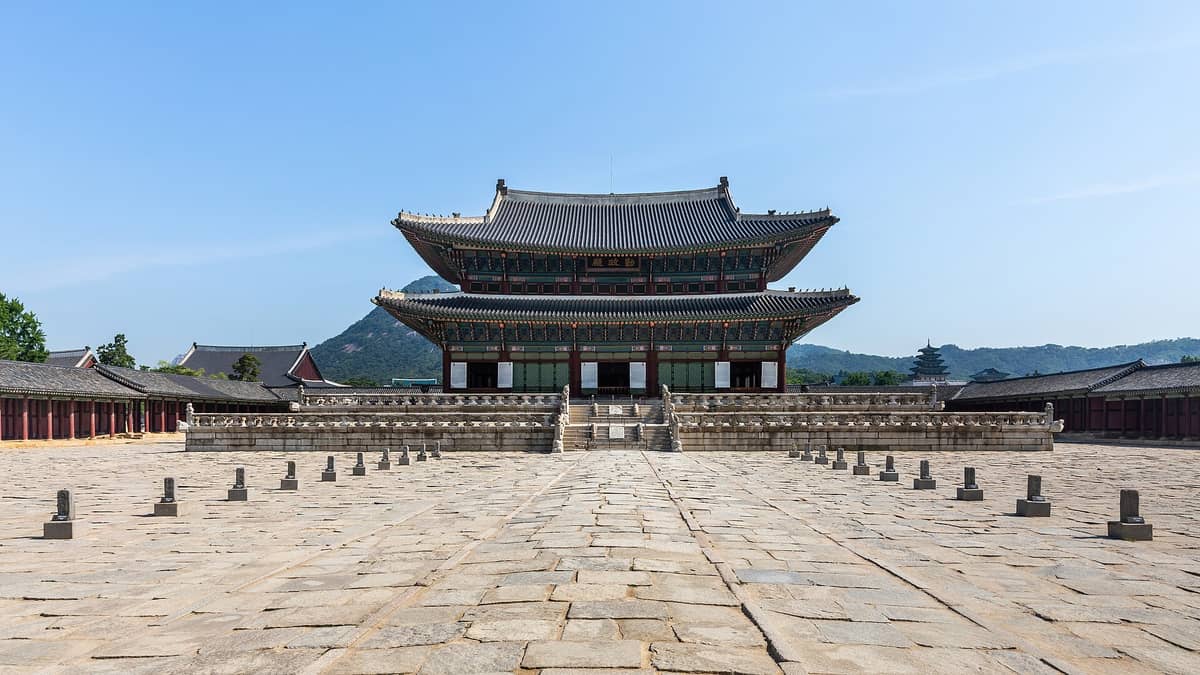
Entering through Gwanghwamun, the palace's three-arched southern gate, immediately establishes the scale. The gate itself is monumental, with two stone haetae (mythical guardian creatures) flanking the approach. Beyond it lies Heungnyemun Gate, and then a second courtyard before you reach Geunjeongjeon, the main throne hall. The progression through successive gates is deliberate: each transition narrows the visitor's focus until the throne hall opens onto a wide paved courtyard marked with stone rank markers, indicating where court officials once stood according to their hierarchy.
Geunjeongjeon sits on a two-tiered stone platform and is the most photographed structure in the compound. Its double-eaved wooden roof, painted in the traditional dancheong style with rich greens, blues, and reds, weighs visually against the pale granite platform below. Walk around the platform rather than simply photographing from the front. The carved stone balustrades feature phoenixes, dragons, and other symbolic animals, and the detail rewards close inspection.
Further north, the compound opens into more intimate spaces. Gyeonghoeru, a two-story pavilion rising from a rectangular lotus pond, is arguably the most elegant structure in the complex. Historically used for state banquets and royal celebrations, it was built on 48 stone pillars rising directly from the water. The pavilion is not open for interior visits as a standard rule, but the exterior view across the pond, particularly with reflections on calm mornings, is one of Seoul's most quietly impressive sights.
For context on the broader palace district and the neighborhood surrounding Gyeongbokgung, the Jongno-Bukchon area guide covers the surrounding streets, nearby attractions, and dining options worth combining with a palace visit.
Tickets & tours
Hand-picked options from our booking partner. Prices are indicative; availability and final rates are confirmed when you complete your booking.
DMZ and Lake Majang Suspension Bridge Tour from Seoul
From 57 €Instant confirmationFree cancellationHalf Day DMZ Tour from Seoul, 3rd Tunnel, Observatory and More
From 47 €Instant confirmationFree cancellationSeoul zombie city exploration game and private tour
From 10 €Instant confirmationFree cancellationLuggage Storage in Seoul
From 7 €Instant confirmationFree cancellation
How the Experience Changes by Time of Day
At 09:00, the palace opens to near silence. The main gate guards perform their ceremonial changing ceremony twice daily (check current schedule on arrival), and if you catch it before the crowds, the formal choreography against the historic architecture is striking rather than theatrical. The morning also brings cooler temperatures, which matters significantly in summer when midday heat on the exposed stone courtyards can be punishing.
By late morning, the dynamic shifts. School groups move in clusters with guides speaking through portable microphones. Weekend afternoons see the largest concentrations of visitors in traditional hanbok dress, a practice actively encouraged by the palace administration, as visitors wearing hanbok receive free entry. This creates an unusual visual texture: modern tourists in rented historical clothing moving through restored Joseon architecture, a scene that is simultaneously anachronistic and genuinely festive. Whether this appeals to you or not is a matter of personal taste.
Late afternoon, roughly 90 minutes before closing, sees crowds thin noticeably. The light becomes warmer and directional, particularly on the western side of the compound. The National Palace Museum of Korea, located on the palace grounds, has its own closing hours, so plan accordingly if you intend to visit both.
⚠️ What to skip
The palace is closed every Tuesday without exception. Arriving on a Tuesday is a common and avoidable mistake. If Tuesday is your only available day, consider Changdeokgung Palace or Deoksugung Palace as alternatives.
Key Structures Worth Your Time
Geunjeongjeon (Main Throne Hall)
The political and ceremonial heart of the Joseon court. The interior can be viewed but not entered; peer through the open lattice doors to see the gilded throne beneath a ceiling decorated with two carved dragons. The acoustic quality of the courtyard on a quiet morning, with stone surfaces amplifying distant footsteps, adds to the sense of formality the space was designed to project.
Gyeonghoeru Pavilion
The lotus pond pavilion best seen from the eastern embankment. In late spring, the lotuses begin to emerge; in autumn, the water reflects the hillside behind the compound. A short northern walk from here leads to Hyangwonjeong, a smaller hexagonal pavilion on a circular island in a second pond, connected by a wooden bridge. It is quieter than Gyeonghoeru and less photographed.
National Folk Museum of Korea
Located within the palace grounds in the northeastern corner, entry is free via a separate museum entrance and does not require a palace ticket. Three permanent exhibition halls cover Korean life from prehistoric times through the late Joseon period. The outdoor exhibit area features reconstructed traditional buildings and tools. It is a practical complement to the palace if you want interpretive context rather than just architectural experience.
The National Folk Museum of Korea has its own dedicated guide covering exhibition highlights and practical visitor information worth reading before combining it with a palace visit.
Getting There and Practical Logistics
The most direct approach is Gyeongbokgung Station on Subway Line 3, Exit 5. The exit deposits you at the palace's western ticket office, a short walk from the main Gwanghwamun Gate. Gwanghwamun Station on Line 5, Exit 2, places you at the southern approach along the ceremonial boulevard, which is the more architecturally intended entrance but involves a slightly longer walk. Both are reasonable options; the Line 5 approach provides a better sense of the palace's original urban relationship.
If you are planning a broader day in the historic core of Seoul, the palace pairs naturally with a walk through Bukchon Hanok Village to the east, or with the Cheonggyecheon Stream to the south for an afternoon contrast of historical grandeur and urban waterway.
Opening hours vary by season: 09:00 to 18:30 from June through August, 09:00 to 18:00 in spring and autumn (March to May, September to October), and 09:00 to 17:00 in the cooler months of January, February, November, and December. Last entry is one hour before closing in all periods. Adult admission is KRW 3,000. Visitors wearing hanbok traditional dress enter free.
ℹ️ Good to know
Seoul's subway system uses a stored-value T-money card, available at any convenience store near the station. A single journey typically costs around KRW 1,550 and covers all lines. It is cheaper and faster than taxis for this route during peak hours.
Accessibility information for the specific palace grounds, including step-free routes and wheelchair availability, should be verified directly with the palace administration before visiting, as restoration work periodically affects accessible pathways.
Seasonal Considerations and Honest Caveats
Spring (April to May) and autumn (September to October) are the most comfortable seasons to visit, aligning with the best time to visit Seoul overall. Cherry blossoms appear briefly in early April, and the palace's internal garden spaces benefit from the color. Autumn brings cooler temperatures and clear skies, with the mountain backdrop turning amber behind the compound's northern walls.
Summer visits are possible but demanding. The exposed stone courtyards offer no shade, temperatures regularly reach 30°C or above in July and August, and the humidity makes prolonged outdoor exposure fatiguing. Bring water, wear a hat, and plan for a midday break in the air-conditioned National Palace Museum. Winter visits have their own character: the palace grounds occasionally receive snow, which transforms the grey stonework and red-painted wood dramatically. Visitor numbers drop significantly, and the atmosphere is spare and serious rather than festive.
Who might want to skip this or temper expectations: visitors who primarily want immersive, undisturbed historical atmosphere may find the weekend hanbok crowds disruptive. The palace is heavily restored rather than original, and those expecting an untouched ancient site should know they are visiting a largely reconstructed compound, however authentic in its methods and materials. If your interest is primarily in Korean traditional architecture at smaller scale and lower visitor volume, Changgyeonggung Palace nearby offers a quieter alternative.
For travelers building a multi-day itinerary around Seoul's historic sites, the guide to palaces in Seoul provides comparative context across all five Joseon palaces, which helps in prioritizing given limited time.
Insider Tips
- Wear hanbok for free entry. Rental shops are clustered on the streets east of the palace, near Bukchon, and most include basic hair accessories. Rental typically runs KRW 10,000–20,000 for two to three hours. It is not purely a tourist gimmick: the palace staff and guards engage more warmly with hanbok-dressed visitors, and the photographic results are considerably more interesting than smartphone snapshots in street clothes.
- The Heungnyemun Gate courtyard, between the outer and inner gates, contains a small stream with stone bridges that most visitors walk across without stopping. Look down at the carved stone waterway channels; they are original stonework, among the oldest intact elements on the grounds.
- The National Palace Museum of Korea (accessed from within the grounds) is free beyond your palace admission and is less visited than it deserves. Its collection of royal seals, court textiles, and celadon ceramics adds interpretive depth that the outdoor structures alone cannot provide.
- The western ticket gate near Line 3 opens slightly faster than the main southern entrance at opening time. If you arrive precisely at 09:00 aiming to beat crowds to Geunjeongjeon, the western entrance is marginally quicker.
- Photography of the interior throne at Geunjeongjeon is possible through the open lattice doors with a wide-angle lens or phone, but a telephoto or zoom gets the gilded throne and ceiling dragons in usable detail without pushing through other visitors.
Who Is Gyeongbokgung Palace For?
- First-time Seoul visitors wanting to understand the city's historical foundation in a single afternoon
- Architecture and design travelers drawn to Joseon-era structural forms and traditional Korean aesthetics
- Photography-focused visitors, especially those who can arrive at opening or return in late afternoon light
- Families with older children who benefit from the adjacent National Folk Museum's interpretive exhibits
- Travelers planning a full Jongno cultural day combining palaces, Bukchon's hanok lanes, and Insa-dong
Nearby Attractions
Other things to see while in Jongno & Bukchon:
- Bukchon Hanok Village
Bukchon Hanok Village (북촌한옥마을) is a preserved residential district of roughly 860 traditional Korean hanok houses in central Seoul, situated between Gyeongbokgung and Changdeokgung palaces. Unlike a museum or theme park, it is a real neighborhood where people still live, which shapes every aspect of visiting it. Entry is free, but access to certain alleys is restricted to protect residents.
- Changdeokgung Palace & Secret Garden
Changdeokgung Palace is the best-preserved of Seoul's five Joseon-era royal palaces, and its rear garden — the Huwon, known as the Secret Garden — remains one of the most atmospheric green spaces in the entire city. Together, they form a UNESCO World Heritage Site that rewards visitors who plan ahead.
- Changgyeonggung Palace
One of Seoul's five grand Joseon-era palaces, Changgyeonggung Palace sits in Jongno-gu and offers a quieter royal grounds experience. With late evening opening hours, low admission, and centuries of layered history, it rewards visitors who arrive without high expectations and leave with quiet satisfaction.
- Gwanghwamun Square
Gwanghwamun Square stretches 40,300 square meters through the center of Seoul, framed by Gyeongbokgung Palace to the north and the distant peaks of Bugaksan beyond. It is free, open 24 hours, and carries more historical weight than most visitors realize on first pass.