Bukchon Hanok Village: Seoul's Living Historic Neighborhood
Bukchon Hanok Village (북촌한옥마을) is a preserved residential district of roughly 860 traditional Korean hanok houses in central Seoul, situated between Gyeongbokgung and Changdeokgung palaces. Unlike a museum or theme park, it is a real neighborhood where people still live, which shapes every aspect of visiting it. Entry is free, but access to certain alleys is restricted to protect residents.
Quick Facts
- Location
- 37 Gyedong-gil, Jongno-gu, Seoul 03059
- Getting There
- Anguk Station (Line 3), Exit 3 — approx. 5–10-minute walk
- Time Needed
- 1.5 to 3 hours depending on pace
- Cost
- Free to enter; individual attractions inside may charge separately
- Best for
- Architecture lovers, photography, history, slow walking
- Official website
- hanok.seoul.go.kr/front/eng/town/town01.do
What Bukchon Actually Is (and Why That Matters)
Bukchon Hanok Village is not a reconstruction or a heritage theme park. It is a functioning residential neighborhood in Jongno-gu that happens to contain around 860 traditional Korean hanok houses, many of them still occupied by Seoul residents. The name translates directly as 'north village' (bukchon, 북촌), a reference to its position north of Cheonggyecheon stream and Jongno, historically placing it between the two great palaces of Joseon-era Seoul: Gyeongbokgung to the west and Changdeokgung to the east.
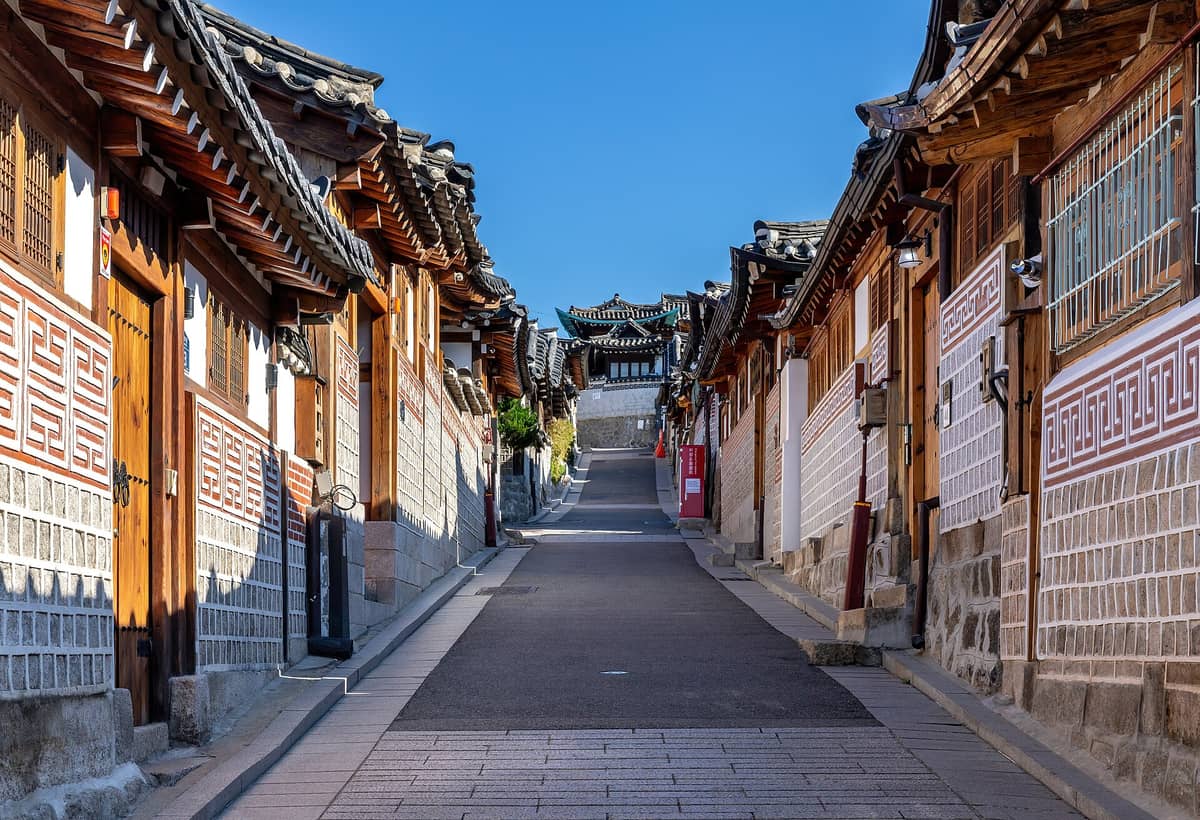
This context matters for how you visit. Narrow alleyways that look like they were designed for photography are also someone's front gate. Tile-roofed corridors that curve photogenically uphill also lead to someone's kitchen window. The village has become one of Seoul's most photographed spots, and the tension between mass tourism and residential life is very real here. Seoul city has responded with restricted access hours for certain alleys (access is limited from 10:00 to 17:00) and ongoing quiet-zone signage throughout the neighborhood.
⚠️ What to skip
Several key alleyways — including the famous viewpoint alley on Gahoe-dong's slope — are designated residential areas with restricted hours: 10:00 to 17:00. Visiting outside these hours is not permitted in those sections. The village is also explicitly a quiet zone; groups should avoid loud conversation, and photographing people inside their homes or through open gates is considered intrusive.
The Architecture: What You Are Looking At
A hanok is a traditional Korean wooden house built around a central courtyard, with a distinctive curved, tiled roof designed to manage Korea's dramatic seasonal range from hot, humid summers to freezing winters. The underfloor heating system, ondol, is one of the defining features, though you will not see it on a walking tour. What you will see is the interplay of dark grey clay roof tiles, white-plastered mud walls, and wooden latticework gates, all compressed into narrow uphill lanes.
Most of Bukchon's hanok were built during the Japanese colonial period in the early twentieth century, when developers divided larger aristocratic estates into smaller residential plots for the urban middle class. This is why the scale feels domestic rather than grand: these were city houses, not palaces or country estates. A small number of properties date to the Joseon Dynasty (1392–1897), but the majority of the surviving streetscape reflects 1920s and 1930s construction. Some have since been converted into small guesthouses, tea rooms, or craft galleries, while the majority remain private residences.
For a deeper understanding of how hanok architecture fits into the broader Seoul landscape, the guide to hanok villages in Seoul covers several comparable neighborhoods, and the Ikseon-dong Hanok Village nearby offers a more commercial, cafe-heavy interpretation of the same building type.
Tickets & tours
Hand-picked options from our booking partner. Prices are indicative; availability and final rates are confirmed when you complete your booking.
DMZ and Lake Majang Suspension Bridge Tour from Seoul
From 57 €Instant confirmationFree cancellationHalf Day DMZ Tour from Seoul, 3rd Tunnel, Observatory and More
From 47 €Instant confirmationFree cancellationSeoul zombie city exploration game and private tour
From 10 €Instant confirmationFree cancellationLuggage Storage in Seoul
From 7 €Instant confirmationFree cancellation
How the Village Changes Through the Day
Tourist access to the Gahoe-dong photo alleys is 10:00–17:00; arriving at opening on a weekday is the calmest legal window. In the early hours, the lanes are quiet enough to hear the sound of passing sparrows and the occasional sound of a door sliding open. The morning light falls at a low angle across the tiled rooftops, and the smell of wood and stone is more noticeable before the foot traffic stirs the dust of the alleyways. This is when photographers typically plant themselves at the upper viewpoint on Gahoe-dong to capture the cascading roofline view with Bugaksan mountain visible in the background.
By 10:00 to 11:00, the character shifts. Tour groups with matching hats arrive from the palace areas, social media content creators set up on the lane bends, and the alleyways near the main viewpoint become genuinely congested. Between 11:00 and 14:00 on weekends is typically the busiest period, with the iconic descending lane becoming close to impassable as visitors queue informally for the same shot. The atmosphere is not unpleasant, but the meditative quality of the early morning is gone.
Late afternoon, roughly 15:00 to 16:30, sees a second lull before access restrictions begin at 17:00. The light is warmer and more diffuse at this hour, and shadows lengthen across the tile roofs in a way that suits wider-angle photography. In autumn, when the ginkgo trees that line nearby streets have turned yellow, this afternoon light is particularly worth seeking. Note that you must be clear of restricted alleys by 17:00.
💡 Local tip
Weekday mornings before 09:30 are consistently less crowded than any part of the weekend. If your schedule has flexibility, a Tuesday or Wednesday visit will feel like a different place compared to a Saturday afternoon.
Walking the Village: A Practical Orientation
Bukchon does not have a single entrance or a fixed route. Most visitors arrive via Anguk Station (Line 3, Exit 3), which deposits you near the southern edge of the village and close to the Bukchon Traditional Culture Center, where free maps are available and information panels explain the history of the neighborhood in English. This is a useful first stop: the maps mark which alleys have restricted hours and identify the key viewpoints.
The most walked route follows a loose circuit through several numbered viewpoints, with the most famous being Viewpoint 2 on Gahoe-dong's descending slope. This is the vantage point reproduced on most travel content about Seoul: a steep lane lined on both sides with hanok rooftops, converging downhill toward the modern city skyline. Getting here involves a climb of several minutes from Anguk Station along a gradually steepening alley. Wear shoes with grip; the lanes are smooth stone and can be slippery after rain.
The terrain across the whole village is hilly, with uneven stone paving throughout. Wheeled luggage and strollers are difficult to manage on many of the steeper alleys, and wheelchair access is genuinely limited in practice. Flat shoes and comfortable walking clothes are the standard. In summer, carry water: there are no reliable water fountains along the main alley routes, and the uphill sections are exposed to direct sun.
Bukchon sits between two of Seoul's most significant palace complexes. Gyeongbokgung Palace is a 10-minute walk to the west, and Changdeokgung Palace is a similarly short walk to the east. Many visitors combine all three in a single half-day.
Seasonal Considerations
Spring (April to May) and autumn (September to October) are generally considered the best seasons to visit Bukchon. In spring, the surrounding Jongno streets have flowering trees that complement the grey tile roofscapes, and temperatures of roughly 10 to 20°C make the uphill walking comfortable. Autumn brings cooler, drier air and the color change on surrounding hillsides, particularly on Bugaksan and Inwangsan visible in the distance from upper viewpoints.
Winter visits (November to February) are underrated. Crowds are thinner than any other season, and a light snowfall on the hanok rooftops creates an atmosphere that summer cannot match. The cold can be sharp, often dropping below 0°C, so layering is important. The shorter daylight hours mean the 17:00 access cutoff can fall in near-darkness, so plan accordingly.
Summer, particularly July and August, brings both heat and the rainy season (jangma). The humidity in the narrow alleys can feel oppressive by mid-morning, and sudden heavy rain makes the stone lanes slippery. If you visit in summer, early morning is even more important both for comfort and safety.
ℹ️ Good to know
For a full breakdown of how Seoul's seasons affect sightseeing across the city, the guides to Seoul in spring and Seoul in autumn cover the wider seasonal picture beyond Bukchon specifically.
Honest Assessment: Is It Worth the Visit?
The short answer is yes, with realistic expectations. Bukchon Hanok Village is genuinely one of the most historically significant urban streetscapes in Seoul: roughly 860 traditional hanok in a continuous neighborhood, situated between two Joseon-era palaces, with Bugaksan as a backdrop. That combination does not exist anywhere else in the city at this scale. The free entry makes it accessible to any budget, and the proximity to multiple other major attractions means it fits naturally into a full day of Jongno sightseeing.
The honest caveat is that peak-hour visits can feel less like cultural immersion and more like queuing for a photograph. If you arrive between 11:00 and 14:00 on a weekend in cherry blossom season expecting a quiet, contemplative experience, you will be disappointed. The village's popularity has made some of its most famous spots feel performative. The actual residential fabric is best appreciated when the crowds thin.
Visitors who dislike uneven terrain, do not have mobility for uphill walking, or are primarily interested in interior access to historical buildings may find that nearby palaces serve them better. Bukchon is fundamentally a walk through a neighborhood, not a ticketed attraction with guided interpretation of interiors.
If the living-neighborhood quality of Bukchon appeals to you, the nearby Seochon Village on the western side of Gyeongbokgung offers a quieter, less-photographed alternative with a similar mix of hanok lanes and small local businesses. For broader context on the Jongno area and how Bukchon fits into it, the Jongno and Bukchon neighborhood guide is a useful companion.
Insider Tips
- The Bukchon Traditional Culture Center near the Anguk Station entrance offers free printed maps in English and Korean that mark restricted alleys and numbered viewpoints. Pick one up before you start rather than relying on phone navigation, which can send you down dead ends.
- Viewpoint 2 on Gahoe-dong is the most photographed spot, but Viewpoint 5 further up the hill can offer a similar roofline view with fewer people.
- Several hanok in the village have been converted into small guesthouses. Staying in one overnight gives you access to the lanes in the early morning and late evening when day visitors are absent, which is a fundamentally different experience from a day visit.
- The side streets east of the main Gahoe-dong axis, toward Changdeokgung, see significantly less foot traffic and contain some of the best-preserved and least-modified hanok facades in the entire village.
- If rain is forecast, visit anyway: a light drizzle makes the grey tiles and stone lanes reflective and atmospherically photogenic in a way that dry conditions do not replicate. Just bring waterproof footwear for the slippery stone surfaces.
Who Is Bukchon Hanok Village For?
- Architecture and design enthusiasts interested in traditional Korean building methods and urban form
- Photographers, particularly those working in early morning light or interested in urban landscape
- History travelers exploring Joseon-era Seoul alongside the palace complexes
- Slow walkers and those who enjoy exploring neighborhoods at their own pace without a fixed itinerary
- Visitors on a tight budget who want substantial cultural depth without admission fees
Nearby Attractions
Other things to see while in Jongno & Bukchon:
- Changdeokgung Palace & Secret Garden
Changdeokgung Palace is the best-preserved of Seoul's five Joseon-era royal palaces, and its rear garden — the Huwon, known as the Secret Garden — remains one of the most atmospheric green spaces in the entire city. Together, they form a UNESCO World Heritage Site that rewards visitors who plan ahead.
- Changgyeonggung Palace
One of Seoul's five grand Joseon-era palaces, Changgyeonggung Palace sits in Jongno-gu and offers a quieter royal grounds experience. With late evening opening hours, low admission, and centuries of layered history, it rewards visitors who arrive without high expectations and leave with quiet satisfaction.
- Gwanghwamun Square
Gwanghwamun Square stretches 40,300 square meters through the center of Seoul, framed by Gyeongbokgung Palace to the north and the distant peaks of Bugaksan beyond. It is free, open 24 hours, and carries more historical weight than most visitors realize on first pass.
- Gwangjang Market
Established in 1905, Gwangjang Market in Jongno is Seoul's oldest continuously operating covered market. It draws visitors for its legendary street food stalls — bindaetteok, mayak gimbap, yukhoe — as much as for its wholesale fabric halls and secondhand clothing floors.