Seochon Village: Seoul's Quieter Side of the Palace District
Seochon Village occupies the narrow alleys west of Gyeongbokgung Palace in Jongno-gu, where Joseon-era hanok architecture survives alongside independent cafes, small galleries, and artist studios. The neighborhood is free to enter, walkable in two to three hours, and noticeably calmer than the tourist corridors on the palace's eastern flank.
Quick Facts
- Location
- Jongno-gu, Seoul (roughly between Pirundae-ro and Jahamun-ro)
- Getting There
- Subway Line 3, Gyeongbokgung Station, Exits 2 or 3 (approx. 617 m walk)
- Time Needed
- 2–3 hours for a relaxed walk; longer if you stop at cafes or galleries
- Cost
- Free to enter the neighborhood; individual cafes, galleries, and shops vary
- Best for
- Architecture lovers, slow walkers, cafe-hoppers, photography
- Official website
- world.seoul.go.kr/seochon-village
What Seochon Village Actually Is
Seochon Village, known in Korean as 서촌마을, is a low-rise residential and cultural neighborhood pressed against the western wall of Gyeongbokgung Palace. The name means simply 'west village,' and it has long been used in daily speech. Most locals, cafes, and maps still call it Seochon.
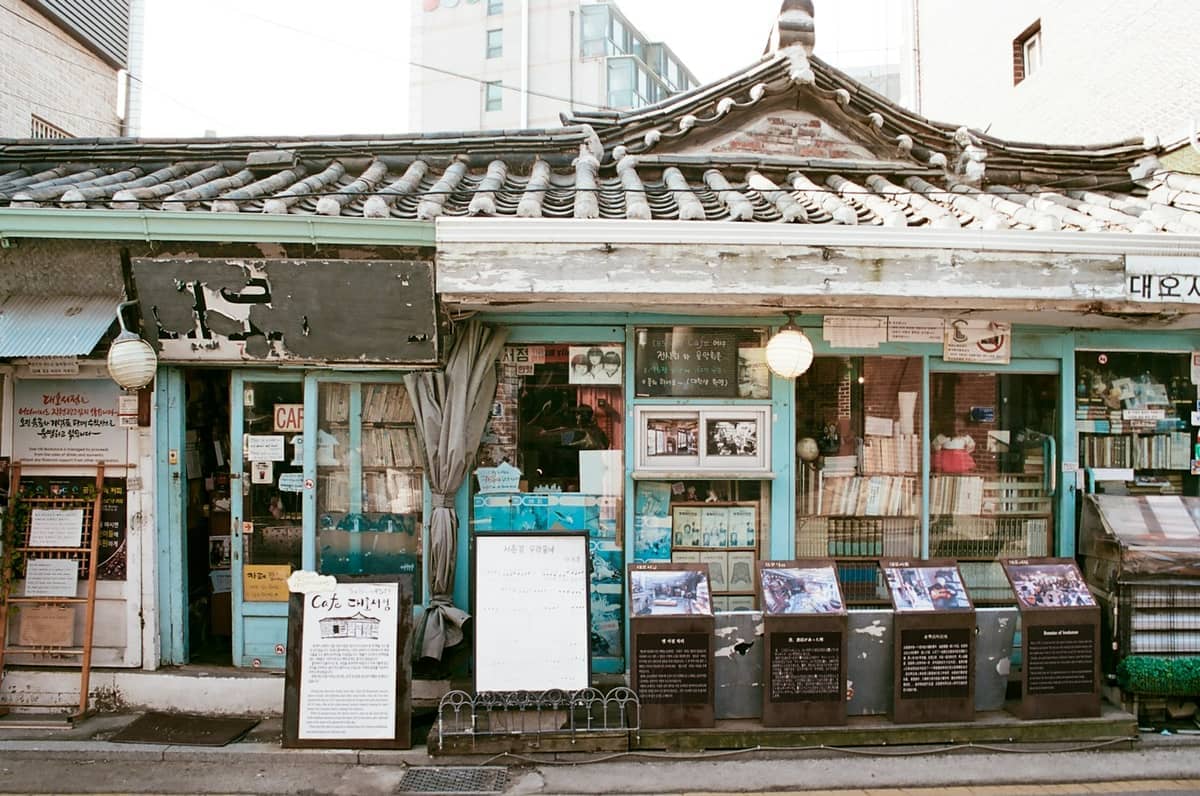
The neighborhood is not a theme park version of old Seoul. It is a functioning residential quarter where people live in hanok row houses that have been continuously occupied or carefully adapted over generations. Tiled rooflines sit a few meters from the street. Narrow alleys dead-end unexpectedly into private courtyards. The mix of working-class heritage and creative new tenants, including painters, ceramicists, and independent publishers, gives Seochon a texture that more commercially polished historic districts tend to lose.
ℹ️ Good to know
Seochon is free to enter and explore as a public neighborhood. There is no gate, ticket booth, or timed entry. Individual shops, galleries, and cafes set their own hours.
History and Cultural Weight
Seochon's roots go back to the Joseon dynasty (1392–1897), when the area west of Gyeongbokgung Palace was settled by mid-ranking government officials, craftsmen, and artists whose social standing placed them close to power but not within the palace grounds. This geography shaped the neighborhood's character: it was always a place of skilled, creative people who worked in the orbit of the court without being royalty themselves.
The painter Lee Sang-beom and the poet Yun Dong-ju both lived in this area during the Japanese colonial period, and their association with Seochon has made it something of a pilgrimage point for Koreans interested in modern literary and artistic heritage. A small house associated with Yun Dong-ju is referenced in local cultural programs. This layer of 20th-century cultural significance sits on top of the older Joseon streetscape, which makes Seochon feel unusually dense with history for its size.
The neighborhood is geographically close to the historic palace corridor covered in depth on the palaces in Seoul guide, and understanding the palace's role in organizing this part of the city helps explain why the alley grid here is so tight and organic compared to the broader boulevards laid out for government functions.
Tickets & tours
Hand-picked options from our booking partner. Prices are indicative; availability and final rates are confirmed when you complete your booking.
DMZ and Lake Majang Suspension Bridge Tour from Seoul
From 57 €Instant confirmationFree cancellationHalf Day DMZ Tour from Seoul, 3rd Tunnel, Observatory and More
From 47 €Instant confirmationFree cancellationSeoul zombie city exploration game and private tour
From 10 €Instant confirmationFree cancellationLuggage Storage in Seoul
From 7 €Instant confirmationFree cancellation
Walking the Alleys: What You Actually See
The entry point most visitors use is the stretch of Jahamun-ro near Gyeongbokgung Station Exit 2, where the road curves north toward Bugaksan. From here, turning west into any of the narrower side streets puts you into the core of the hanok district almost immediately. The lanes are rarely wide enough for two cars to pass, and most of the foot traffic moves at a browsing pace.
What the architecture delivers is a consistent roofline of dark clay tiles, white-plastered walls, and wooden gate frames. Some hanok have been converted into cafes or boutiques with minimal exterior changes, so you often smell ground coffee or incense before you see a signboard. Others remain private homes, identifiable by potted plants crowding the gate threshold and shoes left outside. The contrast between these private and commercial spaces is part of what makes walking Seochon interesting: the neighborhood has not been fully converted into a tourist corridor, so the everyday life around you is genuine.
Cheongun-dong and Ogin-dong are two sub-areas within Seochon worth exploring specifically. Ogin-dong has a small local market that operates on a more neighborhood rhythm than the tourist-facing markets elsewhere in Jongno. It sells produce, dried goods, and household items to residents, and stepping through it in the morning gives a realistic sense of what the neighborhood is like when visitors are absent.
💡 Local tip
Bring comfortable walking shoes. Many lanes are paved with older stone or compressed earth that becomes slippery in rain. The neighborhood has moderate inclines as it rises toward the foothills of Inwangsan and Bugaksan to the north and west.
How the Experience Changes by Time of Day
Early morning, before 9:00, is when Seochon belongs to its residents. The streets are quiet, the cafes are just opening, and the light on the tile roofs is soft and even. If you want to photograph the hanok without crowds in the frame, this is the window. The air in autumn and spring carries the smell of wood smoke and damp stone in the early hours, a sensory quality that disappears once foot traffic and food vendors start in earnest.
Midday on weekends brings the heaviest visitor flow, particularly on the streets closest to Gyeongbokgung Palace. Cafe queues can extend outside doors, and the narrower alleys feel congested when tour groups pass through. This is not the ideal time for contemplative wandering, though the neighborhood retains more breathing room than Bukchon Hanok Village to the east, which handles considerably heavier tourist volume.
Late afternoon, around 15:00 to 17:00, is often the most balanced time to visit. The morning rush is gone, the light turns warm and low enough to be good for photography, and most shops are still open. On weekday afternoons, the neighborhood is noticeably calmer than on weekends, which makes it easier to linger at gallery windows or sit in a courtyard cafe.
For visitors planning a broader day in the area, Seochon pairs naturally with a morning visit to Gyeongbokgung Palace For visitors planning a broader day in the area, Seochon pairs naturally with a morning visit to Gyeongbokgung Palace before crossing into the village for the afternoon.
Cafes, Studios, and What's Worth Stopping For
Seochon has developed one of Seoul's more distinctive independent cafe cultures partly because of its resident artist community and partly because of the physical character of hanok, which convert well into intimate interior spaces with courtyard seating. Several cafes occupy restored houses where you sit on wooden floors or cushioned ledges near low windows, looking into gardens that are sometimes only two or three meters deep but planted with careful attention.
Small galleries and studios appear throughout the neighborhood, some with open doors and no admission charge, others requiring appointments. The density of working artists in Seochon means that even casual exploration turns up handmade ceramics, printmaking workshops, and independent bookshops selling Korean literature and art books. This is not a souvenir-shopping neighborhood in the way that Insa-dong is, and that distinction matters.
Insa-dong, just east of Seochon across the palace grounds, caters explicitly to tourist craft shopping and street food. Seochon's commercial layer is lighter and more locally oriented. If you want the full picture of traditional culture in this part of Seoul, the guide to hanok villages in Seoul explains the differences across the city's main areas in useful detail.
Getting There and Practical Logistics
The most direct approach is Subway Line 3 to Gyeongbokgung Station. Exit 2 puts you on Hyoja-ro, from which the hanok alleys begin within a few minutes of walking west. Exit 3 is also useful if you are arriving from the north or heading toward Cheongun-dong. The walk from the station into the heart of Seochon is a short one before the terrain starts to rise.
Bus routes also serve the area along Jahamun-ro and Pirundae-ro, though the subway is simpler for first-time visitors. Taxis can drop you at the perimeter of the alley network, but the lanes themselves are too narrow for vehicle access in many sections.
The neighborhood address most commonly referenced in official tourism materials is 39, Hyoja-ro, Jongno-gu, Seoul, though Seochon is more usefully thought of as a zone than a single address. Mapping apps set to 'Seochon Village' or '서촌마을' will orient you correctly., though Seochon is more usefully thought of as a zone than a single address. Mapping apps set to 'Seochon Village' or '서촌마을' will orient you correctly.
⚠️ What to skip
Some parts of Seochon rise toward Inwangsan and Bugaksan foothills, where the lanes become steeper and some paths are unpaved. If mobility is a concern, the flatter streets closest to Gyeongbokgung Station are accessible without significant incline, but the full neighborhood cannot be described as universally barrier-free. No official accessibility assessment for the area as a whole has been published.
Who Should Think Twice Before Visiting
Visitors expecting curated museum-style presentation of traditional architecture will find Seochon slightly rough around the edges. Some hanok are in need of repair. Renovation and new construction appear in sections. This is an authentic neighborhood, not a restored heritage zone, and the imperfection is part of its character, but it also means there is no single 'wow' courtyard or gateway moment. Travelers who want a more polished hanok experience often respond better to Bukchon Hanok Village or the interiors of the royal palaces nearby.
Visitors with very limited time who are trying to cover multiple major sites in a single day may find Seochon slow by design. The neighborhood rewards unhurried exploration and does not have a list of must-see individual landmarks. Its value is cumulative and atmospheric, which means it works best for people who are comfortable spending an hour without a specific destination.
For travelers building a fuller itinerary around this part of the city, the 3-day Seoul itinerary covers how to sequence Seochon alongside the palace district and nearby Inwangsan without feeling rushed.
Insider Tips
- The alley running parallel to the western wall of Gyeongbokgung Palace, along Hyoja-ro, is quieter than the main tourist routes and gives a clearer sense of the neighborhood's residential character. Walk it heading north toward Cheongun-dong.
- Ogin-dong Market, tucked inside the neighborhood, operates on a local grocery rhythm rather than a tourist one. Arriving before 10:00 on a weekday morning gives you access to the market before visitors thin out the energy.
- Many of the hanok cafes do not have large signage. The ones worth finding are often identified only by a small wooden placard near the gate. If a door is open and you can smell coffee or tea, it is almost certainly a cafe rather than a private home.
- Seochon is significantly less crowded than Bukchon Hanok Village on the same calendar day. If you have visited Bukchon and found it too congested for photographs, Seochon on a weekday afternoon will feel like a different city.
- The streets nearest Inwangsan to the northwest begin climbing steeply and connect to informal hiking paths. Wear shoes that can handle both polished stone lanes and unpaved hill trails if you plan to explore this edge of the neighborhood.
Who Is Seochon Village For?
- Architecture and photography enthusiasts who want hanok without heavy tourist crowds
- Cafe culture seekers looking for independent, character-driven spaces over chains
- Travelers with an interest in Korean modern literary and artistic history
- Visitors who want a slow half-day walk that complements a morning at Gyeongbokgung Palace
- Anyone planning a deeper exploration of the palace district neighborhood on foot
Nearby Attractions
Other things to see while in Insadong & Seochon:
- Insa-dong
Stretching roughly 700 meters through Jongno-gu, Insa-dong is Seoul's most concentrated stretch of traditional galleries, antique dealers, calligraphy shops, and tea houses. It's free to explore, car-free on weekends, and far more layered than its reputation as a tourist corridor suggests.
- Ssamziegil
Ssamziegil (쌈지길) is a free-entry craft and culture complex in the heart of Insa-dong, built around an open spiral walkway that winds past independent boutiques, ceramic studios, and Korean artisan shops. Opened in 2004, it offers a genuinely different shopping experience from Seoul's malls and department stores.
- Tongin Market
Tongin Market is a traditional neighborhood market in Jongno-gu where visitors exchange Korean won for vintage brass coins and use them to buy small dishes from stalls across the market. It sits at the foot of Inwangsan Mountain, minutes from Gyeongbokgung Palace, and offers one of the most tactile and genuinely local food experiences in central Seoul.