Ssamziegil: Seoul's Spiral Courtyard of Craft and Culture
Ssamziegil (쌈지길) is a free-entry craft and culture complex in the heart of Insa-dong, built around an open spiral walkway that winds past independent boutiques, ceramic studios, and Korean artisan shops. Opened in 2004, it offers a genuinely different shopping experience from Seoul's malls and department stores.
Quick Facts
- Location
- 44 Insadong-gil, Jongno-gu, Seoul (postal code 03146)
- Getting There
- Seoul Subway Line 3, Anguk Station, Exit 6 (approx. 245 m walk)
- Time Needed
- 45 minutes to 1.5 hours
- Cost
- Free to enter; shopping and food extra
- Best for
- Design lovers, souvenir hunters, solo travelers, couples
- Official website
- http://www.ssamzigil.co.kr
What Is Ssamziegil?
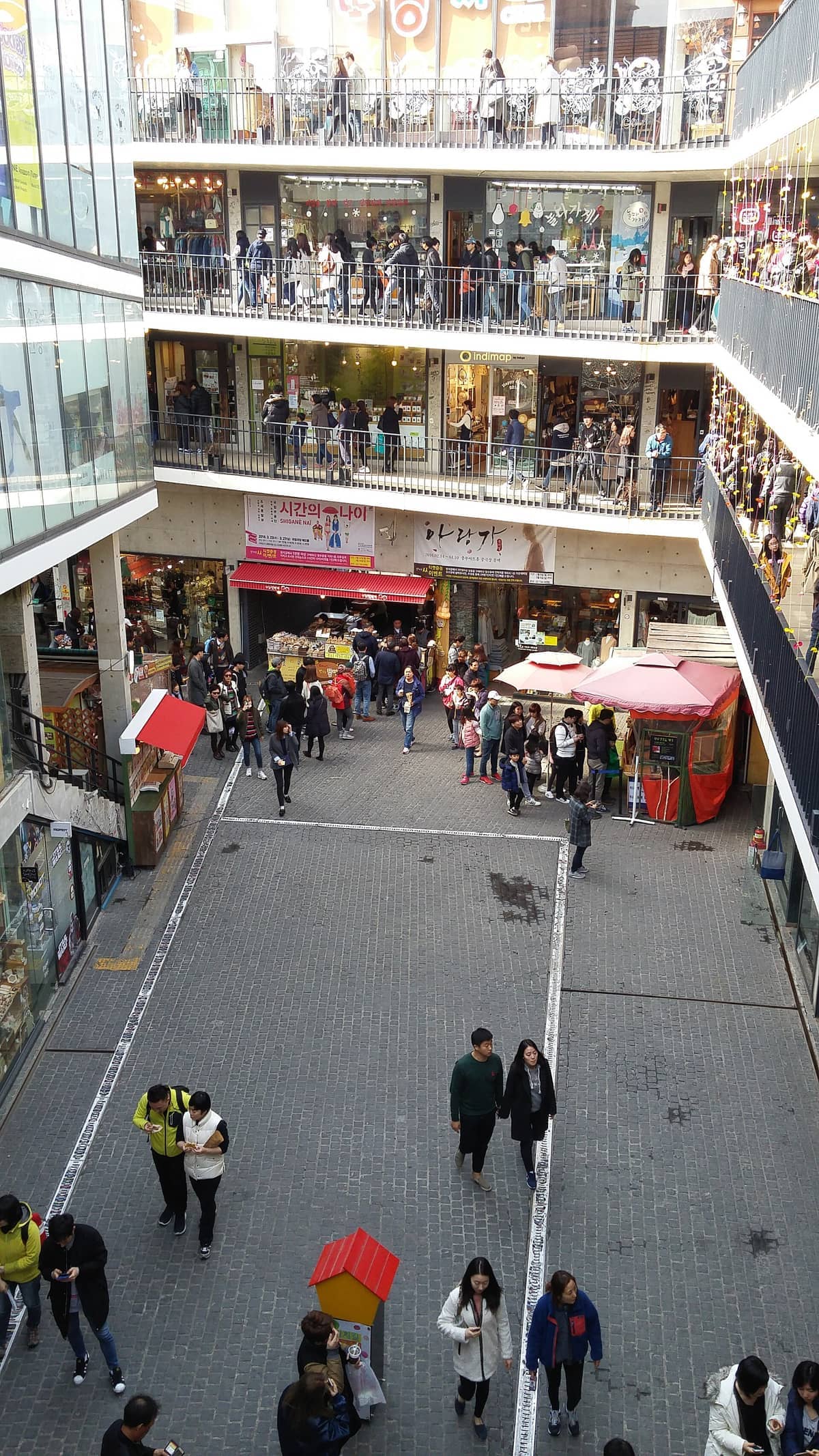
Ssamziegil (쌈지길) is a four-storey open-air shopping and cultural complex that opened in December 2004 in Insa-dong, one of Seoul's most historically layered neighborhoods. Unlike the glass-and-steel vertical malls that dominate much of the city, Ssamziegil is built around a central courtyard and a continuous spiral walkway that loops gently upward from the ground floor to the rooftop. Every level is connected without sharp breaks, which gives the whole building a flowing, almost promenade-like quality.
The complex sits inside the Insa-dong corridor, where traditional tea houses, art galleries, and calligraphy shops have coexisted for decades. Ssamziegil was designed to complement that existing identity rather than displace it. Most of its over 70 shops are independent operators: ceramic artists selling their own work, designers printing limited-run stationery, craftspeople making goods you will not find in airport duty-free. For a fuller sense of the surrounding neighborhood, see the Insa-dong and Seochon district guide.
💡 Local tip
Admission is completely free. You pay only if you shop or eat. There is no obligation to buy anything, and browsing the courtyard alone is worthwhile for the architecture and street-art details.
The Architecture: A Spiral That Earns Its Place
The building's defining feature is the continuous ramped walkway that spirals around the courtyard perimeter. Rather than stacking floors with staircases between them, the design uses a gradual incline so that you transition between levels almost imperceptibly while walking. The courtyard itself is open to the sky, which means natural light reaches the lower floors and the whole complex feels less enclosed than a conventional mall.
The external walls and corridor railings accumulate layers of painted murals, hanging decorations, and handmade signage from the tenants. This changes incrementally over time as shops rotate and seasonal installations go up. In late autumn, small lanterns and paper crafts tend to appear along the railings. In spring, the open courtyard catches enough light that the central area feels genuinely pleasant to linger in. The rooftop level, where the spiral terminates, has a small outdoor terrace with a view over the Insa-dong roofscape.
A practical note on mobility: the spiral walkway is ramp-based rather than step-based between floors, but the complex is multi-level and the incline is continuous. No official accessibility statement has been published. Visitors with significant mobility limitations should check the current layout before visiting, as it may present challenges.
Tickets & tours
Hand-picked options from our booking partner. Prices are indicative; availability and final rates are confirmed when you complete your booking.
DMZ and Lake Majang Suspension Bridge Tour from Seoul
From 57 €Instant confirmationFree cancellationHalf Day DMZ Tour from Seoul, 3rd Tunnel, Observatory and More
From 47 €Instant confirmationFree cancellationSeoul zombie city exploration game and private tour
From 10 €Instant confirmationFree cancellationLuggage Storage in Seoul
From 7 €Instant confirmationFree cancellation
What to Expect Inside: Shops, Studios, and Food
The roughly 70 tenants lean heavily toward craft and design. Expect small-batch ceramics, hand-bound notebooks, Korean ink brushes, embroidered textiles, illustrated postcards, and handmade jewelry. Some shops display work made on the premises. Prices vary: small gift items start around a few thousand won, while original ceramics or artwork can run significantly higher. This is not a bargain shopping destination. It is a place to spend money on things that required skill to make.
Food options are scattered across all four levels. There are Korean snack stalls on the ground floor selling hotteok (sweet filled pancakes), traditional teas, and small bites. Upper levels have sit-down cafes with rooftop seating. The food quality is generally adequate rather than exceptional, but stopping for a cup of barley tea or sikhye (sweet rice punch) while looking down into the open courtyard is a reasonable use of fifteen minutes.
Ssamziegil also hosts occasional small performances and craft markets in the central courtyard, particularly on weekends and during national holidays. If you want to plan a visit around Insa-dong's broader market scene, the Insa-dong main street runs directly outside the complex entrance and is worth at least 30 minutes of your time before or after entering.
How the Experience Changes by Time of Day
Ssamziegil opens in the late morning, and the first couple of hours are the quietest. Weekday mornings see mostly domestic shoppers and the occasional school group. The spiral walkway is unhurried, shop owners are restocking and arranging displays, and you can take photographs of the courtyard architecture without crowds. If you are interested in the building itself rather than the shopping, this is the best window.
By early afternoon on weekends, the complex fills quickly. The central courtyard narrows psychologically when it is packed, and the narrow corridor sections of the spiral can feel slow-moving. By early afternoon on weekends, the complex fills quickly. Weekend afternoons are the peak period. If you dislike crowds, a weekday visit between 10:30 and 12:00 is substantially more comfortable. The complex closes at 20:30, and the evening hour or so before closing has a noticeably calmer atmosphere as day-trippers thin out.
⚠️ What to skip
Ssamziegil is closed on New Year's Day and during Chuseok (Korean Thanksgiving). If your visit falls during a major Korean public holiday, confirm the closure schedule in advance.
Getting There and Practical Details
The most straightforward approach is Seoul Subway Line 3 to Anguk Station, Exit 6. From the exit, the walk to 44 Insadong-gil is approximately 640 meters along a clearly signposted pedestrian route. Anguk Station also serves as the natural starting point for Bukchon Hanok Village and the main palace area, so it is easy to combine Ssamziegil with a broader Jongno-gu itinerary.
If you are constructing a multi-day Seoul itinerary, Ssamziegil fits naturally into a day that also covers Gyeongbokgung Palace to the north and Jogyesa Temple a short walk south. The area is highly walkable and rewards an unhurried pace rather than rushing between landmarks.
Opening hours are daily 10:30 to 20:30. Entry is free. There are no bag checks or ticket counters. You walk in from the street-level entrance on Insadong-gil and the spiral begins immediately.
Photography Notes
The courtyard is a photogenic space, particularly from upper levels looking down. The spiral geometry and the open sky above the central well create strong compositional lines. Morning light entering the open-top courtyard is direct and clean; afternoon light is softer but the crowd level makes wide-angle shots of the courtyard more difficult. The handmade shop signage, small studio windows, and layered murals on the corridor walls reward close-up work as much as wide architectural shots.
On weekends, the courtyard sometimes has performance stages set up, which disrupts the clean architectural view but adds human interest. Check in at ground level when you arrive to see whether any performances or market stalls are scheduled before choosing your shooting angles.
Who Should Reconsider
Travelers whose primary interest is bargain pricing, duty-free luxury goods, or Korean fashion streetwear will not find what they are looking for here. Ssamziegil's shops are small-run and handcraft-focused, and prices reflect that. Visitors who prefer large, air-conditioned malls with international brand anchors would be better served by other parts of the city. Similarly, if your Insa-dong time is very limited and you are trying to cover the main street, the teahouses, and the area around Bukchon Hanok Village, Ssamziegil can reasonably be skipped in favor of the outdoor street itself.
The spiral walkway is manageable for most visitors, but those with significant mobility limitations should be aware that the building relies on a continuous inclined ramp structure rather than a flat ground floor with elevator access to discrete levels. No official accessibility confirmation is available, so contact the complex directly if this is a concern.
Insider Tips
- Visit on a weekday morning between 10:30 and 12:00 for the calmest atmosphere and the best chance to photograph the courtyard architecture without crowds.
- The rooftop terrace at the top of the spiral is easy to miss if you stop before completing the full loop. Walk the entire ramp to the top before doubling back.
- Small studio shops sometimes let you watch makers at work, particularly ceramicists. If a shop door is open and someone is working, a brief, quiet observation is generally welcome.
- The central courtyard occasionally hosts free weekend performances. Arriving without a fixed schedule lets you catch these if they happen to be running.
- Ssamziegil's handmade goods make more practical souvenirs than most mass-produced options nearby: hand-stamped notebooks, ceramic spoons, and ink-brush sets pack compactly and travel well.
Who Is Ssamziegil For?
- Design and craft enthusiasts looking for independently made Korean goods
- Souvenir hunters who want something more considered than generic K-pop merchandise
- Solo travelers who enjoy browsing at their own pace without a fixed agenda
- Couples looking for a low-pressure, photogenic stop in the Insa-dong area
- Travelers combining a broader Jongno-gu itinerary with palaces and temples nearby
Nearby Attractions
Other things to see while in Insadong & Seochon:
- Insa-dong
Stretching roughly 700 meters through Jongno-gu, Insa-dong is Seoul's most concentrated stretch of traditional galleries, antique dealers, calligraphy shops, and tea houses. It's free to explore, car-free on weekends, and far more layered than its reputation as a tourist corridor suggests.
- Seochon Village
Seochon Village occupies the narrow alleys west of Gyeongbokgung Palace in Jongno-gu, where Joseon-era hanok architecture survives alongside independent cafes, small galleries, and artist studios. The neighborhood is free to enter, walkable in two to three hours, and noticeably calmer than the tourist corridors on the palace's eastern flank.
- Tongin Market
Tongin Market is a traditional neighborhood market in Jongno-gu where visitors exchange Korean won for vintage brass coins and use them to buy small dishes from stalls across the market. It sits at the foot of Inwangsan Mountain, minutes from Gyeongbokgung Palace, and offers one of the most tactile and genuinely local food experiences in central Seoul.