Jogyesa Temple: Seoul's Heart of Korean Buddhism
Jogyesa Temple is the headquarters of the Jogye Order of Korean Buddhism, tucked into the historic Jongno district just minutes from major palaces and royal shrines. With free admission, ancient ceremony bells, and centuries-old trees shading its stone courtyards, it offers a rare moment of stillness in central Seoul.
Quick Facts
- Location
- 55 Ujeongguk-ro, Jongno-gu, Seoul (Jongno-Bukchon area)
- Getting There
- Line 1, Jonggak Station, Exit 2 (approx. 413 m); or Line 3, Anguk Station, Exit 6
- Time Needed
- 45 minutes to 1.5 hours
- Cost
- Generally free; some viewing hours list KRW 700 (ages 25–64) and KRW 300 (ages 13–24)
- Best for
- Cultural immersion, quiet reflection, photography, Buddhist ceremony viewing
- Official website
- http://www.jogyesa.kr
What Jogyesa Temple Actually Is
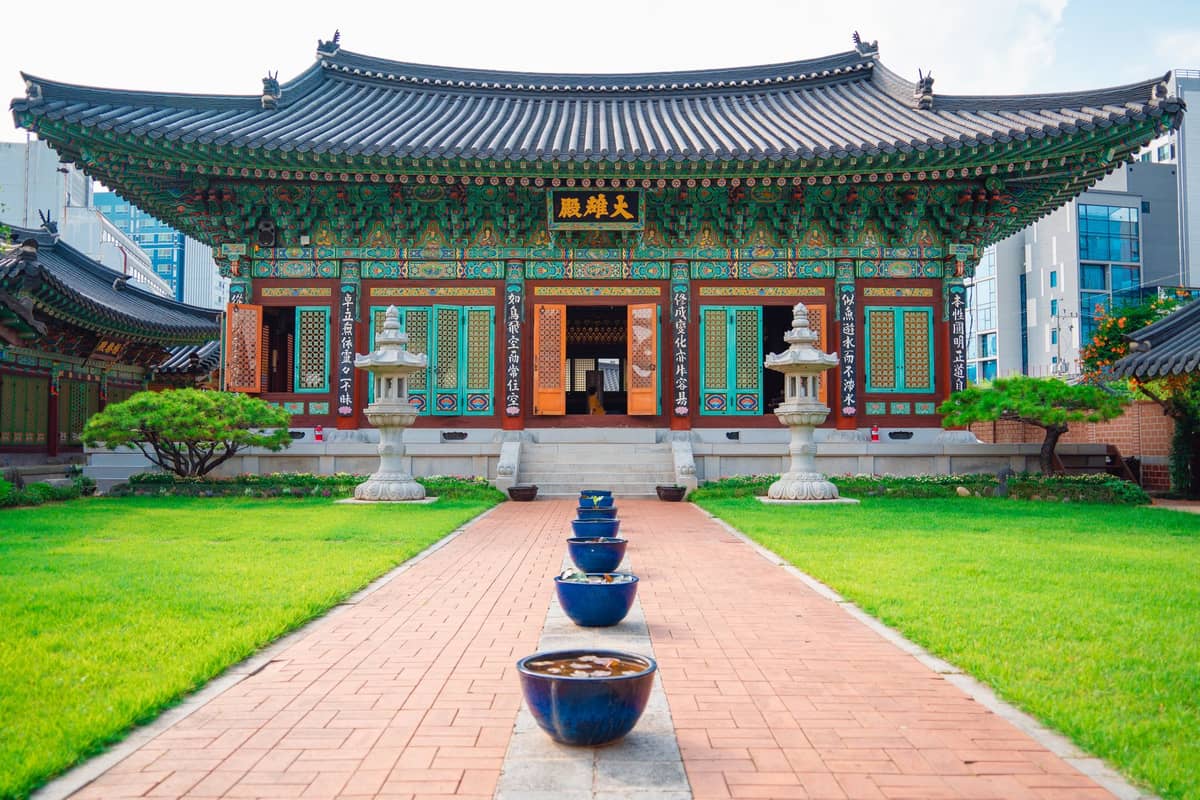
Jogyesa Temple (조계사) is not a relic preserved behind velvet ropes. It is a fully functioning religious headquarters, the administrative and ceremonial center of the Jogye Order, which is the dominant order of Korean Buddhism. Monks in grey robes move through the courtyards between prayer schedules. Worshippers kneel on wooden floors inside Daeungjeon Hall, pressing their foreheads to the ground in deep bows. The incense smoke rising from the stone burners in front of the main hall is not decorative — it is part of a daily ritual cycle that has continued without interruption The incense smoke rising from the stone burners in front of the main hall is not decorative — it is part of a daily ritual cycle that has continued since the temple was formally established in 1910.
The temple was originally founded under the name Gakhwangsa. It was later renamed Taegosa during the Japanese colonial period before receiving its current name, Jogyesa, in 1954, after Korean independence. That renaming was itself a political and religious act — a reassertion of Korean Buddhist identity after decades of colonial influence over the religion's institutions. Understanding that context makes the temple feel less like a tourist site and more like what it is: a place that survived a complicated century and emerged intact.
ℹ️ Good to know
Admission is generally free, though some sources list structured viewing fees of KRW 700 for visitors aged 25–64 and KRW 300 for those aged 13–24, with exemptions for children under 12, seniors over 65, and visitors with disabilities (plus one guardian). Confirm at the entrance before assuming free access applies to your visit.
The Grounds: What You Will Actually See
The first thing most visitors notice is not the architecture but the trees. Two enormous specimens, including a zelkova, dominate the courtyard in front of Daeungjeon Hall. The zelkova is estimated to be over 500 years old, with a trunk circumference that makes it difficult to photograph in full without stepping back to the temple gate. These trees predate the temple building itself, and on overcast days their canopy creates an unusual green-grey light over the courtyard flagstones.
The main hall, Daeungjeon, is a wooden structure completed in 1938, during the colonial period rather than the Joseon era. Its painted wooden eaves, decorated with intricate dancheong patterns in red, green, blue, and gold, are worth examining up close. The interior houses three principal Buddha statues and is open to worshippers throughout the day. Visitors are welcome to enter quietly, but photography during active ceremonies is intrusive and should be avoided. Remove shoes before stepping onto the platform.
Beyond Daeungjeon, the compound includes several secondary halls, a modern education center, and the headquarters building of the Jogye Order administration. The grounds are compact enough to walk in fifteen minutes, but the experience changes significantly depending on whether you visit during a ceremony or between them.
Tickets & tours
Hand-picked options from our booking partner. Prices are indicative; availability and final rates are confirmed when you complete your booking.
DMZ and Lake Majang Suspension Bridge Tour from Seoul
From 57 €Instant confirmationFree cancellationHalf Day DMZ Tour from Seoul, 3rd Tunnel, Observatory and More
From 47 €Instant confirmationFree cancellationSeoul zombie city exploration game and private tour
From 10 €Instant confirmationFree cancellationLuggage Storage in Seoul
From 7 €Instant confirmationFree cancellation
Morning, Afternoon, and Evening: How the Atmosphere Shifts
Early mornings, particularly before 8 a.m., offer the most authentic experience. The air carries incense and, in colder months, the faint smell of burning wood from nearby kitchen prep. The number of worshippers tends to be highest in the early morning, and watching the full prostration bows inside Daeungjeon at this hour is quietly remarkable.
Midday brings a different crowd. Lunch-break office workers from nearby government buildings, school groups, and tourists tend to arrive between 11 a.m. and 2 p.m. The courtyard becomes more crowded but never overwhelming. The light at midday in summer is harsh for photography — the white walls and pale stone reflect strongly. Overcast days or the softer light of late afternoon are better for photographing the dancheong paintwork on the eaves.
Evenings transform the temple most dramatically during the Lotus Lantern Festival, held annually to celebrate Buddha's Birthday, which falls on the 8th day of the 4th lunar month and is typically in May. Thousands of paper lanterns are hung across the courtyard and adjacent streets, and the entire Jongno district participates in a lantern parade that draws enormous crowds. If you are visiting Seoul in late April or May, checking whether this festival coincides with your trip is worthwhile — it is one of the few occasions when the temple feels genuinely festive rather than contemplative.
💡 Local tip
For the Lotus Lantern Festival, arrive well before sunset if you want a position near the temple gate. The parade route fills quickly, and by full dark the surrounding streets can be shoulder-to-shoulder.
Getting There and Practical Orientation
The most direct subway approach is Line 1 to Jonggak Station, Exit 2. From the exit, the walk to the temple gate takes roughly 6 minutes along a straightforward street.
The temple sits in central Jongno, one of Seoul's most historically dense neighborhoods. Within walking distance you will find Gyeongbokgung Palace, Insadong's gallery and tea-house street, and Jongmyo Shrine. Planning a half-day that links these sites requires almost no additional transit.
The temple grounds are reported to be accessible year-round, with the outer courtyard open around the clock. Individual halls operate on their own schedules, and certain ceremonies are not open to casual visitors. For a standard sightseeing visit, arriving during daylight hours and outside of major ceremony blocks is the most reliable approach. No advance booking is required.
Photography, Dress, and Conduct
Photography in the courtyard is generally acceptable. Inside the halls, especially during active worship, exercise strong discretion. If the hall is filled with people in prayer, stepping back and observing from the doorway is both more respectful and, often, more visually interesting. The scale of group prostrations, with dozens of worshippers moving in near-unison, is something a photograph from inside rarely captures well anyway.
There is no strict dress code enforced at the entrance, but the temple is an active religious site. Shorts and sleeveless tops are common among summer tourists, and no one will turn you away, but covering shoulders and knees is a reasonable gesture of respect. Shoes must be removed before entering any hall interior.
⚠️ What to skip
Avoid visiting during major Buddhist ceremonies if a quieter, more reflective experience is what you are after. During high ceremony periods, access to certain halls may be restricted or the courtyard may be fully occupied by organized religious groups.
Honest Assessment: Worth Your Time or Not?
Jogyesa Temple rewards visitors who engage with it on its own terms. If you arrive expecting dramatic mountain scenery, ancient isolation, or the kind of atmospheric ruined grandeur found at some other Korean Buddhist sites, you may be underwhelmed. The temple sits directly in central Seoul, surrounded by city streets, and the sounds of traffic are present throughout. The grounds are compact.
What makes it genuinely worth visiting is precisely that it is not a museum piece. The contrast between the centuries-old zelkova tree, the incense smoke, the steady rhythm of ceremonial bells, and the office towers visible above the roofline is unusual in a way that many more visually spectacular sites are not. For context on how this fits into Seoul's broader Buddhist landscape, the Seoul temples guide outlines other options worth pairing with a Jogyesa visit, including Bongeunsa Temple in Gangnam, which offers a very different atmosphere.
Travelers who prefer outdoor, nature-heavy attractions or who have very limited time in Seoul may find other sites a better use of a morning. But for anyone interested in Korean cultural history, religious practice, or simply a twenty-minute pause from the pace of the city, the temple is a considered, unpretentious choice.
Combining Jogyesa with the Wider Jongno Area
Jongno-Bukchon is Seoul's most layered neighborhood for cultural sightseeing. A morning at Jogyesa can flow naturally into an afternoon at Bukchon Hanok Village, where the traditional tile-roofed houses climb the hillside toward Bugaksan. Alternatively, heading south into Insadong takes you through a street of art galleries, craft shops, and traditional tea houses that complements the temple's atmosphere without feeling repetitive.
If you are structuring a multi-day itinerary, the 3 days in Seoul guide places Jogyesa within a logical first-day Jongno circuit that keeps transit to a minimum and groups the neighborhood's key sites efficiently.
Insider Tips
- The Buddhist goods shop on the temple grounds sells quality prayer beads, incense, and small ceremonial items at reasonable prices. It is a more meaningful souvenir option than most Insadong tourist shops nearby.
- The 500-year-old zelkova tree in the main courtyard is best photographed in early morning with the main hall behind it. By midday, harsh overhead light flattens the texture of both the bark and the paintwork on the eaves.
- If you visit on the first and fifteenth of each lunar month, you are likely to encounter more organized group worship. These are traditional observance days in Korean Buddhism and the temple will be noticeably fuller.
- The small side path running along the northern edge of the temple compound is less trafficked than the main courtyard and gives a closer look at the secondary halls without the flow of tour groups.
- Jogyesa offers templestay programs for visitors who want an immersive overnight experience. These must be booked in advance through the official website and fill up quickly around the Lotus Lantern Festival period.
Who Is Jogyesa Temple For?
- Travelers interested in Korean religious culture and Buddhist history
- Photographers looking for layered subjects combining architecture, nature, and human activity
- Visitors who want a genuine cultural counterpoint to the commercial intensity of nearby shopping districts
- Anyone in Seoul during the Lotus Lantern Festival in late April or May
- Sightseers building a half-day Jongno walking route linking major historical sites
Nearby Attractions
Other things to see while in Jongno & Bukchon:
- Bukchon Hanok Village
Bukchon Hanok Village (북촌한옥마을) is a preserved residential district of roughly 860 traditional Korean hanok houses in central Seoul, situated between Gyeongbokgung and Changdeokgung palaces. Unlike a museum or theme park, it is a real neighborhood where people still live, which shapes every aspect of visiting it. Entry is free, but access to certain alleys is restricted to protect residents.
- Changdeokgung Palace & Secret Garden
Changdeokgung Palace is the best-preserved of Seoul's five Joseon-era royal palaces, and its rear garden — the Huwon, known as the Secret Garden — remains one of the most atmospheric green spaces in the entire city. Together, they form a UNESCO World Heritage Site that rewards visitors who plan ahead.
- Changgyeonggung Palace
One of Seoul's five grand Joseon-era palaces, Changgyeonggung Palace sits in Jongno-gu and offers a quieter royal grounds experience. With late evening opening hours, low admission, and centuries of layered history, it rewards visitors who arrive without high expectations and leave with quiet satisfaction.
- Gwanghwamun Square
Gwanghwamun Square stretches 40,300 square meters through the center of Seoul, framed by Gyeongbokgung Palace to the north and the distant peaks of Bugaksan beyond. It is free, open 24 hours, and carries more historical weight than most visitors realize on first pass.