Jongmyo Shrine: Seoul's Most Spiritually Charged Royal Site
Jongmyo Shrine is a UNESCO World Heritage Site in the heart of Seoul where Joseon dynasty kings performed Confucian ancestral rites for over 500 years. Quiet, austere, and architecturally unlike anything else in the city, it rewards visitors who take time to understand what they're looking at.
Quick Facts
- Location
- 157 Jong-ro, Jongno-gu, Seoul
- Getting There
- Jongno 3-ga Station (Lines 1, 3, 5) — Exit 11 (Line 1) or Exit 8 (Lines 3/5)
- Time Needed
- 1 to 1.5 hours
- Cost
- Adults 1,000 KRW; visitors 18 and under and 65+ enter free
- Best for
- History lovers, architecture, quiet contemplation, cultural depth
- Official website
- http://jm.cha.go.kr
What Jongmyo Shrine Actually Is
Jongmyo Shrine is the royal Confucian ancestral shrine of the Joseon dynasty, founded in 1394 and still in ceremonial use today. It is where the spirit tablets of Joseon kings and queens were enshrined and where ritual offerings were made to honor the royal dead. Unlike the nearby palaces, which were seats of government and daily royal life, Jongmyo was a place of solemn obligation, built to express a fundamental Confucian principle: that political legitimacy rests on proper reverence for one's ancestors.
UNESCO inscribed Jongmyo as a World Heritage Site in 1995, recognizing both the physical site and the Jongmyo Jerye ritual ceremony, which was added to the UNESCO Intangible Cultural Heritage list in 2008. That dual recognition is unusual and tells you something about the place. It is not preserved as a museum relic. The Jongmyo Jerye ceremony, involving music, dance, and ritual offerings, is still performed once a year on the first Sunday in May.
ℹ️ Good to know
Jongmyo is closed every Tuesday. Hours vary by season: Feb–May and Sep–Oct 09:00–18:00, Jun–Aug 09:00–18:30, Nov–Jan 09:00–17:30. Verify current hours before visiting.
The Architecture: Austere by Intention
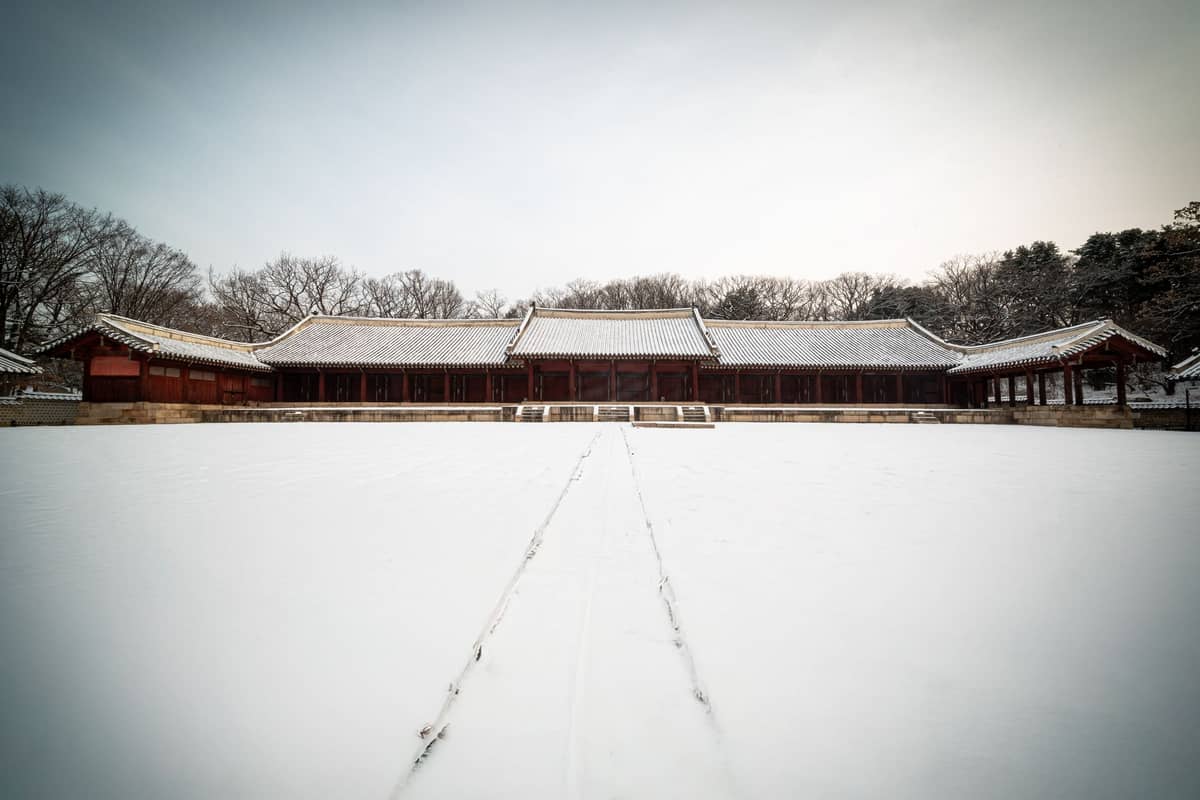
The main hall, Jeongjeon, is a long, low structure that runs horizontally across the landscape with a deliberate, almost severe simplicity. It stretches roughly 109 meters, making it one of the longest wooden structures in East Asia, and it was extended multiple times as new king and queen spirit tablets were added. The gray stone terrace on which it stands, the unornamented timber columns, and the absence of the decorative painting common to Korean palace architecture are all intentional. Ornamentation would be inappropriate here. This is a place for the dead, and the aesthetic reflects it.
The approach to Jeongjeon is through Myodong, the large, flat courtyard paved with irregular stones that have a rough, slightly uneven texture underfoot. The silence here on weekday mornings is genuine, not managed. The trees within the compound are mature and untrimmed in the way of old formal grounds, and the overall effect is of a space that has been allowed to age on its own terms. There is a second, smaller hall called Yeongnyeongjeon that houses spirit tablets of lesser royal family members. It follows the same architectural logic but on a more modest scale.
If you want architectural and historical context for what you see, visit Gyeongbokgung Palace before Jongmyo. Understanding Joseon palace architecture makes the deliberate plainness of Jongmyo far more legible — the contrast is the point.
Tickets & tours
Hand-picked options from our booking partner. Prices are indicative; availability and final rates are confirmed when you complete your booking.
DMZ and Lake Majang Suspension Bridge Tour from Seoul
From 57 €Instant confirmationFree cancellationHalf Day DMZ Tour from Seoul, 3rd Tunnel, Observatory and More
From 47 €Instant confirmationFree cancellationSeoul zombie city exploration game and private tour
From 10 €Instant confirmationFree cancellationLuggage Storage in Seoul
From 7 €Instant confirmationFree cancellation
How the Experience Changes by Time of Day
Early morning visits, shortly after opening, are categorically different from midday. The courtyards are largely empty, the stone pathways are cool underfoot, and the only sounds are birds in the old trees and the occasional shuffle of other visitors. The pine and zelkova trees that shade the inner grounds have a particular smell in the morning air, resinous and slightly damp, especially in spring.
By late morning on weekends, tour groups begin to arrive and guides speak over the courtyards in Korean, English, and Chinese. The atmosphere shifts toward the educational rather than the contemplative. If your goal is to absorb the place rather than learn its history through a narrated tour, arrive before 10:00 on a weekday.
Late afternoon light in autumn is particularly good here. The low sun catches the stone terrace in front of Jeongjeon at an angle that shows the texture of the paving in sharp relief. Autumn foliage within the grounds is quieter than the famous displays at Changdeokgung, but the colors against the gray stone and dark timber are striking in a more understated way.
💡 Local tip
Weekday mornings before 10:00 offer the best combination of light and solitude. If you visit on a Sunday, arrive right at opening — the path from Jongno 3-ga Station takes about five minutes on foot.
Confucian Ritual and the Living Ceremony
The Jongmyo Jerye ceremony, held on the first Sunday of May each year, transforms the site entirely. Participants in Joseon-era court dress perform ritual offerings, while the Jongmyo Jeryeak orchestra plays music that has been transmitted without interruption for centuries. The instrumentation includes instruments rarely heard elsewhere: the pyeonjong (chime bells), the pyeongyeong (stone chimes), and various wind and string instruments of the Joseon court. The music is slow, formal, and quite unlike anything in Korean popular culture.
Attending the ceremony is open to the public and free of charge during the event period, though the grounds become crowded. Even if you are not present on that day, the context enriches the visit. The stone pathways are laid out with ritual movement in mind: there is a central raised path, the Sinno, reserved for the spirits, flanked by lower paths for the king and crown prince. Walking on the Sinno is not permitted.
For further context on Confucian and Buddhist sacred spaces in Seoul, see the guide to Seoul's temples and shrines, which covers sites across different traditions and neighborhoods.
Getting There and Practical Walkthrough
The shrine is located at 157 Jong-ro, Jongno-gu, Seoul. The nearest subway access is Jongno 3-ga Station: take Exit 11 if arriving on Line 1, or Exit 8 if arriving on Line 3 or Line 5. The walk to the entrance takes around five minutes along Jong-ro. Admission is 1,000 KRW for adults; visitors 18 and under and 65+ enter free, paid at the gate.
The site is closed every Tuesday. Seasonal hours apply: February through May and September through October, the shrine closes at 18:00; June through August it closes at 18:30; November through January it closes at 17:30. These hours are subject to change, so confirm on the Korea Heritage Service website before you visit.
The grounds are largely flat and paved, which makes most of the main areas manageable. However, official visitor pages do not detail specific accessibility infrastructure, so visitors with mobility requirements should check directly with the site before arrival.
Jongmyo sits in the Jongno-Bukchon area, which is also home to several other significant sites. A logical half-day circuit could combine Jongmyo with Changgyeonggung Palace and a walk through Ikseon-dong Hanok Village just to the south.
Photography and What to Wear
Photography is permitted throughout the grounds. The main compositional challenge at Jeongjeon is the horizontal scale: the hall is so long that a standard lens captures only a portion without stepping back to the far edge of the courtyard. A wide-angle lens helps, but even then the building resists the kind of single dramatic frame that makes for an obvious social media image. This is arguably its best quality.
For clothing, dress modestly and wear comfortable flat shoes. The stone courtyard is irregular and uneven in places. There is no hanbok rental on-site, unlike at Gyeongbokgung or Changdeokgung, but visitors wearing traditional Korean dress do sometimes visit independently.
⚠️ What to skip
Do not walk on the central raised path (Sinno) between the entrance gate and Jeongjeon. It is marked and is considered reserved for the spirits of the enshrined. This is not a decorative guideline.
Honest Assessment: Who Gets the Most From This Visit
Jongmyo rewards prior reading. Without some background in Joseon history or Confucian ritual practice, the site can feel like a very quiet, very plain compound with a long wooden building. The atmosphere is genuine and the architecture is significant, but there are no interactive exhibits, no dramatic visual spectacles, and no obvious entry point for a visitor arriving with no context.
Travelers who have already visited one or two of Seoul's major palaces and want to understand the cultural and ritual framework that surrounded Joseon kingship will find Jongmyo clarifying and genuinely moving. Architecture students, historians, and anyone interested in East Asian ritual practice will find it more absorbing than almost anywhere else in the city.
Visitors looking for visual drama, photo opportunities comparable to the palace complexes, or a lively atmosphere should adjust expectations. Jongmyo is intentionally quiet, intentionally plain, and unapologetically so. That is not a flaw. It is the point. Families with young children may find the site difficult to hold attention across a full visit, though the open courtyards and trees give space to move around.
If you are planning a broader itinerary across Seoul's historic core, the guide to Seoul's royal palaces covers all five Joseon palaces and how to prioritize them by interest and time available.
Insider Tips
- The entrance from Jong-ro faces south. Combined tickets may be available; check current availability at the ticket booth.
- The Jongmyo Jerye ceremony on the first Sunday of May is free to observe but draws large crowds. Arrive at least 30 minutes before the ceremony begins to secure a clear sightline from the courtyard edges.
- Audio guide rental may be available at the entrance. Even a brief overview before entering Jeongjeon changes the experience significantly, since the visual cues inside the hall — spirit tablet positions, offering table arrangements — are subtle.
- The path between Jongmyo and Ikseon-dong is a short walk and passes through a quieter stretch of Jong-ro that still shows traditional shophouse buildings. It is worth walking rather than taking a taxi.
- On overcast days, the gray stone and dark timber of Jeongjeon photograph better than in direct sunlight. High contrast sun creates harsh shadows across the irregular courtyard paving and the column lines.
Who Is Jongmyo Shrine For?
- Travelers with an existing interest in Korean history or Joseon dynasty culture
- Architecture enthusiasts drawn to monumental East Asian timber construction
- Visitors seeking genuine quiet in the middle of a dense urban area
- Anyone planning to attend or witness the annual Jongmyo Jerye ceremony in May
- Travelers doing a systematic tour of Seoul's UNESCO-listed heritage sites
Nearby Attractions
Other things to see while in Jongno & Bukchon:
- Bukchon Hanok Village
Bukchon Hanok Village (북촌한옥마을) is a preserved residential district of roughly 860 traditional Korean hanok houses in central Seoul, situated between Gyeongbokgung and Changdeokgung palaces. Unlike a museum or theme park, it is a real neighborhood where people still live, which shapes every aspect of visiting it. Entry is free, but access to certain alleys is restricted to protect residents.
- Changdeokgung Palace & Secret Garden
Changdeokgung Palace is the best-preserved of Seoul's five Joseon-era royal palaces, and its rear garden — the Huwon, known as the Secret Garden — remains one of the most atmospheric green spaces in the entire city. Together, they form a UNESCO World Heritage Site that rewards visitors who plan ahead.
- Changgyeonggung Palace
One of Seoul's five grand Joseon-era palaces, Changgyeonggung Palace sits in Jongno-gu and offers a quieter royal grounds experience. With late evening opening hours, low admission, and centuries of layered history, it rewards visitors who arrive without high expectations and leave with quiet satisfaction.
- Gwanghwamun Square
Gwanghwamun Square stretches 40,300 square meters through the center of Seoul, framed by Gyeongbokgung Palace to the north and the distant peaks of Bugaksan beyond. It is free, open 24 hours, and carries more historical weight than most visitors realize on first pass.