Changdeokgung Palace & Secret Garden: The Palace Worth Booking in Advance
Changdeokgung Palace is the best-preserved of Seoul's five Joseon-era royal palaces, and its rear garden — the Huwon, known as the Secret Garden — remains one of the most atmospheric green spaces in the entire city. Together, they form a UNESCO World Heritage Site that rewards visitors who plan ahead.
Quick Facts
- Location
- 99 Yulgok-ro, Jongno-gu, Seoul 03072
- Getting There
- Seoul Metro Line 3, Anguk Station, Exit 3 (approx. 390 m walk)
- Time Needed
- 2–3 hours for palace only; 3–4 hours with Secret Garden tour
- Cost
- Palace: ₩3,000 adults. Secret Garden: separate ticket, guided entry only
- Best for
- History lovers, photographers, autumn foliage, hanbok wearers
What Changdeokgung Palace Actually Is
Changdeokgung Palace Complex is a royal palace complex built in 1405 as a secondary residence for Joseon dynasty kings. Over time it became the main palace for many kings of the dynasty, partly because it survived the destruction of Gyeongbokgung during the 1592 Japanese invasion. In 1997, UNESCO inscribed the complex as a World Heritage Site, citing its exceptional harmony between the built structures and the natural topography — an unusually specific architectural praise that holds up when you walk the grounds.
Unlike Gyeongbokgung Palace, which was rebuilt extensively in the 19th and 20th centuries, Changdeokgung retains a higher proportion of original structures. The Injeongjeon throne hall dates to 1804, and several outer gates and office buildings are older still. That authenticity is palpable in the way the wooden beams sit — slightly uneven, weathered, painted in the traditional dancheong palette of red, blue, and green, but without the sanitized brightness of a recent restoration.
💡 Local tip
The Secret Garden requires a separate guided entry ticket and operates on a timed-tour basis. Book in advance through the official Changdeokgung/K-Royal Culture reservation page, especially for weekend and autumn visits. Walk-up availability disappears quickly.
The Palace Buildings: A Practical Walkthrough
Entering through Donhwamun Gate — the oldest surviving palace gate in Seoul, built in 1412 — you cross a stone bridge over a shallow stream and enter a compound that feels genuinely separate from the city outside. The noise from the street drops almost immediately. The scent shifts to pine resin and old wood on warm days.
The main ceremonial axis leads to Injeongjeon, the throne hall, set within a courtyard of worn stone ranking markers where officials once arranged themselves by rank.
Further into the complex, Nakseonjae is quieter and more intimate. This cluster of buildings served as residential quarters and is architecturally simpler than the ceremonial areas — unpainted timber, low rooflines, courtyard gardens with patterned stone paths. It is often less crowded than the main halls, and the pace slows here in a way that makes the whole visit feel less like a monument tour.
Tickets & tours
Hand-picked options from our booking partner. Prices are indicative; availability and final rates are confirmed when you complete your booking.
DMZ and Lake Majang Suspension Bridge Tour from Seoul
From 57 €Instant confirmationFree cancellationHalf Day DMZ Tour from Seoul, 3rd Tunnel, Observatory and More
From 47 €Instant confirmationFree cancellationSeoul zombie city exploration game and private tour
From 10 €Instant confirmationFree cancellationLuggage Storage in Seoul
From 7 €Instant confirmationFree cancellation
The Secret Garden (Huwon): What to Expect
The Huwon — officially the Rear Garden, colloquially the Secret Garden — covers roughly 110 acres of forested hillside behind the palace buildings. It contains over a hundred species of trees, several pavilions positioned around lotus ponds, and a network of paths that follow the natural contours of the land rather than imposing geometry on it. The design philosophy is legible even now: nothing in this garden feels forced.
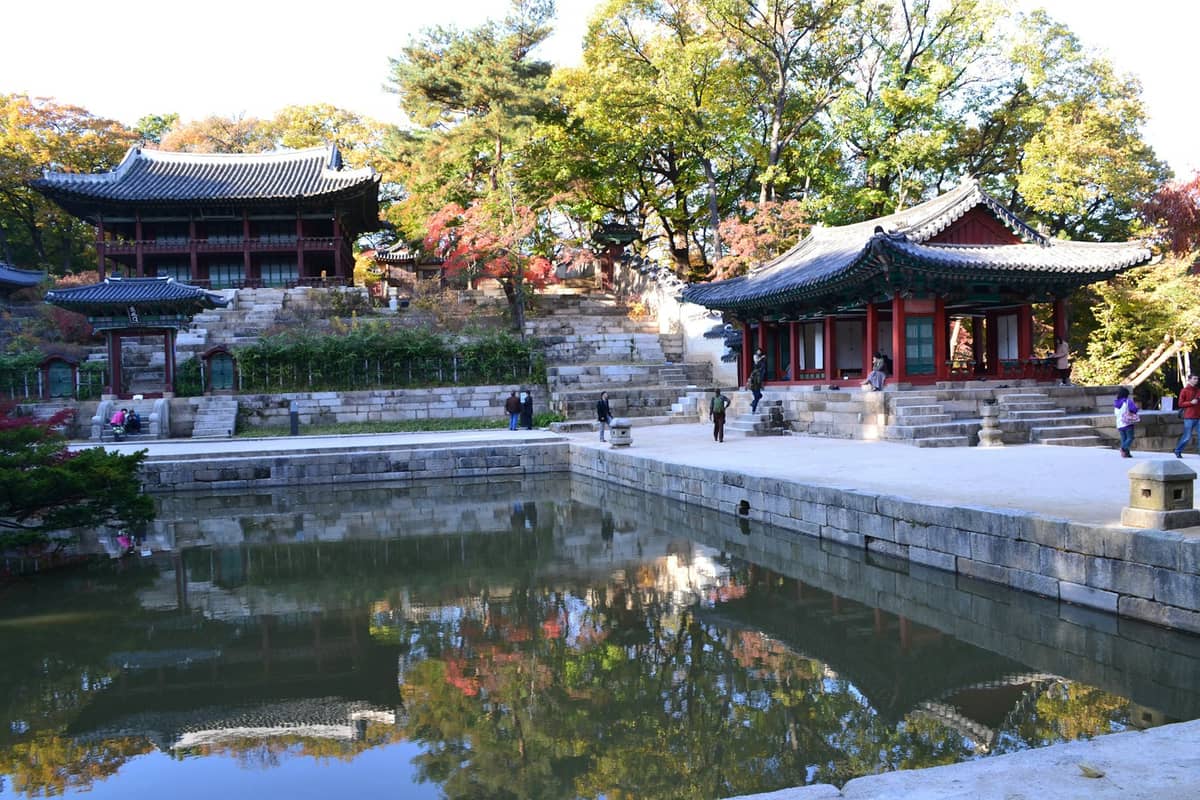
The tour passes through several distinct zones. The first large pond, Buyongji, is the one that photographs best: a square pool with a round island at its center, flanked by the Buyongjeong and Juhamnu pavilions on opposite banks. The round island represents heaven, the square pond represents earth — a cosmological arrangement rooted in traditional Korean thought. On still mornings, the reflection of Juhamnu in the water is near-perfect.
The guided tour lasts roughly 90 minutes and covers the main garden circuit. Group sizes vary, and the commentary quality depends on the guide and the language of the tour. English-language tours run on a fixed schedule; check the official booking page for current times before your visit. Korean-language tours run more frequently throughout the day.
⚠️ What to skip
The Secret Garden path includes uneven terrain, stone steps, and unpaved forest sections. Flat, closed-toe shoes are strongly recommended. The garden is not wheelchair accessible throughout.
How the Experience Changes by Time and Season
Morning visits to the palace area — arriving at opening, around 09:00 — offer noticeably lower crowd density. The courtyard in front of Injeongjeon is large enough that it never feels truly packed, but the narrow corridors between outer buildings and the approach to Nakseonjae can fill up by mid-morning on weekends and public holidays. Tour groups from nearby hotels tend to arrive between 10:00 and 11:00.
Autumn — September through November — is the most visually dramatic season. The Huwon's canopy of ginkgo, maple, and zelkova turns yellow and orange-red across a few weeks in October and early November, making this one of the best spots in Seoul for autumn foliage. This is also the most competitive period for Secret Garden tour bookings. If you are planning a Seoul autumn trip, see our guide to visiting Seoul in autumn for timing and what else to see.
Spring brings cherry blossoms to some of the palace courtyards and early-leafing trees to the garden paths. Summer is lush but humid, and the extra 30 minutes of evening opening in June through August lets you visit in cooler late-afternoon light. Winter visits are underrated: the bare trees in the Huwon reveal the architectural bones of the garden, the crowds thin substantially, and the palace buildings photographed against pale winter sky have a quiet gravity that the fuller seasons don't quite produce.
Opening Hours, Tickets, and Getting There
The palace building area opens at 09:00 year-round. Closing times vary by season: 18:00 in February through May and September through October, 18:30 in June through August, and 17:30 in November through January. Last admission is one hour before closing.
The Secret Garden has shorter hours: tours begin at 10:00, with last entry at 16:00 in March through June and September through October, 16:10 in July through August, 15:30 in November, and 15:00 in December through February. The complex is closed on Mondays, except when a public holiday falls on Monday, or during the K-Royal Culture Festival period.
Palace admission is ₩3,000 for adults aged 19 to 64. Entry is free for visitors aged 18 and under, seniors over 65, visitors wearing hanbok, and on Culture Day (last Wednesday of each month). Group rates for parties of 10 or more are ₩2,400 per adult. The Secret Garden requires a separate ticket purchased at the site or via advance booking.
From the subway, take Seoul Metro Line 3 to Anguk Station and use Exit 3. The palace entrance is approximately 390 metres from the exit — a flat, straightforward walk that also passes the edge of Bukchon. Taxis and Kakao T rides from central Jongno will bring you directly to the Donhwamun Gate entrance on Yulgok-ro.
ℹ️ Good to know
Wearing hanbok grants free admission to the palace building area. Several hanbok rental shops operate within 10 minutes' walk of the palace entrance, particularly along the streets near Bukchon Hanok Village.
Photography Notes and Practical Details
The dancheong paintwork on Injeongjeon and the main gates photographs best in soft, overcast light rather than harsh midday sun, which creates competing shadows across the carved wooden brackets. For the Huwon's Buyongji pond, early morning in autumn gives you both the foliage color and the still-water reflections before the tour groups arrive and disturb the surface.
Tripods are generally permitted in the palace building area but may require a separate fee or permit for commercial photography. The Secret Garden tour does not allow you to break from the group, so spontaneous composition is limited. A 24–70mm range covers most situations here; a longer lens is useful for isolating pavilion details across the pond.
If you are building a full day in the area, Changdeokgung pairs naturally with a walk through Bukchon Hanok Village, which begins just east of the palace walls, or with a visit to Jongmyo Shrine, a 15-minute walk south, which is also a UNESCO World Heritage Site and is frequently undervisited relative to its significance.
Honestly, Who Should Skip This
If your priority is the grandest, most photogenic palace in Seoul and you have time for only one, Gyeongbokgung's scale and the changing of the guard ceremony may serve that goal more efficiently. Changdeokgung rewards patience and a slower pace, and the mandatory tour format of the Secret Garden is not for everyone, particularly travelers who dislike being in a structured group.
Visitors with significant mobility limitations should be aware that the site is a historic heritage complex with uneven paving, stone steps, and no consistent accessible route through the Secret Garden. The palace building area is more navigable but still presents challenges. Check the Korea Heritage Service website for current accessibility information before planning around this attraction.
Insider Tips
- Book the Secret Garden tour online at least a week ahead for autumn weekends. Slots for English-language tours sell out well before the date, and walk-up availability is unreliable from late September through November.
- Hanbok wearers enter the palace building area free of charge. Several rental shops on the streets near Anguk Station and Bukchon offer two to four-hour packages — enough to cover the full palace visit and a walk through the hanok streets nearby.
- The Nakseonjae quarter, in the northeast section of the palace complex, is consistently quieter than the main ceremonial halls and gives a more intimate sense of how the residential parts of the palace actually functioned. Most visitors loop back before reaching it.
- For the best reflection shots at Buyongji pond in the Huwon, aim for the earliest Secret Garden tour slot on a calm, clear morning. Wind from mid-afternoon onwards breaks up the water surface.
- Culture Day, the last Wednesday of each month, waives the palace building area admission fee for all visitors. It does not apply to the separately ticketed Secret Garden, but it is a genuine saving if you are timing a visit around it.
Who Is Changdeokgung Palace & Secret Garden For?
- History and architecture enthusiasts who want depth over spectacle
- Photographers, especially during autumn foliage season in October
- Travelers wearing hanbok looking for the most atmospheric backdrop in Jongno
- Visitors who have already seen Gyeongbokgung and want to understand Joseon palace design more completely
- Anyone with a full day in the Jongno area who wants to combine heritage sites with the surrounding neighborhood
Nearby Attractions
Other things to see while in Jongno & Bukchon:
- Bukchon Hanok Village
Bukchon Hanok Village (북촌한옥마을) is a preserved residential district of roughly 860 traditional Korean hanok houses in central Seoul, situated between Gyeongbokgung and Changdeokgung palaces. Unlike a museum or theme park, it is a real neighborhood where people still live, which shapes every aspect of visiting it. Entry is free, but access to certain alleys is restricted to protect residents.
- Changgyeonggung Palace
One of Seoul's five grand Joseon-era palaces, Changgyeonggung Palace sits in Jongno-gu and offers a quieter royal grounds experience. With late evening opening hours, low admission, and centuries of layered history, it rewards visitors who arrive without high expectations and leave with quiet satisfaction.
- Gwanghwamun Square
Gwanghwamun Square stretches 40,300 square meters through the center of Seoul, framed by Gyeongbokgung Palace to the north and the distant peaks of Bugaksan beyond. It is free, open 24 hours, and carries more historical weight than most visitors realize on first pass.
- Gwangjang Market
Established in 1905, Gwangjang Market in Jongno is Seoul's oldest continuously operating covered market. It draws visitors for its legendary street food stalls — bindaetteok, mayak gimbap, yukhoe — as much as for its wholesale fabric halls and secondhand clothing floors.