Bongeunsa Temple: Seoul's Ancient Buddhist Heart in the Middle of Gangnam
Founded in 794 during the Silla dynasty, Bongeunsa Temple is one of Seoul's most atmospheric religious sites, set against a backdrop of glass towers in the Gangnam district. General admission is free, and the temple opens daily from 05:00 to 22:00, welcoming visitors alongside an active monastic community.
Quick Facts
- Location
- 531 Bongeunsa-ro, Gangnam-gu, Seoul (06087)
- Getting There
- Subway Line 9, Bongeunsa Station, Exit 1 — approx. 135 m walk
- Time Needed
- 45 minutes to 1.5 hours
- Cost
- Free general admission
- Best for
- Buddhist architecture, quiet reflection, cultural contrast, early morning visits
- Official website
- http://www.bongeunsa.org
What Bongeunsa Temple Actually Is
Bongeunsa Temple is an active Buddhist temple in Gangnam-gu, surrounded on three sides by one of Seoul's densest concentrations of commercial skyscrapers. It was first established in 794 CE during the Silla period, and after centuries of use, rebuilding, and royal patronage, it was refurbished and formally renamed Bongeunsa in 1498. That puts it well over 1,200 years old, which makes the surrounding forest of glass-and-steel towers feel all the more disorienting when you're standing at the main gate.
This is not a museum reconstruction or a heritage park. Monks live and practice here. Morning chanting begins before most of the city wakes up, incense burns throughout the day at the main prayer hall, and devout laypeople come to bow and pray on any given Tuesday afternoon. For travelers accustomed to Seoul's commercial energy, the contrast inside these walls registers immediately.
💡 Local tip
General admission is free. The temple grounds are open daily from approximately 05:00 to 22:00, but interior hall access can vary depending on Buddhist services and ceremonial schedules. Arriving mid-morning on a weekday typically gives you the best balance of access and calm.
The Experience by Time of Day
The early morning visit, between 05:30 and 08:00, is genuinely different from anything else in Seoul. The chanting from the main Daeungjeon Hall carries across the courtyard in low, resonant waves. The smell of incense is heavy and specific, not the thin floral kind sold at souvenir shops, but something woodier and more persistent that clings to clothing. The light at this hour is pale and blue, filtered through old pine trees, and the courtyards are mostly empty except for monks walking between buildings and a handful of practitioners completing full prostration bows on the stone pavements.
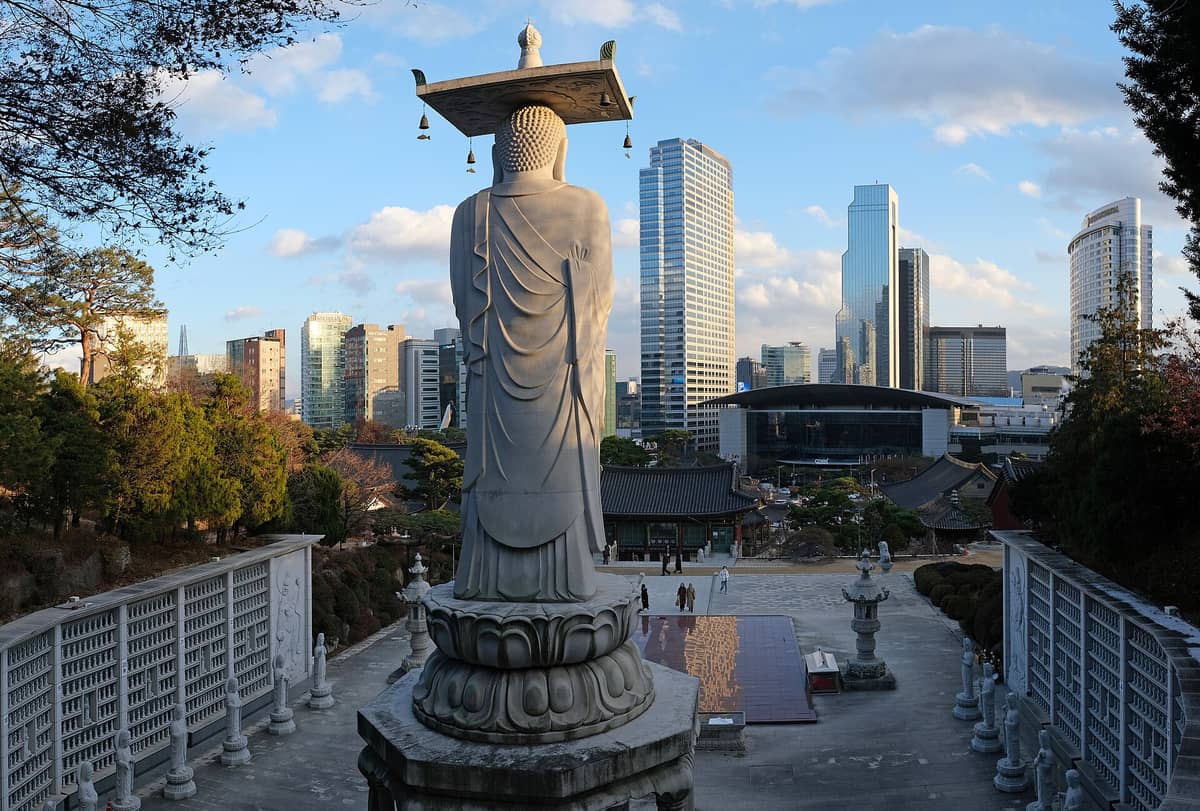
By mid-morning, the character shifts. Tour groups begin arriving, and the central courtyard near the large stone Buddha statue fills up with visitors taking photographs. The 23-meter Mireuk Daebul, a massive standing stone Buddha carved in 1996, becomes the focal point for most casual visitors. It is genuinely impressive in scale, though the newer construction it represents sits alongside older wooden halls that date to more significant periods in the temple's history.
Late afternoon, particularly in autumn, brings a softer quality of light through the ginkgo and pine trees lining the internal paths. The tree cover inside the grounds is denser than it appears from the street, and the sound of the city reduces noticeably once you move toward the rear sections of the temple. By evening, as the 22:00 closing time approaches, the site empties out to near silence.
Tickets & tours
Hand-picked options from our booking partner. Prices are indicative; availability and final rates are confirmed when you complete your booking.
DMZ and Lake Majang Suspension Bridge Tour from Seoul
From 57 €Instant confirmationFree cancellationHalf Day DMZ Tour from Seoul, 3rd Tunnel, Observatory and More
From 47 €Instant confirmationFree cancellationSeoul zombie city exploration game and private tour
From 10 €Instant confirmationFree cancellationLuggage Storage in Seoul
From 7 €Instant confirmationFree cancellation
Historical and Cultural Context
The temple's original founding in 794 places it in the late Unified Silla period, a time when Buddhism held deep influence over Korean political and artistic culture. It was known under a different name until 1498, when it was refurbished under royal patronage during the Joseon dynasty and given the name Bongeunsa. The Joseon period is notable for state-sanctioned Confucianism taking precedence over Buddhism, which makes the continued prominence of Bongeunsa during this era significant.
The temple has been repeatedly rebuilt following fires and wartime destruction, which is a common pattern among Korean Buddhist sites. This means the current buildings are not all ancient, but the site itself has continuous religious history. For deeper context on Buddhist temple culture in Seoul, the Seoul temples guide covers the major sites and their comparative significance.
Bongeunsa is affiliated with the Jogye Order of Korean Buddhism, which is the largest Buddhist order in South Korea. The Jogye Order's headquarters, Jogyesa Temple, sits in the Jongno district on the other side of the city. Bongeunsa serves as a major center for the order's practice in the southern part of Seoul, and it hosts templestay programs that allow visitors to experience monastic routines directly.
What to See Inside the Grounds
The main path from the entrance gate leads through a series of smaller shrine halls before reaching the Daeungjeon, the primary worship hall. The interiors of these halls are ornate in the way Korean Buddhist architecture typically is: layered lacquered woodwork in deep reds and greens, ceiling panels with painted lotus motifs, and gilt Buddha statues flanked by guardian figures and hanging lanterns. Shoes come off at the entrance to the main hall, and visitors who enter should do so quietly, as active prayer may be ongoing.
The Panjeon, a library building that houses carved wooden scripture blocks, is one of the more historically significant structures on the grounds. The woodblocks stored here, though not the famous originals held at Haeinsa Temple in South Gyeongsang Province, represent an important aspect of Korean Buddhist scholarly tradition. The building itself dates to a reconstruction after the Korean War.
Stone lanterns, carved guardians at the main gate, and smaller votive structures are scattered throughout the compound. Walking the full perimeter of the grounds, including the rear paths that loop behind the main halls, takes about 20 to 25 minutes at a slow pace and reveals quieter corners that most visitors on tight schedules miss entirely.
ℹ️ Good to know
The Templestay program at Bongeunsa is one of the most accessible in Seoul. Participants can experience predawn chanting, meditation instruction, and tea ceremony with monks. Programs require advance registration through the official website. This is particularly worthwhile for visitors staying more than two or three days in Seoul.
Getting There and Practical Navigation
Bongeunsa is easily reached by subway. Take Line 9 to Bongeunsa Station and use Exit 1. The temple entrance is approximately 135 meters away, a walk of under two minutes. The station name literally references the temple, so there is no ambiguity. For those using the T-money card system covered in the getting around Seoul guide, the fare from central locations like Gyeongbokgung or City Hall is a straightforward Line 9 or transfer ride.
The temple sits directly across the boulevard from COEX Mall and the adjacent COEX convention complex in Gangnam. This means it is easy to combine with a visit to that area, and the visual contrast between the temple's wooden gate and the glass facade of the convention center is one of the more photogenic juxtapositions in Seoul. The neighborhood around Bongeunsa Station is dense with cafes, restaurants, and convenience stores, so finding food before or after is not a concern.
For visitors planning a full day in Gangnam, Bongeunsa pairs naturally with COEX or a walk through the surrounding commercial district. Those building a broader Seoul itinerary can find suggested combinations in the 3-day Seoul itinerary.
Photography, Dress, and Etiquette
Photography is generally permitted in the outdoor areas of the grounds. Inside the prayer halls, photographing actively worshipping visitors or the altar arrangements up close is considered disrespectful, and some halls have posted restrictions. As a rule, photograph the architecture and exterior details, and use judgment inside.
There is no formal dress code enforced at the entrance, but modest clothing is appropriate. Shoulders and knees covered is the standard benchmark for Buddhist temple visits in Korea. The stone pathways are uneven in places, particularly in older sections near the rear halls, so footwear with some grip is more comfortable than sandals or smooth-soled shoes. This matters more in spring and autumn when leaf litter or rain can make surfaces slippery.
The best light for photography is early morning when the angle is low and the courtyard is clear of crowds. The large stone Mireuk Daebul Buddha photographs well at midday when the figure is fully illuminated, but the surrounding buildings intrude on the frame from certain angles. Positioning yourself low and angling upward toward the statue minimizes the background clutter.
Honest Assessment: What Works and What Doesn't
Bongeunsa is worth visiting, but it rewards a certain kind of traveler. If you come with the expectation of a pristine ancient landscape, the mixture of genuinely old halls with 1990s construction, the proximity of high-rises, and the occasional tourist-facing commercial element (gift shop, information kiosks) can feel underwhelming by comparison with more remote temple complexes. The site's value is not in historical purity but in accessibility, contrast, and the fact that it functions as a real religious institution rather than a heritage attraction.
Visitors who have already explored Gyeongbokgung or Changdeokgung in the north of the city will find Bongeunsa a different but complementary experience. Where the Gyeongbokgung Palace delivers grand Joseon civic architecture, Bongeunsa offers something quieter, more liturgically alive, and more immediately personal in scale.
Who should skip it: travelers with only a single day in Seoul and no particular interest in religion or architectural history may find the time better spent elsewhere. The temple is free and close to transit, but if Gangnam is not already on your route, making a dedicated trip solely for Bongeunsa may not justify the time. On the other hand, if you are already at COEX or Gangnam for another reason, there is no reason not to walk over.
⚠️ What to skip
Opening hours and hall access are subject to change during major Buddhist observances, including Buddha's Birthday (typically in May on the lunar calendar), when the temple sees very large crowds and some areas become restricted. If your visit falls near this date, check the official website at bongeunsa.org for adjusted schedules.
Insider Tips
- Arrive before 07:00 on a weekday for the morning chanting session. You can stand quietly in the courtyard outside the Daeungjeon and listen without disrupting the service. The sound alone is worth the early start.
- The stone path that runs along the left side of the main hall and leads toward the rear garden area is largely bypassed by most visitors. It is quieter, shadier, and gives a better sense of the temple's actual footprint and tree coverage.
- The Templestay program requires advance booking through the official website and fills up quickly around major Buddhist holidays. If this is a priority, register at least two weeks in advance.
- In autumn, usually mid-October to early November, the ginkgo trees inside the grounds turn a sharp yellow and drop leaves across the stone paths. This is one of the more photogenic periods to visit the site.
- The cafe and information center near the entrance sells traditional teas and light refreshments. It is a quieter alternative to the commercial cafes just outside the temple gate, and the proceeds support the temple.
Who Is Bongeunsa Temple For?
- Travelers who want to experience an active Buddhist temple without leaving central Seoul
- Early risers willing to catch morning chanting before the city wakes up
- Architecture enthusiasts interested in the contrast between traditional Korean wooden structures and the surrounding Gangnam skyline
- Anyone combining a Gangnam day with COEX and looking for a counterweight to the commercial district
- Visitors interested in the Templestay program as a deeper cultural experience
Nearby Attractions
Other things to see while in Gangnam:
- COEX Mall & Starfield Library
Sprawling across 85,000 square meters beneath the streets of Gangnam, COEX Mall is one of Asia's largest underground shopping complexes. At its heart sits the Starfield Library, a soaring indoor atrium bookshelf installation that has become one of Seoul's most recognizable spaces. Entry to both is free.