Tongin Market: Seoul's Coin Lunchbox Experience in Seochon
Tongin Market is a traditional neighborhood market in Jongno-gu where visitors exchange Korean won for vintage brass coins and use them to buy small dishes from stalls across the market. It sits at the foot of Inwangsan Mountain, minutes from Gyeongbokgung Palace, and offers one of the most tactile and genuinely local food experiences in central Seoul.
Quick Facts
- Location
- 18, Jahamun-ro 15-gil, Jongno-gu, Seoul (Seochon neighborhood)
- Getting There
- Seoul Subway Line 3, Gyeongbokgung Station Exit 2 — approx. 515m, 5–10 min walk
- Time Needed
- 1–2 hours, including the Lunchbox Café experience
- Cost
- Free entry. Lunchbox Café coins purchased separately (budget around 3,000–5,000 KRW for a light meal, though prices change — verify on site)
- Best for
- Food lovers, solo travelers, anyone wanting a non-touristy market atmosphere near the palace district
- Official website
- http://tonginmarket.co.kr
What Is Tongin Market?
Tongin Market (통인시장) is a covered traditional market that has served the Seochon neighborhood of Jongno-gu for decades. Unlike the grand scale of Gwangjang or the tourist-facing sprawl of Namdaemun, this is a genuinely compact, neighborhood-oriented market, the kind of place where regulars come for banchan side dishes, freshly fried snacks, and seasonal produce rather than souvenirs.
It sits just west of Gyeongbokgung Palace, tucked into the lanes of Seochon, a district of low-rise hanok houses and independent cafés that has developed a loyal following among travelers seeking texture beyond the main palace circuit. If you're already planning a visit to Gyeongbokgung Palace, Tongin Market is a logical and rewarding extension — separated by less than ten minutes on foot.
The market's most talked-about feature is the Dosirak Lunchbox Café, sometimes called the Coin Lunchbox Café. Visitors exchange Korean won for a set of old-style brass coins at a counter near the entrance, receive an empty aluminum lunchbox, and then walk the stalls using those coins to pick individual dishes from different vendors. It sounds gimmicky on paper; in practice it turns a meal into a slow, interactive wander through the market's heart.
ℹ️ Good to know
The market is closed on the third Sunday of every month. The Lunchbox Café is additionally closed on Tuesdays. Plan accordingly, especially if you're visiting over a long weekend.
The Atmosphere: What You Actually Notice When You Walk In
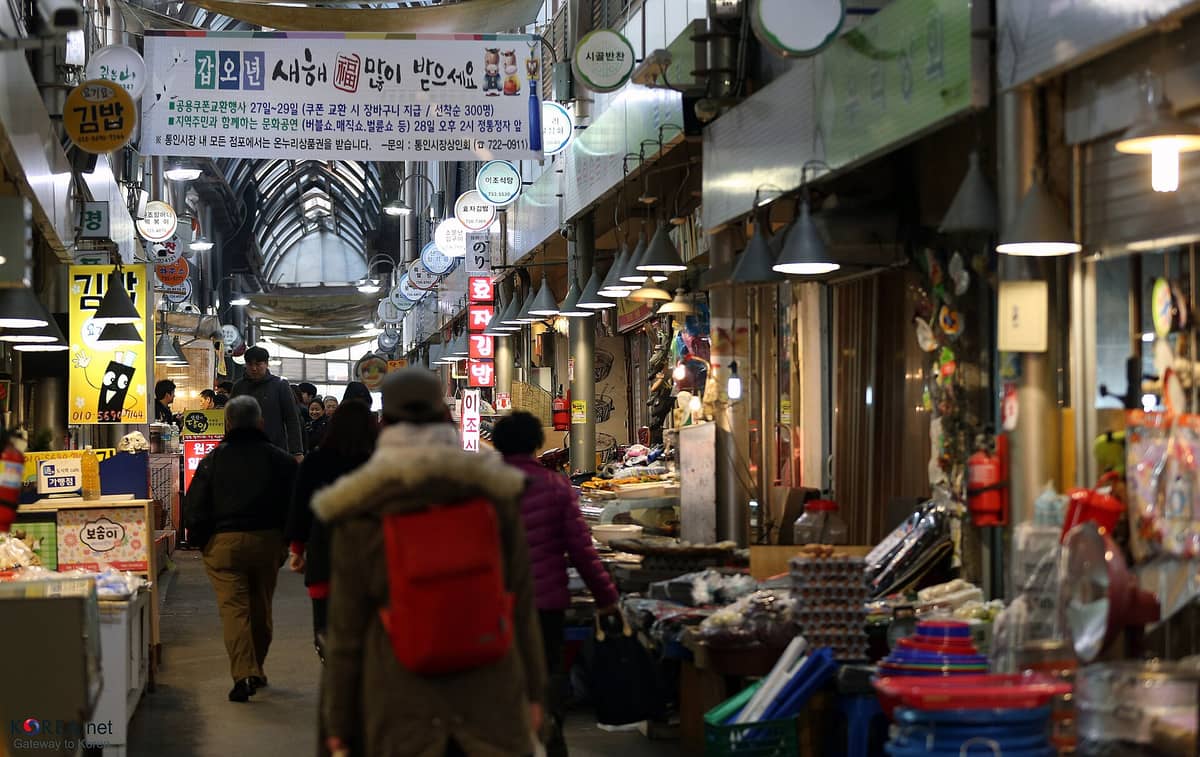
The entrance is unassuming. A low archway leads into a covered alley lined with stalls on both sides. Overhead, the corrugated roof filters light into a muted glow, and the smell hits before the sights do: frying oil, sesame, the faint sweetness of tteok (rice cake), and the mineral tang of cut vegetables laid out on trays. Vendors call out to passersby without pressure, mostly just announcing what they have.
The floor is worn smooth. Stalls are small and stacked with efficiency: banchan containers piled high, trays of yachaejeon (vegetable pancakes) sizzling on flat griddles, small mountains of japchae noodles glossed with sesame oil. The vendors are largely middle-aged and older women who have been at this for years, and there is an unhurried competence to how they work that is worth paying attention to.
Weekday mornings, particularly before 10:00, the market belongs almost entirely to locals. Grandmothers with wheeled carts navigate the narrow corridor. By midday, a mix of Korean office workers and curious travelers passes through, but it never reaches the shoulder-to-shoulder density of larger markets. This relative calm is one of Tongin's genuine advantages.
💡 Local tip
Arrive between 11:00 and 12:00 on a weekday to catch the Lunchbox Café at its most active without fighting for stall access. Arrive earlier if you want the market mostly to yourself.
Tickets & tours
Hand-picked options from our booking partner. Prices are indicative; availability and final rates are confirmed when you complete your booking.
DMZ and Lake Majang Suspension Bridge Tour from Seoul
From 57 €Instant confirmationFree cancellationHalf Day DMZ Tour from Seoul, 3rd Tunnel, Observatory and More
From 47 €Instant confirmationFree cancellationSeoul zombie city exploration game and private tour
From 10 €Instant confirmationFree cancellationLuggage Storage in Seoul
From 7 €Instant confirmationFree cancellation
The Coin Lunchbox Café: How It Works in Practice
The Lunchbox Café operates from a counter near the market entrance. You exchange Korean won for a set of brass coins — reproductions of the traditional yeopjeon coins used in Joseon-era Korea. Each coin has a fixed value that can be spent at participating stalls marked with the café's signage. You also receive an aluminum dosirak (lunchbox) tray to carry your selections.
The practical reality: not every stall in the market participates, so look for the posted signs. The portion sizes are small by design, which is the point. You are assembling a meal the way a Korean home cook might assemble banchan: a little of this, a scoop of that, a single piece of something fried. The aluminum tray fills up faster than expected. Common coin-purchased items include tteokbokki (spiced rice cakes), bindaetteok (mung bean pancakes), japchae, and various fried snacks.
Seating is communal, typically at shared wooden tables inside or near the café area. Eating alongside strangers, both locals and visitors, contributes to the appeal. Bring a small appetite or genuine hunger; half-measures do not work well here.
⚠️ What to skip
Coin prices and the number of coins per set can change. Verify the current rate at the Lunchbox Café counter on arrival rather than budgeting based on older information.
Seochon Context: Why the Location Matters
Tongin Market sits in Seochon, one of Seoul's most intact traditional neighborhoods. The alleys around it are lined with hanok houses adapted into independent coffee shops, small galleries, and low-key restaurants. Seochon existed in something of a development pause for years, which inadvertently preserved its scale and character. For a fuller sense of the area, the Seochon Village lanes are worth wandering after the market.
A ten-minute walk east brings you to Gyeongbokgung, and a short walk north places you at the base of Inwangsan Mountain, where shamanist shrines are tucked among granite boulders. This cluster of experiences, palace, mountain, traditional market, and preserved neighborhood lanes, makes the area one of the more coherent half-day itineraries in central Seoul.
Travelers interested in the full arc of traditional Seoul architecture might also combine this with Bukchon Hanok Village to the east, though that area now draws significantly heavier crowds and operates under noise restrictions in some alleys.
Photography and Practical Notes
Tongin Market photographs well in the morning hours when the corrugated roof lets in angled natural light and before the midday foot traffic complicates wide shots. The stalls themselves, with their layered containers of banchan in primary colors, reward close-up composition. Ask before photographing vendors directly; most are accommodating if you make the gesture of asking, even with hand signals.
The market is covered, which makes it a reasonable stop in light rain. Wet weather does not significantly degrade the experience here the way it might at an outdoor market. In winter, the enclosed corridor retains heat from cooking stalls, making it more comfortable than the streets outside.
Wear comfortable shoes with good grip; the floor can be slightly slick near stalls where liquid spills are common. There are restrooms and a customer service counter on site. Detailed wheelchair accessibility specifications are not confirmed in official sources, so travelers with mobility needs should contact the market directly before visiting.
💡 Local tip
The market is free to enter. Even if you skip the Lunchbox Café, walking through is worthwhile for the atmosphere and for picking up freshly made banchan to take back to accommodation with kitchen facilities.
Who Should Skip This
Tongin Market is small. Travelers expecting the density and variety of a large urban market will find it underwhelming on scale alone. If your primary interest is sheer market spectacle rather than neighborhood character and food interaction, a visit to Gwangjang or Namdaemun will serve you better.
The Lunchbox Café experience also has practical limits: it works best for solo travelers and pairs, less so for large groups where the coin logistics and communal seating become unwieldy. Travelers on very tight budgets should note that while market entry is free, the coin system is the main event, and skipping it leaves the visit feeling incomplete. For a broader sense of how Seoul's traditional markets compare, the Seoul markets guide covers the range of options across the city.
Anyone visiting on a Monday (when the Lunchbox Café is closed) or on the third Sunday of the month (when the entire market is closed) will find either a significantly reduced experience or locked doors. Check the calendar before building your itinerary around this stop.
Insider Tips
- Exchange more coins than you think you need at the Lunchbox Café counter. It's easy to underestimate how many stalls catch your eye, and unused coins are a small loss compared to running short mid-wander.
- The stalls selling freshly made tteok (rice cakes) near the back of the market are popular with locals and sell out by mid-afternoon. Get there before 13:00 if that's a priority.
- Seochon's café alleys directly surrounding the market are a good place to finish the visit. Several serve traditional teas and shaved ice (bingsu) in warmer months, and the pace is much calmer than Insadong.
- If you're visiting Gyeongbokgung on the same day, do the palace first in the morning when light is best for photography, then come to the market for lunch — the timing aligns naturally with the Lunchbox Café's peak operating hours.
- Bring small denomination bills when exchanging for coins. The counter can struggle to break large notes during busy periods, particularly on weekends.
Who Is Tongin Market For?
- Solo travelers who want a genuine neighborhood food experience rather than a tourist-facing market
- Pairs looking for an interactive, unhurried lunch format
- Travelers combining a Gyeongbokgung palace visit with a local Seochon wander
- Food-focused visitors interested in Korean banchan and traditional street snacks beyond tteokbokki
- Photographers drawn to covered market light and the texture of traditional Korean street food stalls
Nearby Attractions
Other things to see while in Insadong & Seochon:
- Insa-dong
Stretching roughly 700 meters through Jongno-gu, Insa-dong is Seoul's most concentrated stretch of traditional galleries, antique dealers, calligraphy shops, and tea houses. It's free to explore, car-free on weekends, and far more layered than its reputation as a tourist corridor suggests.
- Seochon Village
Seochon Village occupies the narrow alleys west of Gyeongbokgung Palace in Jongno-gu, where Joseon-era hanok architecture survives alongside independent cafes, small galleries, and artist studios. The neighborhood is free to enter, walkable in two to three hours, and noticeably calmer than the tourist corridors on the palace's eastern flank.
- Ssamziegil
Ssamziegil (쌈지길) is a free-entry craft and culture complex in the heart of Insa-dong, built around an open spiral walkway that winds past independent boutiques, ceramic studios, and Korean artisan shops. Opened in 2004, it offers a genuinely different shopping experience from Seoul's malls and department stores.