Inwangsan Mountain: Seoul's Sacred Peak and Living Shamanist Heart
Rising 338.2 metres above Jongno-gu, Inwangsan Mountain is one of Seoul's most atmospheric hikes: a compact rocky climb threading past active shamanist shrines, sections of the ancient Seoul City Wall, and sweeping views over the capital. Unlike the polished palace circuits nearby, Inwangsan rewards visitors with something rawer and more layered.
Quick Facts
- Location
- Jongno-gu, Seoul (near Dongnimmun, northwest of Gyeongbokgung)
- Getting There
- Dongnimmun Station, Seoul Metro Line 3, Exit 3-1 — approx. 900m on foot to trailhead
- Time Needed
- 2–3 hours for the main loop; allow an extra hour if you explore the shrine complex thoroughly
- Cost
- Free (no admission fee for mountain or trails)
- Best for
- Hikers, culture seekers, photographers, those interested in Korean shamanism (musok)
- Official website
- english.visitseoul.net/nature/Inwangsan-Mountain/ENP003840
What Inwangsan Actually Is
Inwangsan Mountain (인왕산) is a 338.2-metre granite peak on the western fringe of Seoul's historic centre, administratively within parts of Jongno-gu and Seodaemun-gu. It is one of the four guardian mountains that ancient city planners placed palaces and walls between, and it still carries a distinctly spiritual weight. Where the more famous peaks around Seoul feel like nature escapes, Inwangsan feels like a place that has been in continuous conversation with the city for six centuries.
The mountain was closed to the public for periods because of its proximity to Cheong Wa Dae (the Blue House, the former presidential residence). Those restrictions were later lifted, and the mountain is now open to hikers. The decades of enforced quiet actually preserved the mountain's character: the shamanist shrines that cluster on its lower slopes survived without commercialisation, and the ridgeline sections of the Hanyangdoseong Seoul City Wall remained largely intact.
The combination of geology, history, and living ritual practice puts Inwangsan in a different category from most Seoul attractions. If your itinerary already includes Gyeongbokgung Palace or Bukchon Hanok Village, Inwangsan adds a dimension that neither of those places can offer: the Seoul that predates Confucian order and persists outside it.
The Climb: What You See and Feel on the Way Up
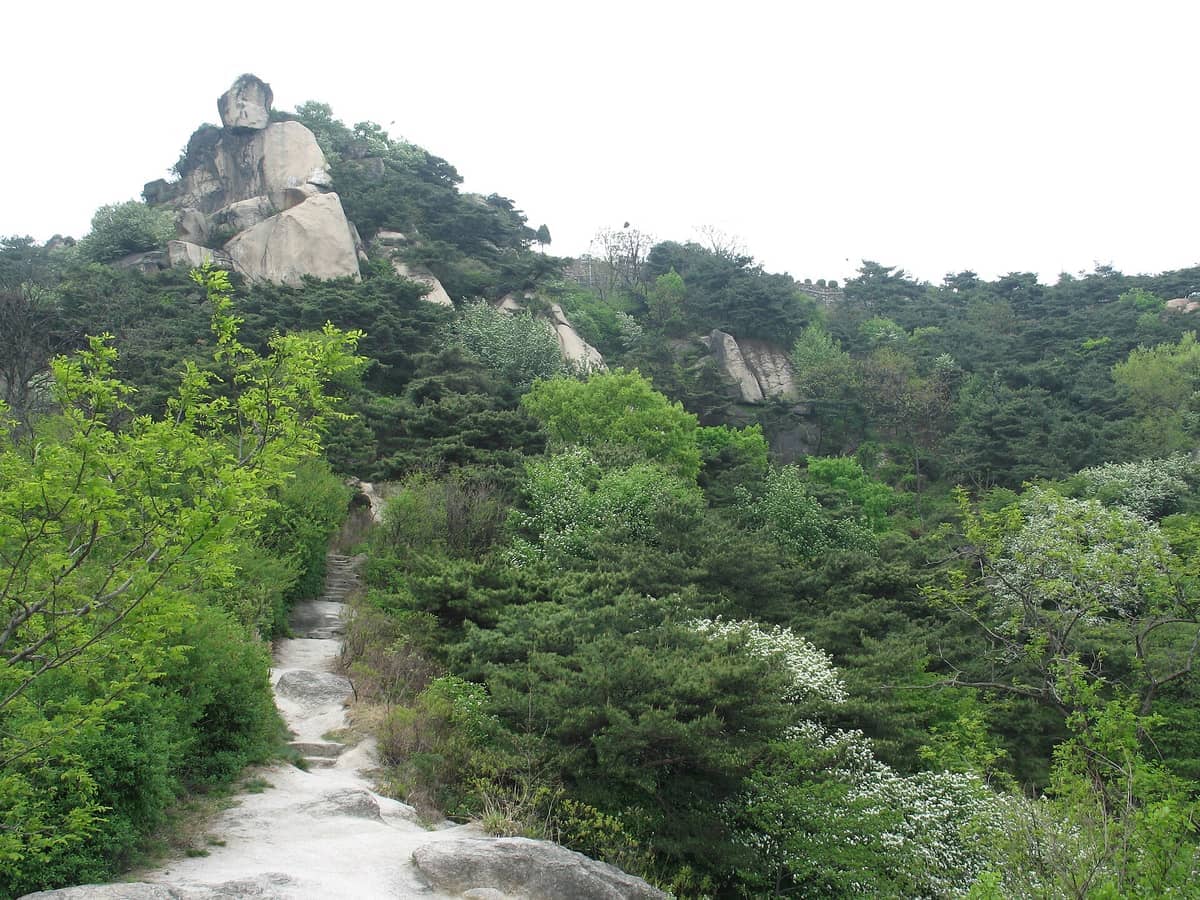
The trail from the Dongnimmun Station side begins through an ordinary residential street that narrows gradually as the gradient rises. Within ten minutes, the city fabric gives way to pine forest and exposed granite slabs. The rock underfoot turns from concrete to stone so smoothly that you barely notice the transition.
The lower section of the trail is where the shamanist shrines, known as musok shrines or gut, are concentrated. These are small, colourful structures draped with flags and ribbons, often with offerings of fruit, rice cakes, or candles placed outside. On certain days you will hear percussion and chanting from a gut ceremony in progress. The sound carries through the trees before you see the source, and the smell of incense mixes with pine resin. This is not a museum exhibit: the ceremonies are active, private, and should be observed from a respectful distance. Do not photograph an ongoing ritual without clear permission.
⚠️ What to skip
The shamanist shrines on Inwangsan are functioning religious sites, not tourist installations. Ceremonies (gut) can be in progress at any time. Keep noise low, do not enter shrine enclosures uninvited, and ask before photographing.
Above the shrine zone, the trail opens onto bare granite. The final approach to the summit ridge involves scrambling over rounded rock faces, some of which are polished smooth by decades of foot traffic. Solid footwear is essential: sandals and flat-soled shoes are a genuine hazard on wet rock. The summit area is marked by a small platform with a view that sweeps east across the tiled rooftops of Jongno-gu, south to Namsan, and west toward the Han River on clear days.
Tickets & tours
Hand-picked options from our booking partner. Prices are indicative; availability and final rates are confirmed when you complete your booking.
DMZ and Lake Majang Suspension Bridge Tour from Seoul
From 57 €Instant confirmationFree cancellationHalf Day DMZ Tour from Seoul, 3rd Tunnel, Observatory and More
From 47 €Instant confirmationFree cancellationSeoul zombie city exploration game and private tour
From 10 €Instant confirmationFree cancellationLuggage Storage in Seoul
From 7 €Instant confirmationFree cancellation
The Seoul City Wall: History You Walk On
Sections of the Hanyangdoseong Seoul City Wall run directly along Inwangsan's ridgeline, and these are among the best-preserved stretches of the 18.6-kilometre fortification that once enclosed the Joseon-era capital. The wall was originally constructed in the 1390s and reinforced repeatedly through the following centuries. On Inwangsan you walk beside and sometimes on top of stonework that is both genuinely old and still structurally sound, with restoration work clearly distinguished from original masonry by stone colour and cutting style.
The ridgeline wall section connects Inwangsan to the broader Seoul City Wall trail network. Fit walkers can continue east along the wall toward Naksan Park or north toward Bugaksan, turning Inwangsan into the opening chapter of a much longer day. Even if you only walk the Inwangsan segment, the experience of standing on a functioning city boundary wall while a 10-million-person metropolis unfolds below is difficult to replicate elsewhere.
Time of Day: How the Experience Changes
Early morning, from around 6am to 8am, is when local residents use Inwangsan as a fitness trail. The pace is brisk and purposeful; vendors near the base sell small bottles of water and energy drinks from mobile carts. The light at this hour hits the granite at a low angle, deepening the texture of the rock and making the city below look almost golden. If you want good photographs without other hikers in frame, this is the window.
Midday in summer is the one time to avoid if possible. The granite surface absorbs heat, there is minimal shade on the upper slopes, and the air between the shrine buildings can feel still and oppressive. Hydration is not optional: bring more water than you think you need. Seoul's summer temperatures regularly reach 30°C or above.
Late afternoon, from around 4pm to 6pm, draws a second wave of visitors including couples, solo photographers with tripods, and older residents moving at a slower pace than the morning crowd. The shrine area can be more active at this hour, and the quality of light on the city below improves as the sun moves westward. Autumn afternoons, when the deciduous trees on the lower slopes change colour, produce the most photogenic conditions on the mountain.
💡 Local tip
Visit in October or early November for the best combination of cool hiking temperatures, clear skies, and autumn foliage on the lower slopes. Spring (late March to April) is a close second, with cherry and plum blossoms near the trailhead area.
The Shamanist Shrines: Cultural Context
Korean shamanism, known as musok (무속), is one of the oldest continuous spiritual traditions in the Korean Peninsula. It operates outside the structured hierarchies of Buddhism and Confucianism, centering on the mudang (shaman), who mediates between the living and spirits through ritual ceremony. Seoul's rapid modernisation pushed many mudang and their shrines to the city's physical and social margins, and the mountains became their primary territory.
Inwangsan became particularly associated with musok because of its granite formations, especially a large rounded boulder near the trailhead known as Seonbawi (선바위). This rock is considered sacred, and the area around it has been a site of ritual and prayer for centuries. Women, particularly those praying for fertility or the wellbeing of family members, have historically made pilgrimages to Seonbawi. On any given weekday morning you are likely to see individuals in deep, private prayer at or near this stone.
Understanding this context changes the quality of the visit. Inwangsan is not a theme park version of shamanism. The practices happening around you represent an unbroken living tradition. Approaching this with curiosity rather than detached spectacle will make the experience more meaningful, and will also ensure you do not inadvertently disrupt something important to someone.
Practical Information: Getting There, What to Bring, Accessibility
The most straightforward access route uses Seoul Metro Line 3 to Dongnimmun Station, Exit 3-1. From the exit, the walk to the main trailhead is approximately 900 metres through a quiet residential area. Taxis from central Jongno-gu cost very little and can drop you closer to the base; use Kakao T to hail one if needed.
Inwangsan is a genuine rocky mountain trail, not a paved park path. The trail is not wheelchair accessible, and there are no facilities (toilets, food stalls, or first aid) on the upper sections. Seoul tourism advises visitors to use the bathroom before starting the climb. If you are combining the hike with a broader day in the Jongno area, the nearby Seochon Village at the mountain's eastern base has cafes and restaurants where you can refuel before or after.
What to bring: trail shoes or sturdy sneakers with grip, at least one litre of water per person, sun protection for the exposed upper sections, and a light layer for the summit even in summer, when wind can be cool. A small amount of cash is useful if you want to buy water or snacks from the vendors near the base.
Admission to Inwangsan is free. The trail is generally open daily, though some sections near the city wall or managed trail access points have reported Monday closures in past visitor accounts. Verify the current access status locally, particularly if visiting on a Monday or after significant rainfall when trail surfaces may be temporarily closed for safety.
ℹ️ Good to know
Some trail sections near the Seoul City Wall have been subject to periodic Monday closures or temporary restrictions after heavy rain. Check Visit Seoul or ask at the Dongnimmun Station tourist kiosk before heading up on a Monday.
Who Should Skip Inwangsan
Inwangsan is not the right choice for everyone. Travellers with limited mobility, knee problems, or young children in strollers will find the rocky upper sections genuinely difficult. Those with only a few hours in Seoul who want to cover multiple landmarks efficiently will likely find the time commitment (two to three hours minimum for a satisfying experience) harder to justify compared to more concentrated attractions nearby.
Visitors who have already hiked Bukhansan National Park may find Inwangsan feels modest in scale by comparison. It is a shorter, less dramatic climb. What Inwangsan offers instead is cultural density: fewer than three kilometres of trail deliver more distinct layers of Seoul's history than almost any other walk in the city. If natural grandeur is your primary goal, Bukhansan is the better choice. If you want to understand the city more deeply, Inwangsan is the stronger argument.
Insider Tips
- Seonbawi (선바위), the large sacred granite boulder near the lower trailhead, is easy to walk past if you are not looking for it. It sits just off the main path and is marked by ritual offerings. This is one of the most photographed and spiritually significant spots on the mountain.
- Weekday mornings produce significantly fewer tourists than weekends. If your schedule allows a Tuesday or Wednesday visit, you will have the shrine zone largely to yourself and will be more likely to witness a gut ceremony without a crowd around it.
- The ridgeline connects to the Seoul City Wall walking trail. If you want to extend the hike, you can follow the wall east toward Inwangsan's neighbour Bugaksan or descend toward Naksan Park. Plan for an additional two or more hours and bring extra water.
- Autumn is when local photographers arrive with serious equipment. If you want unobstructed shots of the city from the summit, arrive before 7am even in October. By 9am on a clear autumn weekend the summit platform gets busy.
- There are no ATMs on the mountain. Cash for vendors, taxi drivers, or any small purchases near the trailhead should be prepared in advance. Most of the cafes in nearby Seochon Village accept cards, but the mobile water carts near the base are cash only.
Who Is Inwangsan Mountain & Shamanist Shrines For?
- Hikers wanting a short but rewarding urban summit with genuine views over central Seoul
- Travellers interested in Korean shamanism and folk religion in a living rather than museum context
- Photographers seeking atmospheric early-morning light on granite rock and ancient city wall stonework
- History enthusiasts combining the trail with the Hanyangdoseong Seoul City Wall route
- Independent travellers who want something off the standard palace and shopping circuit
Nearby Attractions
Other things to see while in Jongno & Bukchon:
- Bukchon Hanok Village
Bukchon Hanok Village (북촌한옥마을) is a preserved residential district of roughly 860 traditional Korean hanok houses in central Seoul, situated between Gyeongbokgung and Changdeokgung palaces. Unlike a museum or theme park, it is a real neighborhood where people still live, which shapes every aspect of visiting it. Entry is free, but access to certain alleys is restricted to protect residents.
- Changdeokgung Palace & Secret Garden
Changdeokgung Palace is the best-preserved of Seoul's five Joseon-era royal palaces, and its rear garden — the Huwon, known as the Secret Garden — remains one of the most atmospheric green spaces in the entire city. Together, they form a UNESCO World Heritage Site that rewards visitors who plan ahead.
- Changgyeonggung Palace
One of Seoul's five grand Joseon-era palaces, Changgyeonggung Palace sits in Jongno-gu and offers a quieter royal grounds experience. With late evening opening hours, low admission, and centuries of layered history, it rewards visitors who arrive without high expectations and leave with quiet satisfaction.
- Gwanghwamun Square
Gwanghwamun Square stretches 40,300 square meters through the center of Seoul, framed by Gyeongbokgung Palace to the north and the distant peaks of Bugaksan beyond. It is free, open 24 hours, and carries more historical weight than most visitors realize on first pass.