Hanyangdoseong (Seoul City Wall): The Ancient Wall That Still Rings the Capital
Hanyangdoseong, the 18.6 km fortress wall built at the founding of the Joseon dynasty in the late 14th century, loops across four mountains and through the modern heart of Seoul. Entry is free, trails are largely open year-round, and the wall offers some of the most historically layered walking in the city.
Quick Facts
- Location
- Jongno-gu and surrounding districts, Seoul (wall spans Jongno-gu, Seongbuk-gu, Jung-gu, Yongsan-gu, and Seodaemun-gu)
- Getting There
- Hyehwa Station (Line 4, Exit 2) for the Naksan section; access points vary by section
- Time Needed
- 1.5–2 hours for a single section; 6–8 hours for the full circuit
- Cost
- Free
- Best for
- History lovers, casual hikers, photographers, and anyone wanting city views without crowds
- Official website
- seoulcitywall.seoul.go.kr/en/content/72.do
What Is Hanyangdoseong?
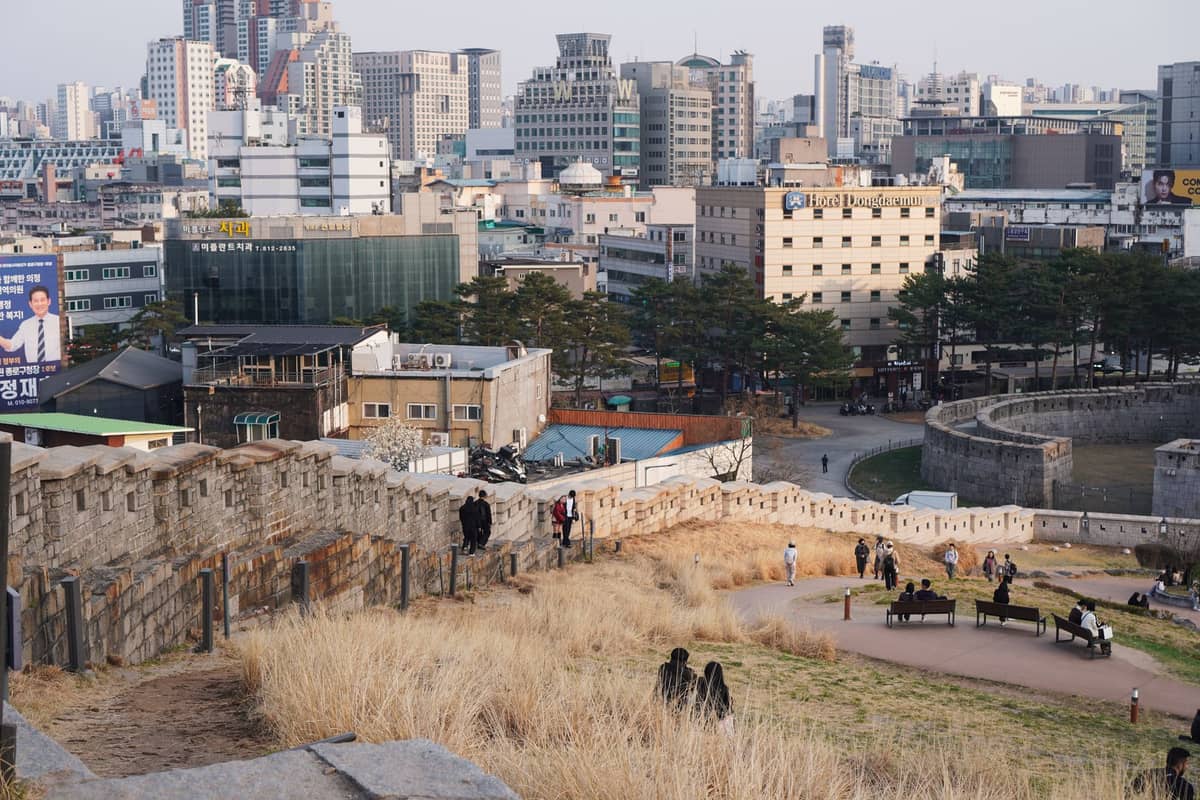
Hanyangdoseong is the original defensive wall built around Hanyang, the Joseon dynasty capital that would become modern Seoul. Construction began in 1396, just four years after the dynasty's founding, under the orders of King Taejo. The wall was built to define and protect the new capital, stretching 18.6 km across the four mountains that ring the city center: Bugaksan to the north, Naksan to the east, Namsan to the south, and Inwangsan to the west. What makes it extraordinary is not just its age, but its survival. Portions of the wall were torn down during the Japanese colonial period and later decades of rapid development, yet substantial sections remain intact, repaired, and walkable today.
The wall is currently on UNESCO's World Heritage tentative list, a designation that reflects both its historical significance and its unusual status as a major ancient monument embedded within a city of nearly 10 million people., a designation that reflects both its historical significance and its unusual status as a major ancient monument embedded within a city of nearly 10 million people. Walking it, you move between granite stones laid in the 14th century and glass towers built in the 21st, often within the same field of view.
ℹ️ Good to know
The wall is not a single enclosed site with one entrance. It is a long trail across multiple mountains and urban districts. Choose a section before you go, not the full circuit, unless you are prepared for a full day of serious hiking.
The Four Sections: What Each One Offers
Each mountain section has a distinct character. The Naksan section, accessed from Hyehwa Station (Line 4, Exit 2), is the most popular with casual visitors. The trail rises gently through a residential neighborhood before the wall appears in full force along the ridge, offering clear views toward Namsan Tower to the south and the old neighborhoods of Ihwa-dong below. This is the section where you are most likely to encounter students, couples, and older residents doing their evening walk. The stone underfoot is well-maintained, the lighting at night is good, and the distance is manageable.
The Namsan section traces the ridge of Namsan Mountain and connects with the area around Namsan Seoul Tower. The terrain here involves steeper climbs, and the views open up dramatically over central Seoul and the Han River corridor to the south. This section blends into the broader Namsan park network, so it is easy to extend into a longer outing.
The Inwangsan section on the western flank is the most atmospheric. The wall here passes through rocky terrain, pine forest, and along ridge lines with unobstructed views over the city. It is also close to Seochon Village and connects thematically with the shamanic culture historically associated with Inwangsan. For those interested in less-trafficked routes, this is a strong choice. More on the wider mountainous options is covered in the hiking in Seoul guide.
The Bugaksan section, running along the ridge directly above Gyeongbokgung Palace, was restricted to the public for decades. Access opened in stages and currently operates with seasonal hours rather than 24-hour availability. Visitors must register at a checkpoint and are required to stay on the designated path. This section rewards the effort with the most dramatic ridge views of any part of the wall, looking directly over the entire palace complex and north toward the mountains beyond the city.
⚠️ What to skip
The Bugaksan (Baegak) section has seasonal and restricted hours unlike other sections. Check the official Seoul City Wall website before visiting, as rules and hours can change.
Tickets & tours
Hand-picked options from our booking partner. Prices are indicative; availability and final rates are confirmed when you complete your booking.
DMZ and Lake Majang Suspension Bridge Tour from Seoul
From 57 €Instant confirmationFree cancellationHalf Day DMZ Tour from Seoul, 3rd Tunnel, Observatory and More
From 47 €Instant confirmationFree cancellationSeoul zombie city exploration game and private tour
From 10 €Instant confirmationFree cancellationLuggage Storage in Seoul
From 7 €Instant confirmationFree cancellation
The Historical Layers Beneath Your Feet
Walking the wall is an exercise in reading history through stonework. Sections of the wall were rebuilt multiple times over the centuries, and the different eras are legible in the masonry. The earliest stones from the Taejo era are rough and irregular. Later Joseon-era rebuilding, particularly after the Japanese invasions of the 1590s, produced tighter, more uniform blocks. Modern restoration work after the Korean War uses concrete-backed stone that is visually similar but structurally different. A trained eye can identify the periods without any signage, but the wall trail includes interpretive panels in Korean and English at regular intervals that explain these distinctions.
The gates in the wall are particularly significant. Heunginjimun (Dongdaemun) to the east and Sungnyemun (Namdaemun) to the south were the great ceremonial gates of the Joseon capital. Both survived, though Sungnyemun suffered devastating fire damage in 2008 and was restored by 2013. Sungnyemun is a National Treasure; Heunginjimun is designated a Treasure.
The wall's relationship to the palaces it once protected adds another layer of significance. Gyeongbokgung Palace sits directly within the wall's northern perimeter, and the visual connection between the palace roofline and the ridge wall above it is one of the more striking urban compositions in Seoul. The guide to Seoul's palaces covers how the palace complex relates to the broader historic core.
What It Actually Feels Like to Walk the Wall
The sensory experience shifts considerably by time of day. In the early morning, around 6 to 8 a.m., the Naksan section is quiet and noticeably cooler than the streets below. The wall stones hold moisture overnight and have a faint mineral smell. The only sounds are birdsong, occasional distant traffic, and the soft steps of regular exercise walkers. The light at this hour hits the old stone at a low angle and picks up the texture of centuries of weathering in a way that afternoon overhead light simply cannot replicate.
By midday on weekends, the Naksan section fills with visitors, particularly near the open pavilion and viewpoint areas. It remains pleasant but loses the feeling of solitude. The Inwangsan section stays quieter throughout the day because the approach requires a longer walk from the nearest transit. The Namsan section, being part of a larger park with cable car access and the tower, is consistently the most crowded of the four regardless of hour.
Evening walks along Naksan are genuinely rewarding. The wall is lit from below after dark, the lanterns in the surrounding neighborhood glow across the downhill alleys, and on clear nights the illuminated Namsan Tower is directly in the sightline to the south. It is one of the few places in central Seoul where you can feel the age of the city without any effort at imagination.
💡 Local tip
For photography: arrive at the Naksan section 30 to 40 minutes before sunset. The warm light on the stone wall with the city spreading below to the south produces strong compositions that do not require any special equipment.
Getting There and Practical Walkthrough
For most visitors, the Naksan section is the right starting point. From Hyehwa Station (Seoul Metro Line 4, Exit 2), walk uphill through the Ihwa-dong mural village neighborhood for about 15 minutes until you reach Naksan Park and the wall trail area. The approach through Ihwa-dong is pleasant in itself, with small cafes and a well-known mural street along the slope.
For the Inwangsan section, the closest access is from Dongnimmun Station (Line 3). The Inwangsan Mountain page covers that route in more detail. For Namsan, numerous bus routes and the cable car give multiple entry options; the wall trail is signposted from the Namsan Seoul Tower complex.
Wear proper walking shoes regardless of which section you choose. The stone path surfaces are uneven in places, and several sections involve significant elevation gain with stone steps rather than graded paths. In summer, the trail sections with tree cover are manageable in the heat, but exposed ridge sections on Namsan and Inwangsan can be taxing in July and August temperatures above 30°C. In winter, icy patches on stone steps are a real concern; microspike footwear attachments are sold at outdoor gear shops near Gyeongbokgung and are worth considering between December and February.
💡 Local tip
The Seoul City Wall Museum near Hyehwa Station provides an overview of the wall's history and restoration. It is a good first stop before starting the Naksan section, particularly if you want context before the trail.
Seasons and Conditions
The wall in spring, typically late March through May, is exceptional. Cherry trees along the lower slopes bloom briefly in early April, and the forested sections turn bright green almost overnight. Autumn, from October into early November, brings the wall its most photogenic period as the deciduous trees alongside the trail turn yellow and red. Both seasons align with the broader peak of Seoul tourism; the autumn in Seoul guide and spring in Seoul guide cover seasonal timing in detail.
Summer visits are possible but demand early morning starts to avoid both heat and weekend crowds. The rainy season, typically June to July, makes stone paths slippery. Winter reduces crowds significantly and produces clear air with long visibility, but ice on stone steps requires real caution. The Naksan section is the most manageable in winter because it has the most consistent lighting and the most even terrain.
Who Might Not Enjoy This
Travelers with limited mobility will find most of the wall trail inaccessible. The stone steps, uneven paths, and mountain terrain are not wheelchair-friendly, and the trail has no fully accessible alternative route. Those who want a self-contained, ticketed, guided experience in a single location will also find the open, unmarked trail format disorienting. The wall is not a museum; it is an active mountain trail with historical infrastructure. If the primary interest is concentrated Joseon-era history with interpretation and shade, the palace grounds offer a more structured alternative.
Visitors arriving on a tight itinerary of one or two days in Seoul often underestimate how much time a single section of the wall takes once you factor in the approach walk, the ridge trail, and the return. If the time budget is short, picking just the Naksan section and committing to it fully is better than attempting multiple sections in a single afternoon.
Insider Tips
- The Seoul City Wall Museum near Hyehwa Station is free and small enough to tour in under an hour. Its scale model of the original wall circuit is the clearest single visual explanation of how the wall once surrounded the entire city.
- The Ihwa-dong approach to the Naksan section passes through one of the last intact hillside neighborhoods in central Seoul. Walk slowly and look at the alley architecture: this is what much of Jongno-gu looked like before redevelopment.
- If you want the wall largely to yourself, try a weekday morning on the Inwangsan section between 7 and 9 a.m. The Naksan section is popular enough that even weekday mornings attract a steady stream of visitors.
- The Bugaksan section requires you to bring your passport or Korean ID for checkpoint registration. Foreign visitors should confirm current entry requirements directly at the Seoul City Wall official site before traveling to that trailhead.
- Sections are not physically connected into a single walkable loop in all parts; some segments end at a gate or road crossing. Download the official Seoul City Wall trail map before you go rather than relying on general mapping apps, which do not always show trail gaps accurately.
Who Is Hanyangdoseong (Seoul City Wall) For?
- History and architecture travelers who want to understand Seoul's Joseon-era urban footprint
- Hikers looking for genuine ridge trails within walking distance of central transit
- Photographers seeking city views and historic stonework, especially at golden hour
- Budget travelers: the wall is free, the transit is inexpensive, and no booking is required
- Repeat visitors to Seoul who have already covered the palace circuit and want a different perspective on the same historic core
Nearby Attractions
Other things to see while in Jongno & Bukchon:
- Bukchon Hanok Village
Bukchon Hanok Village (북촌한옥마을) is a preserved residential district of roughly 860 traditional Korean hanok houses in central Seoul, situated between Gyeongbokgung and Changdeokgung palaces. Unlike a museum or theme park, it is a real neighborhood where people still live, which shapes every aspect of visiting it. Entry is free, but access to certain alleys is restricted to protect residents.
- Changdeokgung Palace & Secret Garden
Changdeokgung Palace is the best-preserved of Seoul's five Joseon-era royal palaces, and its rear garden — the Huwon, known as the Secret Garden — remains one of the most atmospheric green spaces in the entire city. Together, they form a UNESCO World Heritage Site that rewards visitors who plan ahead.
- Changgyeonggung Palace
One of Seoul's five grand Joseon-era palaces, Changgyeonggung Palace sits in Jongno-gu and offers a quieter royal grounds experience. With late evening opening hours, low admission, and centuries of layered history, it rewards visitors who arrive without high expectations and leave with quiet satisfaction.
- Gwanghwamun Square
Gwanghwamun Square stretches 40,300 square meters through the center of Seoul, framed by Gyeongbokgung Palace to the north and the distant peaks of Bugaksan beyond. It is free, open 24 hours, and carries more historical weight than most visitors realize on first pass.