N Seoul Tower (Namsan Seoul Tower): Is the View Worth It?
Standing 479.7 metres above sea level on the summit of Namsan Mountain, N Seoul Tower is Seoul's most recognizable landmark. Construction began in 1969 on Korea's first dedicated telecommunications tower, it now draws visitors for its panoramic city views, rooftop observation deck, and the thousands of love padlocks that crowd its fences. Here is everything you need to decide if it belongs on your itinerary.
Quick Facts
- Location
- 105 Namsangongwon-gil, Yongsan-gu, Seoul (Namsan Mountain summit)
- Getting There
- Chungmuro Station (Line 3/4, Exit 2) or Myeongdong Station (Line 4, Exit 3), then Namsan Circular Bus 01 to Seoul Tower stop
- Time Needed
- 2–3 hours including the Namsan walk and tower visit
- Cost
- Observatory: KRW 29,000 adults / KRW 23,000 children. Namsan Park itself is free.
- Best for
- City panoramas, couples, first-time visitors to Seoul wanting geographic orientation
- Official website
- www.nseoultower.co.kr/eng
What N Seoul Tower Actually Is
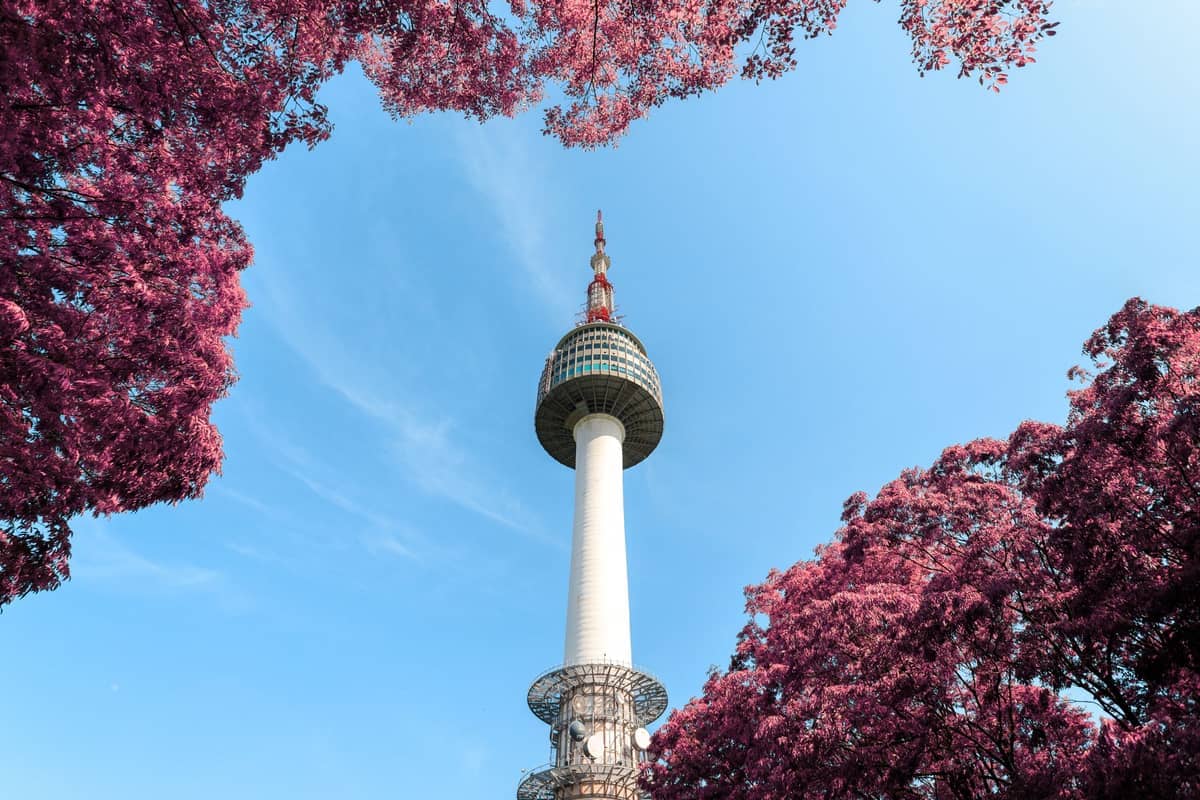
Namsan Seoul Tower, marketed today as N Seoul Tower, rises from the top of Namsan Mountain in central Seoul. The tower itself stands 236.7 metres tall, but because the mountain already sits high above the city basin, the observation deck reaches roughly 479.7 metres above sea level. That elevation is the key to everything the tower offers: a rare, unobstructed 360-degree sightline across a metropolis of nearly 10 million people.
The structure was completed in 1969 as Korea's first dedicated telecommunications tower, designed to broadcast radio and television signals across the Seoul region. For decades it was a working broadcast facility. Visitor infrastructure expanded significantly in the 2000s, and it is now marketed as N Seoul Tower to emphasize its identity as a tourist destination alongside its continued broadcast function.
Today the tower complex includes a ticketed observation deck, several restaurants (including a rotating one near the top), souvenir shops, and the now-iconic love lock fences that wrap around the hilltop plaza. For context on how it fits into the broader Myeongdong and Jung-gu area, see our Myeongdong and Jung-gu neighborhood guide.
The View: What You Can Expect at Different Times of Day
The observation deck wraps around the tower at multiple levels, with floor-to-ceiling glass panels and outdoor terraces. On a clear day, you can trace the Han River threading south through the city, identify the blocky towers of Gangnam on the far side, pick out Gyeongbokgung Palace sitting like a formal rectangle in the northern urban grid, and see Bukhansan's granite ridgeline behind it. The scale of Seoul is genuinely surprising from this vantage: it fills the valley completely in every direction.
Daytime visits offer the clearest geographic orientation, especially useful if you have only arrived in Seoul and want to understand the city's layout before you explore it on the ground. The light is best in the morning hours when haze is thinnest. By early afternoon in summer, atmospheric haze and humidity can flatten the distant views noticeably.
The tower is arguably at its most atmospheric after dark. Seoul's nighttime skyline is dense with neon, LED building skins, and the steady orange glow of low-rise residential neighborhoods. The view from the deck at 9 p.m. on a weekend has a different quality entirely from midday: quieter in the distance, dramatic in the foreground, and the tower itself is lit in color-changing sequences visible from across the city. If your schedule allows only one visit, early evening is the better choice: you catch the sunset transition and then watch the city lights emerge.
💡 Local tip
Observatory hours: Mon–Fri 10:00–22:30, Sat–Sun 10:00–23:00. Last entry is 30 minutes before closing. Plan to arrive at least an hour before close to avoid a rushed visit.
Tickets & tours
Hand-picked options from our booking partner. Prices are indicative; availability and final rates are confirmed when you complete your booking.
DMZ and Lake Majang Suspension Bridge Tour from Seoul
From 57 €Instant confirmationFree cancellationHalf Day DMZ Tour from Seoul, 3rd Tunnel, Observatory and More
From 47 €Instant confirmationFree cancellationSeoul zombie city exploration game and private tour
From 10 €Instant confirmationFree cancellationLuggage Storage in Seoul
From 7 €Instant confirmationFree cancellation
Getting There: The Ascent Matters
Most visitors take the Namsan Circular Bus (Bus 01) from Chungmuro Station (Line 3 or 4, Exit 2). The bus winds up the hillside and drops you at a plaza near the tower base. It runs frequently and costs a standard Seoul bus fare, making it the most practical option for most visitors.
The more rewarding option, if your legs are willing, is to walk. Several pedestrian paths climb through Namsan Park, taking roughly 20 to 40 minutes depending on your starting point and pace. The wooded trails are cool and shaded in spring and autumn, fragrant with pine resin, and noticeably quieter than the tower plaza. Early morning walkers often encounter almost nobody on the lower paths. The uphill sections are paved but genuinely steep in places, so wear shoes with grip.
A cable car also runs from the Myeongdong side of the mountain, offering a short aerial ride over the wooded slopes. It is popular with families and those who prefer to avoid the walk but want something more memorable than a bus. If you are planning Namsan as part of a broader walking day in this part of Seoul, consider reading our guide to Namsan Mountain for the full picture of the park's trails, walls, and viewpoints.
⚠️ What to skip
Taxis and private cars may be restricted on some access routes or at certain times, so do not rely on Kakao T to drop you at the entrance. Confirm current access rules before visiting. Road access restrictions are enforced, so do not rely on Kakao T to drop you at the entrance. Confirm current access rules before visiting.
The Love Locks and the Plaza: What Surrounds the Tower
Before you reach the ticket gates, the hilltop plaza itself is worth time. The open-air terraces around the tower base are lined with thousands of padlocks attached to metal fences, railings, and custom lock boards. Couples attach locks inscribed with names or messages, and the ritual has its own commercial ecosystem at the souvenir shops below the summit. The effect is visually striking, a wall of colored metal catching the light, though the backstory is more recent than visitors might assume: this tradition at Namsan became popular in the late 2000s.
The plaza also has food kiosks, a small convenience store, and outdoor seating. On weekends, street performers occasionally appear near the cable car station. The energy here on a Saturday evening, with groups of friends, couples taking photographs, and the tower glowing above, is distinctly different from the calmer weekday mornings when local office workers occasionally jog up the hill and back before 8 a.m.
Inside the Observatory: Practical Walkthrough
Tickets are purchased at the base of the tower. The entry price is KRW 29,000 for adults and KRW 23,000 for children. The elevator ride to the observation level is fast, under a minute, and deposits you at an enclosed deck ringed with glass. Informational panels around the perimeter identify city districts, landmarks, and distances to world cities, which gives the view a useful layer of context.
An outdoor terrace is accessible from the observation floor. The wind on exposed days is noticeable, and in winter it can be genuinely cold up here even if the street level felt mild. Bring a layer. The glass panels on the enclosed deck are kept clean, which matters for photography: reflections from interior lighting are the main challenge for photos at night, so position yourself close to the glass and block ambient light behind you with your body or a jacket.
The tower also houses N.Grill, a rotating restaurant, and Hancook, a Korean restaurant on a lower floor. Dining here is a premium price point and worth noting mainly if you want a meal with the view built in rather than paying the separate observatory ticket. Accessibility facilities are available for visitors with mobility needs, per the official Seoul tourism listing.
ℹ️ Good to know
Photography tip: For city skyline shots from the outdoor terrace, shoot within 30 minutes of sunset. The soft directional light picks out building facades and the Han River catches the sky. Full darkness flattens depth unless you are shooting the tower itself from below, where the illuminated structure against the night sky makes a strong image.
When to Visit and When to Stay Away
Spring (April and May) and autumn (September and October) are the strongest seasons for a tower visit. Temperatures are comfortable for the walk up and for standing on the outdoor terrace, and the air clarity is generally better than in midsummer. In spring, the Namsan slopes below the tower carry cherry blossoms and then fresh green foliage, which improves both the walk and the view from above.
Summer visits are possible but come with trade-offs. Seoul's rainy season (typically June to July) brings overcast skies and frequent fog that can reduce visibility from the tower to almost nothing on some days. Check the forecast before committing the ticket price. For broader seasonal context, see our guide to the best time to visit Seoul.
Weekends between 6 p.m. and 9 p.m. are the busiest period at the tower. Queues for the elevator can extend outside the ticket hall. If you dislike crowds, aim for a weekday morning or early afternoon, when the experience is considerably calmer and the lighting is good for photography. Winter visits on clear, cold days actually offer some of the year's best visibility: the dry air strips away haze and the city extends sharply to the horizon in every direction.
Who Should Consider Skipping It
The tower charges a significant admission fee for what is, in the end, a view. If the budget is tight, Seoul has free or very low-cost viewpoints that offer comparable perspectives. Namsan Mountain's own walking trails have several open hilltop terraces with strong views, and the best viewpoints in Seoul guide covers alternatives worth comparing before you decide.
Visitors on return trips to Seoul who have already done the tower may get more from their time in Namsan Park itself: the restored sections of the ancient Seoul City Wall that run along the ridgeline, the quiet forest paths, and the views from the open hillside terraces are often more memorable than the deck. The tower is also not the experience for anyone with a strong aversion to heights combined with enclosed glass spaces, as there is limited ability to move to a lower level once at the top.
For visitors building a wider picture of Seoul's historic cityscape and geography, pairing a Namsan visit with a walk along the Hanyangdoseong Seoul City Wall on the Namsan section adds depth without extra cost.
Insider Tips
- The Namsan Circular Bus 01 can be boarded with a standard T-money card tap, and you can ride it in a continuous loop around the mountain before getting off at the tower, which gives you a ground-level preview of the hill's geography for no extra cost.
- If the observatory queue looks long on arrival, the outdoor plaza terraces below the tower are often nearly as good for city views and are completely free. Assess whether the queue is worth it before committing.
- The tower's colored nighttime lighting follows a schedule and varies by season and event. Check the official N Seoul Tower website before visiting if you specifically want to photograph or see a particular light show sequence.
- For the sharpest morning views with the least haze, aim to arrive by 10 a.m. on a weekday immediately after rainfall the night before: the air clarity can be exceptional on those mornings.
- The love lock souvenir shops at the summit charge a premium. If purchasing a lock is part of your plan, buy one in Myeongdong before you ascend and bring a marker for writing on it.
Who Is Namsan Seoul Tower (N Seoul Tower) For?
- First-time visitors to Seoul wanting to map the city geographically before exploring it on foot
- Couples looking for a scenic evening destination with the love lock tradition
- Families with children who enjoy the cable car ride and the compact, walkable plaza
- Photographers shooting the Seoul skyline at golden hour or after dark
- Visitors in Seoul during winter on clear, low-haze days when the views are at their sharpest
Nearby Attractions
Other things to see while in Myeongdong & Jung-gu:
- Cheonggyecheon Stream
Cheonggyecheon Stream is an 11-kilometer restored waterway cutting through central Seoul, offering a rare ground-level escape from the city's elevated streets. Free to access around the clock in normal conditions, it draws early-morning joggers, evening strollers, and weekend families in equal measure.
- Deoksugung Palace
Deoksugung Palace sits in the heart of Jung-gu, surrounded by modern Seoul yet preserved as a rare meeting point of Joseon tradition and early 20th-century Western architecture. At 1,000 KRW and open until 9pm (last admission at 8pm), it is one of the few palaces you can visit after work or after dinner.
- Gyeonghuigung Palace
Once a secondary palace for Joseon kings, Gyeonghuigung stands today as Seoul's least-visited royal site, which is precisely what makes it worth your time. Free to enter and rarely crowded, it offers a grounded, unhurried encounter with Korean dynastic architecture in the heart of the city.
- Myeongdong Cathedral
Myeongdong Cathedral is Seoul's most historically significant Catholic church and one of the city's finest examples of Gothic brick architecture. Founded in 1892 and completed in 1898, it sits on a hilltop above the commercial noise of Myeongdong, offering a rare moment of calm in the middle of one of Seoul's busiest districts. Entry is free.