Myeongdong Cathedral: Seoul's Gothic Heart in the City Centre
Myeongdong Cathedral is Seoul's most historically significant Catholic church and one of the city's finest examples of Gothic brick architecture. Founded in 1892 and completed in 1898, it sits on a hilltop above the commercial noise of Myeongdong, offering a rare moment of calm in the middle of one of Seoul's busiest districts. Entry is free.
Quick Facts
- Location
- 74, Myeongdong-gil, Jung-gu, Seoul
- Getting There
- Line 4, Myeong-dong Station (Exit 8); Line 2, Euljiro 1(il)-ga Station (Exit 5); Line 2, Euljiro 3(sam)-ga Station (Exit 12)
- Time Needed
- 30–60 minutes for a casual visit; longer if attending a service
- Cost
- Free admission
- Best for
- History, architecture, quiet reflection, photography
- Official website
- http://www.mdsd.or.kr
What Myeongdong Cathedral Actually Is
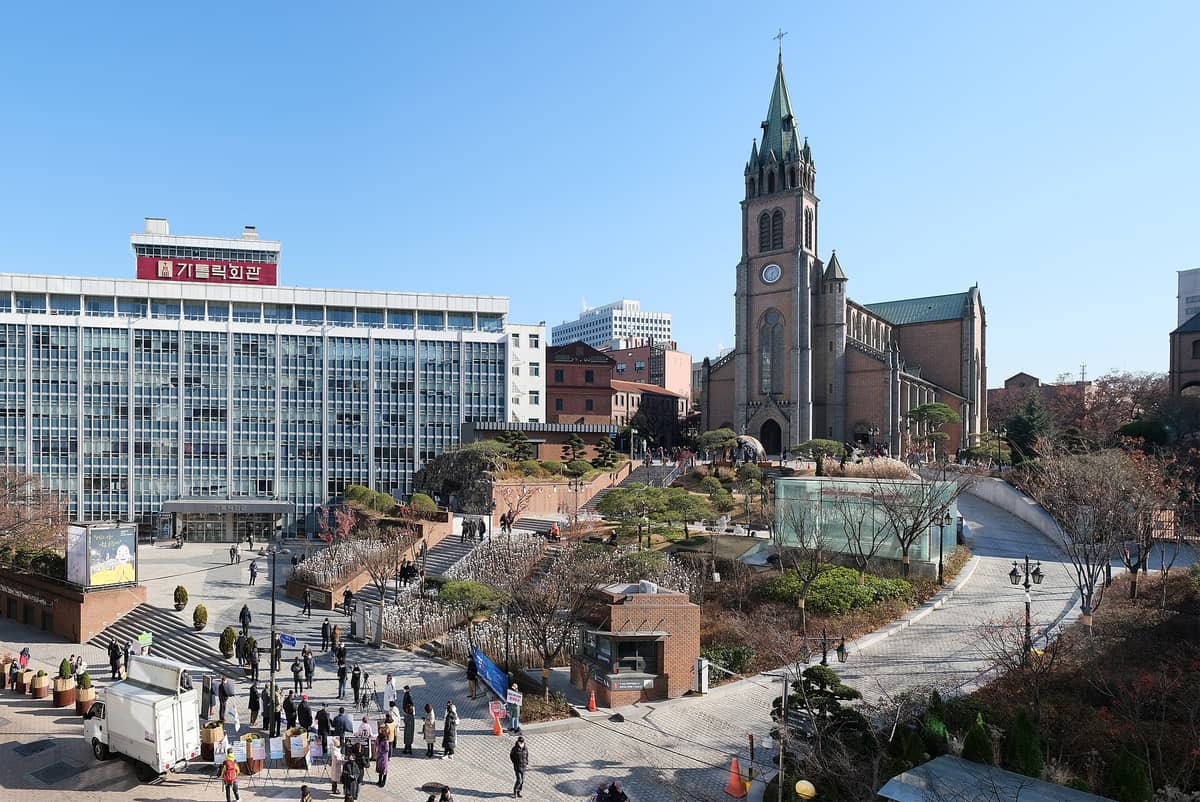
The Cathedral Church of Our Lady of the Immaculate Conception, universally known as Myeongdong Cathedral, is the mother church of the Roman Catholic Archdiocese of Seoul and one of the most architecturally distinctive buildings in South Korea. Its official Korean name is 천주교 서울대교구 주교좌 명동대성당. Founded in 1892 and completed in 1898, it was the first Gothic building ever built in Korea, built from dark red brick with pointed arches, flying buttresses, and a single tall spire that still rises above the surrounding rooftops despite over a century of urban growth around it.
The cathedral is designated a Historic Site by Korea's Cultural Heritage Administration, which reflects not just its architectural value but its political and cultural significance. During the Japanese colonial period and later through the decades of authoritarian rule in the 20th century, the cathedral served as a place of sanctuary for democratic activists. That layered history gives the building a weight that goes beyond its role as a place of worship.
ℹ️ Good to know
Opening hours: Tuesday to Saturday 09:00–19:00; Sunday 07:00–21:00. The cathedral is closed on Mondays. Admission is free.
The Approach: Walking Up from Myeongdong
The cathedral sits on a low hill above the main shopping strip, and the contrast between the two is immediate. Coming from Myeong-dong Station Exit 8, you walk through the heart of one of Seoul's most commercially intense streets — cosmetics shops, street food vendors selling tteokbokki and hotteok, tour groups navigating with maps. Then the road tilts upward, the crowd thins slightly, and the cathedral's red brick facade appears at the top. That upward approach is the first thing many visitors notice, and it does create a genuine sense of arrival. You can also find information about the surrounding district in our Myeongdong and Jung-gu neighborhood guide.
The plaza in front of the cathedral is wide and open, with low stone steps leading to the entrance. Stone benches line the perimeter and are occupied at almost any hour by people resting, eating, or quietly looking up at the facade. The brick has darkened with age in places, giving the building a texture that photographs well in flat morning light or during the soft hour before sunset.
Tickets & tours
Hand-picked options from our booking partner. Prices are indicative; availability and final rates are confirmed when you complete your booking.
DMZ and Lake Majang Suspension Bridge Tour from Seoul
From 57 €Instant confirmationFree cancellationHalf Day DMZ Tour from Seoul, 3rd Tunnel, Observatory and More
From 47 €Instant confirmationFree cancellationSeoul zombie city exploration game and private tour
From 10 €Instant confirmationFree cancellationLuggage Storage in Seoul
From 7 €Instant confirmationFree cancellation
Inside the Cathedral: Light, Scale, and Silence
The interior is relatively modest by European Gothic standards in terms of decoration, but the proportions are impressive for a building of its era and location. The nave is long and narrow, with rows of wooden pews and stone columns supporting the ribbed vaulting overhead. Stained glass windows filter afternoon light into warm color along the side aisles. The altar at the far end is the focal point, ornate against the otherwise restrained interior.
What strikes many visitors is how quiet it is inside, even on weekday afternoons when tourist foot traffic outside is high. Sound from the street does not carry well into the nave. People speak in lowered voices or not at all. There are usually a handful of worshippers praying in the pews regardless of the time of day, which is worth keeping in mind: this is an active parish, not a museum. Dress respectfully, keep voices low, and avoid photographing individuals during prayer.
💡 Local tip
Photography tip: The exterior photographs best in the morning before the crowd builds. The front facade faces roughly east, so morning light hits it directly. Late afternoon creates good shadow detail on the brickwork. Interior photography with a flash is inappropriate during services.
History and Cultural Significance
Construction of the cathedral began in 1892 and was completed in 1898, making it one of the oldest surviving Western buildings in Seoul. The cathedral was designed in the Gothic Revival style that was standard for Catholic ecclesiastical construction in 19th-century Europe. The choice of brick rather than stone was partly practical, given local material availability, but the result is a warm-toned building that ages well in the Korean climate.
During the colonial period under Japan (1910–1945), the cathedral became a symbolic gathering point for Koreans maintaining their cultural and spiritual identity. In the 1970s and 1980s, during the period of military-backed authoritarian government, the cathedral grounds were used repeatedly as a refuge by pro-democracy protesters, who understood that the authorities were reluctant to enter church grounds forcibly. This history is acknowledged locally and makes the cathedral meaningful to older Koreans in a way that extends far beyond its religious role.
For visitors interested in exploring more of Seoul's layered historical sites, Seodaemun Prison History Hall offers a harder look at the colonial period, while Gyeongbokgung Palace anchors the earlier Joseon-era history of the capital.
How the Experience Changes by Time of Day
Early morning on a Sunday is when the cathedral is at its most alive as a place of worship. Multiple Masses are held throughout the day on Sundays, and the pews fill with local parishioners. The Sunday opening time of 07:00 means you can visit before the Myeongdong shopping district wakes up, which makes the surrounding streets unusually calm. The combination of empty streets below and church bells overhead is one of the more unexpected experiences Seoul offers.
Weekday afternoons bring a steady trickle of tourists alongside the regular worshippers. The plaza outside gets busier but never overwhelmed. Evenings before closing (19:00 Tuesday to Saturday, 21:00 Sunday) are peaceful, with the exterior lit and the plaza quieter than midday. Rain does not significantly affect the experience of visiting the cathedral; the interior is fully sheltered and the brick exterior actually deepens in color when wet.
⚠️ What to skip
The cathedral is closed on Mondays. If you are planning a visit as part of a Myeongdong itinerary, confirm the day before committing to a specific schedule.
Getting There and Practical Logistics
The most straightforward route is Seoul Metro Line 4 to Myeong-dong Station, Exit 8. From the exit it is roughly a five-minute walk uphill through the main shopping street. Alternatively, Line 2 to Euljiro 1(il)-ga Station (Exit 5) or Euljiro 3(sam)-ga Station (Exit 12) both provide access from a slightly different angle. The walk from any of these exits is short and well-marked.
The cathedral is easy to combine with other central Seoul visits. Cheonggyecheon Stream is a short walk to the north, and the historic gates and squares of central Seoul are within comfortable walking distance. If you are planning a fuller day in this part of the city, the 3-day Seoul itinerary covers several nearby landmarks in a logical sequence.
Accessibility information for the cathedral is not comprehensively documented in official English sources. If step-free access is a requirement for your visit, contact the cathedral directly before your trip or check the most recent visitor reports, as conditions may have changed.
Who Should Skip This
Travelers with no interest in religious architecture or 19th-century colonial history may find the visit brief and unremarkable compared to Seoul's grander temples and palaces. The interior, while atmospheric, does not have the decorative richness of major European Gothic cathedrals, and visitors expecting that scale or spectacle may be underwhelmed. The cathedral is also not an ideal destination if you are traveling with young children who are not likely to observe the required quiet inside. For family-friendly options nearby, the wider Myeongdong area offers far more active engagement.
For a different kind of sacred architecture in Seoul, Jogyesa Temple in Jongno provides a completely contrasting Buddhist atmosphere, colorful and communal, just a short metro ride away.
Insider Tips
- The small grotto and outdoor Stations of the Cross on the south side of the cathedral grounds are easy to miss but worth walking through. They provide a quieter, more contemplative space than the main plaza.
- If you visit on a Sunday, check the Mass schedule on the cathedral's official website (mdsd.or.kr) before you go. Arriving between services gives you the best access to the interior without disrupting worship.
- The view back down toward Myeongdong from the top of the entrance steps is one of the better street-level views of the district, with the spire framing the foreground and the commercial buildings stretching below. It is worth pausing here before entering.
- The cathedral grounds stay open later than many of Seoul's religious and historic sites, particularly on Sundays (until 21:00). An evening visit after the dinner rush in Myeongdong is noticeably calmer than a midday one.
- Look closely at the brickwork near the base of the building. The texture and color variation in the original 19th-century masonry is distinct from the sections that were repaired or restored later, which is visible if you know to look for it.
Who Is Myeongdong Cathedral For?
- Travelers with an interest in Korean modern history and colonial-era architecture
- Those seeking a quiet pause in the middle of a hectic Myeongdong visit
- Photographers looking for Gothic architecture in an unexpected urban Asian context
- Catholic visitors and pilgrims for whom the cathedral has personal religious significance
- Anyone following a central Seoul walking itinerary who wants to add depth to the commercial district
Nearby Attractions
Other things to see while in Myeongdong & Jung-gu:
- Cheonggyecheon Stream
Cheonggyecheon Stream is an 11-kilometer restored waterway cutting through central Seoul, offering a rare ground-level escape from the city's elevated streets. Free to access around the clock in normal conditions, it draws early-morning joggers, evening strollers, and weekend families in equal measure.
- Deoksugung Palace
Deoksugung Palace sits in the heart of Jung-gu, surrounded by modern Seoul yet preserved as a rare meeting point of Joseon tradition and early 20th-century Western architecture. At 1,000 KRW and open until 9pm (last admission at 8pm), it is one of the few palaces you can visit after work or after dinner.
- Gyeonghuigung Palace
Once a secondary palace for Joseon kings, Gyeonghuigung stands today as Seoul's least-visited royal site, which is precisely what makes it worth your time. Free to enter and rarely crowded, it offers a grounded, unhurried encounter with Korean dynastic architecture in the heart of the city.
- Namdaemun Market
Namdaemun Market (남대문시장) Namdaemun Market (남대문시장) has operated in the heart of Seoul's Jung-gu district since 1414, making it the largest traditional market in South Korea. Spread across a dense network of alleys and covered arcades, it sells everything from wholesale eyewear and kitchenware to street food and children's clothing — and it barely sleeps.