Seodaemun Prison History Hall: Korea's Most Sobering Memorial
Seodaemun Prison History Hall preserves the grounds where Japanese colonial authorities imprisoned and executed Korean independence activists from 1908 onwards. The site combines original prison buildings, a detailed museum, and outdoor memorials into one of Seoul's most historically significant and emotionally demanding experiences.
Quick Facts
- Location
- 251 Tongil-ro, Seodaemun-gu, Seoul
- Getting There
- Line 3, Dongnimmun Station, Exit 5 (approx. 5-min walk)
- Time Needed
- 1.5 to 2.5 hours
- Cost
- KRW 3,000 adults / KRW 1,500 teens & students / KRW 1,000 children / Free for seniors 65+, age 6 and under, persons with disabilities, patriots, and veterans
- Best for
- History lovers, Korean culture students, independent travelers, school groups
- Official website
- sphh.sscmc.or.kr/_eng/hall/hallview_01.php
What Seodaemun Prison History Hall Actually Is
Seodaemun Prison History Hall (서대문형무소역사관) is not a conventional museum. It is a preserved colonial-era prison complex in northwestern Seoul where Korean independence activists were detained, tortured, and in some cases executed during the Japanese occupation of Korea, which lasted from 1910 to 1945. The site opened as a public history hall on November 5, 1998, after years of advocacy to preserve it rather than demolish it.
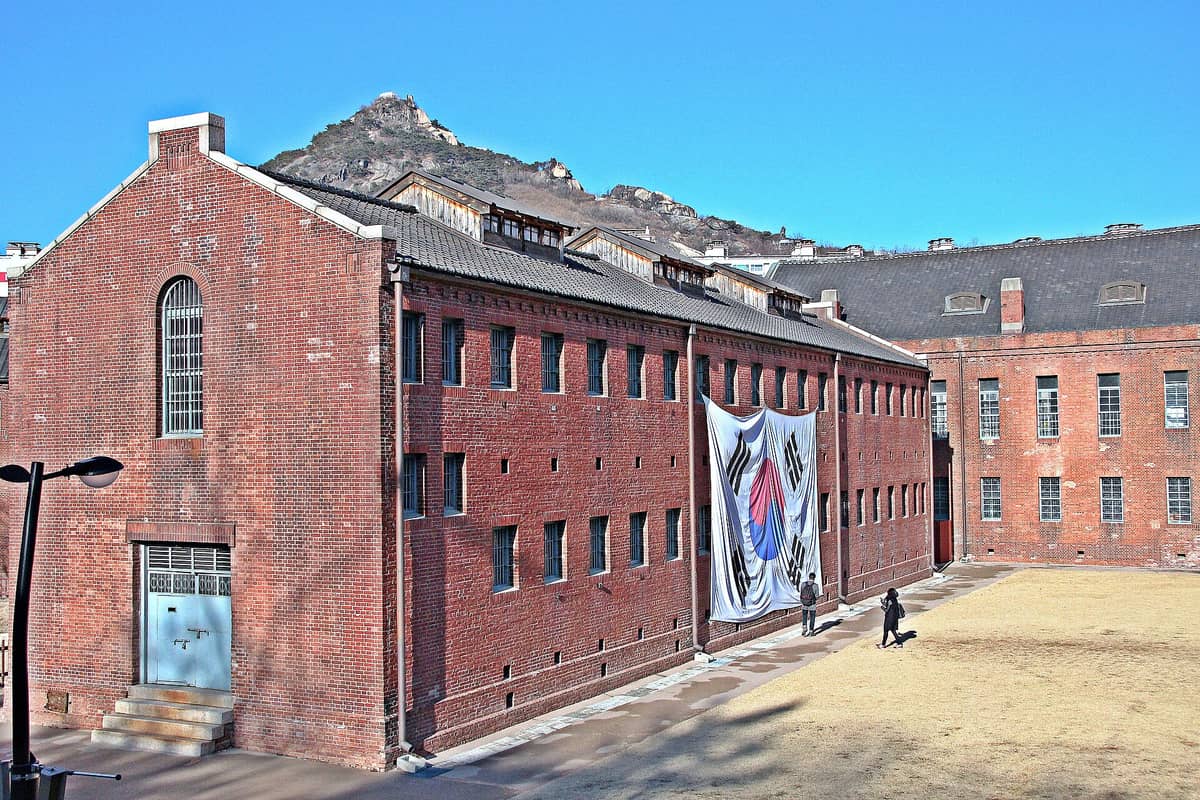
The prison itself predates the formal annexation: construction began in 1908, and it was expanded repeatedly over the following decades as colonial authorities intensified their suppression of Korean resistance. At its peak, the facility held far more detainees than it was designed for. The physical structures that survive today include the main prison building with intact cell blocks, an execution building with a condemned prisoner's path still visible, a guard watchtower, a women's ward, and several smaller structures.
The surrounding area is Seodaemun Independence Park, which frames the prison complex with monuments to key resistance figures. The independence movement arch known as Dongnimmun Gate stands just outside, making the juxtaposition of defiance and imprisonment vivid and intentional.
ℹ️ Good to know
The site is closed every Monday. If Monday falls on a public holiday, it also closes the following Tuesday. It is also closed on New Year's Day, Lunar New Year's Day (Seollal), and Chuseok. Plan accordingly, especially around major Korean holidays.
The Layout: What You Will Encounter
Visitors enter through a ticketing area and move into an outdoor complex where the scale of the prison becomes immediately apparent. The main red-brick cell block, several stories tall and organized in a distinctive fan shape, allows guards to have surveilled multiple wings from a central point. Standing at the base of that building on a quiet morning, with the brick weathered and the corridors dark, the functional logic of the architecture feels deeply unsettling.
Inside the main building, cells have been preserved with minimal restoration. Some contain wax figures depicting conditions of confinement. The explanation panels are available in Korean and English. The exhibits trace the arc of Japanese colonial policy, the organized resistance movements of the early twentieth century, and the specific stories of individuals held here, including figures who later became central to Korean national identity.
The women's ward deserves particular attention. A separate building housed female independence activists, and the exhibits there document the often-overlooked role women played in the March 1st Movement of 1919 and broader anti-colonial organizing. Yu Gwan-sun, one of the most recognized figures of Korean resistance, was imprisoned here and died in 1920 at age 17. Her story is presented in detail.
The execution building sits at the rear of the compound. A poplar tree inside the enclosure is identified as the site where condemned prisoners reportedly embraced it before execution. The building is deliberately spare in its presentation, letting the physical space convey weight rather than relying on explanatory text.
Tickets & tours
Hand-picked options from our booking partner. Prices are indicative; availability and final rates are confirmed when you complete your booking.
DMZ and Lake Majang Suspension Bridge Tour from Seoul
From 57 €Instant confirmationFree cancellationHalf Day DMZ Tour from Seoul, 3rd Tunnel, Observatory and More
From 47 €Instant confirmationFree cancellationSeoul zombie city exploration game and private tour
From 10 €Instant confirmationFree cancellationLuggage Storage in Seoul
From 7 €Instant confirmationFree cancellation
Time of Day and Crowd Patterns
The prison opens at 09:30 year-round. Arriving within the first hour gives you the cell blocks and outdoor areas largely to yourself.
Weekday afternoons between about 13:00 and 16:00 see mixed crowds: individual tourists, couples, and older Korean visitors who often spend extended time in front of particular panels. Weekends draw family visitors alongside international tourists. The site never feels as crowded as major palaces or Gyeongbokgung, partly because of its subject matter, partly because it sits slightly off the central tourist corridors of Jongno.
💡 Local tip
Come on a weekday before 11:00 if possible. The outdoor grounds and cell blocks feel completely different when they are not occupied by dozens of students. Morning light also falls across the red brick in a way that makes the architecture more visible and more photogenic, if that is a consideration.
Historical and Cultural Context
Understanding this site requires at least a basic framework of Korean twentieth-century history. Japan formally annexed Korea in 1910, and for the following 35 years administered the peninsula as a colonial territory. Suppression of Korean political organization, language, and cultural identity was systematic. Seodaemun Prison was one of the primary instruments of that suppression in the capital.
The March 1st Movement (Samil Undong) of 1919 is the single most important historical event connected to this site. A nationwide series of nonviolent demonstrations against colonial rule began on March 1 and spread across Korea over the following weeks. Japanese authorities responded with mass arrests and violence. Large numbers of participants ended up in Seodaemun Prison. The date remains a national holiday in South Korea. For a broader picture of the independence sites around the old city, the Gyeongbokgung Palace complex and the area around Gwanghwamun are worth connecting to this visit.
The prison continued operating after Korean liberation in 1945, functioning as a detention facility under subsequent South Korean governments through periods that were themselves marked by political repression. This layered history is addressed in the exhibits, though the colonial period understandably receives the primary focus. Some visitors from countries with their own complex histories of political imprisonment have noted that the site's emotional register feels universal in certain respects.
Seodaemun Prison sits administratively in Seodaemun-gu, slightly outside the core of the Jongno-Bukchon area, but it connects naturally to a day spent exploring the northern reaches of the old city. The surrounding park and the proximity to Dongnimmun Gate make the broader outdoor area worth at least 30 minutes beyond the prison itself.
Practical Walkthrough: Getting There, Moving Through, Getting Out
From Dongnimmun Station (Seoul Metro Line 3), Exit 5 places you at the edge of Seodaemun Independence Park. The prison entrance is a short walk from the station, well-signposted in English and Korean. The walk from the subway exit takes roughly five minutes on flat ground.
Opening hours are 09:30 to 18:00 from March through October, and 09:30 to 17:00 from November through February. Last admission is 30 minutes before closing. Admission costs KRW 3,000 for adults, KRW 1,500 for teenagers and students as well as military personnel, and KRW 1,000 for children. Seniors aged 65 and older, children aged 6 and under, persons with disabilities, patriots, and veterans enter free.
Allow between 90 minutes and two and a half hours for a thorough visit. English-language panels are available throughout, though some of the smaller display cases have Korean-only text. An English audio guide or brochure at the entrance can help fill gaps. The outdoor areas require walking on uneven ground, including some gravel paths and inclines around the rear of the complex.
⚠️ What to skip
The prison interiors are dimly lit and some areas are genuinely cold, especially the basement-level sections and the cell blocks in winter months. Bring a layer even in spring or autumn. Visitors with a history of claustrophobia should be aware that some cell reproduction areas involve tight spaces and low ceilings.
Photography is generally permitted throughout the outdoor areas and most of the interior exhibits. The execution building area has a more subdued atmosphere that most visitors naturally respond to by putting cameras away, though there is no formal restriction.
Who Should Think Carefully Before Visiting
This is a site documenting imprisonment, torture, and execution. The exhibits do not sanitize these facts. Wax figures depicting conditions of abuse, preserved instruments of confinement, and direct accounts of what prisoners experienced are all present. Visitors who are sensitive to graphic historical content, or who are traveling with young children, should assess this honestly before deciding.
Visitors looking for a lighter or more visually spectacular morning should look elsewhere. Seoul has no shortage of architecturally striking or scenically rewarding experiences: Bukchon Hanok Village is accessible from the same general area and offers a very different register. The choice between these two sites on the same day depends entirely on what kind of experience you are seeking.
Travelers with very limited time in Seoul who are building a one-day itinerary around major visual highlights may find that Seodaemun Prison demands more emotional investment than a short visit allows. This is not a site to spend 30 minutes in and then rush onward. If you go, go with sufficient time to sit with what you encounter.
Insider Tips
- The site marks March 1st each year with special programming around the anniversary of the Samil Movement. If your trip coincides with late February or early March, check the official website for events that may coincide with your visit.
- The basement of the main cell block building contains exhibits on interrogation methods. This area tends to have the most significant emotional impact on visitors. Consider the order in which you move through the complex rather than simply following the crowd.
- Seodaemun Independence Park, which surrounds the prison, contains the Dongnimmun Gate, a triumphal arch built by Korean independence reformers in the 1890s on the site of an older gate used to welcome Chinese envoys. It is worth reading the gate's history before visiting rather than after, as it reframes the spatial relationship between the gate and the prison.
- The site has a small outdoor area behind the prison buildings that most short-visit tourists skip. The rear view of the brick structures and the execution building perimeter gives a clearer sense of the facility's total scale.
- Winter visits between November and February mean shorter opening hours but also emptier grounds. The bare trees and cold light in the outdoor compound fit the site's character in a way that summer greenery does not.
Who Is Seodaemun Prison History Hall For?
- Travelers with a serious interest in twentieth-century Korean and East Asian history
- Students and educators seeking an immersive engagement with the colonial period
- Independent travelers building a historically coherent day itinerary around the old city's northern districts
- Visitors to Korea who want to understand the emotional and historical foundations of Korean national identity
- Travelers who found the War Memorial of Korea compelling and want to continue exploring Korea's modern historical memory
Nearby Attractions
Other things to see while in Jongno & Bukchon:
- Bukchon Hanok Village
Bukchon Hanok Village (북촌한옥마을) is a preserved residential district of roughly 860 traditional Korean hanok houses in central Seoul, situated between Gyeongbokgung and Changdeokgung palaces. Unlike a museum or theme park, it is a real neighborhood where people still live, which shapes every aspect of visiting it. Entry is free, but access to certain alleys is restricted to protect residents.
- Changdeokgung Palace & Secret Garden
Changdeokgung Palace is the best-preserved of Seoul's five Joseon-era royal palaces, and its rear garden — the Huwon, known as the Secret Garden — remains one of the most atmospheric green spaces in the entire city. Together, they form a UNESCO World Heritage Site that rewards visitors who plan ahead.
- Changgyeonggung Palace
One of Seoul's five grand Joseon-era palaces, Changgyeonggung Palace sits in Jongno-gu and offers a quieter royal grounds experience. With late evening opening hours, low admission, and centuries of layered history, it rewards visitors who arrive without high expectations and leave with quiet satisfaction.
- Gwanghwamun Square
Gwanghwamun Square stretches 40,300 square meters through the center of Seoul, framed by Gyeongbokgung Palace to the north and the distant peaks of Bugaksan beyond. It is free, open 24 hours, and carries more historical weight than most visitors realize on first pass.