Gyeonghuigung Palace: Seoul's Forgotten Royal Retreat
Once a secondary palace for Joseon kings, Gyeonghuigung stands today as Seoul's least-visited royal site, which is precisely what makes it worth your time. Free to enter and rarely crowded, it offers a grounded, unhurried encounter with Korean dynastic architecture in the heart of the city.
Quick Facts
- Location
- 45 Saemunan-ro, Jongno-gu, Seoul
- Getting There
- Subway Line 5, Seodaemun Station Exit 4 (approx. 640 m); Gwanghwamun Station Exit 1 (approx. 875 m)
- Time Needed
- 45–90 minutes
- Cost
- Free admission
- Best for
- History enthusiasts, solo explorers, and travelers who want a palace without the crowds
- Official website
- museum.seoul.go.kr/eng/about/annex/gyeonghuigungPalace.jsp
What Is Gyeonghuigung Palace?
Gyeonghuigung Palace is one of Seoul's five grand Joseon-era royal palaces, but unlike Gyeongbokgung or Changdeokgung, it receives only a fraction of their visitor traffic. That contrast is not an accident of geography. Gyeonghuigung was systematically dismantled during the Japanese colonial period in the early 20th century, and the site was repurposed as a Japanese school. Much of what you see today is the result of careful reconstruction work that began in the 1990s, guided by surviving historical records. What remains is partial but genuine in spirit, and the grounds carry a quietness that the more prominent palaces simply cannot offer on a weekend afternoon.
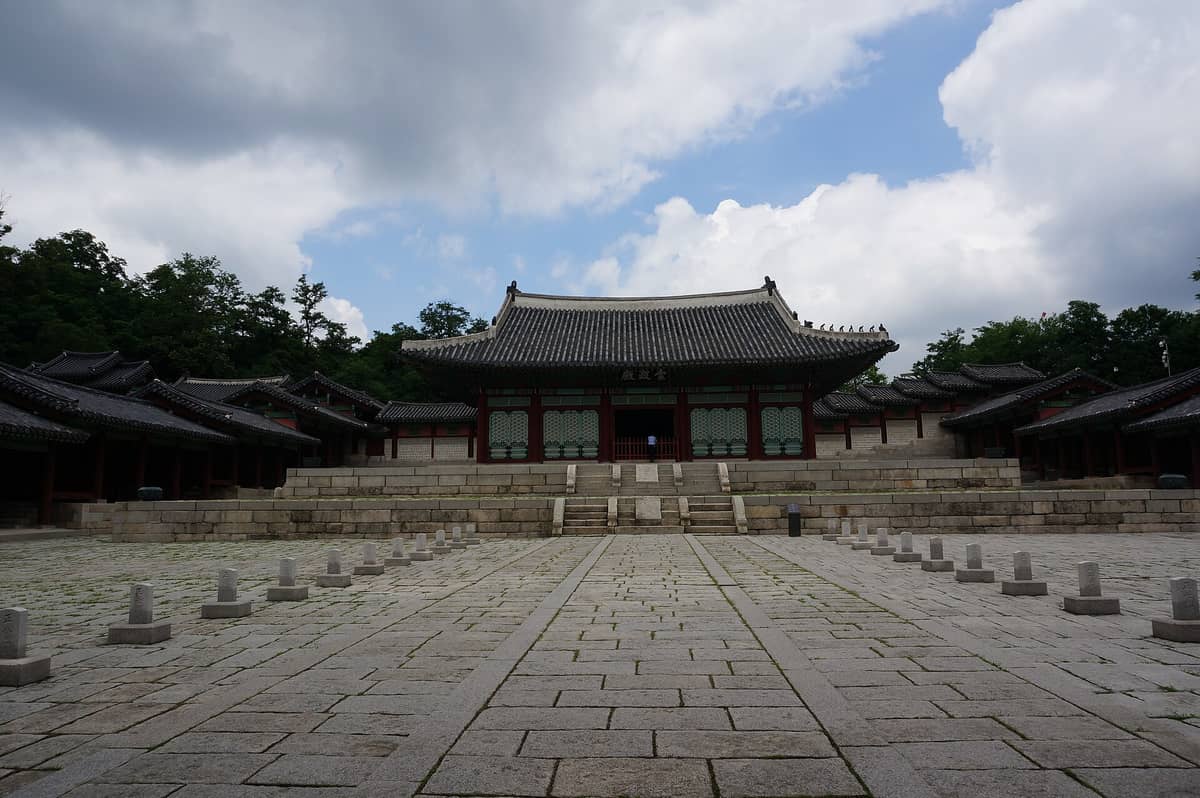
The palace was originally constructed The palace was originally constructed in 1617 as a secondary royal residence. Its original name was Gyeongdeokgung, and it served as a refuge for Joseon kings when the primary palace was unavailable. In 1760, King Yeongjo officially renamed it Gyeonghuigung, meaning 'Palace of Serene Harmony.' At its height, the complex comprised more than 100 buildings. Today, a handful of restored structures remain, including the main throne hall, Sungjeongjeon, and the ceremonial gate, Heunghwamun.
ℹ️ Good to know
Gyeonghuigung is open 09:00–18:00 daily, with last admission at 17:30. It is closed every Monday and on New Year's Day. Admission is free.
Arriving at the Palace: First Impressions
The approach from Seodaemun Station Exit 4 takes you through a stretch of low-rise commercial streets before the palace gate comes into view. There are no souvenir stalls or queues here. The entrance is modest by palace standards, and that modesty sets the tone for everything that follows. On weekday mornings, the grounds can feel almost private. You may share the courtyard with a handful of elderly visitors doing their morning walk, a student sketching the rooflines, or a photographer angling for a shot of Sungjeongjeon before the light gets too direct.
On weekends, especially in spring when the cherry blossoms appear in the nearby streets, visitor numbers tick up noticeably but never approach the volume you would encounter at Gyeongbokgung. The absence of a ticket gate contributes to this: with no admission fee and no queue to manage, the entry flow stays informal throughout the day.
Tickets & tours
Hand-picked options from our booking partner. Prices are indicative; availability and final rates are confirmed when you complete your booking.
DMZ and Lake Majang Suspension Bridge Tour from Seoul
From 57 €Instant confirmationFree cancellationHalf Day DMZ Tour from Seoul, 3rd Tunnel, Observatory and More
From 47 €Instant confirmationFree cancellationSeoul zombie city exploration game and private tour
From 10 €Instant confirmationFree cancellationLuggage Storage in Seoul
From 7 €Instant confirmationFree cancellation
The Architecture: What Survives and What It Tells You
Sungjeongjeon, the main throne hall, is the visual centerpiece of the palace and the structure most worth studying closely. Its double-tiered roof, bracket system, and the broad stone-paved courtyard in front of it follow the same formal grammar as other Joseon throne halls, but the scale here is more intimate than at Gyeongbokgung's Geunjeongjeon. Standing in front of it, you get a clearer sense of the proportions Joseon architects were working with when they built for function rather than pure ceremony.
Heunghwamun, the ceremonial main gate, has a particularly layered history. During the Japanese colonial period, it was physically relocated to serve as the front gate of a Buddhist temple in Jangchung-dong. It was returned to the palace site only during the 1990s restoration. Knowing that history changes how you look at the gate: the wear on its wooden columns and stone foundations is real, not simulated, and predates the reconstruction around it.
The site also connects directly to the Seoul Museum of History, which occupies land adjacent to the palace grounds. The two sites share an entrance area, and visiting both in the same morning is a logical combination. The museum provides the documentary and artifact context that the outdoor palace grounds cannot carry on their own.
How the Experience Changes by Time of Day
Early morning, between 09:00 and 10:30, is the strongest time to visit. The light comes in at a low angle from the east, catching the underside of the eaves and the texture of the stone courtyard in a way that the flat midday light erases. The grounds are cool and quiet, and the only sounds are the distant hum of traffic on Saemunan-ro and occasionally a crow or two on the rooftop ridgeline.
By early afternoon, the palace fills a little more, particularly on weekends. School groups sometimes arrive in the late morning. The hard paved courtyards offer little shade, so midsummer visits between 12:00 and 15:00 can be uncomfortable, particularly in July and August when Seoul's temperatures regularly reach 30°C or above with high humidity. In those months, an early start is not just pleasant, it is genuinely advisable.
Autumn, specifically October and early November, is when the palace looks best by a clear margin. The deciduous trees on the hillside behind Sungjeongjeon turn amber and red, and the color against the grey tile roofs is the most photogenic combination the site offers. Spring in April brings a softer, brighter quality, though the blossoms are more evident in the streets around the palace than inside the grounds themselves.
💡 Local tip
Photography tip: Position yourself in the lower courtyard facing Sungjeongjeon in the morning for the cleanest composition. By midday, the overhead light flattens the rooflines considerably. A polarizing filter helps cut glare from the stone paving.
Practical Walkthrough: Moving Through the Site
The palace grounds are compact enough to cover thoroughly in under an hour at a comfortable pace. Most visitors enter through the southern gate area, cross the main courtyard, and spend the bulk of their time around Sungjeongjeon. Behind and above the main hall, a hillside garden area provides shade and a higher vantage point over the rooflines. This upper section is worth the short climb, particularly for photographers, and is often overlooked by visitors who turn back at the main hall.
Information panels throughout the site are provided in both Korean and English. They are clear and substantive rather than minimal, which makes self-guided visits straightforward. There is no audio guide system in place at the time of writing, so independent exploration is the standard mode for international visitors.
Comfortable walking shoes are sufficient for the grounds. The main pathways are paved and level, though the upper hillside area involves uneven stone steps. Visitors with significant mobility limitations may find the upper section inaccessible, though the primary structures in the main courtyard are reachable on flat ground. Detailed accessibility information is not available through official listings, so visitors with specific requirements should contact the site in advance.
⚠️ What to skip
The palace is closed every Monday. If your Seoul itinerary is tight and Monday is your only free morning, plan for an alternative. Changdeokgung or Deoksugung are nearby alternatives with different closure days.
Honest Assessment: Is It Worth the Detour?
Gyeonghuigung is not a replacement for the major palaces. Visitors who have not yet seen Gyeongbokgung or Changdeokgung should visit those first. Gyeonghuigung works best as a second or third palace visit for travelers who want to understand how these sites differ in scale, status, and historical fate. The contrast between what Gyeonghuigung was at its height and what survives today is itself the most informative thing the site communicates.
Travelers who prioritize completeness, architecture study, or a break from Seoul's more congested tourist corridors will find genuine value here. Those looking for spectacle, fully reconstructed grandeur, or an immersive cultural performance should look elsewhere. The palace rewards patience and prior reading rather than arriving cold with high expectations.
The free admission makes the calculation simple. If you are spending a day exploring central Seoul and the Seoul Museum of History is already on your list, adding Gyeonghuigung costs only 30 to 60 minutes. In that context, it consistently delivers more than it asks for.
Getting There and Getting Around
The most direct route is via Seoul's subway network. Take Line 5 to Seodaemun Station and exit from Exit 4. The palace entrance is approximately 640 meters from the exit, a flat and straightforward walk. Gwanghwamun Station on Line 5 is also viable from Exit 1, roughly 875 meters away, and that route passes through the area around Gyeongbokgung if you want to orient yourself spatially between the two palace sites.
Buses serve the Saemunan-ro corridor and stop near the palace. If you are using Kakao T or another taxi app, the address 45 Saemunan-ro, Jongno-gu will locate the site reliably. Street parking in the area is limited, and the surrounding roads can be busy during morning and evening rush hours, so public transit is the more predictable option.
Insider Tips
- Visit the Seoul Museum of History immediately after the palace: the museum displays scale models and artifact collections that directly fill the gaps left by Gyeonghuigung's partial reconstruction. The two sites share a logical narrative and can be combined in a single two-to-three hour block.
- The upper hillside area behind Sungjeongjeon is the least-visited section of the grounds and offers the best elevated view of the main hall roofline. Most casual visitors turn back at the courtyard level.
- October is the single best month to visit. The tree cover on the hillside shifts to warm autumnal color, and the cooler temperatures make the stone courtyard comfortable to linger in rather than a surface you want to cross quickly.
- Because admission is free and there is no ticket gate, you can enter, spend 15 minutes, and leave without any logistical commitment. This makes it an easy addition to a morning that also includes the nearby Gwanghwamun Square or Deoksugung.
- Avoid the 11:30 to 13:30 window on weekdays in spring and autumn, when school group visits tend to cluster. The site is small enough that a single large group changes the atmosphere noticeably.
Who Is Gyeonghuigung Palace For?
- History and architecture travelers who have already visited the main palaces and want deeper context
- Solo travelers seeking a reflective, uncrowded cultural experience without an admission fee
- Photographers working in autumn, when the foliage behind the main hall creates strong compositional contrast
- Travelers pairing the site with the Seoul Museum of History for a half-day history-focused itinerary
- Anyone with limited time who wants a genuine taste of Joseon palace architecture without the crowds of Gyeongbokgung
Nearby Attractions
Other things to see while in Myeongdong & Jung-gu:
- Cheonggyecheon Stream
Cheonggyecheon Stream is an 11-kilometer restored waterway cutting through central Seoul, offering a rare ground-level escape from the city's elevated streets. Free to access around the clock in normal conditions, it draws early-morning joggers, evening strollers, and weekend families in equal measure.
- Deoksugung Palace
Deoksugung Palace sits in the heart of Jung-gu, surrounded by modern Seoul yet preserved as a rare meeting point of Joseon tradition and early 20th-century Western architecture. At 1,000 KRW and open until 9pm (last admission at 8pm), it is one of the few palaces you can visit after work or after dinner.
- Myeongdong Cathedral
Myeongdong Cathedral is Seoul's most historically significant Catholic church and one of the city's finest examples of Gothic brick architecture. Founded in 1892 and completed in 1898, it sits on a hilltop above the commercial noise of Myeongdong, offering a rare moment of calm in the middle of one of Seoul's busiest districts. Entry is free.
- Namdaemun Market
Namdaemun Market (남대문시장) Namdaemun Market (남대문시장) has operated in the heart of Seoul's Jung-gu district since 1414, making it the largest traditional market in South Korea. Spread across a dense network of alleys and covered arcades, it sells everything from wholesale eyewear and kitchenware to street food and children's clothing — and it barely sleeps.