Namsan Mountain & Park: Seoul's Green Heart Above the City
Namsan Mountain is a 270-metre wooded peak rising directly from central Seoul, offering forest walks, panoramic city views, and the iconic N Seoul Tower. Accessible by cable car or on foot, it rewards visitors differently at dawn, dusk, and after dark.
Quick Facts
- Location
- 231 Samil-daero, Jung-gu, Seoul (Namsan Park)
- Getting There
- Subway Line 4: Myeong-dong Station Exit 3 (approx. 846m) or Hoehyeon Station Exit 4 (approx. 932m)
- Time Needed
- 1.5–3 hours for the park and tower; half a day if hiking all trails
- Cost
- Park entry free. N Seoul Tower Observatory: KRW 29,000 adults / KRW 23,000 children. Cable Car (round trip): KRW 15,000 adults / KRW 11,500 children
- Best for
- City views, evening skyline photos, nature walks away from the crowds below
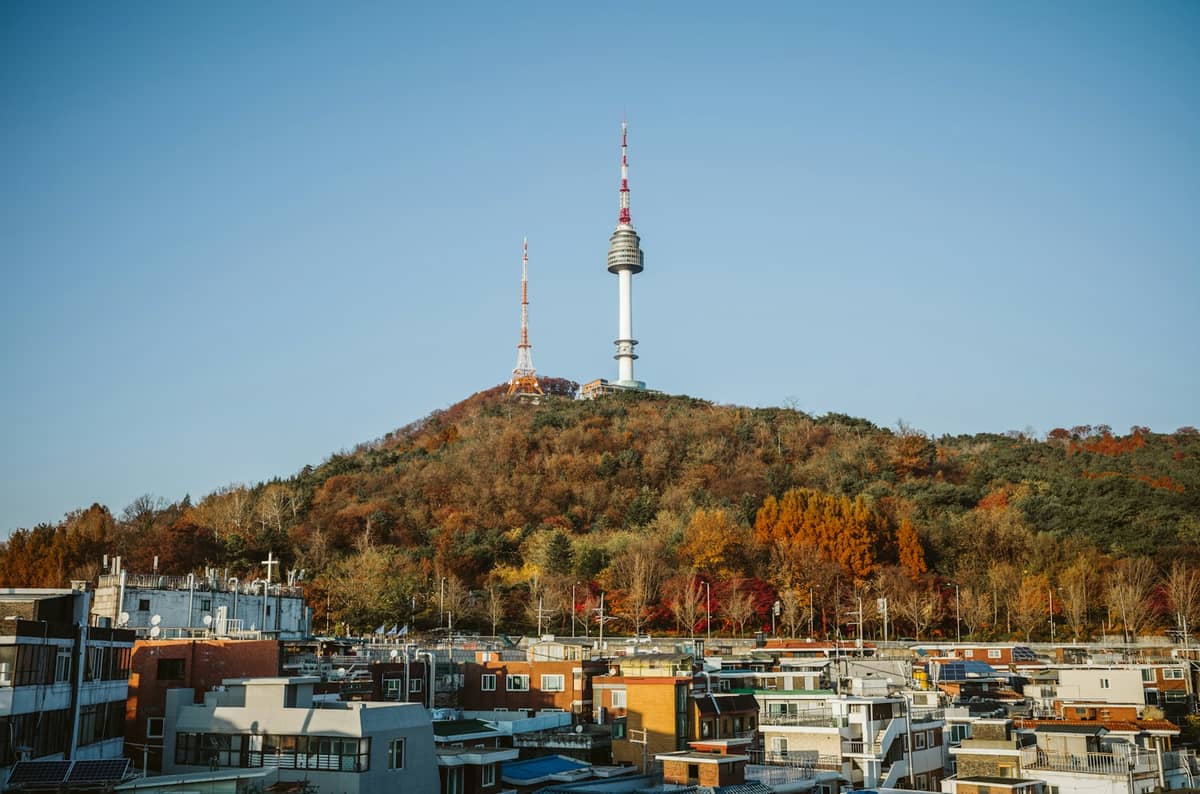
What Namsan Mountain Actually Is
Namsan Mountain is a 265-metre forested peak that sits at the geographical center of old Seoul, surrounded by Jung-gu below and the broader city in every direction. The name simply means 'South Mountain' in Korean, a reference to its position relative to the historic royal capital of Joseon-era Seoul. For centuries it served as a natural southern boundary of the walled city, and sections of the ancient city wall that once encircled the capital still trace along its ridgeline today.
The surrounding green space was formally designated Namsan Park in 1910, making it one of Seoul's oldest urban parks., making it one of Seoul's oldest urban parks. Today it functions as a genuine green lung for central Seoul: pine trees and deciduous forest cover the slopes, offering air and quiet that feel genuinely different from the streets just minutes away. The N Seoul Tower, which sits atop the peak, has become the most recognizable element of the Seoul skyline, visible from much of the city.
ℹ️ Good to know
The park itself is free to enter. You only pay if you use the cable car or go up to the N Seoul Tower Observatory. Many visitors walk the trails and enjoy the views from the outdoor deck around the tower base without buying a ticket.
How the Experience Changes by Time of Day
Morning on Namsan is a different world from evening. By 7am on a clear weekday, the lower trails near Hoehyeon and Myeong-dong fill with Seoul residents doing their daily walk, joggers moving at a steady pace on the paved circular road, and older visitors in full hiking gear who treat this as seriously as any mountain. The air smells of pine resin and wet stone in cooler months. Sounds carry differently here: the city traffic below is audible but muffled, and birdsong is surprisingly prominent in spring.
Midday from about 11am to 2pm is when tourist groups arrive in force, particularly on weekends. The cable car line can stretch long, the tower plaza gets crowded, and the atmosphere shifts from contemplative to social. This is not the worst time to visit if you want energy and the tower, but it is the least atmospheric period for the park itself.
The most rewarding window for most visitors is the late afternoon to early evening transition, roughly 4pm to 7pm. The crowds thin slightly as tour groups depart, the light turns golden across the Han River and the northern hills, and the city begins to illuminate below. After dark, the N Seoul Tower lights up and the observatory offers one of Seoul's most complete nighttime panoramas. The cable car also operates late enough for a late ascent to be practical. so a late ascent is entirely practical.
💡 Local tip
For the best photography, aim for the hour before sunset. The tower is backlit against the sky and the city grid below picks up warm light. After dark, the Han River bridges and Gangnam towers glow clearly to the south.
Tickets & tours
Hand-picked options from our booking partner. Prices are indicative; availability and final rates are confirmed when you complete your booking.
DMZ and Lake Majang Suspension Bridge Tour from Seoul
From 57 €Instant confirmationFree cancellationHalf Day DMZ Tour from Seoul, 3rd Tunnel, Observatory and More
From 47 €Instant confirmationFree cancellationSeoul zombie city exploration game and private tour
From 10 €Instant confirmationFree cancellationLuggage Storage in Seoul
From 7 €Instant confirmationFree cancellation
Getting Up the Mountain: Your Options
There are three realistic ways to reach the summit area. The cable car departs from near Myeong-dong and is the easiest and most popular option, but the line at peak times on weekends can mean a 20-30 minute wait. The round-trip fare is KRW 15,000 for adults and KRW 11,500 for children. The cable car itself offers a brief but clear view over the trees as you rise. It is the easiest and most popular option, but the line at peak times on weekends can mean a 20-30 minute wait. The round-trip fare is KRW 15,000 for adults and KRW 11,500 for children. The cable car itself offers a brief but clear view over the trees as you rise.
Walking is the better option for anyone with reasonable fitness. Several paved and unpaved trail routes wind up from the base, with the most accessible starting near Myeong-dong Cathedral and from Hoehyeon Station. The circular road around the mountain is a favorite for joggers and is wide enough that foot traffic and the occasional city bus share the space comfortably. Expect 30 to 45 minutes of walking to reach the summit plateau depending on your route and pace.
City buses also serve the mountain, with a circular shuttle stopping at key points including the cable car station and areas near the tower. Check current schedules locally, as routes and timetables are updated periodically.
The Tower, the Trails, and What Else to See
The N Seoul Tower Observatory sits at the top of the peak and offers a 360-degree view across the Seoul Basin. On a clear day, the visibility extends to Bukhansan to the north and deep into Gyeonggi Province to the south. Observatory hours and ticket prices should be checked on the official tower website. The outdoor deck below the observatory is free and gives you a nearly equivalent view of the city without the indoor queues, though it lacks the protected glass vantage points and floor-level displays inside.
The famous love locks that once covered every railing near the tower have been officially managed and partially removed over the years for structural reasons, but padlocks are still attached in designated areas by visitors. It is a photogenic tradition, if somewhat worn from overexposure. The broader summit plaza also contains the Seoul City Wall trace running along the ridge, connecting Namsan to the wider Hanyangdoseong walking route that extends toward Naksan Park and Bugaksan.
The Patriot Ahn Jung-geun Memorial Hall, located on the park grounds, commemorates the Korean independence activist who assassinated Ito Hirobumi, the first Japanese Resident-General of Korea, in 1909. Admission details should be confirmed on-site. The memorial provides meaningful historical context that goes well beyond the tower and the views, and it is frequently overlooked by visitors who come only for the skyline.
Seasonal Differences and Weather Realities
Namsan in spring, particularly late March through early May, is genuinely compelling. Cherry trees line the lower slopes and the walking paths, and the combination of blossom and the city backdrop draws large crowds on weekends. If you are planning a spring Seoul visit, the Seoul spring guide covers timing in detail. Autumn, from October into early November, brings clear skies and rust-colored foliage across the trails, which is arguably the most photographable season on the mountain.
Summer visits from June through August are possible but come with caveats. The humidity in Seoul during this period is significant, and hiking up through dense forest on a humid afternoon is sweaty work. The mountain does provide more shade than open city streets, but you will want water and breathable clothing. The monsoon season, typically June into July, can bring heavy rain that makes the unpaved paths slippery.
Winter visits have a quiet appeal that is easy to underestimate. On cold clear days, with snow on the slopes and no leaf cover to block the lines of sight, the city views are exceptionally sharp. The trails are far less crowded. Bring proper footwear for icy sections on unpaved paths, and dress in layers: the summit sits higher than the city streets and wind chill is a real factor.
⚠️ What to skip
Air quality in Seoul can vary significantly, particularly in spring when yellow dust (hwangsa) blows in from mainland China. On bad air days, the panoramic view from the tower is largely obscured by haze. Check air quality forecasts before making the tower admission fee a priority.
Practical Details and Who Should Reconsider
Namsan Park is accessible from central Seoul without much planning. From Myeong-dong Station (Line 4, Exit 3) the walk to the cable car base takes about 10 minutes through the lower park. From Hoehyeon Station (Line 4, Exit 4) the approach is slightly longer but passes through a quieter section of the park. Both stations put you in the heart of Myeongdong and Jung-gu, which makes combining Namsan with other nearby sites straightforward.
Accessibility facilities for visitors with mobility limitations are noted in official Seoul tourism materials, though the specific scope of those facilities is not detailed in publicly available English-language summaries. The cable car provides access to the upper area without requiring the walk, and the summit plaza itself is largely paved. Anyone with significant mobility concerns should contact the park administration directly before visiting to confirm current facility details.
Visitors who are primarily interested in shopping, nightlife, or food-centric experiences may find Namsan a lower priority given Seoul's density of other options. The tower admission price is real, and the view, while excellent, is one of several strong vantage points in the city. If panoramic views are the specific goal, it is worth comparing Namsan against other top viewpoints in Seoul before committing the time and cost.
Insider Tips
- The free outdoor observation deck at the tower base (no ticket required) gives you a strong city view, particularly good for photos of the southern skyline and Han River.
- The Namsan circular walking road is one of the few places in central Seoul where you can run or walk a meaningful loop (about 5km) in relative quiet. Early morning on weekdays it feels nothing like the tourist attraction it becomes by noon.
- If you take the cable car up, consider walking down on one of the forest trails instead of paying for the return ride. The descent takes 20-30 minutes and is far more atmospheric than the queue.
- The Ahn Jung-geun Memorial Hall is consistently undervisited and provides context for one of the most significant events in modern Korean history. It takes 30-40 minutes and reframes the independence movement in concrete terms.
- On weekends during cherry blossom season, the cable car queue can reach 45 minutes or more. Walking up is faster and you pass through the best of the blossom canopy on the lower trails.
Who Is Namsan Mountain & Park For?
- Evening visitors who want Seoul's best combination of skyline and city lights in a single setting
- Walkers and joggers looking for green space and moderate elevation within 15 minutes of central Seoul
- History-focused travelers who want to combine the city wall walk with the Ahn Jung-geun Memorial
- Spring and autumn visitors chasing seasonal color with a strong photographic backdrop
- Families looking for a half-day outdoor activity accessible by subway without renting gear or guides
Nearby Attractions
Other things to see while in Myeongdong & Jung-gu:
- Cheonggyecheon Stream
Cheonggyecheon Stream is an 11-kilometer restored waterway cutting through central Seoul, offering a rare ground-level escape from the city's elevated streets. Free to access around the clock in normal conditions, it draws early-morning joggers, evening strollers, and weekend families in equal measure.
- Deoksugung Palace
Deoksugung Palace sits in the heart of Jung-gu, surrounded by modern Seoul yet preserved as a rare meeting point of Joseon tradition and early 20th-century Western architecture. At 1,000 KRW and open until 9pm (last admission at 8pm), it is one of the few palaces you can visit after work or after dinner.
- Gyeonghuigung Palace
Once a secondary palace for Joseon kings, Gyeonghuigung stands today as Seoul's least-visited royal site, which is precisely what makes it worth your time. Free to enter and rarely crowded, it offers a grounded, unhurried encounter with Korean dynastic architecture in the heart of the city.
- Myeongdong Cathedral
Myeongdong Cathedral is Seoul's most historically significant Catholic church and one of the city's finest examples of Gothic brick architecture. Founded in 1892 and completed in 1898, it sits on a hilltop above the commercial noise of Myeongdong, offering a rare moment of calm in the middle of one of Seoul's busiest districts. Entry is free.