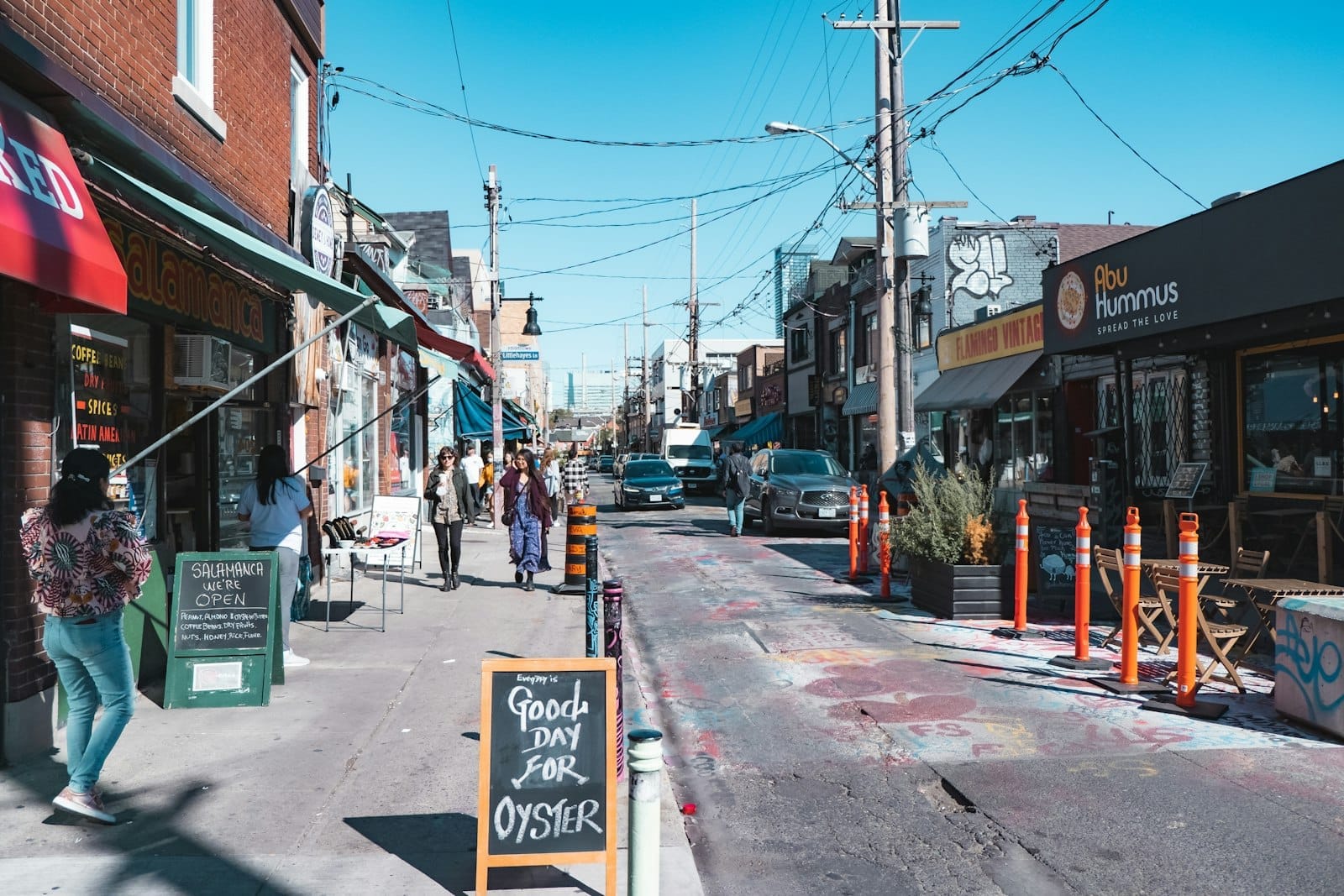
Kensington Market is one of Toronto's most distinctive inner-city neighborhoods, a compact grid of narrow one-way streets packed with independent vintage shops, global food vendors, murals, and decades of counterculture history. Designated a National Historic Site of Canada, it sits just west of the downtown core, bordered by Spadina Avenue, College Street, Bathurst Street, and Dundas Street West.
Kensington Market is the kind of neighborhood that resists easy description. A National Historic Site of Canada wedged into a few short blocks west of downtown Toronto, it layers Portuguese bakeries, Jamaican patty shops, vintage clothing dens, and anarchist bookstores onto streets barely wide enough for a single car. Nothing about it feels accidental, and nothing about it feels like anywhere else in the city.
Orientation
Kensington Market occupies a tight, roughly rectangular patch of the city bounded by College Street to the north, Spadina Avenue to the east, Dundas Street West to the south, and Bathurst Street to the west. In terms of actual walking distance, you can cross the entire neighborhood in about ten minutes, yet the density of what's packed into those blocks makes it feel far larger.
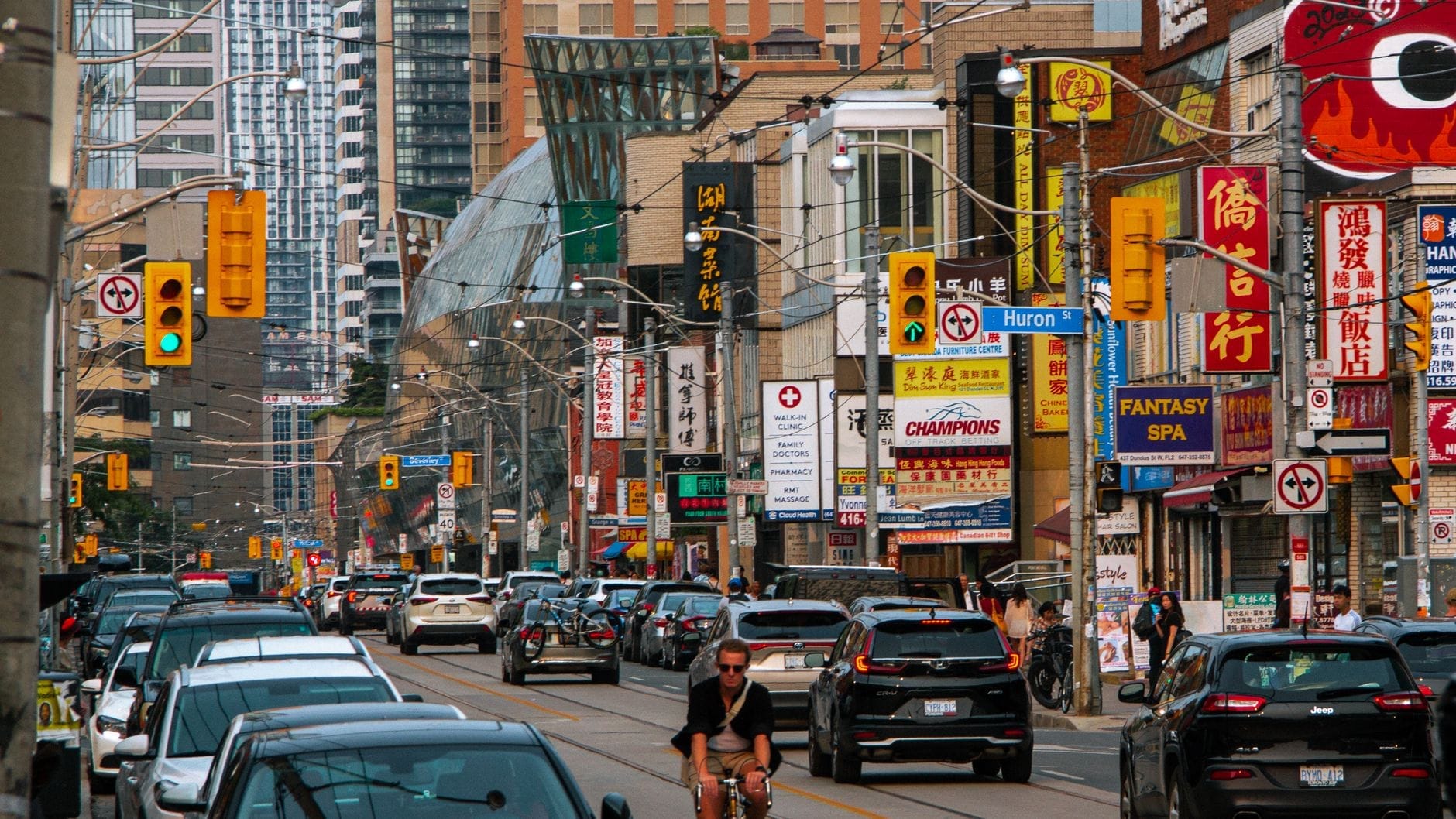
The market sits directly west of Toronto's historic Chinatown on Spadina Avenue, and the two bleed into each other along the eastern edge. Walk south along Spadina from the market and you're in the thick of Chinatown's produce stalls and roast duck windows within a block. Head north on Spadina past College and you reach the Annex neighborhood and the University of Toronto campus.
The internal street grid is what makes Kensington feel like its own world. Augusta Avenue runs north-south through the heart of the market and is the main commercial spine. Nassau Street, Baldwin Street, and Kensington Avenue branch off it, each with a slightly different character. Nassau has some of the oldest residential rowhouses. Baldwin has a run of cafe tables that spill onto the sidewalk in warm weather. Kensington Avenue itself, running south from Augusta toward Dundas, concentrates the vintage clothing shops and cheese vendors that gave the market its original identity.
ℹ️ Good to know
Kensington Market was designated a National Historic Site of Canada in 2005, recognized for its evolution from a Jewish immigrant market in the early 20th century into one of the country's most culturally layered urban neighborhoods.
Character and Atmosphere
Early on a weekday morning, Kensington Market is almost quiet. Vendors at the cheese shops and fishmongers on Kensington Avenue are hosing down sidewalks and setting out display cases. The smell of fresh bread drifts from the Portuguese bakeries on Augusta. A few cyclists lock up outside the cafes on Baldwin. There is a specific unhurried quality to the neighborhood at this hour that disappears entirely by noon on a weekend.
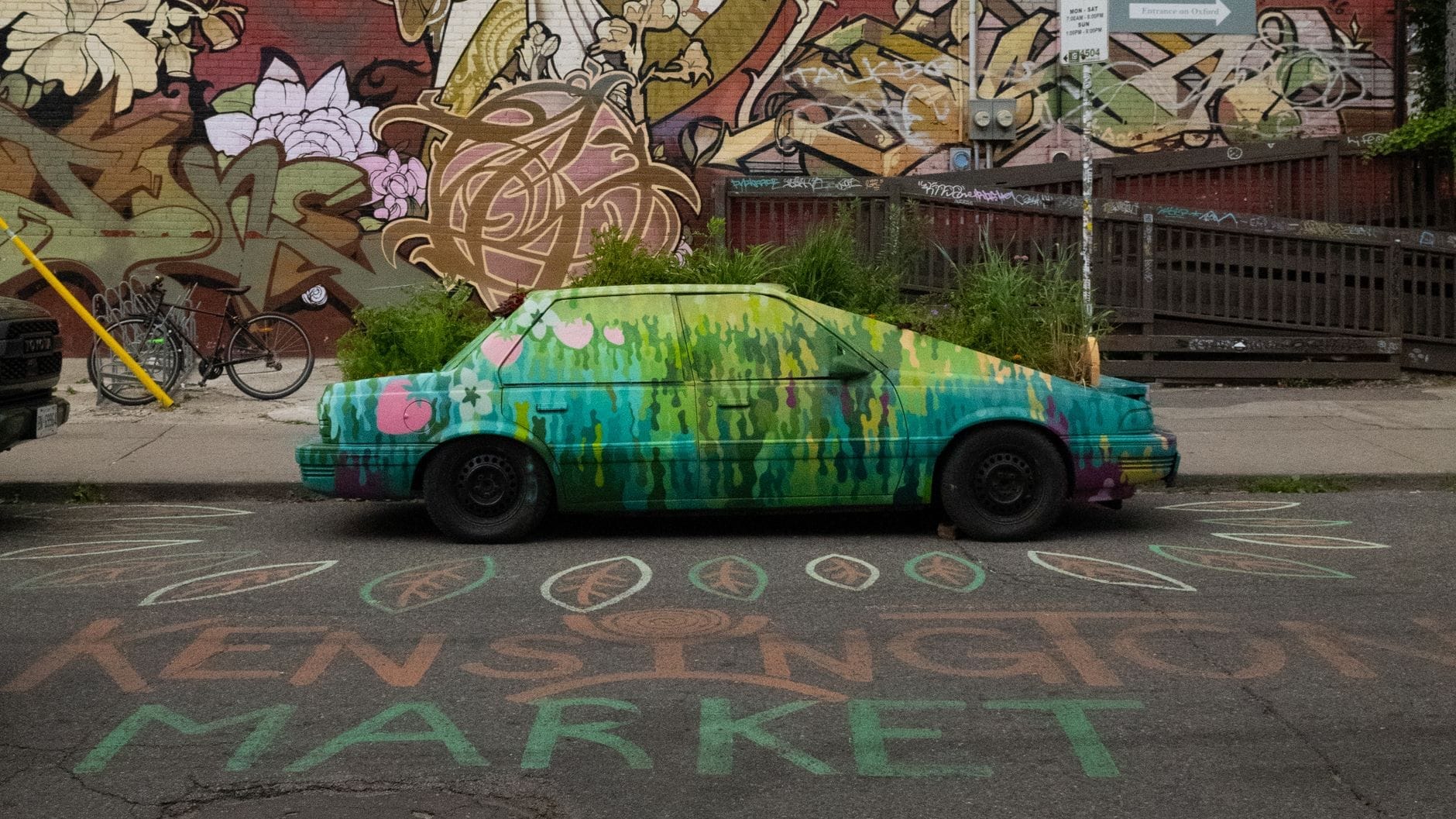
By Saturday afternoon, the dynamic shifts completely. Pedestrian traffic thickens on Augusta between Baldwin and Nassau. Street food vendors set up near corners. Music leaks from open shop doors, usually overlapping genres from adjacent storefronts. The murals covering nearly every available exterior wall, which are easy to walk past during the week, suddenly become backdrops for a steady stream of people photographing them. It is loud, compressed, and energetic in a way that feels genuinely organic rather than managed.
The neighborhood runs on its own schedule after dark on weekends. Bars along Augusta and Kensington Avenue stay open late, and the streets around them stay lively. This is not the polished nightlife corridor of King Street West. The bars here are small, often cash-only, and range from dive bars with pool tables to tight live music venues. Noise carries easily given the narrow streets and dense housing, which is worth knowing if you are staying nearby.
The neighborhood's character has deep roots in waves of immigration. In the early 1900s, it was a predominantly Jewish market district where vendors sold goods from pushcarts and front porches. Through the mid-20th century, Portuguese, Caribbean, and East Asian communities moved in and layered their own food traditions and businesses onto the streets. By the 1970s, it had become associated with counterculture and independent retail, a reputation it actively maintains. Today the demographics are harder to pin down, but the legacy of every wave shows up in what is still sold and served here.
What to See and Do
The market itself is the primary activity. Walking the core streets, browsing shops, reading the murals, and eating your way through the food options is the point. There is no central attraction to queue for, no observation deck, no ticketed museum inside the neighborhood boundaries. What Kensington offers is texture, and engaging with it requires slowing down.
The murals deserve more attention than they typically get from first-time visitors. They cover walls, garage doors, and fences across the neighborhood, ranging from large commissioned pieces to small stencil work, and they change over time. Pair a walk through Kensington with a visit to Graffiti Alley, which runs along the south side of Queen Street West just a short walk south of the market's Dundas Street boundary. The two together make a coherent tour of Toronto's street art culture.
Walk Augusta Avenue from Dundas to College and back, stopping at the vintage clothing shops, cheese stores, and produce vendors along the way
Browse Baldwin Street's cafe strip on a weekday morning when tables are less crowded
Look for the community message boards and independent zine racks inside some of the smaller shops on Nassau Street
Check whether a Pedestrian Sunday is scheduled, a monthly event in warmer months when cars are banned from the market streets
Walk east on Dundas into Chinatown for the produce markets and roast meat shops that line the street toward Spadina
If you want to understand the broader cultural context of the neighborhood, the Art Gallery of Ontario is a ten-minute walk east on Dundas Street West and has a permanent collection that includes significant Canadian and Indigenous art alongside international works. It is a natural pairing with a Kensington morning.
💡 Local tip
Pedestrian Sundays typically run on the last Sunday of the month from May through October. The market streets are closed to vehicles from noon to 10pm, and the atmosphere shifts noticeably. Vendors and performers spill onto the road. It is the best single day to experience Kensington at full intensity, though it is also the most crowded.
Eating and Drinking
Kensington Market is one of the most concentrated stretches of independent food in Toronto, and it connects naturally to the broader conversation in the city's food guide. The range covers an unusual amount of ground for such a small area: Portuguese custard tarts alongside Jamaican beef patties, Mexican tacos, Middle Eastern falafel, and Japanese ramen, all within a few blocks of each other.
The cheese shops on Kensington Avenue are among the more specific draws. Several have been operating for decades and stock an eclectic international selection, often with samples available. The fishmongers on the same strip are equally well-regarded among locals. For baked goods, the Portuguese bakeries on Augusta are the practical choice, with pastéis de nata and crusty bread loaves at low prices.
Cafes are concentrated on Baldwin Street and the southern end of Augusta. Most are independent, many roast their own coffee, and the price point is generally lower than comparable quality in neighborhoods like Yorkville or the Financial District. Seating spills outside whenever the weather allows, and the side streets provide enough shade in summer that outdoor tables stay usable through the afternoon.
For bars, Augusta Avenue is the main corridor after dark. The options lean toward small, informal spaces: craft beer bars with exposed brick interiors, bars with live music on small stages in the back, and a few that function as hybrids between a coffee shop by day and a bar by night. Prices are generally lower than downtown venues, and the atmosphere is decidedly local.
Cheese and deli shops on Kensington Avenue for artisan cheeses, olives, and cured meats
Portuguese bakeries on Augusta Avenue for pastéis de nata and fresh bread
Jamaican and Caribbean vendors for patties and jerk along Dundas and within the market streets
Ramen, tacos, and falafel from multiple independent operators in the Nassau and Kensington Avenue area
Independent cafes on Baldwin Street for specialty coffee with outdoor seating
⚠️ What to skip
Many smaller shops and food stalls in Kensington Market are cash-only or have a minimum purchase for card payments. Bring cash, especially if you plan to graze from multiple vendors. The nearest ATMs are on Spadina Avenue and College Street.
Getting There and Around
Kensington Market is well-served by the TTC, Toronto's public transit network, without being directly on a subway line. The most practical approach from the subway is to take Line 1 to Spadina station and board the 510 Spadina streetcar southbound to College Street, then walk west into the market. From Queen's Park station on Line 1, you can walk a short distance to College Street and board the 506 Carlton streetcar westbound to Spadina, at the eastern edge of the neighborhood.
From downtown, the walk is entirely manageable. From the intersection of Spadina and College at the northeast corner of the market, it is about a 20-minute walk south from Bloor Street, or around 25 minutes west from Yonge and Dundas Square. The route through Chinatown along Dundas or Spadina is interesting enough that the walk does not feel like dead time.
Driving into Kensington Market is not practical and not recommended. The internal streets are narrow, one-way, and designed for pedestrian traffic. Parking within the market is essentially non-existent. Paid lots exist near the Spadina and Dundas intersection, and street parking on the peripheral streets can occasionally be found, but it is not reliable. If you are coming by car, the best strategy is to park on a side street south of Dundas and walk in from the south, or use one of the paid lots near Chinatown.
Cycling is a natural fit for the neighborhood. Several bike lanes run along Spadina Avenue, and the market streets themselves are low-speed enough that cycling feels comfortable even for casual riders. Bike share stations from Toronto's Bike Share Toronto network are located near the Spadina and College intersection.
Where to Stay
There are no major hotels within Kensington Market itself. Accommodation options in the area are primarily short-term rental apartments and a handful of bed-and-breakfast style properties on the residential streets around the market. For travelers who want to be near the market but have more hotel options, the Queen Street West corridor to the south and the area around College and Spadina offer more variety.
Staying in or immediately around Kensington Market makes most sense for travelers who prioritize neighborhood character over hotel amenities, want walkable access to independent food and shops, and are comfortable with some weekend night noise. If those trade-offs work, the location is genuinely useful: Chinatown, the market itself, the Art Gallery of Ontario, and Queen Street West are all within a 15-minute walk.
Travelers who want quieter streets, proximity to downtown offices, or reliable hotel infrastructure will be better served by neighborhoods like Yorkville, the Financial District, or the Entertainment District. Kensington is not a conventional hotel neighborhood and doesn't try to be.
Practical Considerations
Kensington Market is generally considered safe during daytime hours and on evenings with pedestrian activity. Like any urban neighborhood with active nightlife, it is worth being aware of your surroundings late at night, particularly on streets away from the main bar and cafe strip. For a broader overview of safety across Toronto's neighborhoods, the Toronto safety guide covers practical considerations in more detail.
The market's narrow streets and pedestrian-heavy character mean that accessibility for mobility devices can be challenging. Curb cuts are inconsistent, sidewalks narrow in places, and the volume of pedestrians on weekends makes navigation difficult for anyone who needs clear paths. Most of the shops involve small steps or uneven thresholds.
Kensington Market is worth combining with adjacent areas into a half-day or full-day walk. A logical route from downtown would run through Chinatown along Spadina, through the market streets, and then south on Augusta or Kensington Avenue to Dundas before continuing west or looping back east toward the Art Gallery of Ontario. This is exactly the kind of self-directed walking that Toronto's inner-city grid rewards.
TL;DR
Kensington Market is a compact, walkable neighborhood with dense independent food, vintage retail, murals, and a genuine local identity built over more than a century of immigration and community.
Best for: independent travelers, food explorers, street art enthusiasts, and anyone who wants to see a part of Toronto that exists entirely outside the tourist infrastructure.
Not ideal for: travelers who want hotel amenities within the neighborhood, easy parking, or quiet streets on weekend nights.
Best visited: on a weekday morning for a relaxed browse, or on a Pedestrian Sunday (last Sunday of the month, May to October) for the full market-streets experience.
Pair it with: a walk through Chinatown to the east, a visit to the Art Gallery of Ontario ten minutes away on Dundas, or a southward detour to Graffiti Alley and Queen Street West.
Three days is enough time to cover the best of Toronto's downtown core, historic districts, waterfront, and cultural institutions — if you plan smartly. This itinerary is built around the TTC subway and streetcar network, so you never need a rental car. Expect a mix of landmark sights, neighbourhood wandering, and genuine local texture.
Toronto punches well above its weight for museum culture. Whether you're drawn to ancient civilisations, contemporary art, or the history of hockey, this guide covers the best museums in Toronto across every interest and budget.
Toronto has over 1,500 parks and more than 8,000 hectares of green space, from sweeping urban forests and lakefront trails to formal gardens and island beaches. This guide covers the best of them, organised by type and neighbourhood, so you can find exactly the kind of outdoor escape you're looking for.
Toronto has four genuinely distinct seasons, and the best time to visit depends entirely on what you want from the trip. This guide breaks down weather, crowds, pricing, and events month by month so you can make an informed decision.
Toronto's skyline is one of the most dramatic in North America, dominated by the CN Tower and framed by Lake Ontario. This guide covers the best vantage points in the city, from high-rise observation decks and waterfront parks to island ferry crossings and hilltop lookouts.
Toronto sits at the centre of one of Canada's richest regions for day-tripping. Within two hours in any direction you'll find roaring waterfalls, wine country, historic theatre towns, wilderness beaches, and mountain resorts. This guide covers the top day trips from Toronto, with practical details on how to get there and what to do once you arrive.
Toronto is a surprisingly generous city for budget travellers. From free museum evenings and sprawling parks to street art laneways and historic neighbourhoods, here are the best free things to do in Toronto across every season.
Toronto's transit network spans the TTC subway, streetcars, GO Transit regional rail, the UP Express airport link, ferries, and bike share. This guide breaks down every option with fares, routes, timings, and practical advice on what actually works for visitors.
Toronto is one of the safest major cities in North America, but that doesn't mean risk-free. This guide breaks down real crime patterns, which areas to be aware of, seasonal hazards, and the practical precautions that actually make a difference for visitors.
Toronto sits on the northwestern shore of Lake Ontario, the easternmost and smallest of the Great Lakes by surface area. From the Toronto Islands and the Martin Goodman Trail to the towering Scarborough Bluffs, this guide covers every major way to experience the lake — with seasonal advice, transit details, and honest assessments of what's worth your time.
Toronto is Canada's largest city and one of North America's most genuinely diverse destinations. This guide covers the best things to do in Toronto across every budget, season, and interest — with honest assessments, current prices, and practical logistics.
Five days in Toronto is enough time to cover the iconic landmarks, dig into the city's diverse neighbourhoods, and still squeeze in a day trip to Niagara Falls. This itinerary is structured for efficiency without sacrificing depth, whether you're arriving at Pearson Airport or Billy Bishop.
Everything you need to navigate Toronto Pearson International Airport (YYZ), from terminal layouts and airside connections to the fastest and cheapest ways into downtown Toronto. Covers the UP Express, taxis, ride-hailing, public transit, and key practical details for first-timers and connecting passengers.
Toronto's skyline tells a 200-year story in brick, glass, and concrete. This guide covers the city's most architecturally significant buildings across every era, from Victorian flatirons and Beaux-Arts civic halls to Gehry-designed galleries and record-breaking towers, with practical visiting tips for each.
Toronto Caribbean Carnival, still widely known as Caribana, draws over a million visitors to the city each summer for more than a week of soca music, steelpan competitions, costumed masquerade, and street food. This guide covers everything: dates, the Grand Parade route, ticket prices, what to skip, and how to plan your visit like someone who has been before.
Toronto's sakura season is spectacular but brutally short. This guide covers the exact bloom window, the best viewing locations beyond High Park, how to get there without a car, and what the City's official trackers actually tell you in real time.
Toronto's food scene is one of North America's most diverse, shaped by over 200 ethnic communities and anchored by legendary markets, neighbourhood food districts, and a Michelin Guide earned in 2022. This guide breaks down what to eat, where to eat it, and how to navigate the city's culinary landscape like a local.
Toronto's food market scene ranges from a historic 200-year-old market hall to shipping-container villages and neighbourhood farmers' markets. This guide covers the best places to browse, graze, and stock up across the city.
Toronto delivers a surprising range of romantic experiences, from skyline dining and waterfront ferry rides to candlelit heritage districts and world-class performing arts. This guide breaks down the best date ideas by season, budget, and vibe, with honest assessments of what's worth the effort.
Summer turns Toronto into one of North America's most active outdoor cities. From June jazz on Bloor Street to Caribbean Carnival floats and lakefront beaches with lifeguards on duty until Labour Day, this guide covers every major event, the best swimming spots, and the practical logistics to make the most of the season.
Toronto winters are cold, but the city leans into the season rather than shutting down. From free outdoor skating rinks under the Gardiner Expressway to the glittering Distillery District Christmas Market, this guide covers every practical detail you need to enjoy Toronto from late November through March.
The Toronto International Film Festival is one of the world's most accessible and influential film events, open to the public every September. This guide covers dates, ticket prices, venues, logistics, and how to get the most out of your visit.
The Toronto Islands are a chain of 15 car-free islands just a short ferry ride from downtown, offering beaches, cycling trails, skyline views, and a rare slice of calm in the middle of a major city. This guide covers ferry logistics, the best spots on each island, seasonal realities, and the common mistakes first-time visitors make.
Toronto's upscale travel scene goes well beyond five-star hotels. This guide covers the best luxury hotels in downtown Toronto and Yorkville, premium dining, exclusive experiences, and practical logistics for high-end visitors to Canada's largest city.
Toronto is one of the most diverse cities in the world, with roughly half its population born outside Canada. This guide covers the key ethnic districts, what makes each distinct, how to get there, and what to prioritize on a visit.
Niagara Falls sits about 136 km from downtown Toronto, making it the most popular day trip from the city. This guide covers every transport option, realistic costs, seasonal timing advice, and practical tips on what is worth your time once you arrive.
Toronto nightlife runs deeper than most visitors expect. From the dense bar corridor along King West to indie live music rooms on Queen West and all-night clubs in the Entertainment District, this guide breaks down where to go, what to spend, and how to plan your night like a local.
Nuit Blanche Toronto is a free, city-run all-night contemporary art festival that transforms public spaces across Toronto from dusk to dawn each October. This guide covers the event's history, logistics, what to expect on the night, and how to make the most of 12 hours of outdoor art.
Toronto is Canada's largest city and one of North America's most expensive destinations — but with the right approach, you can experience it without draining your wallet. This guide covers free attractions, affordable transit, budget eats, and the smartest times to visit to keep costs low.
Toronto's PATH is the world's largest underground pedestrian network, stretching more than 30 km through the heart of downtown. This guide covers how to navigate it without getting lost, which routes to use, when it's open, and what to realistically expect from the experience.
Toronto's ravine system is one of the largest urban greenspace networks in North America, threading through neighbourhoods most visitors never see. This guide covers the best trails, how to reach them by transit, what conditions to expect by season, and how to string routes together for a full day outdoors.
Toronto's shopping scene spans luxury boutiques in Yorkville, 230-plus retailers at the Eaton Centre, historic indoor markets, and independent street strips that reward slow browsing. This guide breaks down every major option by category, with transit directions, honest assessments, and seasonal tips.
Toronto is one of North America's most practical cities for solo travel, with an extensive transit network, walkable districts, and a concentration of world-class attractions in the downtown core. This guide covers everything from airport arrivals and neighbourhood logistics to safety realities and the best solo-friendly experiences across Canada's largest city.
Toronto rewards walkers. From the Victorian laneways of the Distillery District to the lakefront trail and Kensington Market's chaotic grid, the city's best stories are told on foot. This guide covers the top guided walking tours, free tip-based options, City-published self-guided routes, and the neighbourhoods worth exploring on your own schedule.
Toronto's waterfront runs approximately 37 kilometres along Lake Ontario, from Etobicoke in the west to the Rouge River in the east. This guide covers the best things to do, how to get around, seasonal conditions, and which parts of the lakeshore are actually worth your time.
From shark tunnels at Ripley's Aquarium to free ferry rides and dinosaur bones at the ROM, Toronto delivers serious options for families with children of all ages. This guide covers the top attractions, practical logistics, honest pricing, and seasonal advice to help you plan a trip that actually works.
Toronto has dozens of distinct neighbourhoods, and choosing the right one to stay in makes a real difference to your trip. This guide breaks down the best areas by location, price range, transit access, and atmosphere — so you can book with confidence.