Graffiti Alley (Rush Lane): Toronto's Open-Air Street Art Corridor
Officially known as Rush Lane, Graffiti Alley is a nearly one-kilometre public laneway in Toronto's Fashion District, running parallel to Queen Street West from Spadina Avenue to Portland Street. What began as an unsanctioned graffiti hotspot was designated an area of municipal significance in 2011, and today its walls are covered in layered, ever-changing murals supported by the city's StreetARToronto program. Entry is free, and the alley is accessible around the clock.
Quick Facts
- Location
- Rush Lane (south of Queen Street West), between Spadina Ave and Portland St, Fashion District, Toronto
- Getting There
- TTC streetcar routes along Queen Street West (501); Spadina or Osgoode subway stations (Line 1) within walking distance
- Time Needed
- 30–60 minutes to walk the full length; longer if you stop to photograph
- Cost
- Free. No ticket or entry fee. Nearby city parking lots charge standard hourly rates.
- Best for
- Street art enthusiasts, photographers, culture-curious walkers, and anyone pairing it with a Queen Street West afternoon
What Graffiti Alley Actually Is
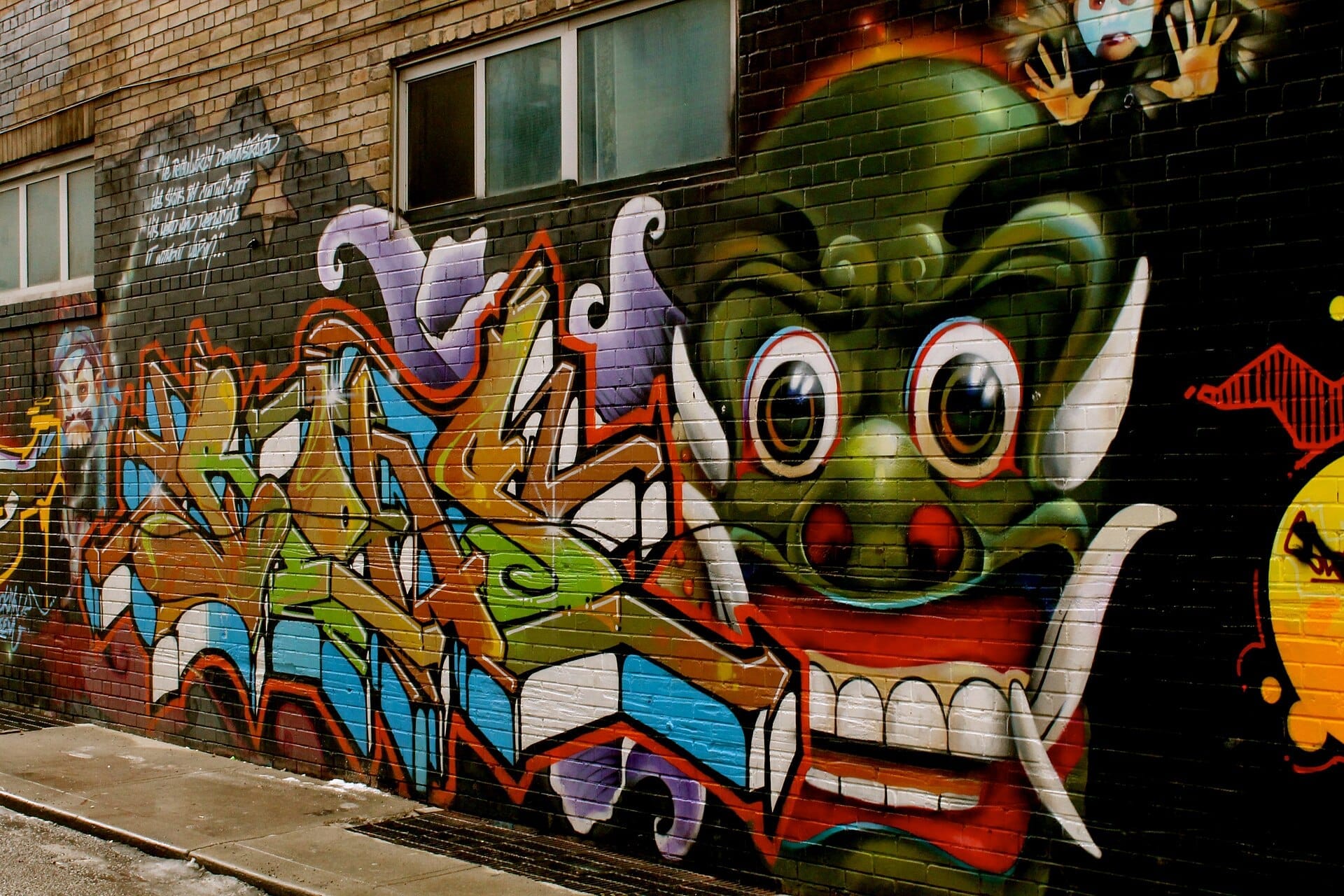
Graffiti Alley, formally named Rush Lane on City of Toronto maps, is a one-lane service alley running roughly one kilometre south of Queen Street West, parallel to the main road between Spadina Avenue and Portland Street. Both sides of the lane, plus gable ends, loading bay doors, dumpster enclosures, and the occasional fire escape, are covered almost entirely in murals, tags, and layered spray work. No building is left bare. The scale surprises most first-time visitors: this is not a stretch of a few painted walls but an unbroken corridor of street art at eye level and above.
The alley is still a functioning service lane. Delivery trucks use it. Local businesses park there. On weekday mornings you may have to step aside for a van unloading stock into a back door, which is a useful reminder that this is not a curated gallery space but a working urban laneway that happens to be covered in art. That tension is part of what makes it interesting.
ℹ️ Good to know
Rush Lane has no gates, no staff, and no posted hours. It is freely accessible 24 hours a day. There is no ticket booth and no sign-in. Simply enter from Spadina Avenue or Portland Street and walk.
From Unsanctioned Tags to Municipal Designation: A Brief History
The lane's evolution from a contested graffiti wall into a recognized public art site tracks a broader shift in how Canadian cities treat street art. Through the 2000s, Rush Lane accumulated unsanctioned tags and murals that the City repeatedly faced pressure to remove. Rather than pursue enforcement, the Queen Street West Business Improvement Association backed a different approach: legalize the walls and let artists work there openly.
In 2011, the area was designated as a space of municipal significance, and the City of Toronto created the StreetARToronto (StART) program, which funds and approves public mural and graffiti projects across the city. Rush Lane became one of the program's most publicized sites. That designation did not freeze the walls into a permanent installation. Artists continue to paint over existing work, which means the alley looks different every few months. A mural photographed in spring may be partially or entirely gone by autumn, replaced by something new.
Canadian audiences may recognize the alley from another angle: it served as the backdrop for the "rants" segment on the long-running Canadian television program the Rick Mercer Report, giving Rush Lane national visibility well before it became a tourism draw.
Tickets & tours
Live prices and dates from our booking partner. If you book, we may earn a commission at no extra cost to you.
Toronto Old Town: Dark Side Exploration Game and Tour
From 12 €Instant confirmationFree cancellationLEGOLAND Discovery Centre Toronto tickets
From 16 €Instant confirmationFree cancellationToronto 'Little Canada' entrance tickets
From 27 €Instant confirmationFree cancellationNiagara Falls evening tour with boat, dinner and Illumination Tower
From 77 €Instant confirmationFree cancellation
What the Walk Looks and Feels Like
The entrance from Spadina Avenue deposits you directly in front of the densest concentration of large-scale murals. The walls here are painted floor to ceiling, with work stacked on top of older work in places, creating visible geological layers of colour and lettering. The smell is that familiar faint chemical residue of spray paint, especially noticeable in the warmer months when new work has recently gone up.
Walking east toward Portland, the style of work shifts in ways that reflect different artists and different eras of painting. You will see crisp large-format portraits alongside typographic pieces, abstract colour-field work, political imagery, and tags that have survived multiple repaints. Some sections feature tight collaborative work where multiple artists have clearly negotiated space; others show a single artist covering a long continuous stretch. There is no consistent curatorial voice, which is precisely the point.
The alley is narrow enough that you are always close to the walls. Unlike looking at a mural across a plaza, here you stand almost within arm's reach of most pieces, which gives you a different relationship with the scale and detail of the work. A mural that would read as a simple portrait from a distance reveals brushwork, overspray gradients, and hand-lettered tags when you are standing two metres away.
💡 Local tip
Look up. Some of the most intricate work climbs to the second storey and above, particularly on building gable ends. Many visitors walk the lane focused at eye level and miss what's overhead.
Best Time to Visit and How Light Changes the Experience
The alley runs roughly east to west, which means the quality and direction of light changes significantly across the day. In the morning, light enters from the east end and rakes across the western sections at a low angle, creating depth in textured paint layers and long shadows across relief details. By midday, direct overhead light bleaches colours and reduces contrast, making this one of the few times the alley is less photogenic than usual.
Late afternoon, from around 3 pm until an hour before sunset, is the most favourable window for both photography and a relaxed visit. The light is warmer and more directional, colours in the murals appear more saturated, and crowd levels tend to thin after the main tourist rush. Arriving at this hour on a weekday gives you the walls largely to yourself.
Visiting in winter is perfectly viable and has its own character. Snow on the ground against painted walls produces strong colour contrasts, and the alley is noticeably quieter. Carry waterproof footwear in icy conditions because the lane surface does not get the same sidewalk maintenance as main streets. In summer, the alley can get crowded between 11 am and 2 pm, particularly on weekends, when photo sessions and tour groups overlap.
⚠️ What to skip
Graffiti Alley is a working service lane. Delivery vehicles use it throughout the day, particularly on weekday mornings. Stay alert to moving vehicles, especially near the Spadina end where truck access is more frequent.
Photography Practical Notes
The narrow lane width creates a genuine challenge for wide shots. A wide-angle lens (or the ultra-wide mode on a smartphone) is useful for capturing full wall sections, but expect noticeable distortion at the edges. The most reliable approach is to work section by section rather than trying to capture long runs of wall in a single frame.
Including a person in the frame gives scale and makes the size of the murals legible in photos. The alley also works well for portrait photography with street art as backdrop, which is why it draws a steady stream of content creators. If you want the walls to yourself for unobstructed shots, arrive on a weekday morning before 9 am or in the early evening after 5 pm.
Night photography is possible because streetlights provide some ambient illumination, but the light is uneven and warm-toned, which can make colour accuracy difficult. Bring a small LED panel or use a companion to hold a phone torch on the walls if you want accurate colour rendition after dark.
Getting There and the Surrounding Area
Graffiti Alley sits within Toronto's Fashion District, at the western edge of Queen Street West. The most direct transit approach is the 501 Queen streetcar, which runs along Queen Street West and stops within a one-minute walk of the Spadina Avenue entrance to the lane. From Spadina subway station on Line 1, the walk south to the alley takes roughly eight minutes.
Most visitors combine the alley with a broader afternoon on Queen Street West, which has independent clothing stores, record shops, cafés, and galleries running east toward downtown. Kensington Market is a short walk north of Spadina and makes a natural pairing for a half-day itinerary covering two of the city's most visually dense neighbourhoods.
For visitors building a broader arts and culture day, the Art Gallery of Ontario is about a 15-minute walk northeast, and the Museum of Contemporary Art Toronto is accessible by streetcar to the west. The alley pairs naturally with either for a day oriented around Toronto's visual arts landscape.
Drivers should note that on-street parking on Queen Street West is limited and metered. The nearest paid parking options are city parking lots in the Fashion District; rates are standard city hourly charges. For a more complete overview of moving around the city, the getting around Toronto guide covers TTC routes, cycling infrastructure, and ride-hailing in detail.
Accessibility and Practical Conditions
Rush Lane is a standard paved service alley with no dedicated accessibility infrastructure. The surface is generally flat asphalt but with the typical conditions of a working lane: occasional patches, uneven sections near loading areas, and loose gravel at the edges. Wheelchair users and visitors with strollers can navigate most of the lane on a dry day, but should expect surface irregularities and the possibility of parked vehicles narrowing the walkable width.
There are no public washrooms within the alley itself. The nearest options are in nearby cafés and restaurants on Queen Street West, most of which are open to customers. There is no seating, no shelter from rain, and no water fountains. It is an outdoor laneway, and should be treated as one in terms of planning.
Visitors who find open-air urban environments, active traffic lanes, or unpredictable conditions difficult will find this a challenging visit. The experience is entirely self-directed: there are no staff, no guided route, and no interpretation panels. That suits independent explorers well, but it is worth setting expectations if you are visiting with someone who prefers structured, accessible attractions.
Insider Tips
- The walls change constantly. If you visit and want to document a specific piece, check that it is still there before making a special trip: search the piece's artist name plus 'Rush Lane' on Instagram for recent posts, which are usually more current than any guidebook.
- Enter from the Spadina Avenue end if you want to start with the densest concentration of large-format murals, then walk east. The Portland Street end has good work but the density thins slightly as you approach it.
- Local street art tours run through Graffiti Alley periodically and provide artist context, commissioning history, and technique detail that you would not pick up walking through alone. Check StreetARToronto and local tour operators for current schedules.
- The lane is narrowest near active loading docks, particularly mid-alley on the north wall. If you are trying to photograph a wall section near a dock, morning visits on weekdays give you less vehicle traffic and more unobstructed access.
- Rain can be an asset, not a reason to avoid the alley. Wet paint on freshly rained-on murals produces unusually saturated colours, and the lane is typically less crowded in light rain.
Who Is Graffiti Alley For?
- Street art and graffiti culture enthusiasts who want to see a high-density, constantly evolving outdoor collection
- Photographers, including both casual smartphone users and those doing portrait or editorial work against an urban art backdrop
- Travellers pairing a Queen Street West afternoon with visual arts venues like the Art Gallery of Ontario or the Museum of Contemporary Art Toronto
- Visitors on a tight budget looking for a free, high-interest cultural stop that takes under an hour
- Anyone curious about how a city can integrate public art policy with an active urban neighbourhood rather than isolating it in a formal gallery setting
Nearby Attractions
Other things to see while in Queen Street West:
- Museum of Contemporary Art Toronto (MOCA)
Housed in a converted 10-storey industrial tower on Sterling Road, the Museum of Contemporary Art Toronto Canada (MOCA) presents rotating exhibitions of Canadian and international contemporary art. The building is as much an attraction as the work inside, and admission is genuinely affordable by Toronto standards.
- Ossington Avenue
Ossington Avenue, specifically the stretch between Dundas Street West and Queen Street West, is one of Toronto's most concentrated dining and nightlife corridors. Converted from an industrial warehouse district, it now draws a mix of locals and visitors looking for serious cocktails, independent restaurants, and the kind of street energy that only comes from a neighbourhood that hasn't been fully smoothed over.
- Trinity Bellwoods Park
Sprawling across 15.4 hectares in the heart of Queen Street West, Trinity Bellwoods Park is where Toronto comes to be itself. Free to enter and open around the clock, it draws dog walkers at dawn, picnic crowds at noon, and quiet readers at dusk, all on grounds that once held one of Ontario's earliest university buildings.
Planning a trip? Discover personalized activities with the Nomado app.