Kensington Market: Toronto's Most Culturally Layered Neighbourhood
A National Historic Site of about 27 hectares in downtown Toronto, Kensington Market is an open, walkable neighbourhood where independent food shops, vintage clothing stores, and street food vendors crowd narrow streets that have welcomed successive waves of immigrants since the early 20th century. There is no admission fee, no single front door, and no two visits that feel quite the same.
Quick Facts
- Location
- Bounded by College St (N), Spadina Ave (E), Dundas St W (S), and Bathurst St (W), Toronto, Ontario
- Getting There
- 510 Spadina streetcar to College St, or 506 Carlton streetcar to Spadina Ave; walk into the market from either stop
- Time Needed
- 1.5 to 3 hours for a thorough walk; longer if you stop to eat or shop
- Cost
- Free to enter; spending depends entirely on what you buy from individual vendors (prices in CAD)
- Best for
- Food explorers, vintage hunters, photographers, and anyone interested in Toronto's multicultural urban history
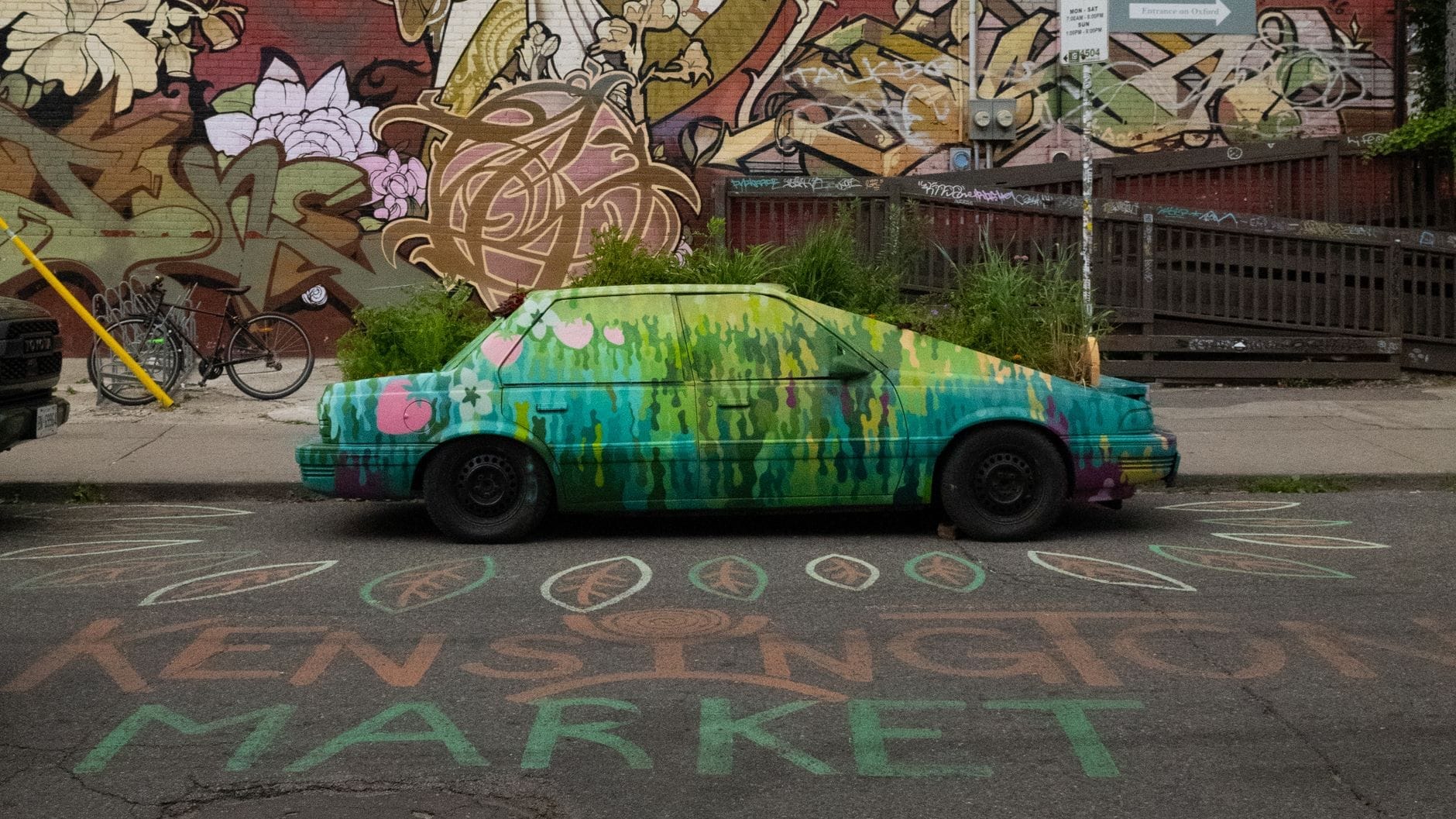
What Kensington Market Actually Is
Kensington Market is not a market in the conventional sense. There is no covered hall, no ticketed entrance, no organized stall grid. It is a neighbourhood, roughly 27 hectares of Victorian-era rowhouses and storefronts on a street plan that has barely changed since the early 1900s, and it was designated a National Historic Site of Canada in 2006 in recognition of exactly that: a place where generations of immigrants built and rebuilt commercial and community life in dense, overlapping layers.
The land itself has a longer history. George Taylor Denison secured the estate in the early 19th century, but the character visitors encounter today took shape through the early 20th century, when Jewish immigrants from Eastern Europe established what was then called the Jewish Market, running poultry stalls, fish vendors, and textile shops from their front porches and storefronts. That community was followed by waves of Portuguese, Caribbean, Latin American, East Asian, and South Asian residents and traders, each adding a distinct layer to the food, signage, and atmosphere of the streets.
Today the market sits immediately west of Toronto's historic Chinatown, and the two blend together at Spadina Avenue. If you are planning a longer exploration of this part of the city, the Chinatown Toronto and Kensington blocks pair naturally into a half-day walk.
ℹ️ Good to know
Kensington Market streets are publicly accessible every day of the week, at all hours. Individual shops and food stalls set their own opening times; most retail opens late morning and many food spots run into the evening, particularly on weekends.
The Street Experience: What You See, Smell, and Hear
Walk south from College Street on Augusta Avenue and the shift is immediate. The sidewalk narrows, painted murals cover most vertical surfaces, and the smell shifts block by block: roasted coffee from a small-batch roaster, dried spices spilling from open sacks outside a Caribbean grocery, fresh bread from a Portuguese bakery, and occasionally the sharp tang of an aged-cheese shop with its wheels stacked in the window. These are not food hall approximations. They are independent, owner-operated businesses that have held on against considerable gentrification pressure.
The visual texture is dense. Vintage clothing stores hang garments on outdoor racks year-round. Record shops stack crates on the pavement on warm days. Produce vendors use hand-painted signs. Practically every building carries street art, some commissioned, some not, and the cumulative effect reads less like urban decoration and more like evidence of a neighbourhood talking to itself.
Sound matters here too. On a Saturday afternoon you will hear live buskers at the corners of Augusta and Baldwin, competing with cumbia from a speaker inside a Mexican restaurant and the general low hum of a crowd that is comfortable loitering. It is rarely quiet, and that is part of the point.
Tickets & tours
Live prices and dates from our booking partner. If you book, we may earn a commission at no extra cost to you.
How the Neighbourhood Changes Through the Day
Weekday mornings before 10 a.m. belong to residents and shop owners. Deliveries happen, gates roll up, and the streets have a functional, pre-performance calm. This is the best time to photograph the murals and architecture without crowds, and the few cafés that open early serve a genuinely local clientele.
By late morning on weekends, the pace accelerates sharply. Augusta Avenue becomes difficult to walk in a straight line by noon on a Saturday, as vendors push further onto the sidewalk and foot traffic builds from both the Spadina end and the College Street end simultaneously. The food stalls, particularly those selling arepas, tacos, and jerk chicken from outdoor grills, draw lines that stretch half a block by 1 p.m.
Sunday evenings shift toward a bar and café atmosphere. Many of the food shops wind down, but the neighbourhood's restaurants and patios fill with locals. If you want to eat and drink without fighting for space at a vendor cart, Sunday evening is one of the more comfortable windows.
💡 Local tip
Pedestrian Sundays run on the last Sunday of the month from May through October, when selected streets are closed to vehicles and filled with live music, outdoor vendors, and community events. This is the market at its most festive, but also its most crowded. Arrive before noon for a manageable experience.
Food: What to Eat and Where to Look
The food in Kensington Market reflects the neighbourhood's demographic history more accurately than any description can. In the space of two or three blocks you can find Brazilian empanadas, Jamaican patties, Ethiopian injera, Vietnamese banh mi, and Middle Eastern falafel, not as a curated international food court, but as the natural result of different communities running food businesses in the same small area for decades.
Baldwin Street is particularly dense with cafés and lunch spots. The stretch between Spadina and Augusta has been a restaurant corridor since at least the 1970s, and while individual businesses come and go, the format persists: small rooms, modest prices, menus that lean toward the owners' own backgrounds. Lunch here costs substantially less than in Yorkville or the Financial District, and the quality in the best spots is genuinely high.
The grocery and specialty food shops are worth attention even if you are not cooking. Several cheese shops, a dedicated spice merchant, vintage-style fruit stands, and at least one fishmonger operate within the market's core. These are working food businesses serving the neighbourhood, not tourist props, and they are priced accordingly.
For a broader picture of where this neighbourhood fits into Toronto's food culture, the Toronto food markets guide covers the city's major market options and how they compare.
Practical Walkthrough: Getting There and Moving Around
The most straightforward TTC approach is the 510 Spadina streetcar southbound from Spadina Station (Line 2 Bloor-Danforth), alighting at College Street. From there, walk one block west along College and turn south on any of the main streets: Augusta Avenue, Kensington Avenue, or Baldwin Street each cut through the core of the neighbourhood. Alternatively, the 506 Carlton streetcar runs along College Street itself; board at Queen's Park Station and ride west to the Spadina stop.
Driving is technically possible but practically unnecessary and often frustrating. The City of Toronto's own maps describe the area as better suited to pedestrians than cars, and parking nearby relies on Green P lots that fill quickly on weekends. Cycling is common and practical; both Spadina Avenue and College Street have bike lanes leading directly to the neighbourhood.
The streets are narrow and some surface conditions are uneven, with tree roots affecting sidewalk slabs in places. Mobility aid users should note that while the streets are technically accessible, the crowded sidewalks and uneven paving on older blocks can present challenges. Individual businesses vary significantly in their internal accessibility, and Destination Ontario recommends contacting specific retailers in advance.
⚠️ What to skip
Kensington Market has no dedicated parking structure. On Pedestrian Sundays and weekend afternoons, nearby surface lots and street parking fill within a few blocks. If driving is unavoidable, allow extra time or use a ride-hailing service for drop-off.
Photography, Weather, and What to Bring
Kensington Market is one of the most photographed neighbourhoods in Toronto, primarily because the density of murals, hand-lettered signs, and layered storefronts offers continuous visual material at street level. The narrow streets mean that wide-angle lenses work better than long telephoto for architecture and murals; light is often blocked by buildings until late morning. The best natural light for photography falls on the western side of Augusta Avenue in the afternoon.
Weather significantly affects the experience. In summer, the outdoor vendor culture and patio dining are fully active, and the neighbourhood reaches its highest energy level. Winters are cold in Toronto, with January averages around -3.7 degrees Celsius, and while the neighbourhood does not shut down, outdoor food stalls thin out considerably and the social energy concentrates inside the cafés and bars. Spring visits from late April onward catch the neighbourhood reactivating, with vendors returning to outdoor setups before the peak summer crowds arrive.
For detailed advice on when Toronto's outdoor spaces are most rewarding, the best time to visit Toronto guide covers seasonal trade-offs across different types of attractions.
Bring small bills in Canadian dollars. Many vendors are cash-preferred or cash-only, and while debit and credit are accepted in most formal shops, the smaller food stalls and outdoor vendors frequently are not equipped for card payments. An ATM is located near Spadina and College.
Honest Assessment: Who This Is and Is Not For
Kensington Market delivers something that is genuinely difficult to replicate in other Toronto neighbourhoods: commercial density shaped by community use rather than developer planning, with prices and scale that still reflect the neighbourhood's working population rather than an upscale visitor market. For travellers interested in urban texture, multicultural food culture, or independent retail, it earns its reputation.
It is worth being direct about the limitations. The neighbourhood is small; a thorough walk covers its core in under an hour. It is not a destination for polished dining experiences or predictable hours. Visitors looking for the kind of curated, branded retail experience found in Yorkville or a large indoor market like St. Lawrence Market will find Kensington rougher and more variable in quality.
Travellers with limited mobility will face real difficulties on weekend afternoons, when sidewalks become too crowded for comfortable navigation. Families with strollers can manage on quieter weekday mornings, but the same weekend crowds that make the market lively also make it physically difficult to move. Anyone expecting the predictability of a major tourist attraction, standard hours, posted menus, or guaranteed availability of specific items, will need to adjust expectations. The unpredictability is not a flaw. For the right traveller, it is the entire appeal.
Insider Tips
- Weekday mornings between 9 and 11 a.m. offer the best combination of open shops and manageable crowds. Several bakeries and cheese shops restock in the morning, so early arrivals often see the widest selection at the specialty food stores.
- The stretch of Kensington Avenue south of St. Andrew Street has some of the neighbourhood's older fish and meat shops, largely unchanged in format for decades. These are working food businesses used by local residents, not tourist-facing vendors, and they are significantly cheaper than equivalent products in supermarkets.
- Baldwin Street's café concentration makes it the most comfortable street to take a break mid-walk. Several of the cafés have small patios that fill quickly on sunny weekend days; arriving before noon secures a seat.
- Pedestrian Sundays (last Sunday of the month, May to October) are worth planning around if you want to see the neighbourhood at maximum energy, but the event also attracts the largest crowds of the month. Arriving by 11 a.m. and leaving before 2 p.m. avoids the most congested window.
- Most of the vintage clothing stores in the market price by individual tag rather than weight or zone, and negotiation is not standard practice. The stores on Augusta Avenue tend toward curated vintage; those closer to Dundas Street West typically run a higher-volume, lower-price format.
Who Is Kensington Market Street Food & Shops For?
- Food travellers wanting to eat across multiple culinary traditions in a single afternoon at low cost
- Photographers and street art enthusiasts looking for dense, constantly-changing visual material
- Visitors interested in Toronto's immigrant history and the physical evidence of successive community settlement
- Vintage and independent retail shoppers who prefer owner-operated stores over chains
- Travellers on a budget looking for a full afternoon of activity with minimal mandatory spending
Nearby Attractions
Other things to see while in Kensington Market:
- Chinatown
Centred at Spadina Avenue and Dundas Street West, Toronto's Downtown Chinatown is one of the oldest continuously active Chinese neighbourhoods in Canada, with roots traced to 1878. It's an open, free-to-enter urban district where the real draw is the street-level mix of produce markets, Cantonese and Taiwanese restaurants, herbal medicine shops, and the energy of a neighbourhood that hasn't been polished for tourism.
Planning a trip? Discover personalized activities with the Nomado app.