St. Lawrence Market: Toronto's Historic Heart, Still Beating Since 1803
St. Lawrence Market is Toronto's oldest continuously operating public market, anchoring the city's historic St. Lawrence neighbourhood since 1803. Spread across three interconnected buildings on Front Street East, it draws serious food shoppers, casual browsers, and curious visitors with over 120 vendors selling fresh produce, butchered meats, artisan cheeses, and ready-to-eat food. Entry is free, the Saturday farmers' market opens at 5am, and the surrounding neighbourhood rewards anyone who explores beyond the main hall.
Quick Facts
- Location
- 92–95 Front Street East, Toronto, ON M5E 1C3 (St. Lawrence neighbourhood, downtown Toronto)
- Getting There
- King Station (TTC Line 1, Yonge–University), approximately 5-minute walk east
- Time Needed
- 1–2 hours for a focused visit; 2–3 hours if you eat, browse, and explore the surrounding streets
- Cost
- Free entry; vendor purchases in Canadian dollars (CAD)
- Best for
- Food lovers, weekend morning markets, history buffs, photography, casual solo exploration
- Official website
- www.stlawrencemarket.com
What St. Lawrence Market Actually Is
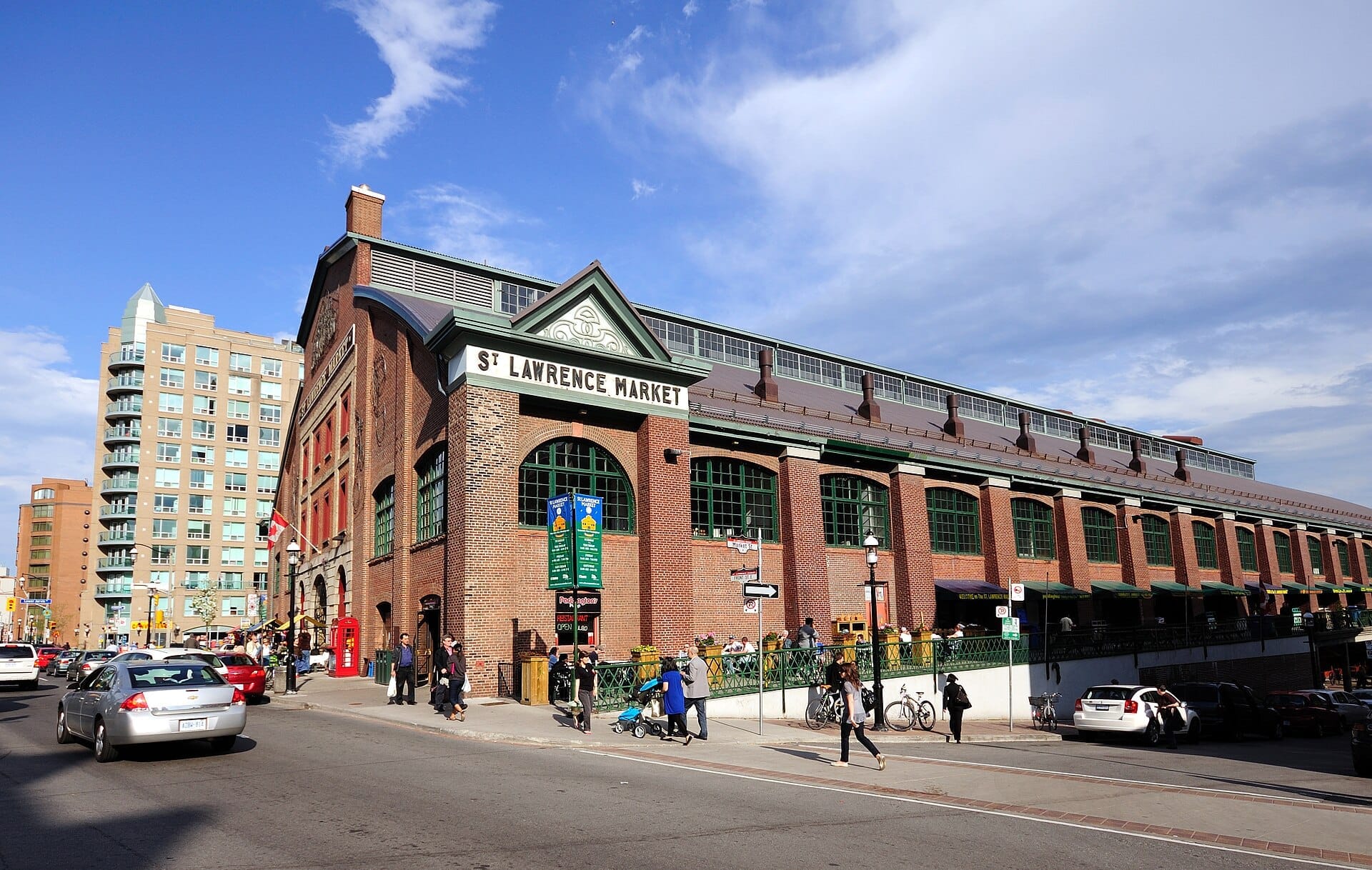
St. Lawrence Market is not a single building. It is a complex of three structures occupying a full city block on Front Street East in downtown Toronto: the South Market (the main year-round hall), the North Market (home to the Saturday farmers' market and Sunday antique market, while the North Market building is currently being rebuilt as part of the market complex's redevelopment), and St. Lawrence Hall, a formal Italianate civic building completed in 1850 that stands just northwest of King and Jarvis Streets. Together, they form the historic core of what the City of Toronto designates as the St. Lawrence Market District.
The South Market is where most visitors spend their time. It is a modernized two-level hall housing over 120 vendors selling fresh meat, fish, cheese, baked goods, specialty groceries, prepared foods, and a handful of non-food stalls. The ground floor focuses on food; the upper level holds a small gallery space and rotating exhibitions curated by the City. Admission to the buildings is free, which keeps foot traffic genuinely democratic: chefs sourcing ingredients for restaurant service, office workers grabbing lunch, and first-time tourists all occupy the same aisles.
💡 Local tip
The South Market is closed on Mondays. If your Toronto visit falls on a Monday, plan around it. Tuesday through Friday offers the most relaxed browsing; Saturday is the peak experience but also the most crowded.
The History Behind the Market
The site has operated as a public market since 1803, making it one of the oldest continuously functioning markets in North America. The original market predates most of the city around it. At that time, this was the frontier edge of York (Toronto's name before 1834), and the market square served as the commercial and civic hub of a fledgling colonial town. The Saturday farmers' market on the North Market side maintains an unbroken tradition from that 1803 founding.
St. Lawrence Hall, the grand Palladian-inflected building at King and Jarvis, was built in 1850 and served as Toronto's main public assembly hall throughout the second half of the 19th century. Jenny Lind performed there. Anti-slavery meetings were held in its great hall during the years leading up to the American Civil War, when Toronto sat near the northern terminus of the Underground Railroad. The building was designated a National Historic Site of Canada and underwent restoration in the 1960s and 1970s. Today it houses private event spaces and is not publicly open for casual browsing, but its facade alone is worth studying from the street.
Understanding this history changes how you experience the market. You are not walking through a manufactured heritage experience. This area was Toronto's original commercial and civic spine, and the market reflects genuine continuity rather than nostalgia. Pair your visit with a read of the Toronto architecture guide if the built environment interests you, because the surrounding St. Lawrence neighbourhood contains some of the city's most intact 19th-century commercial streetscapes.
Tickets & tours
Live prices and dates from our booking partner. If you book, we may earn a commission at no extra cost to you.
Toronto Old Town: Dark Side Exploration Game and Tour
From 12 €Instant confirmationFree cancellationLEGOLAND Discovery Centre Toronto tickets
From 16 €Instant confirmationFree cancellationToronto 'Little Canada' entrance tickets
From 27 €Instant confirmationFree cancellationNiagara Falls evening tour with boat, dinner and Illumination Tower
From 77 €Instant confirmationFree cancellation
What It Feels Like to Visit: Morning to Afternoon
Arrive at the South Market on a Tuesday or Wednesday morning around 9:30am and the atmosphere is practical rather than theatrical. The smell hits you immediately inside the front doors on Front Street: a combination of cured meats, fresh bread from the bakery stalls near the center of the hall, and the faint brine of fish counters along the east wall. The lighting is bright and commercial. The floor is polished concrete. Vendors are setting out the last of their displays, and a handful of regulars are already deep in conversation with butchers they have clearly known for years.
By midday on a weekday, the energy shifts toward quick service. The prepared food stalls fill up with lunchtime customers, and the peameal bacon sandwich — a Toronto original, made from back bacon rolled in cornmeal and served on a soft kaiser roll — draws a visible queue at Carousel Bakery on the ground floor. This is the item most associated with the market in local food culture, and the hype is not entirely misplaced. It is a good sandwich, served simply, with no frills.
Saturday is the market's defining day. The farmers' market on the North Market side opens at 5:00am, which means the first customers arriving at that hour are not tourists. They are professional buyers, restaurant scouts, and long-time residents who have been coming since before most visitors wake up. By 8am the North Market is fully animated, and the South Market fills steadily through the morning. By 10am on a warm Saturday, the sidewalks around Front and Jarvis are genuinely congested, the cheese counters inside have queues, and navigating with a stroller or large bag becomes awkward.
⚠️ What to skip
Saturday between 10am and noon is the most crowded window of the entire week. If you are sensitive to crowds, arrive before 8am or come on a weekday. The Sunday antique market on the North Market side runs at a much quieter pace.
What to Buy and Where to Look
The South Market's ground floor is organized in a loose grid of permanent vendor stalls, most of which have operated for years or decades. The meat vendors along the western wall are where you find whole cuts, specialty sausages, and house-made charcuterie. The fish stalls on the east side stock both farmed and wild-caught options and will fillet to order. Several cheese vendors carry local Ontario selections alongside imported European varieties.
For prepared food and snacks, the central aisles offer the widest variety: Ukrainian pierogies, Portuguese pastries, Indian curries, Japanese bento boxes, and classic Canadian deli items all coexist within a few meters of each other. This is not a curated food hall with a unified aesthetic; it looks like what it is, which is a working market that has added vendors over time without a master design vision. The visual result is a little chaotic, which is part of its appeal.
The Saturday farmers' market on the North Market side skews toward seasonal produce, local honey, maple products, fresh flowers, and small-batch preserves. The quality is reliable, but do not expect a sprawling outdoor market in the European tradition. It is a contained, covered market with over 80 stalls depending on the season. For a broader picture of Toronto's food market scene, including how St. Lawrence compares to other options, the Toronto food markets guide is worth reading before you visit.
Getting There and Practical Logistics
The market sits at 92 Front Street East, two blocks east of Yonge Street. From King Station on TTC Line 1, walk east along King Street to Jarvis, then turn south to Front Street. The walk takes five to eight minutes at a relaxed pace. The 504 King streetcar also stops close by, and multiple bus routes serve the area.
Parking exists in nearby lots on Jarvis Street and in the underground garage beneath the complex, but driving on a Saturday morning is inadvisable unless you are arriving before 7:30am. Street parking on Front and Jarvis fills quickly and the surrounding blocks see significant pedestrian traffic. The market is most logistically straightforward when reached by transit or on foot.
The market is located at the eastern edge of downtown Toronto, within walking distance of the Distillery District to the east and Union Station to the west. A visit pairs naturally with an afternoon in the Distillery District or a walk along the waterfront. The Toronto waterfront guide covers what is accessible within a short walk south of the market.
ℹ️ Good to know
The South Market is open Tuesday to Friday 8:00–18:00, Saturday 7:00–17:00, and Sunday 10:00–17:00. It is closed on Mondays. The Saturday farmers' market (North Market) opens at 5:00am and closes at 3:00pm. Hours may vary on public holidays; check the official site before visiting.
Photography, Accessibility, and Weather Considerations
The South Market is a well-lit indoor space that photographs cleanly in natural conditions. The upper gallery level offers a partial elevated view down into the main floor, which is useful for wide-angle shots. Vendor stalls are compact and personnel are generally accustomed to people photographing their displays, though brief acknowledgment before pointing a lens at someone directly is a reasonable courtesy.
Because the market is primarily indoors, weather has limited effect on the South Market experience. Rain and cold make it a more appealing destination than usual, since the building is warm and dry. The Saturday farmers' market on the North Market side is also covered, though that building is a temporary structure pending the long-planned reconstruction of the North Market; conditions there are more utilitarian. In summer, the area around the market includes outdoor patios and street activity, but the market itself stays consistent year-round.
The South Market is a modern municipal building with accessible entrances, elevators, and public washrooms. Visitors with mobility requirements should note that the aisles inside can become very narrow during peak Saturday hours due to vendor display extensions and shopping carts. A weekday visit is significantly more manageable for anyone who needs clear circulation space. For detailed accessibility information, contact the market directly at 416-392-7219.
Who Should Reconsider This Visit
St. Lawrence Market is genuinely useful if you have an interest in food, local produce, or the history of the city. It is less compelling if your primary goal is sightseeing spectacle or a single visual landmark. The building is a working market, not a designed attraction, and it will feel ordinary to anyone expecting something more curated or dramatic. Visitors who arrived expecting a sprawling European-style open-air market sometimes leave underwhelmed by the scale and covered format.
If your Toronto visit is short and you are focused on iconic views and major institutions, the market may not make the cut. The 3-day Toronto itinerary treats it as a strong morning option rather than a standalone destination, which reflects its most natural role in a trip.
Insider Tips
- The peameal bacon sandwich at Carousel Bakery is the market's most famous item. Arrive before 10:30am on a Saturday to avoid a 15–20 minute queue. On weekdays there is almost no wait.
- The Saturday farmers' market opens at 5:00am and the most interesting seasonal produce, including small-batch items from specialty growers, tends to sell out by late morning. If you care about what you are buying rather than just the experience of being there, arrive early.
- The upper level of the South Market houses a small gallery with rotating exhibitions. It is rarely crowded, takes about 15 minutes, and adds genuine depth to understanding the neighbourhood. Most visitors skip it entirely.
- St. Lawrence Hall, the 1850 civic building at King and Jarvis immediately north of the main market complex, is not open for casual visitors but its exterior is one of the finest examples of mid-Victorian civic architecture in Ontario. Walk around the full exterior and look at the pedimented roofline and cast-iron details at street level.
- For the best cheese selection with the shortest crowd pressure, visit on a Tuesday or Wednesday afternoon. The vendors are fully stocked and there is time to ask questions and try samples without someone at your shoulder.
Who Is St. Lawrence Market For?
- Food-focused travelers who want to shop for local Ontario ingredients, artisan products, or prepared meals in a genuine working market environment
- History and architecture enthusiasts interested in Toronto's original civic core and 19th-century built environment
- Early risers who want a purposeful Saturday morning: arrive by 7am, eat a peameal bacon sandwich, and browse the farmers' market before the crowds arrive
- Solo travelers or couples who want an authentic, non-touristy neighbourhood experience in central Toronto
- Anyone building a half-day itinerary that combines the market with the Distillery District or the waterfront, both within walking distance
Nearby Attractions
Other things to see while in Downtown Toronto:
- Allan Gardens Conservatory
Allan Gardens Conservatory is a free, year-round botanical conservatory at 160 Gerrard Street East in downtown Toronto. Housed in six glass display houses anchored by a 1910 Edwardian Palm House, it holds about 1,500 m² of tropical palms, cacti, orchids, and seasonal blooms. One of the oldest parks in Toronto, it remains one of the city's most underrated green spaces.
- Art Gallery of Ontario
The Art Gallery of Ontario is one of North America's largest art museums, housing over 90,000 works inside a landmark Frank Gehry-renovated building in downtown Toronto. From Indigenous Canadian art to European masters and contemporary photography, the AGO rewards focused visitors and casual explorers alike.
- Brookfield Place (Allen Lambert Galleria)
The Allen Lambert Galleria inside Brookfield Place is a free, publicly accessible arcade designed by architect Santiago Calatrava between 1987 and 1992. Its arching steel-and-glass canopy, rising between two of downtown Toronto's tallest towers, is one of the most impressive interior spaces in Canada.
- Campbell House Museum
Built in 1822 for Upper Canada's Chief Justice, Campbell House Museum is the oldest surviving residence from the original Town of York. Moved to its current downtown corner in 1972 and opened as a museum in 1974, it offers an intimate, unhurried window into early colonial Toronto — a sharp contrast to the glass towers surrounding it.
Planning a trip? Discover personalized activities with the Nomado app.