Allan Gardens Conservatory: Toronto's Free Botanical Escape in the Heart of Downtown
Allan Gardens Conservatory is a free, year-round botanical conservatory at 160 Gerrard Street East in downtown Toronto. Housed in six glass display houses anchored by a 1910 Edwardian Palm House, it holds about 1,500 m² of tropical palms, cacti, orchids, and seasonal blooms. One of the oldest parks in Toronto, it remains one of the city's most underrated green spaces.
Quick Facts
- Location
- 160 Gerrard St E (park) / 19 Horticultural Ave (conservatory entrance), Toronto, ON M5A 2E5
- Getting There
- TTC: College station (Line 1), then 506 Carlton streetcar east to Sherbourne St; or bus routes along Jarvis/Sherbourne
- Time Needed
- 45–90 minutes for a relaxed walk through all six houses
- Cost
- Free admission; some programs may carry a fee or suggested donation
- Best for
- Winter warmth-seekers, plant enthusiasts, architecture lovers, families, budget travelers
What Allan Gardens Actually Is
Allan Gardens Conservatory is a publicly owned botanical glasshouse complex operated by the City of Toronto's Parks, Forestry and Recreation Division. It sits inside Allan Gardens park, an approximately 6-acre green space bounded by Jarvis Street to the west, Sherbourne Street to the east, Carlton Street to the north, and Gerrard Street East to the south. The conservatory itself spans roughly 1,500 m² (16,000 sq ft) across six interconnected display houses, each maintaining its own climate and plant collection. Entry is free, the doors open every single day of the year from 10:00 am to 5:00 pm (last entry 4:45 pm), and there is no reservation required.
That combination — free, centrally located, climate-controlled, open year-round — makes this one of the most genuinely useful green spaces in downtown Toronto. It is not a manicured botanical garden in the formal sense. The park surrounding the conservatory is an active urban park used daily by a wide cross-section of the neighbourhood, and the glasshouses have the lived-in, slightly worn quality of a city institution. That is precisely part of the appeal.
💡 Local tip
Arrive shortly after 10:00 am on a weekday morning for the quietest experience. Weekends between noon and 3:00 pm draw the largest crowds, particularly families with young children and photography enthusiasts.
History: 165 Years of Public Green Space
The land was donated in 1858 by George William Allan, a prominent Toronto politician and businessman, to the Horticultural Society of Toronto for free public plant display. The park officially opened in 1860, with the Prince of Wales (later King Edward VII) presiding over the ceremony — a detail that signals how seriously Victorian Toronto took its public green spaces. This makes Allan Gardens one of the oldest parks in the city.
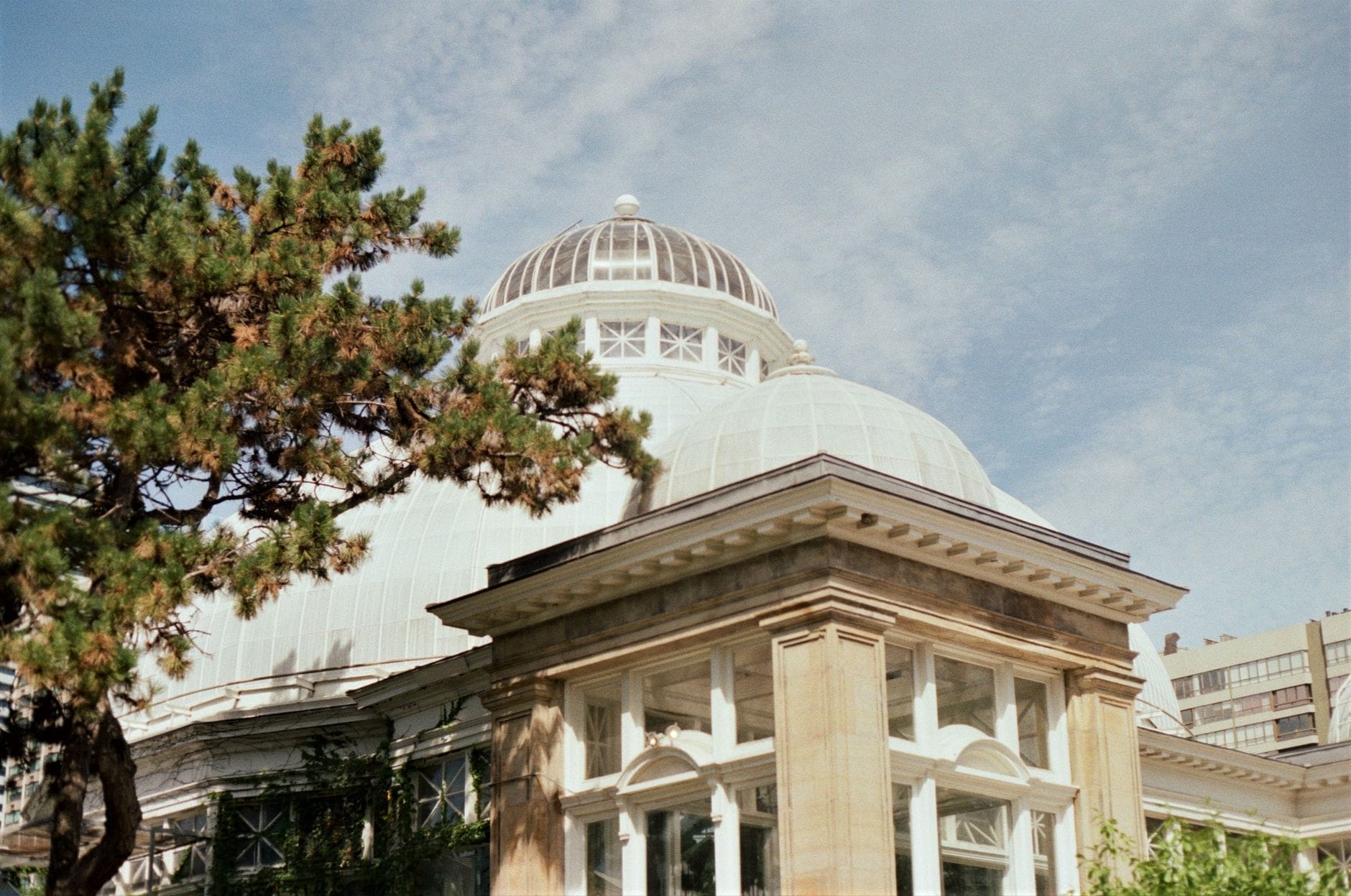
The current Palm House, the conservatory's dominant structure, opened in 1910. It was designed by Robert McCallum, the City of Toronto's architect at the time, in the Edwardian Baroque style that was fashionable for institutional buildings of that era. The Palm House features a central dome flanked by lower wings, a form that draws clear comparisons to Victorian glasshouses in London and Dublin, though on a more modest municipal scale. The structure has undergone restoration work since, led in part by Zeidler Architecture, but its original steel-and-glass bones remain intact.
The conservatory's longevity reflects a quiet civic commitment to free public access that is worth acknowledging. In a city that has seen many green spaces reduced or redeveloped, Allan Gardens has remained free and open through more than a century of urban change. For more on how this fits into Toronto's park landscape, the best parks in Toronto guide provides useful context.
Tickets & tours
Live prices and dates from our booking partner. If you book, we may earn a commission at no extra cost to you.
Toronto Old Town: Dark Side Exploration Game and Tour
From 12 €Instant confirmationFree cancellationLEGOLAND Discovery Centre Toronto tickets
From 16 €Instant confirmationFree cancellationToronto 'Little Canada' entrance tickets
From 27 €Instant confirmationFree cancellationNiagara Falls evening tour with boat, dinner and Illumination Tower
From 77 €Instant confirmationFree cancellation
Inside the Six Houses: What You'll Actually See
The six display houses each hold a distinct plant collection and microclimate. The Palm House, at the centre, is the first thing most visitors enter and the most architecturally striking. Its domed ceiling climbs roughly 16 metres, high enough to accommodate mature palms whose canopy fans out across the upper glass. The air inside is warm and noticeably humid, and the smell — damp earth, green foliage, a faint sweetness from flowering plants — is immediate and distinctive. In January or February, stepping from a frozen Toronto street into this space is a genuine sensory shift.
Adjacent houses contain different collections: a Tropical House with broad-leafed aroids and ferns; a Cactus and Succulent House where the air runs noticeably drier and the light feels sharper; an Orchid and Bromeliad House where colour tends to be most concentrated; a Cool Temperature House with plants suited to Mediterranean-style climates; and a house used for seasonal and rotating displays. The seasonal house changes with the calendar: chrysanthemums in autumn, poinsettias in December, tulips and hyacinths in spring.
The accessible washrooms are located in the Orchid and Bromeliad House (the southernmost house), open during conservatory hours. The path between houses is level and wide enough for wheelchairs and strollers.
ℹ️ Good to know
Photography is permitted without flash. The Palm House's central dome creates excellent diffused natural light for plant photography, particularly in late morning when sunlight enters through the upper glass panels at a low angle.
How the Experience Changes by Time and Season
Early weekday mornings (10:00–11:30 am) are the best window for a peaceful visit. The houses are quiet, light is soft, and you can spend several minutes with individual plants without anyone waiting behind you. Midday on weekends brings school groups, families, and a general increase in foot traffic that, while never truly crowded in the way a museum blockbuster show can be, does change the rhythm of the visit.
Seasonally, the conservatory earns its most loyal visitors in winter. Between November and March, when Toronto regularly sees temperatures below minus 10°C and the surrounding park is grey and bare, the glasshouses offer a pocket of warmth and colour that has real psychological weight. The seasonal display house is at its most elaborate during the Christmas Flower Show, which typically runs through December and features ornamental displays using poinsettias, cyclamen, and other winter-flowering plants. Exact dates vary by year, so check the City of Toronto or Friends of Allan Gardens website before visiting specifically for this.
Spring is when the outdoor gardens around the conservatory become relevant as well. The park's formal beds are planted with seasonal flowers, and if you time a visit for late April or early May, the combination of indoor orchids and outdoor spring planting can be rewarding. Toronto's cherry blossom season, which peaks nearby at High Park, overlaps with this window. The Toronto cherry blossom guide is worth reading alongside a planned spring visit to Allan Gardens.
Getting There and Practical Logistics
The most straightforward TTC route is Line 1 subway to College station, followed by the 506 Carlton streetcar eastbound to Sherbourne Street. From the streetcar stop, the conservatory entrance on Horticultural Avenue is a short walk south into the park. Alternatively, buses running along Jarvis Street (TTC Route 75) stop near the park's western boundary. The park is also within comfortable walking distance of the Church-Wellesley Village to the west and Cabbagetown to the east.
Cycling is practical: Sherbourne Street has a protected bike lane, and the park has bicycle parking near the conservatory entrance. Driving is possible but street parking along the surrounding blocks is metered and competitive during business hours. There is no dedicated parking lot within the park itself.
The conservatory is approximately 1.5 km east of Yonge-Dundas Square, placing it within easy walking range of central downtown. If you are planning a half-day in this part of the city, Allan Gardens pairs naturally with a walk through Cabbagetown's Victorian streetscapes or a visit to St. James Cathedral before heading back west toward the core.
⚠️ What to skip
The surrounding Allan Gardens park is an active urban park and social space used by the full spectrum of the neighbourhood, including people experiencing homelessness. The park itself can feel rough at certain hours, particularly after dark, but the conservatory interior is well-managed during opening hours and generally calm.
Architecture: The Palm House Up Close
The Palm House deserves more attention than it typically gets in Toronto architecture discussions. Designed in 1910 by Robert McCallum in the Edwardian Baroque style, it is one of the few surviving examples of a Victorian-era municipal glasshouse in Canada. The central dome, flanked by lower wings with arched windows and decorative cornices, reads as an intentionally civic and dignified structure — not a utilitarian greenhouse but a statement about the city's investment in public culture.
The steel-and-glass construction follows principles developed in 19th-century industrial architecture, using a relatively slender frame to maximize light transmission while spanning a large interior volume. Restoration work by Zeidler Architecture has preserved the original character while addressing structural and weatherproofing requirements. If you have an interest in Toronto's architectural heritage, it is worth setting the Palm House against the broader context of the city's early-20th-century civic buildings. The Toronto architecture guide covers this period in more depth.
Who Should Skip This
Allan Gardens is not a manicured botanical garden on the scale of formal institutions like Kew or the Montreal Botanical Garden. The collections are well-maintained but modest. If your primary interest is rare or specialized plant collections with research-level curation and signage, you may find the depth here limited. The outdoor park areas are functional rather than ornamental for much of the year. Visitors expecting a polished, amenity-rich tourist attraction with a gift shop, cafe, and interpretive programming may also be underwhelmed — the conservatory is a quiet, low-key civic space, not an attraction built around visitor experience design.
The surrounding park can be uncomfortable for visitors who are sensitive to visible urban hardship. This is worth knowing in advance, not as a deterrent, but as an honest description of the environment.
Insider Tips
- The Cactus and Succulent House is the least visited of the six and often the most peaceful. It is also the driest and coolest, which provides a useful sensory contrast after the humidity of the Palm House.
- The Christmas Flower Show in December is one of the conservatory's highest-effort seasonal displays and draws visitors specifically for it. Check the Friends of Allan Gardens website (friendsofallangardens.ca) for exact dates, as they vary year to year.
- Bring a light layer you can remove: the Palm House and Tropical House run warm and humid, while the Cactus House and outdoor park air in winter are significantly cooler. The temperature swings between houses are noticeable.
- The best natural light for photography in the Palm House falls roughly between 10:30 am and noon on clear days, when sunlight enters the dome from the southeast and illuminates the upper palm canopy without harsh shadows.
- The Friends of Allan Gardens is a volunteer stewardship organization that runs occasional programming and advocates for the conservatory. Their website has the most current visitor information, often more up-to-date than the City of Toronto page.
Who Is Allan Gardens Conservatory For?
- Winter visitors needing a warm, green respite from Toronto's coldest months
- Plant and botany enthusiasts interested in tropical, desert, and orchid collections under one roof
- Architecture and heritage buffs interested in Edwardian civic glasshouse design
- Budget and free-activity focused travelers — no cost, no booking required
- Families with young children looking for a sheltered, engaging indoor space in any season
Nearby Attractions
Other things to see while in Downtown Toronto:
- Art Gallery of Ontario
The Art Gallery of Ontario is one of North America's largest art museums, housing over 90,000 works inside a landmark Frank Gehry-renovated building in downtown Toronto. From Indigenous Canadian art to European masters and contemporary photography, the AGO rewards focused visitors and casual explorers alike.
- Brookfield Place (Allen Lambert Galleria)
The Allen Lambert Galleria inside Brookfield Place is a free, publicly accessible arcade designed by architect Santiago Calatrava between 1987 and 1992. Its arching steel-and-glass canopy, rising between two of downtown Toronto's tallest towers, is one of the most impressive interior spaces in Canada.
- Campbell House Museum
Built in 1822 for Upper Canada's Chief Justice, Campbell House Museum is the oldest surviving residence from the original Town of York. Moved to its current downtown corner in 1972 and opened as a museum in 1974, it offers an intimate, unhurried window into early colonial Toronto — a sharp contrast to the glass towers surrounding it.
- Church-Wellesley Village (Gay Village)
Church-Wellesley Village is Toronto's historic LGBTQ+ neighbourhood, anchored along Church Street between Gerrard and Charles streets. Equal parts social hub, cultural landmark, and community gathering point, it rewards visitors at every hour — from quiet afternoon coffee to the full-volume energy of Pride weekend.
Planning a trip? Discover personalized activities with the Nomado app.