St. James Cathedral: Toronto's Oldest Anglican Congregation
Rising above the corner of King Street East and Church Street, St. James Cathedral is one of Toronto's most significant historic landmarks. Built in Gothic Revival style and completed in 1874, it anchors the city's oldest Anglican congregation, founded in 1797. Entry is free, the architecture is extraordinary, and the surrounding St. James Park makes it one of downtown's most rewarding short stops.
Quick Facts
- Location
- 106 King St E (corner of King St E & Church St), Downtown Toronto, ON M5C 2E9
- Getting There
- King Station (Line 1) ~5 min walk; Queen Station ~7 min walk
- Time Needed
- 30–60 minutes for the interior and grounds
- Cost
- Free admission; donations welcome
- Best for
- Architecture lovers, history seekers, quiet reflection, photographers
- Official website
- stjamescathedral.ca
Why St. James Cathedral Stands Apart
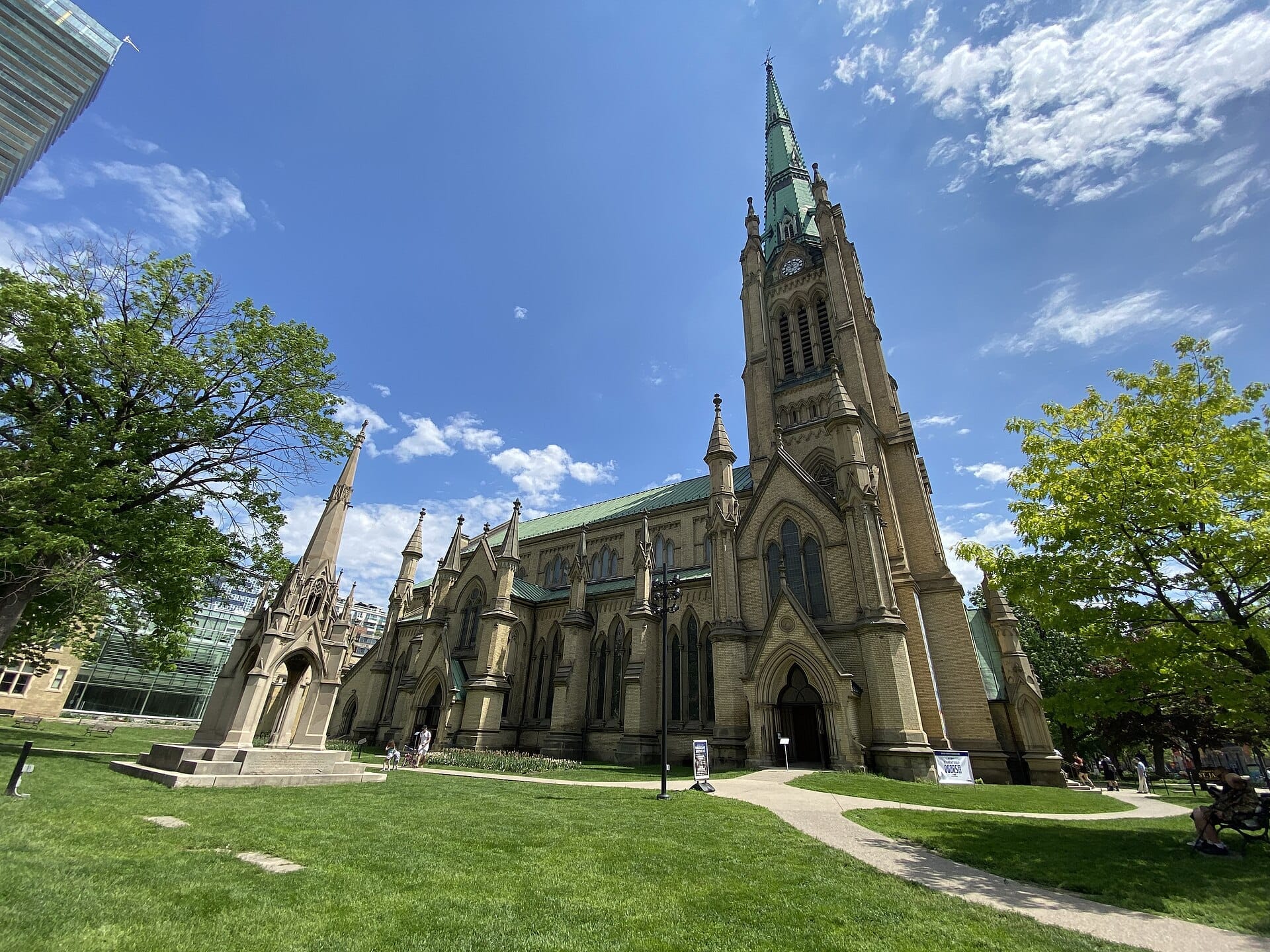
The Cathedral Church of St. James is not simply a place of worship — it is the physical record of Toronto's entire civic history, rendered in stone, stained glass, and Gothic pointed arches. The congregation dates to 1797, predating the city's own incorporation, which gives the site a weight that few other Toronto landmarks can match. The current building, begun in 1850 after a devastating fire destroyed its predecessor in 1849, was opened for services in 1853 and fully completed in 1874. It holds Ontario Heritage Property designation.
For a visitor, the experience begins before you even step inside. The cathedral's spire is one of the most prominent on the Toronto skyline east of the Financial District, visible from several blocks in each direction along King Street East. Standing at the corner of King and Church streets, you get a genuine sense of scale: the pale limestone facade, the lancet windows, and the sheer vertical ambition of the design communicate the mid-Victorian desire to build something that would outlast every other structure in a young colonial city.
💡 Local tip
Visitor access runs Monday to Friday, 7:30–17:30, and Saturday, 9:00–17:00. Sunday is primarily for services (8:00, 9:00, 11:00, and 16:30 Evensong). Hours may change on holidays — check stjamescathedral.ca before visiting.
The Architecture: What You Are Actually Looking At
The building belongs firmly to the Gothic Revival tradition that swept Anglican church design in Britain and its colonies through the mid-19th century. The style draws from medieval English Gothic: pointed arches, ribbed vaulting, flying buttresses, and an emphasis on vertical height to pull the eye — and ostensibly the spirit — upward. At St. James, this vocabulary is executed in Credit Valley limestone, a warm cream-toned stone that weathers well and gives the exterior a softer quality than harsher granites.
Inside, the nave is long and high, with a series of stained glass windows lining both aisles. Morning light comes through the south-facing windows and throws colored patterns across the stone floor — a detail that rewards arriving closer to 10:00 than 14:00. The woodwork in the choir and chancel is detailed and dark, creating a visual contrast with the lighter limestone walls. The organ, positioned prominently, gives you a sense of why the cathedral's music program has such a long reputation in the city.
Photography is possible inside during visitor hours, though the low light levels require patience with a smartphone camera. A wide-angle lens or stitched panorama does the nave far more justice than a single standard frame. If you want the exterior spire against a clear sky, the best angle is from the park to the north, where you can step back far enough to capture the full height without foreground clutter.
Tickets & tours
Live prices and dates from our booking partner. If you book, we may earn a commission at no extra cost to you.
Toronto Old Town: Dark Side Exploration Game and Tour
From 12 €Instant confirmationFree cancellationLEGOLAND Discovery Centre Toronto tickets
From 16 €Instant confirmationFree cancellationToronto 'Little Canada' entrance tickets
From 27 €Instant confirmationFree cancellationNiagara Falls evening tour with boat, dinner and Illumination Tower
From 77 €Instant confirmationFree cancellation
Historical Context: From Colonial Parish to Cathedral
The St. James congregation was formally established in 1797, at a time when the settlement then known as York had only a few hundred residents. The location at King and Church streets — Church Street itself was named for this congregation — placed the parish at what was effectively the civic and social center of early Upper Canada. The lieutenant governor, the judiciary, and the colonial merchant class all worshipped here, giving the church an outsized role in early Toronto's public life.
Earlier buildings on this site burned and were rebuilt multiple times. The great fire of 1849, one of the most destructive in the city's early history, consumed the previous cathedral entirely. The decision to rebuild immediately and at greater scale reflected both the congregation's means and its ambition. Construction began in 1850 and the building opened for services in 1853, though the spire and final elements took until 1874 to complete — meaning the cathedral was an active construction site for the better part of two decades while services continued inside.
The cathedral sits in what is now the St. Lawrence neighbourhood, one of the oldest parts of the city. The St. Lawrence Market is a short walk south, and the broader area around Front Street East retains more pre-20th-century building fabric than almost any other part of downtown Toronto. A walk between the two anchors — cathedral and market — covers the geographic core of the original town of York.
The Grounds and St. James Park
The cathedral is flanked on its north side by St. James Park, a well-maintained green space that provides an unusual amount of breathing room in an otherwise densely built part of downtown. In warmer months, the park fills with office workers at lunch, locals walking dogs, and the occasional outdoor chess game. In late spring, the flowering trees in the park bloom in sequence with those throughout the rest of the neighborhood, making this a pleasant stop during the short blossom window.
Winter changes the character considerably. The bare trees expose the cathedral's full silhouette, and on overcast days the pale stone takes on a grey, almost monochrome quality that gives the whole scene a distinctly northern European atmosphere. Snow on the roof and grounds amplifies this effect. If you are visiting Toronto in winter and want one architectural photograph that captures the city's older, quieter side rather than its glass-and-steel skyline, the cathedral in snow is a strong candidate.
ℹ️ Good to know
The Toronto Christmas Market, one of the city's most popular seasonal events, is held in the Distillery District a short transit ride east. Combining a visit to St. James Cathedral with the market makes for a logical half-day in this part of downtown in late November and December.
What to Expect Inside: A Practical Walkthrough
Enter from the main doors on Church Street during visitor hours. The transition from the street is immediate and noticeable: the sound drops, the temperature is cooler even in summer, and the scale of the interior — taller than you expect from outside — takes a moment to register. There is no formal ticketing or check-in process. The cathedral is a working place of worship, so the expectation is quiet, respectful movement.
Walk the full length of the nave to the chancel. Take time with the stained glass windows on both sides — they vary in age and quality, and the older panels in particular reward close attention. The memorial plaques and commemorative inscriptions on the walls provide a compressed social history of colonial and early 20th-century Toronto: military officers, merchants, clergy, and politicians, many of whose names appear elsewhere in the city's street grid and institutions.
The cathedral is not a museum and does not have interpretive signage at every point, so visitors with a strong interest in the history will benefit from reviewing the historical material on the cathedral's website before arriving. There is no dedicated audio guide, though guided tours may be available on certain dates — check current programming directly with the cathedral office.
⚠️ What to skip
If you arrive outside visitor hours (Mon–Fri 7:30–17:30, Sat 9:00–17:00), the interior will not be accessible unless a service is in progress. Sunday services are open to all, but the atmosphere and movement during a service are quite different from a self-guided visit.
Getting There and Practical Notes
King Station on TTC Line 1 is the most direct subway stop, roughly a 5-minute walk away. Queen Station is also walkable at about 7 minutes. The area is well-served by TTC streetcars on King Street. For broader context on moving around the city, the getting around Toronto guide covers transit options in detail.
Accessibility: the cathedral does not provide detailed accessibility specifications on its public web pages. Visitors with specific mobility or access requirements should contact the cathedral directly before visiting: +1 416-364-7865 or info@stjamescathedral.ca.
The surrounding neighbourhood rewards exploration on foot. The St. Lawrence Market is a 5-minute walk south and makes a natural pairing — particularly on a Saturday morning when the outdoor farmers market runs alongside the main building. The downtown Toronto area holds several other heritage buildings within a short radius, including Old City Hall to the west and Osgoode Hall.
Those with an interest in Toronto's architectural heritage should note that the city has a unusually concentrated collection of 19th and early 20th-century civic buildings within walking distance of this area. The Toronto architecture guide covers the broader picture, including the contrast between this historic core and the city's more recent high-rise development.
Who Should Skip This Attraction
St. James Cathedral is a quiet, contemplative space. Visitors looking for interactive exhibits, audio-visual experiences, or family-oriented programming will not find them here. Young children tend to find the interior less engaging than outdoor attractions or hands-on museums. The limited visitor hours (three hours per day on weekdays and Saturdays) make it easy to miss if your schedule is not flexible. And if your interest in Gothic Revival architecture is already well-satisfied by other Toronto churches or by churches you have visited elsewhere, this may not justify a dedicated detour — though it remains worth combining with a St. Lawrence Market visit regardless.
Insider Tips
- Visit between 10:00 and 11:30 on a weekday morning for the best light through the south-facing stained glass windows — afternoon visits get flatter, cooler light inside the nave.
- The view of the spire from St. James Park (north side of the building) is significantly more photogenic than the street-level view from King Street East. Step back toward the park benches to get the full height in frame.
- Sunday Evensong at 16:30 is open to all and provides a completely different experience from a self-guided visit — the cathedral's music program is well-regarded, and this is one of the few ways to hear the organ in full use without attending a special concert.
- The memorial inscriptions on the interior walls are worth reading slowly. Many names appear elsewhere in Toronto's street names and institutions, giving you an unexpected geography lesson about the city's early elite.
- If you are visiting in late November or December, the nearby Toronto Christmas Market in the Distillery District and the cathedral grounds are an easy half-day combination that covers two of the most atmospheric spots in this part of the city.
Who Is St. James Cathedral For?
- Architecture and heritage enthusiasts who want to understand Toronto's pre-20th-century building history
- Photographers looking for Gothic stone architecture and interior stained glass without a ticket price
- Travellers combining a visit with the St. Lawrence Market on a Saturday morning
- Anyone seeking quiet and a change of pace from the noise of the Financial District and King Street traffic
- Visitors attending Sunday Evensong for a live choral and organ music experience in a historic setting
Nearby Attractions
Other things to see while in Downtown Toronto:
- Allan Gardens Conservatory
Allan Gardens Conservatory is a free, year-round botanical conservatory at 160 Gerrard Street East in downtown Toronto. Housed in six glass display houses anchored by a 1910 Edwardian Palm House, it holds about 1,500 m² of tropical palms, cacti, orchids, and seasonal blooms. One of the oldest parks in Toronto, it remains one of the city's most underrated green spaces.
- Art Gallery of Ontario
The Art Gallery of Ontario is one of North America's largest art museums, housing over 90,000 works inside a landmark Frank Gehry-renovated building in downtown Toronto. From Indigenous Canadian art to European masters and contemporary photography, the AGO rewards focused visitors and casual explorers alike.
- Brookfield Place (Allen Lambert Galleria)
The Allen Lambert Galleria inside Brookfield Place is a free, publicly accessible arcade designed by architect Santiago Calatrava between 1987 and 1992. Its arching steel-and-glass canopy, rising between two of downtown Toronto's tallest towers, is one of the most impressive interior spaces in Canada.
- Campbell House Museum
Built in 1822 for Upper Canada's Chief Justice, Campbell House Museum is the oldest surviving residence from the original Town of York. Moved to its current downtown corner in 1972 and opened as a museum in 1974, it offers an intimate, unhurried window into early colonial Toronto — a sharp contrast to the glass towers surrounding it.
Planning a trip? Discover personalized activities with the Nomado app.