Campbell House Museum: Toronto's Oldest Surviving House
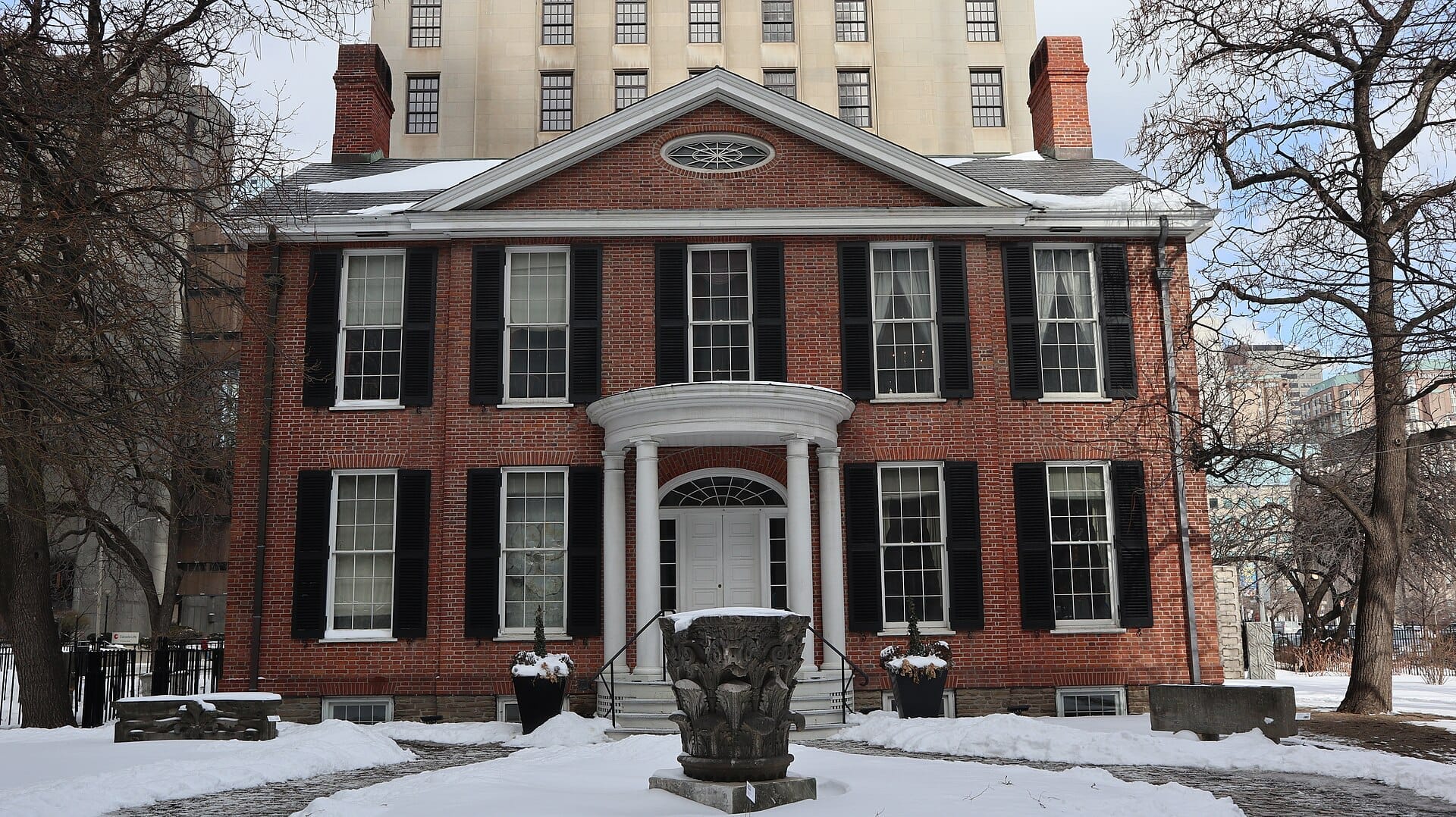
Built in 1822 for Upper Canada's Chief Justice, Campbell House Museum is the oldest surviving residence from the original Town of York. Moved to its current downtown corner in 1972 and opened as a museum in 1974, it offers an intimate, unhurried window into early colonial Toronto — a sharp contrast to the glass towers surrounding it.
Quick Facts
- Location
- 160 Queen Street West, at University Avenue, Downtown Toronto
- Getting There
- Osgoode Station (Line 1); Queen St streetcar (501) stops nearby
- Time Needed
- 45 minutes to 1.5 hours
- Cost
- Approximately CAD $10 general admission; verify with museum before visiting
- Best for
- History enthusiasts, architecture lovers, quiet mid-week exploring
- Official website
- campbellhousemuseum.ca
What Is Campbell House Museum?
Campbell House Museum is a Georgian-Palladian house museum at the northwest corner of Queen Street West and University Avenue in downtown Toronto. Built in 1822, it is the oldest surviving residence from the original Town of York, the settlement that would grow into one of North America's largest cities. That alone makes it remarkable. What makes it genuinely interesting is the contrast: the building sits less than a block from the Ontario Court of Justice, surrounded by mid-century brutalist towers and glass-clad office blocks, looking like a transplant from another era — because it essentially is.
The house was constructed for Sir William Campbell, who served as Chief Justice of Upper Canada, and his wife Hannah. Two centuries later, it functions as a house museum operated by a preservation foundation, giving visitors an hour-long guided look at early colonial domestic life in what is now Toronto. It is a small institution with a focused mission, and it delivers on that focus with more depth than its footprint suggests.
ℹ️ Good to know
Opening hours: Tuesday to Friday 9:30–16:30; Saturday 12:00–16:30. Closed Sunday and Monday. Last entry is at 16:00. Confirm hours on the official website before visiting, as seasonal adjustments are possible.
The History Behind the House
Sir William Campbell arrived in Upper Canada as a Scottish immigrant and rose to become the province's fourth Chief Justice, serving from 1825 to 1829. His Queen Street house, completed in 1822, reflected the aspirations of the colonial elite: a two-storey brick structure built in the Georgian tradition, with Palladian proportions that were deliberately formal and symmetrical. In the context of York, a muddy lakeside settlement of a few thousand people, this was a statement of permanence and authority.
The house survived Toronto's explosive growth largely through neglect rather than preservation planning. By the late 20th century, it faced demolition as the surrounding legal and financial districts intensified. In 1972, the Advocates' Society undertook the remarkable engineering effort of moving the entire structure several blocks to its current location at Queen and University, pulling it out of the path of development. It was formally opened as a museum in 1974 by the Queen Mother. That relocation story is itself part of the attraction's identity: this is a building that Toronto, after nearly losing, chose to keep.
For context on how this house fits into Toronto's broader architectural heritage, the Toronto architecture guide covers the city's evolving built environment from colonial-era structures through to contemporary landmarks.
Tickets & tours
Live prices and dates from our booking partner. If you book, we may earn a commission at no extra cost to you.
Toronto Old Town: Dark Side Exploration Game and Tour
From 12 €Instant confirmationFree cancellationLEGOLAND Discovery Centre Toronto tickets
From 16 €Instant confirmationFree cancellationToronto 'Little Canada' entrance tickets
From 27 €Instant confirmationFree cancellationNiagara Falls evening tour with boat, dinner and Illumination Tower
From 77 €Instant confirmationFree cancellation
What the Visit Actually Looks Like
Arriving at Campbell House, the first thing you notice is the building's physical incongruity. The red brick exterior and low-slung Georgian profile are dwarfed by everything around them. The front facade faces the wide intersection of Queen and University, and on a weekday morning, the foot traffic outside is entirely of the courthouse and financial district variety: lawyers with rolling briefcases, couriers, construction workers from nearby builds. The house itself reads almost like a stage set dropped into a working city.
Inside, the scale shifts. The rooms are intimate by modern standards, with low ceilings and carefully maintained period furnishings. Guided tours walk visitors through the ground floor and upper rooms, explaining how a Chief Justice household would have functioned in the 1820s: the formal receiving rooms intended for social performance, the domestic spaces behind them, and the kinds of objects that signified status in colonial Upper Canada. The guides tend to be knowledgeable and comfortable fielding questions, and the tour format means you absorb context without having to read every label.
The house's Georgian interior details are well-preserved: corniced ceilings, wide plank floors, and sash windows that filter whatever light the surrounding towers allow through. In the afternoon, natural light falls across the front rooms in a way that makes the period furnishings feel less like display objects and more like things someone recently left. The smell is old wood and slightly dried-out textile, familiar to anyone who has spent time in heritage buildings.
💡 Local tip
Weekday mornings between 10:00 and noon are the quietest time to visit. Groups and school tours tend to arrive later in the morning or early afternoon. The museum is small enough that a simultaneous group visit can feel crowded.
Practical Walkthrough: Getting There and Getting In
Campbell House Museum is one of the most transit-accessible heritage sites in Toronto. Osgoode Station on the TTC's Line 1 (Yonge-University) is a two-minute walk. The 501 Queen streetcar stops nearby. By foot from the Eaton Centre area, the walk along Queen Street takes roughly 10 minutes. There is no dedicated parking, but paid lots exist on surrounding streets and in nearby buildings.
Admission is approximately CAD $10 for general visitors. Prices should be confirmed with the museum directly, as they are not prominently listed on all third-party sites. The museum is compact enough that no advance booking is required for individuals or small groups, though school or tour groups should arrange in advance.
Accessibility is limited by the building's original fabric. The 1822 structure was designed without any provision for mobility access, and heritage preservation requirements constrain what modifications can be made. Visitors with mobility needs are encouraged to contact the museum in advance to discuss what can be arranged.
If you are building a day around downtown Toronto's historic sites, pairing Campbell House with a visit to Osgoode Hall directly across the street makes sense. The two buildings represent different aspects of Upper Canada's legal and civic identity, and they are close enough to visit back-to-back without additional transit.
How It Changes Through the Day
Early in the morning before opening, the building looks almost austere against the grey stone of the Law Society building across Queen Street. By late morning, once the museum is running, there is a low-level purposefulness inside: a curator or guide moving between rooms, the particular quiet of a small museum that has not yet filled for the day. The best light in the front rooms arrives between 10:00 and 13:00, when the sun hits the south-facing windows before being blocked by adjacent towers.
Saturdays operate on slightly reduced hours, opening at noon, and tend to draw a different visitor profile than weekdays: fewer school groups, more couples and individual tourists working through downtown's historic sites. The neighbourhood itself shifts on weekends, with fewer commuters and more pedestrian traffic on Queen Street from shoppers and gallery visitors. The combination of a quieter street and a focused museum can make Saturday afternoon one of the more pleasant times to visit, though the shorter window before 16:30 close means you need to arrive promptly.
Photography and What to Notice
The exterior photograph that most visitors attempt, framing the Georgian facade against the glass office towers behind it, is harder to execute than it looks. The best angle is from slightly east along Queen Street, shooting westward so the building fills the mid-ground with sky and towers behind. Early morning on a clear day gives the cleanest light on the brick facade. By afternoon, the surrounding buildings cast irregular shadows across the front.
Inside, photography is generally permitted, though flash and tripods may be restricted. The most photogenic interior elements are the corniced plaster ceilings, the staircase with its turned balusters, and the front reception rooms with their period furniture arrangements. The museum is small, so framing without visible tour groups or staff in the background requires patience.
⚠️ What to skip
The interior rooms are small. A standard zoom lens or a wide-angle prime works better than anything longer. Handheld shots at ISO 800–1600 will be necessary in the dimmer back rooms, especially on overcast days.
Who Should Visit, and Who Might Not
Campbell House rewards visitors who come with at least some curiosity about Canadian history, early colonial architecture, or the specific period of Upper Canada in the first decades of the 19th century. The museum does not try to be all things. It is a single house, covering a specific household and era, interpreted through guided tours and period objects. If that framing appeals to you, the visit is worth every minute of its modest running time.
Visitors looking for a broad survey of Toronto's history would be better served by larger institutions. The Fort York National Historic Site covers a longer arc of Toronto's early development with more interpretive programming and outdoor space. Families with young children may find the intimate, guide-led format of Campbell House less engaging than more interactive venues, though older children with an interest in history often respond well to the guided format.
Anyone with significant mobility limitations should contact the museum in advance, as the heritage structure's constraints are real and not easily worked around on arrival.
Insider Tips
- The Advocates' Society, which funded the 1972 relocation, still has a connection to the museum. Occasional legal history events and special programming draw an informed, engaged crowd worth sharing a tour with if you happen to overlap.
- The exterior corner at Queen and University is one of the few places in downtown Toronto where you can photograph a pre-Confederation building with the city's contemporary skyline in the same frame. It works best as a wide shot from across the street on a clear morning.
- Osgoode Hall directly across the street has its own public access during business hours and features one of the most ornate Victorian interiors in the city. Combining both into a single morning requires only about two hours total.
- Last entry is 16:00, not 16:30. Arriving at 16:15 will mean a turned-away visit. Factor in this earlier cutoff when planning late-afternoon downtown itineraries.
- The museum occasionally hosts evening events and special programming beyond regular hours. Checking the official website's events calendar before your trip can reveal access to the house in contexts that differ significantly from the standard tour format.
Who Is Campbell House Museum For?
- History enthusiasts interested in colonial-era Upper Canada and early Toronto
- Architecture lovers focused on Georgian and Palladian heritage buildings
- Travellers wanting a quiet, unhurried museum experience in the middle of downtown
- Solo explorers pairing historical sites along Queen Street West
- Visitors who have done the major Toronto institutions and want something more specific and less crowded
Nearby Attractions
Other things to see while in Downtown Toronto:
- Allan Gardens Conservatory
Allan Gardens Conservatory is a free, year-round botanical conservatory at 160 Gerrard Street East in downtown Toronto. Housed in six glass display houses anchored by a 1910 Edwardian Palm House, it holds about 1,500 m² of tropical palms, cacti, orchids, and seasonal blooms. One of the oldest parks in Toronto, it remains one of the city's most underrated green spaces.
- Art Gallery of Ontario
The Art Gallery of Ontario is one of North America's largest art museums, housing over 90,000 works inside a landmark Frank Gehry-renovated building in downtown Toronto. From Indigenous Canadian art to European masters and contemporary photography, the AGO rewards focused visitors and casual explorers alike.
- Brookfield Place (Allen Lambert Galleria)
The Allen Lambert Galleria inside Brookfield Place is a free, publicly accessible arcade designed by architect Santiago Calatrava between 1987 and 1992. Its arching steel-and-glass canopy, rising between two of downtown Toronto's tallest towers, is one of the most impressive interior spaces in Canada.
- Church-Wellesley Village (Gay Village)
Church-Wellesley Village is Toronto's historic LGBTQ+ neighbourhood, anchored along Church Street between Gerrard and Charles streets. Equal parts social hub, cultural landmark, and community gathering point, it rewards visitors at every hour — from quiet afternoon coffee to the full-volume energy of Pride weekend.
Planning a trip? Discover personalized activities with the Nomado app.