Osgoode Hall: Toronto's Grand Courthouse and Legal Legacy
Osgoode Hall is one of Toronto's most architecturally distinguished buildings, a National Historic Site of Canada that has anchored the city's legal landscape since 1829. Set behind ornate wrought-iron gates on Queen Street West, it houses the Court of Appeal for Ontario and the Law Society of Ontario, and opens its doors to the public for free summer tours.
Quick Facts
- Location
- 130 Queen Street West, Downtown Toronto
- Getting There
- Osgoode Station (Line 1); 501 Queen streetcar stops at the front door
- Time Needed
- 30–90 minutes depending on tour availability
- Cost
- Free (public access and summer tours at no charge)
- Best for
- Architecture lovers, history buffs, photography, Doors Open Toronto
- Official website
- www.ontariocourts.ca/coa/about-the-court/visiting-osgoode-hall
What Is Osgoode Hall?
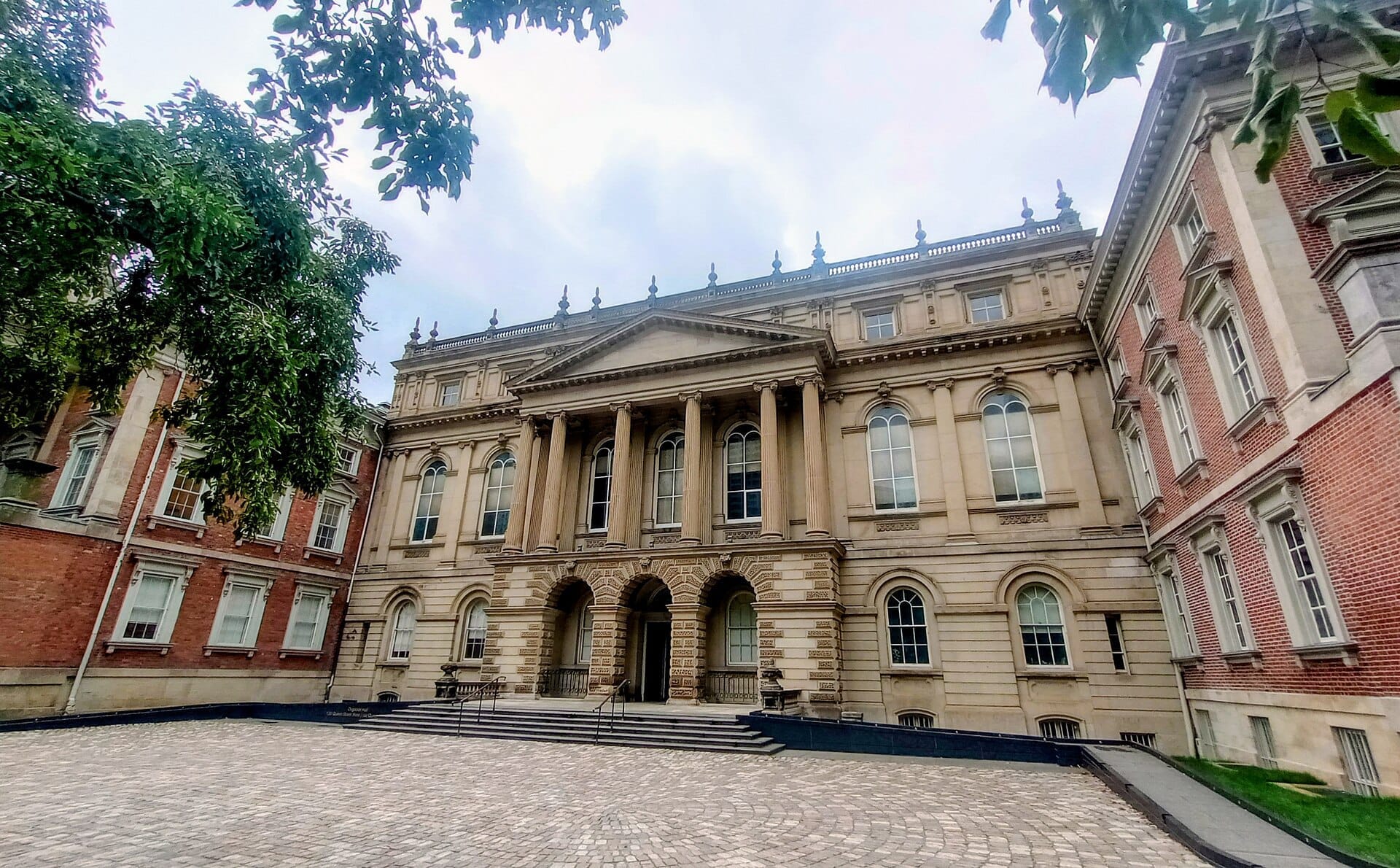
Osgoode Hall is a neoclassical courthouse complex that occupies an entire city block on Queen Street West, at the corner where University Avenue begins its formal march northward. It is a National Historic Site of Canada and one of the oldest continuously functioning legal institutions in the country, home to the Court of Appeal for Ontario, the Divisional Court of the Superior Court of Justice, as well as the Law Society of Ontario, the regulatory body for lawyers and paralegals in the province.
Few buildings in Toronto carry this level of institutional gravity. Construction began in 1829, making Osgoode Hall older than Canadian Confederation itself. What you see today is largely the product of several building campaigns: the east wing went up by 1832, the centre and west wings were added between 1844 and 1846, and the centre section was then substantially reconstructed between 1856 and 1859 by the prominent architectural firm Cumberland and Storm. The result is a layered classical composition that rewards close inspection.
The hall is named after William Osgoode, the first Chief Justice of Upper Canada. For a deeper look at how this building fits into Toronto's architectural heritage, the Toronto architecture guide provides useful context on the city's most significant historic structures.
The Grounds and the Famous Gate
Before you even reach the entrance, the perimeter makes an impression. A stone and wrought-iron fence runs the length of the property, punctuated by elaborately designed gates that were historically kept narrow enough to prevent cattle from wandering onto the grounds. Whether this story is strictly accurate or has been embellished over time, the gates remain one of the most photographed details on the entire street, their curved ironwork sitting in striking contrast to the granite paving and closely trimmed lawn behind.
The front lawn is unusually generous for downtown Toronto. In warmer months, it functions as an impromptu green respite, with office workers eating lunch on the grass and the occasional small group gathered near the gates for photographs. In winter, the bare branches of the mature trees give the scene a more austere quality, and frost on the ironwork can produce remarkable textures for close-up photography.
💡 Local tip
For photography, the late afternoon light in spring and autumn hits the south-facing facade at a warm angle. The early morning, before the Queen Street streetcar traffic thickens, gives you clearer sightlines from across the road.
Osgoode Hall sits directly adjacent to Nathan Phillips Square and Toronto City Hall, making this stretch of Queen Street West one of the densest concentrations of civic architecture in the city. Walking between them takes less than five minutes.
Tickets & tours
Live prices and dates from our booking partner. If you book, we may earn a commission at no extra cost to you.
90-minute Toronto express city tour with photo stop at City Hall
From 44 €Instant confirmationFree cancellationToronto Old Town: Dark Side Exploration Game and Tour
From 12 €Instant confirmationFree cancellationLEGOLAND Discovery Centre Toronto tickets
From 16 €Instant confirmationFree cancellationToronto 'Little Canada' entrance tickets
From 27 €Instant confirmationFree cancellation
The Architecture Up Close
The building's main facade presents a long colonnaded portico with Ionic columns that run across the central pavilion, flanked by projecting wings. The pale stone contrasts with the dark ironwork of the gate and gives the complex a composed, almost sedately confident presence, quite different from the Victorian exuberance of Old City Hall just to the east. This is deliberate classicism, meant to project authority and permanence.
Cumberland and Storm's 1856 to 1859 reconstruction of the centre section introduced the grand portico that defines the building today. The firm was responsible for several of Toronto's most important mid-nineteenth-century buildings, and the work at Osgoode Hall is considered among their best. The proportions are careful and the detailing precise, from the cornice line to the window surrounds on the flanking wings.
The building does not shout for attention the way some civic architecture does. Standing on Queen Street and looking across, it reads as a composed horizontal mass behind the greenery of the lawn. Walk through the gate, however, and the scale becomes much more apparent. The portico columns are tall and the entrance steps broad, framing a formal arrival sequence that still functions as intended nearly 170 years after construction.
Those with a strong interest in Toronto's built environment may also want to visit Old City Hall, just steps away, which represents a completely different architectural sensibility: late Victorian Romanesque Revival, completed in 1899.
Visiting the Interior: Tours and Public Access
Osgoode Hall is an active courthouse, not a museum, so interior access is more restricted than the grounds. As a working legal complex, its public areas are accessible during regular business hours, Monday through Friday from approximately 9:00 to 17:00. The courts and the Law Society offices occupy the upper floors and formal rooms, which are generally not open to casual visitors outside of organized programs.
ℹ️ Good to know
The Law Society of Ontario runs free public tours of the interior during summer months. Osgoode Hall also participates in Doors Open Toronto, the annual weekend when historic and architecturally significant buildings open their doors to the public at no charge. These are the two best opportunities to access the building's most impressive interior spaces.
The interior rewards the effort. The Great Library, which dates from the mid-nineteenth century, is one of the finest rooms in Toronto: a two-storey vaulted space lined with legal volumes, lit by tall windows, and ornamented with plasterwork that reflects the ambitions of the Law Society at the height of Upper Canada's development. Visitors who access it during a guided tour or Doors Open typically find it more impressive than expected, a space more European than anything else in the city at that period of construction.
The corridor proportions, the courtroom detailing, and the mosaic and tile work in various passages all reflect successive layers of renovation and care across nearly two centuries. This is not a static building that stopped in 1859. It has been adapted and maintained as a living institution, which gives it an operational authenticity that purpose-built museum reconstructions cannot replicate.
When to Visit and What to Expect
On a weekday morning, the area around Osgoode Hall has a purposeful, working character. Lawyers in robes occasionally move between buildings, clerks carry document bags, and the gates see a steady flow of people connected to the courts. It is not a tourist zone in the way Distillery District or the waterfront are. That directness is actually part of the appeal: you are visiting a place that has its own logic and is not organized for your convenience.
For exterior visits and photography, any weekday from late morning to early afternoon works well. The lawn is accessible and the gates are open. On summer Saturdays, the grounds are quiet and the streetcar traffic lighter, making it a pleasant stop if you are walking through the area, though the building itself will be closed.
Weather affects the experience less here than at most outdoor attractions, since the primary draw is architectural. Rain softens the stone tones and makes the ironwork gleam; snow against the pale facade and iron gate can produce some of the most visually striking conditions of any season. That said, the formal interior tours are a summer-only offering, so if the Great Library is your priority, plan accordingly.
⚠️ What to skip
Osgoode Hall is closed to the public on weekends and public holidays outside of special programs like Doors Open Toronto. If you arrive on a Saturday expecting interior access, you will only be able to see the exterior grounds.
If you want to combine this with other free cultural sites in the area, the free things to do in Toronto guide lists several attractions within easy walking distance.
Practical Information for Visitors
Getting here is straightforward. Osgoode Station on TTC Line 1 (Yonge-University) exits almost directly onto the building's corner at Queen and University. The 501 Queen streetcar stops at the front of the property on Queen Street West at York Street. From Union Station, the walk north along University Avenue takes roughly ten minutes and passes several notable civic and institutional buildings along the way.
There is no admission fee for the grounds or for the public summer tours offered by the Law Society. Doors Open Toronto, which typically takes place over a weekend in May, is also free. Neither event requires advance booking in recent years, though this is worth confirming with the Law Society or Doors Open Toronto organizers closer to your visit date, as event formats can change.
Accessibility information for the interior is not comprehensively detailed in publicly available sources. Courthouse buildings in Ontario are generally required to provide accessible entrances and facilities, but if you have specific mobility requirements, contacting the Court of Appeal for Ontario or the Law Society directly before your visit is advisable. The grounds themselves are flat and accessible from the street.
Osgoode Hall is a short walk from several other significant downtown Toronto attractions. Toronto City Hall and Nathan Phillips Square are immediately to the east, and the Art Gallery of Ontario is about a ten-minute walk west through the financial district edge into Grange Park.
Insider Tips
- The summer tours run by the Law Society are the only reliable way to see the Great Library without being connected to a legal matter. Check the Law Society of Ontario website in late spring for tour dates and times before you finalize your itinerary.
- Doors Open Toronto typically happens over a single weekend in May and is the one occasion when you can explore rooms not normally accessible even on regular tours. Mark it in your calendar if you are visiting in spring.
- The gate on the Queen Street West side is the main photographic target, but walk around the perimeter to University Avenue for a less-photographed angle on the west facade, which shows the full building length against the formal boulevard.
- Courtroom proceedings at the Court of Appeal for Ontario are generally open to the public when the court is sitting. Observing a session is a genuinely unusual experience and costs nothing; check the court's published schedule on the Ontario Courts website.
- The flat stone steps of the main entrance portico stay clear of ice faster than the surrounding sidewalks in winter, making the building slightly more accessible in cold weather than you might expect, though take care on the surrounding paths after freezing rain.
Who Is Osgoode Hall For?
- Architecture enthusiasts who want to see Toronto's finest neoclassical building up close
- History visitors interested in Ontario's legal and colonial past in a setting that is still actively in use
- Photographers looking for formal, classically composed subjects in the downtown core
- Visitors attending Doors Open Toronto who want to access spaces rarely open to the public
- Anyone walking the Queen Street West civic corridor who wants more than a passing glance at one of the city's oldest institutions
Nearby Attractions
Other things to see while in Downtown Toronto:
- Allan Gardens Conservatory
Allan Gardens Conservatory is a free, year-round botanical conservatory at 160 Gerrard Street East in downtown Toronto. Housed in six glass display houses anchored by a 1910 Edwardian Palm House, it holds about 1,500 m² of tropical palms, cacti, orchids, and seasonal blooms. One of the oldest parks in Toronto, it remains one of the city's most underrated green spaces.
- Art Gallery of Ontario
The Art Gallery of Ontario is one of North America's largest art museums, housing over 90,000 works inside a landmark Frank Gehry-renovated building in downtown Toronto. From Indigenous Canadian art to European masters and contemporary photography, the AGO rewards focused visitors and casual explorers alike.
- Brookfield Place (Allen Lambert Galleria)
The Allen Lambert Galleria inside Brookfield Place is a free, publicly accessible arcade designed by architect Santiago Calatrava between 1987 and 1992. Its arching steel-and-glass canopy, rising between two of downtown Toronto's tallest towers, is one of the most impressive interior spaces in Canada.
- Campbell House Museum
Built in 1822 for Upper Canada's Chief Justice, Campbell House Museum is the oldest surviving residence from the original Town of York. Moved to its current downtown corner in 1972 and opened as a museum in 1974, it offers an intimate, unhurried window into early colonial Toronto — a sharp contrast to the glass towers surrounding it.
Planning a trip? Discover personalized activities with the Nomado app.