Toronto City Hall: The Civic Icon That Changed the City's Skyline
Designed by Finnish architect Viljo Revell and opened in 1965, Toronto City Hall is one of North America's most recognizable pieces of civic architecture. The twin curved towers and domed council chamber at 100 Queen St W anchor Nathan Phillips Square, a public plaza that serves as a gathering point for the city in every season.
Quick Facts
- Location
- 100 Queen St W, Downtown Toronto, Ontario
- Getting There
- Osgoode Station (TTC Line 1) — 2-minute walk
- Time Needed
- 30–60 minutes for the exterior and square; longer if attending an event
- Cost
- Free to visit the exterior and Nathan Phillips Square; interior access on weekdays during business hours
- Best for
- Architecture lovers, photographers, first-time visitors, history buffs
What Toronto City Hall Actually Is
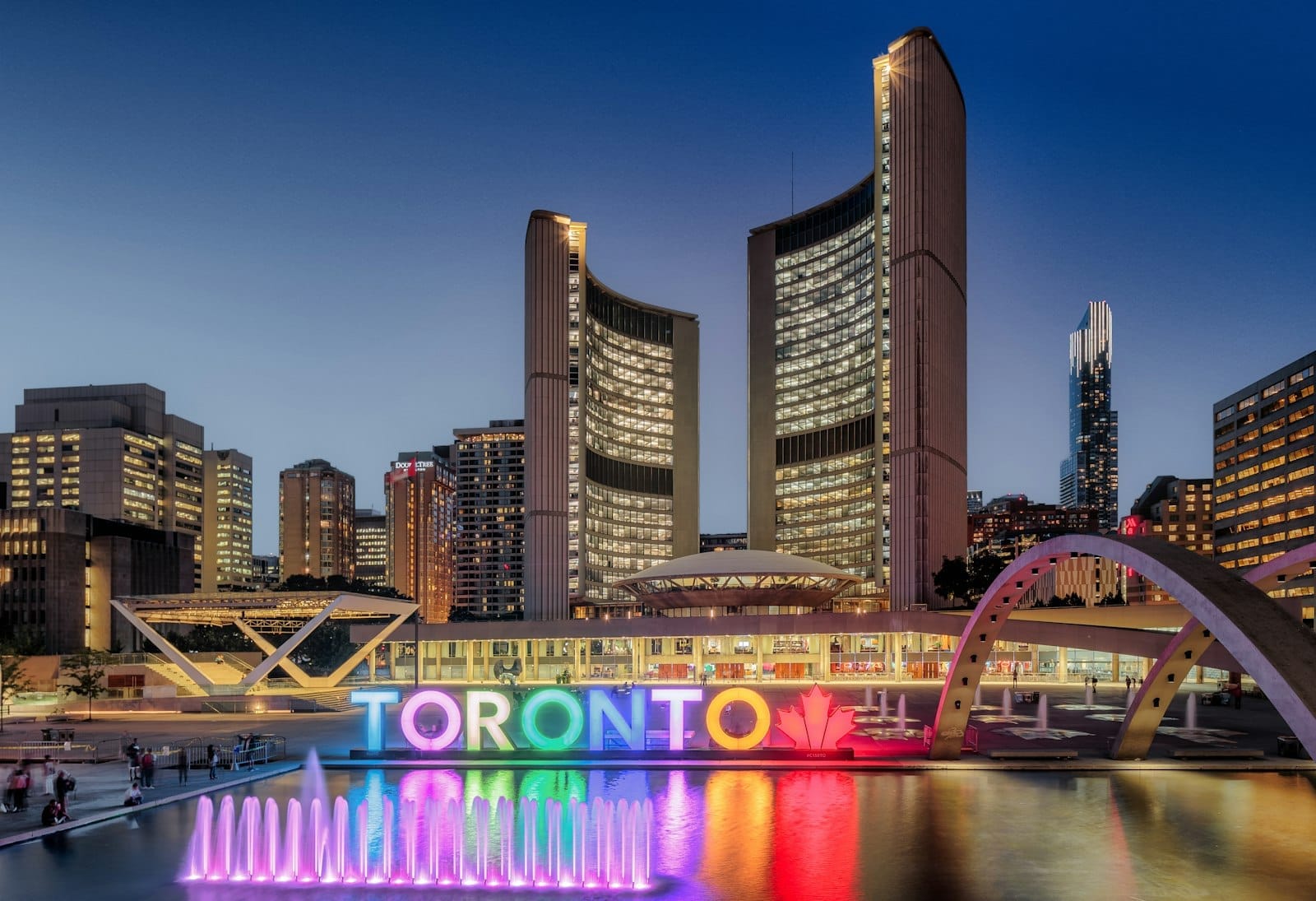
Toronto City Hall is the working seat of the municipal government of Toronto, Ontario's largest city and Canada's most populous city. But to describe it purely as a government office building is to miss what makes it worth a deliberate visit. The structure, completed in 1965 to a design by Finnish architect Viljo Revell and structural engineer Hannskarl Bandel, was the result of an international architectural competition that drew 520 entries from 42 countries. What Revell proposed, and what now stands at the northwest corner of Queen Street West and Bay Street, is two curved towers of unequal height encircling a low, dome-shaped council chamber. From above, the composition looks like an eye. From the street, the towers frame the domed chamber like cupped hands.
The building is also commonly called New City Hall, to distinguish it from the Romanesque Revival Old City Hall directly across Bay Street to the east, which dates to 1899 and remains a functioning courthouse. Having both buildings in your sightline at once gives you an immediate, compressed lesson in how dramatically Toronto's civic ambitions shifted across the twentieth century.
ℹ️ Good to know
Interior access is available Monday to Friday, 8:00 AM to 5:00 PM. The building is closed on weekends. The exterior and Nathan Phillips Square are accessible at any hour, every day of the year.
The Architecture: Why It Still Holds Up
Revell's design sits in the tradition of mid-century civic modernism, but it does not look derivative. The taller east tower reaches 27 storeys; the shorter west tower reaches 20 storeys. Both towers curve inward in plan, so their facades trace arcs rather than straight lines. The concrete and glass cladding has a slightly textured quality that catches light differently depending on the angle and hour. In the early morning, when the low sun hits from the east, the towers take on a warm, almost amber cast. By midday, the surfaces flatten into grey and white. At dusk, when the interior office lights come on and the exterior remains dark, the windows glow in grid-like patterns that read almost like circuitry.
The dome of the council chamber, visible at ground level as a shallow convex form in the centre of the square, is clad in a material that weathers to a muted green-grey. It sits lower than you expect when you see the building from a distance, which amplifies the sense of the towers rising protectively around it. The structural logic is honest: you can read from the outside exactly what is inside.
For travelers who want to put this building in context with Toronto's broader architectural story, the Toronto architecture guide covers the full range of the city's significant structures, from Victorian commercial blocks to contemporary towers.
Tickets & tours
Live prices and dates from our booking partner. If you book, we may earn a commission at no extra cost to you.
90-minute Toronto express city tour with photo stop at City Hall
From 44 €Instant confirmationFree cancellationToronto Old Town: Dark Side Exploration Game and Tour
From 12 €Instant confirmationFree cancellationLEGOLAND Discovery Centre Toronto tickets
From 16 €Instant confirmationFree cancellationToronto 'Little Canada' entrance tickets
From 27 €Instant confirmationFree cancellation
Nathan Phillips Square: The Public Space Around the Building
The real draw for most visitors is not the building itself but the plaza in front of it. Nathan Phillips Square, named after the mayor who championed the new City Hall project, is a wide, open concrete expanse that stretches south from the towers toward Queen Street West. It is the closest thing Toronto has to a central civic square, and it functions as one year-round.
In summer, the reflecting pool at the square's centre becomes a wading area and hosts outdoor concerts, food truck gatherings, and cultural festivals. In winter, the same pool is converted into a public ice skating rink, one of the most used in the city. The rink is typically open from approximately November through February, weather permitting. Skate rentals are available on-site. On a cold Saturday afternoon in January, the ice is crowded with families, teenagers, and office workers on lunch break; the surrounding concrete seating areas fill with spectators. The combination of the rink, the illuminated arch sculptures, and the curved towers behind creates a backdrop that is genuinely photogenic in a way that is hard to manufacture.
The square also contains the Peace Garden, a small landscaped area with an eternal flame installed in 1984 as a memorial to Hiroshima and Nagasaki. It is easy to walk past without registering what it is. Worth pausing at.
💡 Local tip
For the best photographs of the towers and dome together, stand near the southern edge of the reflecting pool and shoot north. This angle compresses the two towers symmetrically with the dome between them. Early morning on a weekday gives you the composition without pedestrian traffic obscuring the foreground.
How the Experience Changes by Time of Day and Season
Weekday mornings before 9:00 AM are quiet enough that you can examine the building's facade in detail without navigating crowds. City workers arrive steadily from about 8:30 onwards, crossing the square from the Osgoode subway entrance on the west side of the square or from Queen Street to the south. The plaza smells of coffee from the carts that set up near the Queen Street edge, and the sound is mostly shoe leather on concrete and the distant rumble of streetcar bells from Queen Street.
Midday on a weekday brings the square to its most populated state: food vendors, bench sitters, organized tour groups, and scattered tourists. The energy is not overwhelming, but the plaza loses its meditative quality. Weekend afternoons vary enormously depending on whether an event is scheduled. The square hosts major events including the Cavalcade of Lights and other holiday programming in late November and December, outdoor concerts in summer, and civic demonstrations throughout the year. Check the City of Toronto events calendar before visiting if you want to avoid or specifically attend a particular event.
Evening visits, especially in summer, are underrated. The towers are lit from below after dark, and the council chamber dome takes on a different quality under artificial light. The square stays active until late on event nights, with food and drink vendors extending operating hours.
Nathan Phillips Square is one stop on a natural walking route through downtown that connects to Old City Hall directly east and continues south toward the waterfront. If you are planning a full day on foot, the Toronto walking tours guide has mapped routes that include this area.
Getting There and Practical Logistics
The most direct transit option is Osgoode Station on TTC Line 1 (Yonge-University). From the station exit on the southwest corner of Queen Street West and University Avenue, the square is immediately visible to the east. The walk is under two minutes. Queen Street West streetcars (TTC routes 501 and 301) also stop directly in front of the square, at stops labeled 'City Hall' or 'Nathan Phillips Square'.
If you are walking from Union Station, the route north along Bay Street takes approximately 10 to 12 minutes on foot and passes through the financial district. This walk is straightforward and flat. The PATH underground walkway network also connects Union Station to the City Hall area, though the connections involve several direction changes; useful in extreme winter weather but not the fastest route.
Street parking exists on nearby blocks but is limited and expensive at peak hours. The area is well served by ride-hailing apps. Bicycle parking is available at several points around the perimeter of the square.
The site is confirmed wheelchair accessible. The square's main level is flat concrete with no significant grade changes. The interior of the building, accessible on weekdays during business hours at no charge, includes elevator access between floors.
⚠️ What to skip
The interior is a functioning government building. Bags may be subject to security screening at the entrance. Photography is generally permitted in public-facing areas, but individual security officers may have discretion to restrict it in certain corridors.
Historical Context: The Competition That Built Modern Toronto
The decision to commission a new city hall via an international design competition was not uncontroversial. The 1958 competition, organized with significant effort by Toronto's civic leadership, was one of the largest architectural competitions of the postwar period. Viljo Revell, a Finnish architect who had built a reputation in Helsinki but was not widely known in North America, won over finalists that included designs from American and Canadian firms. His proposal was the most formally ambitious of the submissions: no other entry used the curved tower configuration that became the building's defining feature.
The building opened in September 1965. Revell died in 1964, before construction was complete. A plaque commemorating his contribution is located within the building. The opening was accompanied by significant public attention, and the building was quickly recognized as a departure from the conservative institutional architecture that had characterized Canadian civic buildings for decades. It is now protected under heritage designation.
The area around City Hall sits within downtown Toronto, which contains a high concentration of the city's civic, cultural, and commercial institutions within a walkable radius.
Who This Attraction Works For (and Who Should Skip It)
Toronto City Hall rewards visitors who have at least a passing interest in architecture or urban design. The building is not a museum and there is no interpretive content on-site explaining its history or construction, so visitors who need context should do some reading before arriving or during the visit. The exterior experience is entirely self-directed.
Families with children will find the square itself more engaging than the building, particularly in winter when the skating rink is operating. The open space is easy to navigate with a stroller. Young children are unlikely to find the architecture compelling, but the plaza provides enough room to move around freely.
Visitors primarily focused on nature, food, or nightlife will find the City Hall area a useful orientation point but not a destination in itself. It sits one block north of Queen Street West, which has considerably more to offer those travelers. Visitors who are uncomfortable in open, exposed urban plazas, particularly in winter when cold wind crosses the square, may want to limit their time outside.
If you are building a full itinerary for the city, the 3-day Toronto itinerary includes City Hall as part of a downtown orientation loop that makes efficient use of a limited visit.
Insider Tips
- The best elevated view of Nathan Phillips Square and the twin towers together is from the upper floors of the Sheraton Centre Hotel across Queen Street, particularly from the lobby-level windows facing north. You do not need to be a guest to walk through the lobby.
- The Toronto Christmas Market, typically held in the Distillery District, is separate from City Hall, but Nathan Phillips Square hosts its own holiday skating and events in December that draw large crowds. Weekday evenings before 6:00 PM are significantly less crowded than weekends.
- Old City Hall, directly across Bay Street to the east, is visually and historically inseparable from New City Hall. The contrast between the 1899 Romanesque Revival building and Revell's 1965 modernist structure is best appreciated from the median of Bay Street, looking north.
- The eternal flame in the Peace Garden is easy to miss because it is set back from the main circulation paths. It is located in the northwest corner of the square, near the covered walkway. Take 90 seconds to find it.
- If you visit on a weekday and want to go inside, the atrium lobby level gives you an upward view into the curved interior of the east tower and shows the structural relationship between the towers and the dome that you cannot understand from the outside alone.
Who Is Toronto City Hall For?
- Architecture and design enthusiasts who want to see a landmark of mid-century civic modernism
- First-time visitors to Toronto using the square as a central orientation point for the downtown core
- Winter visitors looking for free outdoor skating in a photogenic urban setting
- Photographers seeking strong geometric compositions combining old and new architecture
- Travelers on a budget who want a free, high-quality cultural experience in the city centre
Nearby Attractions
Other things to see while in Downtown Toronto:
- Allan Gardens Conservatory
Allan Gardens Conservatory is a free, year-round botanical conservatory at 160 Gerrard Street East in downtown Toronto. Housed in six glass display houses anchored by a 1910 Edwardian Palm House, it holds about 1,500 m² of tropical palms, cacti, orchids, and seasonal blooms. One of the oldest parks in Toronto, it remains one of the city's most underrated green spaces.
- Art Gallery of Ontario
The Art Gallery of Ontario is one of North America's largest art museums, housing over 90,000 works inside a landmark Frank Gehry-renovated building in downtown Toronto. From Indigenous Canadian art to European masters and contemporary photography, the AGO rewards focused visitors and casual explorers alike.
- Brookfield Place (Allen Lambert Galleria)
The Allen Lambert Galleria inside Brookfield Place is a free, publicly accessible arcade designed by architect Santiago Calatrava between 1987 and 1992. Its arching steel-and-glass canopy, rising between two of downtown Toronto's tallest towers, is one of the most impressive interior spaces in Canada.
- Campbell House Museum
Built in 1822 for Upper Canada's Chief Justice, Campbell House Museum is the oldest surviving residence from the original Town of York. Moved to its current downtown corner in 1972 and opened as a museum in 1974, it offers an intimate, unhurried window into early colonial Toronto — a sharp contrast to the glass towers surrounding it.
Planning a trip? Discover personalized activities with the Nomado app.