Brookfield Place (Allen Lambert Galleria): Toronto's Most Spectacular Indoor Space
The Allen Lambert Galleria inside Brookfield Place is a free, publicly accessible arcade designed by architect Santiago Calatrava between 1987 and 1992. Its arching steel-and-glass canopy, rising between two of downtown Toronto's tallest towers, is one of the most impressive interior spaces in Canada.
Quick Facts
- Location
- 181 Bay Street, Toronto, ON M5J 2T3 (bounded by Bay, Yonge, Front & Wellington Streets)
- Getting There
- Union Station (TTC Line 1, GO Transit, UP Express); also accessible via the PATH underground network
- Time Needed
- 20–45 minutes to explore the Galleria; longer if dining or visiting the Hockey Hall of Fame
- Cost
- Free (public access to the Galleria); individual shops, restaurants, and the Hockey Hall of Fame charge separately
- Best for
- Architecture lovers, photography, winter and rainy-day walks, first-time visitors to Toronto
- Official website
- axiistenantapp.com/bfpl-toronto-home
What Is Allen Lambert Galleria?
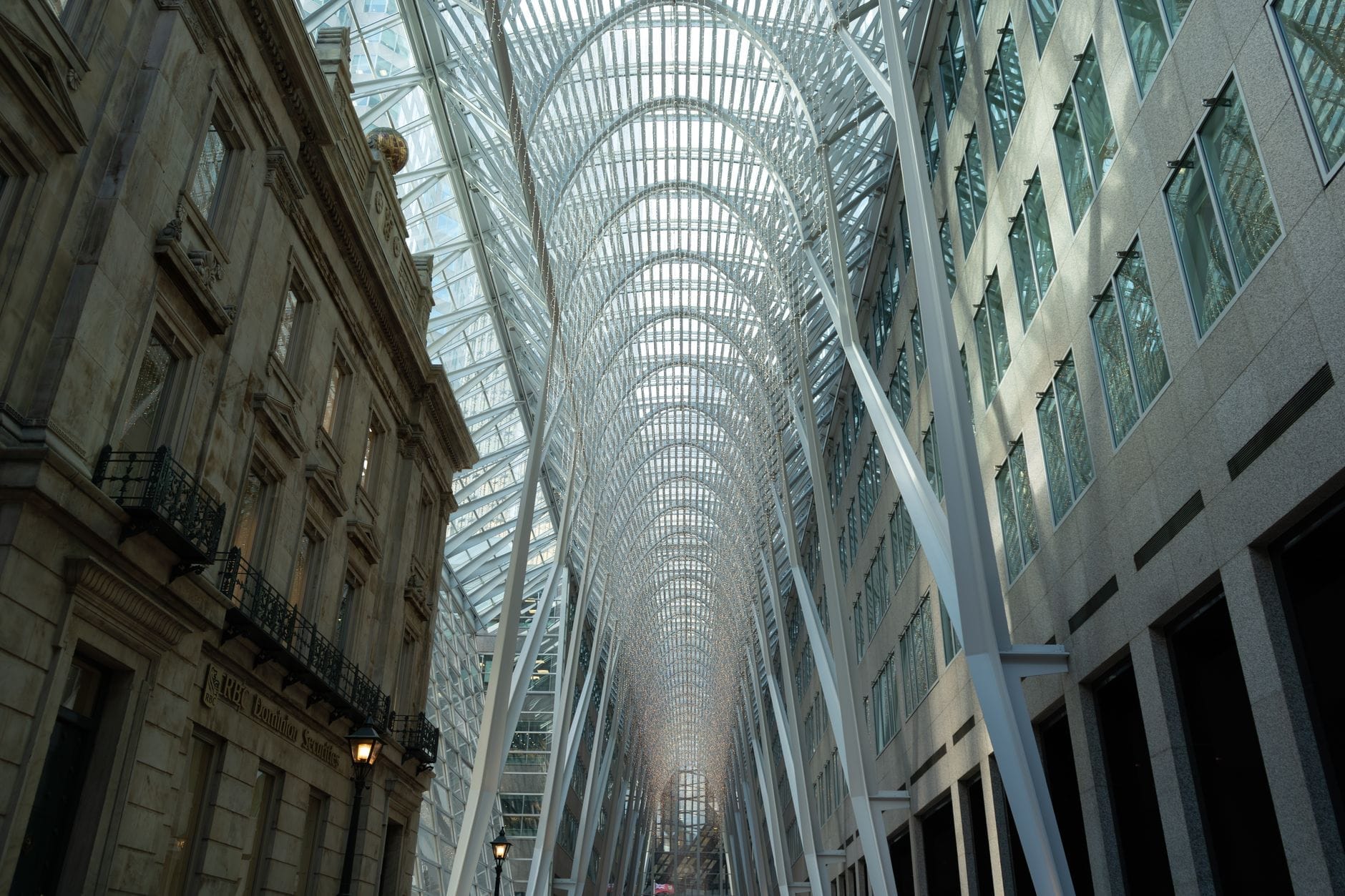
The Allen Lambert Galleria is a steel-and-glass arcade that connects two of downtown Toronto's tallest towers inside the Brookfield Place complex. Designed by Spanish-Swiss architect Santiago Calatrava and completed in 1992 (construction ran from 1987), the galleria stretches roughly 128 metres between the TD Canada Trust Tower (now TD Place) and the Bay-Wellington Tower. It functions as an indoor street: a covered public walkway lined with cafes, food stalls, and retail outlets, all capped by a skeletal white canopy that floods the floor with daylight.
The complex occupies a full 2.1-hectare city block, bounded by Bay Street, Yonge Street, Front Street West, and Wellington Street West. What was then called BCE Place opened to the public in the early 1990s and was later rebranded Brookfield Place when Brookfield Properties acquired the asset. The Allen Lambert Galleria name honours Allen Lambert, a former chair of Toronto-Dominion Bank and a key patron of the project.
ℹ️ Good to know
Entry to the Allen Lambert Galleria is free. You can walk through during the complex's public access hours (typically Monday to Sunday, early morning to late evening; check current hours on the official site), without a ticket or reservation.
The Architecture: Why Calatrava's Design Still Stops People Mid-Step
Calatrava's signature vocabulary, branching white structural ribs that mimic the geometry of bone and foliage, is on full display here. The canopy overhead is formed by a series of arched steel trusses that spread outward as they rise, creating the impression of a forest canopy rendered in industrial materials. On a clear morning, light passes through the glass panels and traces long, shifting shadows down the arcade floor: the effect changes hourly and is quite different at noon than at mid-afternoon.
At street level, the Galleria is about 15 metres wide and rises several storeys at its apex. The scale is generous without feeling cavernous. The white-painted steel framework pops sharply against the stone-clad lower walls, and the tiled floor has a cream tone that amplifies available light rather than absorbing it. On overcast winter days, the space still feels bright compared to the grey streets outside, which is part of what makes it such an effective piece of urban infrastructure.
The galleria also incorporates Heritage Square, connecting to the restored facades of two 19th-century commercial buildings on Yonge Street, integrating the city's Victorian heritage fabric into a late-20th-century corporate complex. This layering of old stone frontages against Calatrava's exoskeletal steel is worth examining closely: look for the contrast where the historic facades meet the new structure at the Yonge Street end.
For broader context on Toronto's built environment, the Toronto architecture guide covers other significant buildings worth pairing with a visit here.
Tickets & tours
Live prices and dates from our booking partner. If you book, we may earn a commission at no extra cost to you.
Toronto Old Town: Dark Side Exploration Game and Tour
From 12 €Instant confirmationFree cancellationLEGOLAND Discovery Centre Toronto tickets
From 16 €Instant confirmationFree cancellationToronto 'Little Canada' entrance tickets
From 27 €Instant confirmationFree cancellationNiagara Falls evening tour with boat, dinner and Illumination Tower
From 77 €Instant confirmationFree cancellation
What a Visit Actually Feels Like, Hour by Hour
Early morning, before 8:30, the Galleria is quieter than you might expect for a space inside a major financial district complex. The food counters are opening, coffee smells drift from the cafes along the arcade's western side, and a handful of office workers cut through on their way to the towers. The light at this hour, entering at a low angle through the south-facing glass, catches the steel ribs and creates long warm lines across the floor. It is probably the best time for photography: crowds are thin, and the morning light quality is exceptional.
By 12:00 to 13:30, the Galleria transforms entirely. The food court section fills with Bay Street professionals on lunch breaks, line-ups form at the more popular stalls, and the acoustic environment shifts from near-silence to a sustained hum of conversation. The architecture becomes harder to appreciate as an object in this period: the space is doing its civic job well, but it is less contemplative. That said, watching the space at capacity gives a different reading of Calatrava's engineering. The structure handles the noise and density without feeling oppressive.
Evenings after 18:00 offer another version entirely. Most of the food operators have closed or are winding down, the office population has thinned, and the galleria returns to something closer to the quiet of early morning. Lighting shifts from daylight supplemented by artificial sources to a primarily artificial environment: the space holds up well, with warm uplighting on the steel frame, but the daytime drama of the glass canopy is absent. It is still worth walking through, but the primary architectural experience is a daytime one.
💡 Local tip
For photography, arrive between 8:00 and 10:00 on a clear day. The south-facing glass canopy channels morning light directly down the arcade, creating the cleanest contrast between the white steel framework and the sky above. A wide-angle or ultrawide lens and a tripod will get you the full vertical sweep from floor to apex.
Getting There and Getting Around Inside
Union Station is the most convenient arrival point. The TTC's Line 1 (Yonge-University) runs through Union, which also serves multiple GO Transit regional rail lines and the UP Express from Toronto Pearson Airport. From Union Station's main concourse, Brookfield Place is a roughly four-minute walk northeast along Front Street, or reachable entirely underground via the PATH pedestrian network, which connects directly into the complex's lower levels.
The PATH connection is especially useful in winter or during heavy rain. Toronto's PATH underground city extends over 28 kilometres of indoor walkways and connects Brookfield Place to Union Station, the Air Canada Centre precinct, and several other downtown towers without stepping outside.
Inside Brookfield Place, the Allen Lambert Galleria runs roughly north-south between Front Street and Wellington Street. The main ground-floor entrances on Bay Street and Yonge Street both open into the galleria or its immediate surroundings. The complex has underground parking accessible from Bay Street, though for a visit focused on the galleria itself, arriving by transit is straightforwardly easier.
Accessibility is good throughout. The galleria level is step-free, lifts connect to the lower PATH concourse and upper retail levels, and the wide, flat floor makes navigation straightforward for visitors with mobility aids or with strollers.
What Else Is in the Complex
The Hockey Hall of Fame occupies a significant portion of Brookfield Place's lower levels and heritage wing, including the restored Bank of Montreal building from 1885 at the Front and Yonge Street corner. If you have children with any interest in ice hockey, or any interest in the sport yourself, this is a natural pairing with a galleria visit. The Hall charges a separate admission fee; check current pricing directly, as it changes periodically.
The Hockey Hall of Fame is genuinely one of the better sports museums in North America, well-curated and worth the entry price even for casual fans.
The retail and dining offer along the galleria itself is primarily aimed at the office-worker lunch trade: upscale food hall counters, a handful of quick-service spots, and a few sit-down restaurants. There are also financial and professional service tenants on upper floors, which means the complex is less oriented toward leisure retail than, say, a conventional shopping centre. Do not come expecting extensive boutique shopping. Come for the architecture, eat if it suits, and perhaps combine with the Hockey Hall of Fame.
💡 Local tip
The Heritage Square courtyard at the Yonge Street end of Brookfield Place is an underused outdoor space between the restored Victorian facades and the new towers. It catches afternoon sun and offers a different perspective on how Calatrava's structure meets the historic streetscape. Worth two minutes of your time.
Fitting Brookfield Place Into a Wider Itinerary
Brookfield Place sits in Toronto's financial district, a few minutes' walk from a cluster of other significant downtown sites. To the south, the waterfront and Harbourfront Centre are about a 10–15-minute walk down Bay Street. Union Station itself is an architectural landmark: the 1927 Beaux-Arts train shed is undergoing ongoing restoration and is worth a slow look if you are passing through. To the east along Front Street, the St. Lawrence Market neighbourhood has one of North America's better food markets.
If you are building a day around downtown architecture, the Union Station and the St. Lawrence Market pair well with Brookfield Place for a focused morning walk that covers the commercial and civic layers of old Toronto.
The galleria visit itself is brief: most people spend 20 to 30 minutes walking its length, looking up, and photographing the canopy. It does not require a significant time commitment, which makes it an easy addition to any downtown itinerary rather than a standalone destination requiring special planning.
Who Should Skip This, and Who Will Love It
If your primary interest is nature, beaches, or outdoor experiences, Brookfield Place will not register as a priority. It is an interior architectural space in the middle of the financial district, and its appeal is intellectual and visual rather than experiential in a broader sense. Similarly, if you have very limited time in Toronto and are choosing between major attractions, the CN Tower, the Royal Ontario Museum, or a trip to the Toronto Islands will give you more varied experiences for the time invested.
Conversely, for anyone with a serious interest in 20th-century architecture, Calatrava's work, structural engineering, or urban design, the Allen Lambert Galleria is genuinely important. It is one of the most significant pieces of architectural work in Toronto, built at a moment when Calatrava was completing his early major commissions and before his style became widely imitated. Seeing it in person, at the right time of day, is a different experience from photographs: the scale and the light behaviour of the glass canopy are not fully communicated in images.
Insider Tips
- The best single photograph of the galleria is taken from near the Wellington Street end looking south: position yourself on the central axis of the arcade and shoot toward the south-facing glass. The white ribs converge in a perspective that makes the space look even larger than it is.
- The restored Bank of Montreal building (circa 1885) at the Front Street and Yonge Street corner is often overlooked because people are focused on Calatrava's steel canopy. Step inside if the doors are open: the original banking hall interior, now part of the Hockey Hall of Fame, is a serious piece of Victorian-era institutional architecture.
- The PATH connection from Union Station brings you directly into Brookfield Place's lower concourse, bypassing the street-level entrances entirely. This is the fastest and driest route on bad-weather days, but it means you miss the exterior view of the complex from Bay Street, which contextualises the scale of the project.
- Lunchtime on weekdays (12:00 to 13:30) is by far the most crowded period. If you want the space to yourself, a Tuesday or Wednesday morning before 9:00 gives you something close to an empty galleria, which is a genuinely different experience from the midday rush.
- Look up at the junctions where the secondary steel ribs branch from the primary arches. The detailing at these nodes is where Calatrava's engineering logic is clearest: each branching point is structurally resolved with the same form language repeated at different scales, a characteristic of his biomorphic structural approach.
Who Is Brookfield Place (Allen Lambert Galleria) For?
- Architecture and design enthusiasts visiting Toronto for the first time or researching Calatrava's work
- Photographers seeking dramatic interior light and geometric structure without a permit or entry fee
- Visitors caught by winter cold or rain who want an indoor route connecting Union Station to the financial district
- Travellers pairing the Hockey Hall of Fame with a broader downtown walk
- Anyone building a half-day itinerary around Toronto's historic and modern financial district streetscape
Nearby Attractions
Other things to see while in Downtown Toronto:
- Allan Gardens Conservatory
Allan Gardens Conservatory is a free, year-round botanical conservatory at 160 Gerrard Street East in downtown Toronto. Housed in six glass display houses anchored by a 1910 Edwardian Palm House, it holds about 1,500 m² of tropical palms, cacti, orchids, and seasonal blooms. One of the oldest parks in Toronto, it remains one of the city's most underrated green spaces.
- Art Gallery of Ontario
The Art Gallery of Ontario is one of North America's largest art museums, housing over 90,000 works inside a landmark Frank Gehry-renovated building in downtown Toronto. From Indigenous Canadian art to European masters and contemporary photography, the AGO rewards focused visitors and casual explorers alike.
- Campbell House Museum
Built in 1822 for Upper Canada's Chief Justice, Campbell House Museum is the oldest surviving residence from the original Town of York. Moved to its current downtown corner in 1972 and opened as a museum in 1974, it offers an intimate, unhurried window into early colonial Toronto — a sharp contrast to the glass towers surrounding it.
- Church-Wellesley Village (Gay Village)
Church-Wellesley Village is Toronto's historic LGBTQ+ neighbourhood, anchored along Church Street between Gerrard and Charles streets. Equal parts social hub, cultural landmark, and community gathering point, it rewards visitors at every hour — from quiet afternoon coffee to the full-volume energy of Pride weekend.
Planning a trip? Discover personalized activities with the Nomado app.