Toronto Union Station: The Grand Gateway to Canada's Largest City
Built between 1914 and 1920 and opened in 1927, Toronto Union Station is both a working rail terminal and a designated National Historic Site. Its soaring Great Hall, limestone columns, and intricate coffered ceilings make it one of North America's finest examples of Beaux-Arts civic architecture. Entry is free, and the station connects most major transit modes in the city under one roof.
Quick Facts
- Location
- 65 Front Street West, Toronto, ON M5J 1E6 — between Bay and York Streets, opposite the Fairmont Royal York Hotel
- Getting There
- TTC Line 1 (Union Station stop); GO Transit trains and buses; UP Express to Pearson Airport; PATH underground walkway access
- Time Needed
- 20–45 minutes to explore the architecture and hall; longer if catching a train or browsing shops
- Cost
- Free to enter the station building. Train, GO Transit, and UP Express fares charged separately by operator.
- Best for
- Architecture enthusiasts, first-time Toronto visitors, transit travellers, photography
- Official website
- torontounion.ca
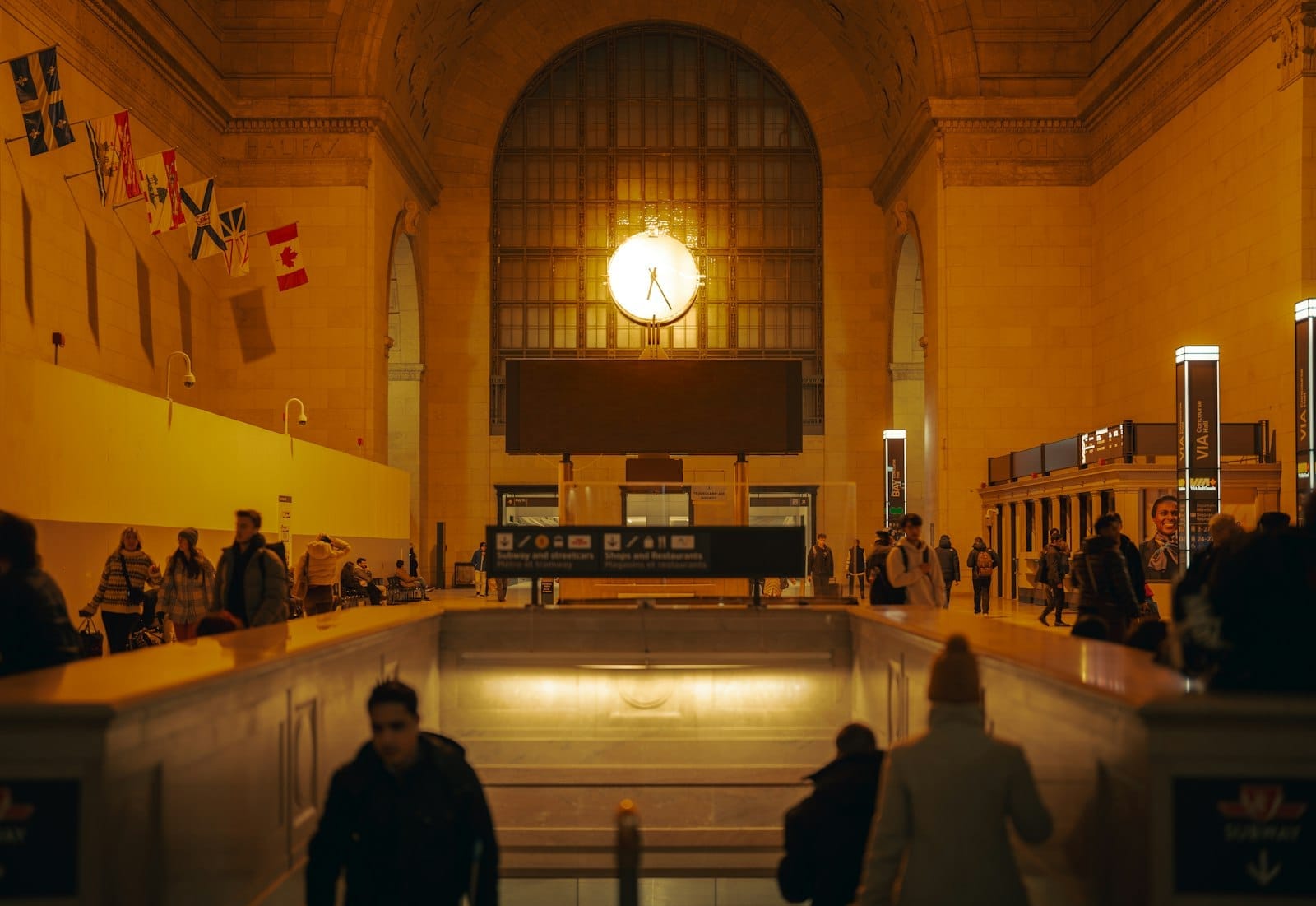
What Union Station Actually Is
Toronto Union Station is Canada's busiest passenger transportation hub, processing over 70 million passengers each year. Sitting at 65 Front Street West in the heart of downtown Toronto, it functions simultaneously as a VIA Rail intercity terminal, a GO Transit commuter rail and bus hub, the downtown terminus of the UP Express airport rail link, a TTC subway station, and the northern anchor of the PATH underground pedestrian network. For most visitors arriving in Toronto by train, this is their first architectural impression of the city — and it is a considerable one.
The station building is generally open daily from around 5:30 a.m. to 12:45 a.m. Entry is free; you pay only if you are actually boarding a train or bus service. This makes it one of the few genuinely grand civic spaces in Toronto that any visitor can walk into without spending a dollar.
💡 Local tip
You do not need a train ticket to enter Union Station and explore the Great Hall. Walk in from Front Street, spend twenty minutes looking up at the ceiling, and leave. Nobody will stop you.
The Architecture: What to Look For
Union Station was constructed between 1914 and 1920, though a series of delays meant it did not open to the public until 1927. It was designated a National Historic Site of Canada in 1975, formally recognized as the Union Station (Canadian Pacific and Grand Trunk) National Historic Site, and it remains one of the finest intact examples of Beaux-Arts civic architecture in North America.
The Great Hall is the centrepiece. It runs roughly the length of a city block and reaches approximately 28 metres at its peak. The ceiling is a coffered barrel vault clad in Guastavino tile, a terracotta interlocking system developed by Rafael Guastavino that was favoured for its structural efficiency and acoustic quality. The floor is Tennessee marble in warm tones often described as pink. The walls are Indiana limestone, the same material used on the exterior facade facing Front Street. Look up long enough and you will notice the names of Canadian cities carved in a frieze running along the upper walls: a roll call of destinations served when the station opened.
The exterior colonnade along Front Street — twelve massive limestone columns supporting a broad entablature — follows the same Beaux-Arts grammar used for the great American stations of the same era: Grand Central Terminal in New York, Washington Union Station, and others. The similarity is deliberate. These stations were designed to project civic confidence and national ambition. Standing outside on Front Street and looking up at that facade against a clear sky is a moment the building still earns.
The station's total gross floor area is approximately 706,426 square feet, with extensive track and platform infrastructure beneath and around it. A major revitalization project in the 2010s restored and reopened much of the concourse space and improved pedestrian circulation. The renovated retail concourse now runs below the Great Hall level, connecting the TTC subway platforms to GO Transit and VIA Rail. For more context on how the station fits into Toronto's broader architectural story, see the Toronto architecture guide.
Tickets & tours
Live prices and dates from our booking partner. If you book, we may earn a commission at no extra cost to you.
Toronto Old Town: Dark Side Exploration Game and Tour
From 12 €Instant confirmationFree cancellationLEGOLAND Discovery Centre Toronto tickets
From 16 €Instant confirmationFree cancellationToronto 'Little Canada' entrance tickets
From 27 €Instant confirmationFree cancellationNiagara Falls tour with local winery visit from Toronto
From 70 €Instant confirmationFree cancellation
How the Experience Changes by Time of Day
Arriving at Union Station at 8:00 a.m. on a weekday is a fundamentally different experience from visiting at noon on a Sunday. During the morning rush, the Great Hall and concourses fill with commuters moving at pace — coffee cups, briefcases, the flat percussion of hard-soled shoes on marble. The scale of the space absorbs the crowd without feeling chaotic, but it is genuinely loud: announcements over the PA system, the low rumble of trains below, ambient conversation amplified by the tile vault above.
Midday on a weekday offers a reasonable middle ground. The commuter surge has passed, the lunchtime food vendors are open, and the hall is populated but not packed. This is the easiest time to stand in the centre of the Great Hall and photograph the ceiling without a sea of heads in the foreground.
Weekend mornings, particularly Sunday before 10:00 a.m., are the quietest periods. The marble floor reflects whatever light comes through the clerestory windows, and the building shows its proportions most clearly when it is not performing as a rush-hour machine. If the architecture is your primary interest rather than the transit spectacle, aim for weekend mornings.
ℹ️ Good to know
The Great Hall is also used as an event venue. On some evenings or weekends, sections may be sectioned off for private events, markets, or seasonal installations. Check the Toronto Union website before visiting if architectural access is the main goal.
Getting There and Getting Around Inside
The station sits at the foot of Bay Street, directly on Front Street West. By TTC subway, take Line 1 to the Union Station stop — the platform exits bring you directly into the lower concourse. From there, escalators and stairs lead up to the Great Hall level and the VIA Rail and GO Transit platforms.
If you are arriving from Pearson International Airport, the UP Express drops you at Union Station in approximately 25 minutes, with trains running every 15 minutes during most service hours. This is by far the most predictable way to get from the airport to the downtown core, and stepping off the UP Express into the station's lower level and emerging into the Great Hall is a decent arrival sequence for a first-time visitor.
For those arriving by car: there is no public parking at Union Station itself. The Gardiner Expressway Bay Street exit deposits you nearby, but street and garage parking in this part of downtown is limited and expensive. The station is designed as a transit destination, not a driving one. If you plan to use it as part of a walking tour of downtown, the PATH underground network connects directly from the station's lower level to much of the Financial District, the Fairmont Royal York Hotel, and buildings north toward Queen Street. Read more about navigating this system in the PATH underground city guide.
Accessibility: VIA Rail lists the station as offering wheelchair access, and the revitalized concourses include improved circulation routes. Elevator access connects the street level, Great Hall, and lower platforms. Travellers with specific accessibility needs — tactile guidance, accessible washrooms, curbside assistance — should confirm details directly with VIA Rail, GO Transit, or the TTC, as each operator manages its own infrastructure within the building.
The Station as a Transit Hub: Practical Notes for Travellers
VIA Rail operates long-distance and corridor services from Union Station, including the Toronto-Montreal and Toronto-Ottawa routes. GO Transit uses the station as its primary downtown terminus for all train lines and several bus routes connecting to the Greater Toronto and Hamilton Area. Fares and schedules for both operators vary by route and season; check viarail.ca and gotransit.com before travelling, as this guide does not quote live fares.
For day trips out of Toronto, GO Transit departures from Union Station give access to destinations including Hamilton, Niagara Falls (via the GO Niagara seasonal service), and towns along the Lakeshore corridor. See the day trips from Toronto guide for route ideas that use Union Station as a starting point.
⚠️ What to skip
GO Transit and VIA Rail platforms are separated within the station. If you are catching a commuter train versus an intercity train, confirm which platform level and entrance applies to your ticket before you arrive. The lower concourse can be confusing to navigate for first-time users.
Photography, Context, and Honest Expectations
The Great Hall photographs well with a wide-angle lens. The coffered vault and the symmetry of the hall reward a shot from the centre of the floor looking toward either end. Natural light enters through the clerestory windows and is strongest in the late morning. In low light or on overcast days, the interior can feel dimmer than expected for a phone camera without flash — bring a camera with decent low-light capability if the ceiling is the target.
The exterior colonnade along Front Street is best photographed in the early morning before the tourist buses and commuter crowds pile up on the sidewalk. The Fairmont Royal York Hotel across the street provides a useful Edwardian counterpoint in the same frame — two institutions of the same era facing each other across Front Street.
It is worth being honest about what Union Station is not. It does not have a dedicated visitor centre or interpretive museum inside (unlike, say, the Toronto Railway Museum at nearby Roundhouse Park, which covers the history of rail in Canada with exhibits and restored equipment). The station is primarily a working building. The retail and food options in the lower concourse are standard transit-station fare: coffee chains, quick-service food, convenience shops. If you are hoping for a curated heritage experience with plaques and guided context, the station alone will not fully deliver that — though the architecture itself speaks clearly enough to anyone paying attention.
The station's immediate surroundings reward exploration. The St. Lawrence Market is a short walk east along Front Street, and the waterfront is a few blocks south. Directly north up Bay Street or York Street, the Financial District's towers rise immediately, and the entrance to Brookfield Place — with its own spectacular atrium — is a five-minute walk. For a full picture of what's walkable from the station, the Toronto waterfront guide covers the lakefront area directly south.
Insider Tips
- The best unobstructed view of the Great Hall ceiling is from the east end of the hall, near the VIA Rail gates, looking west. At this angle the coffered vault is fully visible and foot traffic is lighter than at the main Front Street entrance.
- If you arrive via the UP Express from Pearson, walk up to the Great Hall level before heading to your hotel. Most airport arrivals rush straight to the taxi rank or PATH exits and miss the building entirely.
- The seasonal Toronto Christmas Market, held nearby at the Distillery District, draws large crowds to the city in December, often increasing ridership through Union Station. Union Station becomes unusually crowded on those evenings — plan transit connections with extra time.
- The PATH network entrance inside Union Station is well-signed but the system itself is not intuitive. Pick up a PATH map from a concourse information post or download the TTC/PATH map before navigating underground — the colour coding by building block is the key to reading it.
- Weekend evenings occasionally feature live music or pop-up events in the Great Hall. Check the Toronto Union social media or website calendar for these, as they offer a rare chance to experience the acoustics of the Guastavino vault with something other than PA announcements filling the air.
Who Is Union Station For?
- Architecture and design enthusiasts who want to see one of North America's finest surviving Beaux-Arts interiors
- First-time Toronto visitors arriving by train who want immediate orientation to the city's transit network
- Photographers looking for dramatic civic interiors with natural light and human-scale detail
- Travellers using GO Transit or VIA Rail as a base for day trips across Ontario
- Curious visitors who want a free, weather-proof stop that connects to the PATH, the waterfront, and the Financial District on foot
Nearby Attractions
Other things to see while in Downtown Toronto:
- Allan Gardens Conservatory
Allan Gardens Conservatory is a free, year-round botanical conservatory at 160 Gerrard Street East in downtown Toronto. Housed in six glass display houses anchored by a 1910 Edwardian Palm House, it holds about 1,500 m² of tropical palms, cacti, orchids, and seasonal blooms. One of the oldest parks in Toronto, it remains one of the city's most underrated green spaces.
- Art Gallery of Ontario
The Art Gallery of Ontario is one of North America's largest art museums, housing over 90,000 works inside a landmark Frank Gehry-renovated building in downtown Toronto. From Indigenous Canadian art to European masters and contemporary photography, the AGO rewards focused visitors and casual explorers alike.
- Brookfield Place (Allen Lambert Galleria)
The Allen Lambert Galleria inside Brookfield Place is a free, publicly accessible arcade designed by architect Santiago Calatrava between 1987 and 1992. Its arching steel-and-glass canopy, rising between two of downtown Toronto's tallest towers, is one of the most impressive interior spaces in Canada.
- Campbell House Museum
Built in 1822 for Upper Canada's Chief Justice, Campbell House Museum is the oldest surviving residence from the original Town of York. Moved to its current downtown corner in 1972 and opened as a museum in 1974, it offers an intimate, unhurried window into early colonial Toronto — a sharp contrast to the glass towers surrounding it.
Planning a trip? Discover personalized activities with the Nomado app.