Old City Hall Toronto: A National Historic Site at a Turning Point
Designed by E. J. Lennox and completed in 1899, Old City Hall is one of Toronto's most photogenic landmarks and a designated National Historic Site of Canada. After more than a century of civic and legal service, the building entered a new chapter in April 2025 — making this an unusually interesting moment to visit.
Quick Facts
- Location
- 60 Queen Street West, at the corner of Queen St W and Bay St, Downtown Toronto
- Getting There
- Queen Station (TTC Line 1 – Yonge–University), a short walk west along Queen St W
- Time Needed
- 20–40 minutes for the exterior and surroundings; longer if visiting during a special event
- Cost
- Free to view exterior; no regular general public admission currently. Event access (e.g., Doors Open Toronto) is typically free — confirm per event
- Best for
- Architecture enthusiasts, history seekers, photographers, and anyone walking the Queen & Bay corridor
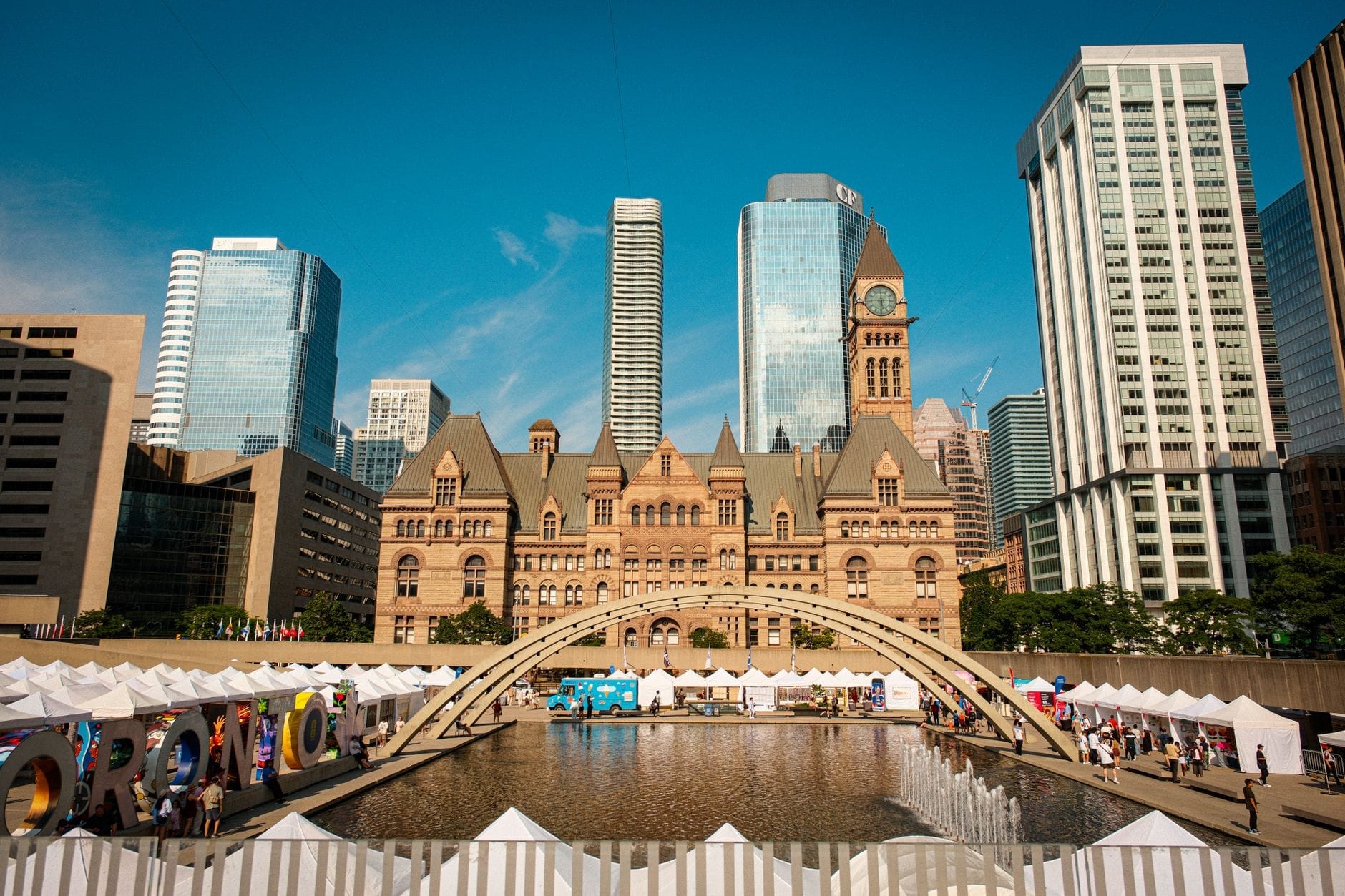
What Old City Hall Actually Is Right Now
Old City Hall is a Richardsonian Romanesque sandstone building that has anchored the corner of Queen Street West and Bay Street since 1899. For most of its life it served Toronto first as the seat of city government, then for decades as a provincial courthouse. The City of Toronto notes it functioned as a provincial courthouse until April 2025, when court operations ceased in the building. It is now largely unused while the City of Toronto and CreateTO assess what comes next.
That transitional status means there are currently no regular public visiting hours. Interior access is limited to scheduled special events. What remains fully open is the exterior, which is among the most detailed and photographically rewarding facades in the entire city. If you are passing through the Queen and Bay area, stopping in front of Old City Hall costs you nothing and takes less than half an hour.
⚠️ What to skip
Interior access is not available for casual drop‑in visitors as of 2025. Before planning a trip specifically to go inside, check the City of Toronto's official events page for scheduled openings such as Doors Open Toronto.
The Architecture: Why This Building Still Stops People
The building was designed by Toronto architect Edward James Lennox, who worked on the plans between 1883 and 1886, with construction running from approximately 1889 to 1899. The style is Richardsonian Romanesque, a North American interpretation of medieval European forms popularized by American architect H. H. Richardson in the 1870s and 1880s. The hallmarks are all present here: rough-cut sandstone in warm buff and reddish-brown tones, rounded arches over the main entrance, deeply recessed windows, and heavy corner towers that give the mass a sense of gravity without appearing oppressive.
The clock tower is the element that rewards the longest look. It rises prominently above the roofline and terminates the view looking north from Bay Street, which means that as you walk south on Bay toward Queen, the tower fills the end of your sightline well before you reach the intersection. This framing was not accidental. Lennox understood axial composition, and the tower functions as a civic anchor in a way that the current City Hall, for all its modernist ambition, does not replicate.
The main entrance on Queen Street features carved stone details including grotesques and decorative foliage around the arched portal. The depth of the carving is visible even from across the street. Up close, the texture of the sandstone is rough to the eye and clearly aged, with subtle color variation between the courses. This is not a building that reads the same way on an overcast November morning as it does in direct afternoon light in October, when the stone takes on an amber warmth that photographs exceptionally well.
💡 Local tip
For photography, late afternoon on a clear day in spring or fall produces the most flattering light on the south-facing Queen Street facade. The surrounding trees on the Nathan Phillips Square side add foreground interest in summer.
Tickets & tours
Live prices and dates from our booking partner. If you book, we may earn a commission at no extra cost to you.
90-minute Toronto express city tour with photo stop at City Hall
From 44 €Instant confirmationFree cancellationToronto Old Town: Dark Side Exploration Game and Tour
From 12 €Instant confirmationFree cancellationLEGOLAND Discovery Centre Toronto tickets
From 16 €Instant confirmationFree cancellationToronto 'Little Canada' entrance tickets
From 27 €Instant confirmationFree cancellation
Historical Context: From City Hall to Courthouse to Uncertain Future
Old City Hall opened in 1899 as the municipal seat of the City of Toronto, replacing an earlier building that no longer met the city's needs. It served as City Hall until 1965, when the current City Hall designed by Finnish architect Viljo Revell opened across the street at Nathan Phillips Square. At that point, the building was converted for use as a provincial courthouse, a role it held until April 2025.
The building was designated a National Historic Site of Canada in 1989, recognized under the official bilingual name Old Toronto City Hall and York County Court House. The designation acknowledged both its architectural significance and its role in Ontario's civic and legal history. It is one of the largest and most elaborate Richardsonian Romanesque civic structures in the country.
The contrast between Old City Hall and the current Toronto City Hall directly across Queen Street is one of the most compelling architectural juxtapositions in downtown Toronto. Revell's 1965 design, with its two curved towers and saucer-shaped council chamber, represents high modernism at civic scale. Lennox's 1899 building embodies the Victorian confidence in ornament and permanence. Standing between them at the Nathan Phillips Square entrance, you can see both traditions clearly, and neither cancels out the other.
The Surrounding Area and How to Work It Into a Visit
Old City Hall sits within a dense cluster of civic and cultural landmarks. Immediately to the west, Nathan Phillips Square serves as the city's main public plaza, used for concerts, markets, the annual winter skating rink, and large civic events. The square is worth a few minutes regardless of the season.
A short walk east along Queen Street brings you to Osgoode Hall, another of Toronto's significant heritage buildings, and further east to the financial district and St. Lawrence Market, one of the best food markets in the city. North along Bay Street leads quickly into the heart of the financial core.
If you are building a walking itinerary around downtown architecture, combining Old City Hall with Osgoode Hall and the Ontario Legislative Building at Queen's Park gives you a coherent survey of Ontario's civic heritage in a single half-day. The distances are walkable, and the contrast between the styles and eras is instructive.
What the Exterior Visit Actually Feels Like
The Queen and Bay intersection is a major pedestrian and transit crossroads. On weekday mornings, office workers stream past in both directions, largely without pausing. On weekends, the pace is slower, and you will often find a handful of visitors stopped on the south sidewalk photographing the facade. The noise here is persistent: streetcar bells, buses, the background hum of a downtown core. This is not a quiet contemplative space, and the building does not ask you to be quiet. It asks you to look.
The best vantage point for taking in the full composition is from the opposite side of Queen Street, ideally from the Nathan Phillips Square side, where you can see the full width of the building with the clock tower above the center. Getting closer lets you study the carved stone details around the entrance arches and along the window surrounds. Both distances reward attention in different ways.
In winter, the stone's gray-brown tones can appear heavy against a low sky, but snow on the ledges and towers gives the building a quality that summer visits do not offer. In summer, the mature trees around Nathan Phillips Square provide green framing that softens the view from across the street. Autumn is arguably the strongest season for a visit, when the light is lower and warmer and the surrounding city takes on color.
Getting There and Practical Notes
The most direct public transit option is Queen Station on TTC Line 1, the Yonge-University line. From the station, Old City Hall is a short walk west along Queen Street West. Streetcar routes on Queen Street also stop nearby. From Union Station, the walk north along Bay Street takes approximately ten minutes and approaches the building from the south along its best axial view.
Underground parking is available at Nathan Phillips Square, with entrances from Bay Street north of Queen, from Queen Street West opposite the Sheraton, and from Chestnut Street north of City Hall. Driving is not necessary for this visit and is not recommended during peak hours given the density of transit options and the walkability of the surrounding area.
Accessibility note: ramp access to the building is available only at the Albert Street entrance. The City of Toronto states there are no accessible washrooms inside Old City Hall. For any event-based interior visit, confirm accessibility provisions in advance through the City's events listings.
ℹ️ Good to know
Doors Open Toronto, the annual free heritage building access event typically held in late spring, has included Old City Hall in previous years. Check the official Doors Open Toronto program each year for confirmed participating buildings and dates.
Who Should Manage Expectations Here
If your interest in Old City Hall is primarily interior, the current situation is genuinely limiting. There is no permanent museum, no interpretive exhibition, and no guided tour program available at the time of writing. Travelers who want a rich interior heritage experience in Toronto are better served right now by nearby options such as Campbell House Museum or the Fort York National Historic Site, both of which offer structured visits with interpretive content.
For architecture enthusiasts, urban photographers, and anyone interested in Toronto's civic history, the exterior alone justifies a stop. This is not a destination that requires ninety minutes; it rewards twenty to thirty minutes of attentive looking, paired naturally with the broader Queen and Bay area.
Insider Tips
- Look for E. J. Lennox's name carved into the building's stonework — he reportedly added it without official approval after the city government failed to credit him properly for the design.
- The view of Old City Hall's clock tower from the south end of Bay Street, looking north, is one of Toronto's classic urban vistas. Walk a full block south on Bay to get the full axial perspective.
- Doors Open Toronto, usually held in May, is your best opportunity for free interior access. Add it to your calendar if you are planning a spring visit — spots for popular buildings fill up quickly.
- The combination of Old City Hall, the current City Hall, and Nathan Phillips Square occupies roughly one city block and can be fully explored in under an hour. Treat them as a single stop rather than separate destinations.
- Early weekend mornings between 7 and 9 AM offer the quietest conditions for photography, with minimal foot traffic and consistent morning light on the south facade.
Who Is Old City Hall For?
- Architecture and heritage enthusiasts who appreciate Richardsonian Romanesque civic design
- Urban photographers looking for a textured, historically layered subject in natural light
- Visitors building a downtown Toronto walking itinerary around civic landmarks
- History-minded travelers interested in Ontario's political and legal history
- Anyone already visiting Nathan Phillips Square or the Queen and Bay corridor
Nearby Attractions
Other things to see while in Downtown Toronto:
- Allan Gardens Conservatory
Allan Gardens Conservatory is a free, year-round botanical conservatory at 160 Gerrard Street East in downtown Toronto. Housed in six glass display houses anchored by a 1910 Edwardian Palm House, it holds about 1,500 m² of tropical palms, cacti, orchids, and seasonal blooms. One of the oldest parks in Toronto, it remains one of the city's most underrated green spaces.
- Art Gallery of Ontario
The Art Gallery of Ontario is one of North America's largest art museums, housing over 90,000 works inside a landmark Frank Gehry-renovated building in downtown Toronto. From Indigenous Canadian art to European masters and contemporary photography, the AGO rewards focused visitors and casual explorers alike.
- Brookfield Place (Allen Lambert Galleria)
The Allen Lambert Galleria inside Brookfield Place is a free, publicly accessible arcade designed by architect Santiago Calatrava between 1987 and 1992. Its arching steel-and-glass canopy, rising between two of downtown Toronto's tallest towers, is one of the most impressive interior spaces in Canada.
- Campbell House Museum
Built in 1822 for Upper Canada's Chief Justice, Campbell House Museum is the oldest surviving residence from the original Town of York. Moved to its current downtown corner in 1972 and opened as a museum in 1974, it offers an intimate, unhurried window into early colonial Toronto — a sharp contrast to the glass towers surrounding it.
Planning a trip? Discover personalized activities with the Nomado app.