Ontario Legislative Building: Inside Queen's Park
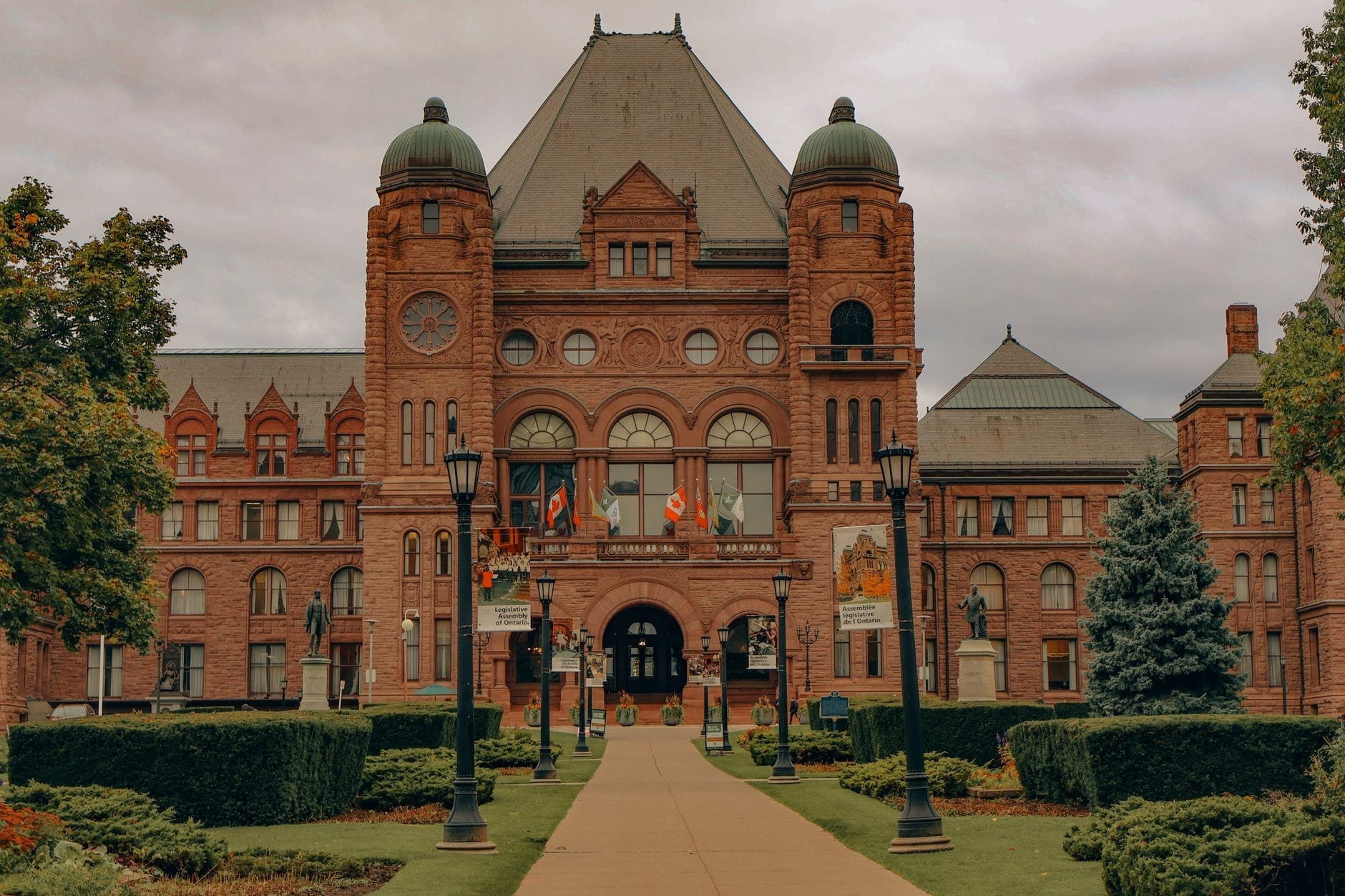
The Ontario Legislative Building is the seat of Ontario's provincial parliament, a Richardsonian Romanesque sandstone landmark officially opened on April 4, 1893 at the centre of Queen's Park. Admission and guided tours are free, making it one of Toronto's most accessible and architecturally significant public buildings.
Quick Facts
- Location
- 1 Queen's Park, Toronto, ON M7A 1A2
- Getting There
- Queen's Park Station (Line 1, ~3 min walk); Museum Station (~8 min walk)
- Time Needed
- 45–90 minutes for a guided tour plus grounds
- Cost
- Free (no admission fee; guided tours free)
- Best for
- Architecture lovers, history enthusiasts, first-time Toronto visitors
- Official website
- www.ola.org/en
What the Ontario Legislative Building Actually Is
The Ontario Legislative Building is the working parliament of Canada's most populous province, not a museum replica or a heritage shell. When the legislature is in session, you can watch elected Members of Provincial Parliament debate from the public gallery, which changes the experience considerably compared to an off-season visit. This is civic architecture still performing its original function, over 130 years after it opened.
The building sits at the head of University Avenue in Queen's Park, a circular green space that effectively forms a ceremonial axis between downtown Toronto and the University of Toronto campus to the north. Its position is deliberate: the sandstone facade faces south, framing the view up from the city core. At street level, the scale only becomes apparent once you pass through the iron gates and approach the main entrance on foot.
ℹ️ Good to know
Security screening is required to enter. Visitors aged 17 and over must present government-issued photo ID. Allow an extra 5–10 minutes, especially on weekdays when staff and visitor traffic is higher.
Architecture: What Makes This Building Unusual
Architect Richard A. Waite designed the building in the Richardsonian Romanesque style, a heavy, expressive approach popularised by American architect H.H. Richardson that favoured rough-hewn stone, round-arched openings, and asymmetric massing. The Ontario Legislative Building is clad in pink Medina sandstone quarried in Ontario, which gives the exterior a warm, reddish-brown tone that shifts visibly depending on light conditions. In morning sun the facade looks almost terracotta; on overcast afternoons it reads as a deeper burgundy.
The structure is described as five storeys with a load-bearing iron frame, which was technically advanced for its completion date in 1893. The building is asymmetrical by design: the central tower does not dominate in the way a classical dome would. Instead, the composition is more horizontal and textural, with carved stone detailing around the main arched entrance that repays close inspection. Look at the column capitals and the carved frieze near the roofline on the south facade before you go inside.
For those already interested in Toronto's built environment, the Legislative Building reads as a useful counterpoint to the modernist towers of the financial district and the Beaux-Arts civic buildings downtown. The Toronto architecture guide covers how this building fits into the city's broader architectural development from the late Victorian era onward.
Tickets & tours
Live prices and dates from our booking partner. If you book, we may earn a commission at no extra cost to you.
Toronto Old Town: Dark Side Exploration Game and Tour
From 12 €Instant confirmationFree cancellationLEGOLAND Discovery Centre Toronto tickets
From 16 €Instant confirmationFree cancellationToronto 'Little Canada' entrance tickets
From 27 €Instant confirmationFree cancellationNiagara Falls evening tour with boat, dinner and Illumination Tower
From 77 €Instant confirmationFree cancellation
The Grounds: Queen's Park Before You Go Inside
Queen's Park is a public green space surrounding the building, and it is worth a slow circuit before entering. The park contains a mix of formal planting, mature trees, and a number of bronze statues and memorial plaques, including the equestrian statue of King Edward VII near the main gates and several provincial war memorials. On weekday mornings, the paths are quiet. On warm afternoons and weekends, university students, office workers, and political demonstrators all share the space in an informal but distinctly Toronto way.
The grounds are also a regular site for public protests and demonstrations, which is worth knowing before you visit. The park's proximity to the University of Toronto means that organized rallies, student demonstrations, and labour gatherings occur here with some frequency. If your visit coincides with one, the experience on the grounds will be louder and more crowded than usual, but the building itself remains open and accessible.
The Guided Tour: What You Actually See Inside
Free guided tours run regularly and cover the main ceremonial spaces: the Legislative Chamber where MPPs sit and debate, the ornate corridors lined with oil portraits of former premiers, the Lieutenant Governor's suite, and the Reading Room. The scale of the interior is different from what the exterior suggests. The ceiling heights in the main corridor are generous, and the carved woodwork and painted stonework in the chamber itself are in considerably better condition than you might expect in a building of this age. Natural light enters through high windows above the chamber floor, giving the space a serious, concentrated quality during daytime visits.
Tours last roughly 45 minutes and depart frequently during opening hours, though frequency can vary. The guides tend to be knowledgeable about both the building's history and current parliamentary procedure, and questions are welcomed. If the legislature is in session during your visit, you may be able to observe Question Period from the public gallery, which runs on a separate schedule. Check the Legislative Assembly's official website before visiting to confirm session dates.
💡 Local tip
Tour frequency and availability can change when the legislature is in session or during special events. Confirm current tour times at www.ola.org or by calling ahead. Weekend public visiting hours are typically 10:00–16:00, especially during the summer season.
Best Times to Visit and How the Experience Changes
Weekday mornings between 10:00 and noon are the least crowded for the interior. The building is generally open to visitors from 08:00 on weekdays, but tours typically begin a little later. Arriving around 09:30–10:00 gives you time to walk the grounds while they are still quiet, then join an early tour before school groups and lunchtime visitors arrive. Weekday afternoons can be noticeably busier when school trips are scheduled, particularly in spring.
Winter visits have a specific quality worth mentioning. The sandstone exterior looks particularly striking against a grey sky or dusted with snow, and the interior is warm and unhurried. Summer brings more foot traffic on the grounds and a livelier park atmosphere, but the building itself is air-conditioned and comfortable. The grounds are at their most photogenic in late April and May when the park's trees are in new leaf, and again in October during the autumn colour period.
For the broader question of when to plan a Toronto trip, the best time to visit Toronto breaks down seasonal conditions, major events, and weather patterns across the year.
Getting There and Practical Details
The most convenient subway stop is Queen's Park Station on TTC Line 1 (Yonge-University), a roughly three-minute walk north along the park path to the building's main entrance. Museum Station, one stop north on the same line, provides an alternative approach from the north side and takes about eight minutes on foot. There is no dedicated parking at the building itself; street parking in the immediate area is limited on weekdays.
The building sits at the edge of The Annex neighbourhood and within easy walking distance of the University of Toronto's St. George campus. Combine the visit with a walk through the university grounds or north into the Annex for a half-day neighbourhood loop. If you are coming from downtown, getting around Toronto by transit covers TTC fares, Presto card setup, and route-planning tools in detail.
Accessibility: the building is open for accessible visits. For specific mobility access arrangements or assistive services, contact the Legislative Assembly's tour office directly before your visit. Security screening at the entrance involves bag checks and metal detectors, which is standard for working government buildings.
Photography and Honest Expectations
The exterior is the most rewarding subject photographically, particularly the south-facing main entrance in morning or early afternoon light when the sandstone colour is most saturated. The surrounding park trees can obstruct wide-angle shots of the full facade from ground level; crossing to the far side of University Avenue or shooting from a slight angle works better than trying to capture the whole building head-on from close range.
Interior photography is generally permitted in public areas, but restrictions apply in the Legislative Chamber. Confirm with your tour guide on the day. Flash photography is not appropriate, and the lighting inside the chamber is relatively dim, so a phone with a capable low-light mode or a camera with a fast lens will produce better results.
The Legislative Building appears on most lists of Toronto's notable views and civic landmarks. For a broader selection of the city's architecturally and visually interesting public spaces, see the guide to best views in Toronto.
Who Should Consider Skipping This
Visitors primarily looking for interactive experiences, hands-on exhibits, or entertainment aimed at young children will likely find the Ontario Legislative Building underwhelming. The building is a working government facility and a formal architectural landmark, not a visitor attraction with designed interpretive experiences. Children under about ten will typically struggle with the pace and format of the guided tour. Families with young kids would be better served by nearby options.
Similarly, if your interest in Toronto is primarily its contemporary food scene, waterfront, or nightlife, this building is unlikely to rank as a priority. The Toronto things to do guide offers a broader breakdown of attractions by interest and neighbourhood to help with prioritisation.
Insider Tips
- Check the Legislative Assembly's official sitting calendar at ola.org before visiting. Observing an active Question Period from the public gallery is a completely different experience from touring an empty chamber, and it costs nothing.
- The building's main entrance faces south but the light on the facade is best in the morning before it moves around to the east side. Arrive by 09:30 for the best exterior photography conditions.
- Security lines can back up on weekday mornings when staff are arriving for work. If you arrive between 08:30 and 09:15, expect a slightly slower entry. The 10:00–11:30 window is generally faster for tour-focused visitors.
- The carved stone details around the main archway are worth examining at close range before entering. Most visitors walk straight past the decorative stonework without looking up. Bring binoculars if you want to see the upper cornice detailing clearly.
- Combine the visit with a walk south through the University of Toronto's St. George campus or north into the Annex. Both are within easy walking distance and add significant context to the building's neighbourhood setting without requiring transit.
Who Is Ontario Legislative Building For?
- Architecture enthusiasts interested in Richardsonian Romanesque buildings and late Victorian civic design
- First-time Toronto visitors wanting a free, substantive cultural experience in the city centre
- History travellers curious about Canadian provincial governance and parliamentary tradition
- Photographers looking for dramatic stone facades and formal public gardens
- Visitors who enjoy combining a building tour with a walk through a historic university precinct
Nearby Attractions
Other things to see while in The Annex:
- Casa Loma
Casa Loma is a 98-room Gothic Revival mansion perched 140 metres above Lake Ontario in Toronto's midtown area. Built between 1911 and 1914 for financier Sir Henry Pellatt, it remains one of Canada's most architecturally ambitious private residences and a landmark worth understanding before you walk through its gates.
- Koreatown
Stretching along Bloor Street West between Bathurst and Christie subway stations, Toronto's Koreatown is a compact but densely packed commercial corridor rooted in a Korean immigrant community that began settling here in the 1970s. Today it draws visitors for Korean BBQ, late-night karaoke, Korean bakeries, and grocery stores stocked with ingredients you won't find elsewhere in the city.
- Little Italy
Little Italy is a lively stretch of College Street between Bathurst and Shaw where Italian-Canadian history, independent cafés, and a strong restaurant culture come together. Access is free, the street is walkable at any hour, and the neighbourhood rewards those who slow down.
- Spadina Museum
Spadina Museum, also known as Spadina House, is a 55-room National Historic Site on Spadina Road in Toronto's Annex neighbourhood. Built in 1866 and redesigned over generations, it preserves the domestic life of one of the city's most prominent families across nearly a century of change. Admission to the house is free, guided tours run Wednesday through Sunday, and the gardens are open daily from 11 a.m. to 5 p.m.
Planning a trip? Discover personalized activities with the Nomado app.