Koreatown Toronto: A Street-Level Guide to Bloor's Korean Strip
Stretching along Bloor Street West between Bathurst and Christie subway stations, Toronto's Koreatown is a compact but densely packed commercial corridor rooted in a Korean immigrant community that began settling here in the 1970s. Today it draws visitors for Korean BBQ, late-night karaoke, Korean bakeries, and grocery stores stocked with ingredients you won't find elsewhere in the city.
Quick Facts
- Location
- Bloor Street West between Bathurst St and Christie St, Toronto, ON
- Getting There
- Bathurst Station (Line 2, west end) or Christie Station (Line 2, east end)
- Time Needed
- 1.5 to 3 hours for a meal and a browse; longer if you linger over karaoke
- Cost
- Free to walk; costs depend entirely on what you eat, drink, or buy
- Best for
- Food explorers, late-night diners, K-culture fans, grocery hunters
- Official website
- koreatownto.com
What Koreatown Actually Is (and Isn't)
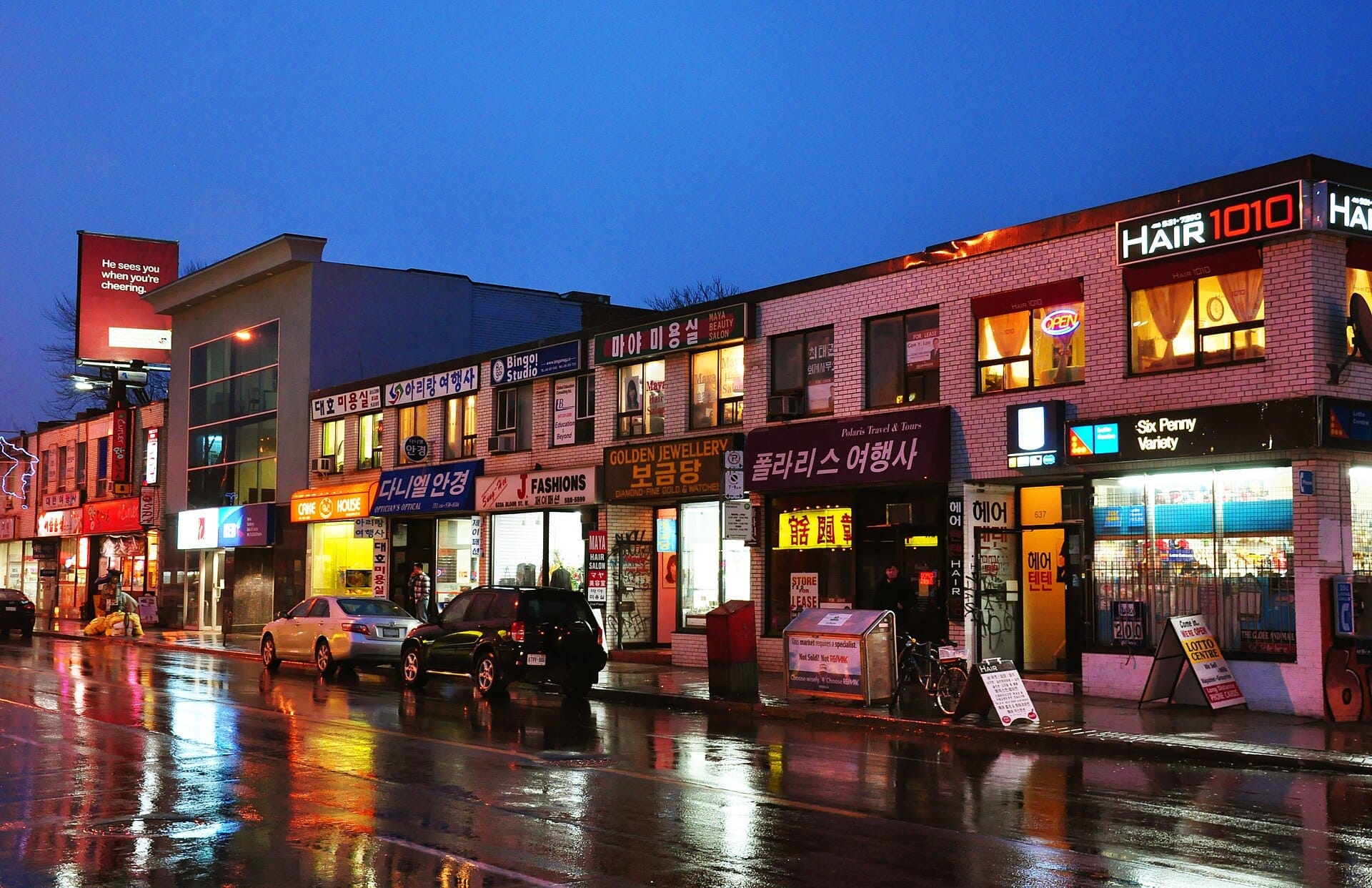
Toronto's Koreatown is not a theme park version of Korean culture. It is a working commercial strip, roughly eight blocks long, where Korean-owned restaurants, grocery stores, bakeries, hair salons, and karaoke rooms operate alongside each other in a stretch of low-rise storefronts that have barely changed in architectural feel since the 1980s. The signage is bilingual, the menus lean toward Korean, and the smell that hits you near a BBQ vent at 7pm on a Friday is unmistakably charcoal-tinged and smoky.
The strip runs along Bloor Street West between Bathurst Street to the west and Christie Street to the east. Both ends are anchored by subway stations on Line 2, making this one of the most transit-accessible ethnic food corridors in the city. You can step off the train and be sitting in front of a banchan spread within five minutes.
Unlike some of Toronto's other cultural enclaves, Koreatown sits in a neighborhood that mixes longtime Korean businesses with newer cafes, bars, and residences serving the surrounding Seaton Village and The Annex communities. The result is a strip that feels genuinely used rather than curated for visitors, which is precisely what makes it interesting.
💡 Local tip
Arrive hungry. The best way to experience Koreatown is to walk the full stretch from Bathurst to Christie first, scanning menus and looking through windows, then double back to wherever the smoke and the crowd pulled you in.
History: How the Strip Came to Be
Korean immigration to Toronto began in significant numbers during the 1970s, following changes to Canada's immigration policy that opened the door to skilled workers and families from Asia. The Bloor Street West corridor became an early focal point for that community, with Korean-owned businesses establishing themselves between Bathurst and Christie through the late 1970s and into the 1980s.
According to the 2016 Canadian Census, the Toronto census metropolitan area was home to approximately 64,000 Korean residents, representing the largest single concentration of Koreans in Canada. The Koreatown strip on Bloor was the commercial heart of that community, and while many Korean Canadians have since moved to suburban areas like North York and Scarborough, the Bloor strip has retained its identity as the symbolic and culinary center of Korean life in the city.
The Korea Town Business Improvement Area (BIA) now formally organizes and promotes the district. The BIA designation, common across Toronto's ethnic commercial corridors, gives the area resources for streetscaping, events, and collective promotion, while individual business owners retain full independence. This structure means the strip evolves organically: restaurants open and close, karaoke bars cycle in and out, and Korean bakery chains arrive without the area losing its ground-level character.
Tickets & tours
Live prices and dates from our booking partner. If you book, we may earn a commission at no extra cost to you.
Toronto Old Town: Dark Side Exploration Game and Tour
From 12 €Instant confirmationFree cancellationLEGOLAND Discovery Centre Toronto tickets
From 16 €Instant confirmationFree cancellationToronto 'Little Canada' entrance tickets
From 27 €Instant confirmationFree cancellationNiagara Falls tour with local winery visit from Toronto
From 70 €Instant confirmationFree cancellation
The Street, Hour by Hour
Koreatown runs differently depending on when you show up. In the morning, between roughly 9am and noon, the strip is quiet. A few Korean bakeries open early, and you can sit at a window seat with a red bean bun and a coffee with very little competition for space. The grocery stores are stocking shelves. This is also the best time to browse without pressure.
By early evening, from around 5pm onward, the character shifts sharply. Restaurant ventilation fans push smoke and garlic out onto the sidewalk. Groups form outside the more popular Korean BBQ spots, and you will often see small clusters of people waiting on the pavement, phones out, checking wait times. The strip has no real pedestrian mall or plaza, so the social energy plays out on the sidewalk itself, which gets genuinely crowded on Friday and Saturday evenings.
Late night is where Koreatown earns a different kind of reputation. Several restaurants serve past midnight, and the karaoke rooms, known as norebang, operate well into the early hours. If you're walking the strip at 11pm, you'll hear muffled singing leaking through walls and see groups of students and young professionals going in and out of the stairwells that lead up to second-floor karaoke venues. This is not a rowdy nightlife strip in the conventional sense; it is more of a prolonged dinner-and-entertainment culture that runs later than most Toronto neighborhoods.
⚠️ What to skip
Weekend evenings at the most popular Korean BBQ restaurants can mean 30 to 60 minute waits. Most spots don't take reservations, or only take them for larger groups. Arrive before 6pm or after 9pm to reduce wait times significantly.
What to Eat and Where to Look
Korean BBQ is the obvious draw, and for good reason. Several restaurants along the strip offer tableside grills where you cook marinated bulgogi, pork belly, and galbi over charcoal or gas, surrounded by small dishes of banchan. The format encourages long meals and shared plates, which is part of why the strip skews toward groups rather than solo diners, though solo visitors are not unusual.
Beyond BBQ, the strip has strong representation of Korean fried chicken (crispy, double-fried, often glazed with sweet chili or soy garlic sauces), Korean Chinese fusion dishes like jajangmyeon and jjampong, and soups including sundubu jjigae and doenjang jjigae. Korean bakeries offer shokupan-style milk breads, cream-filled pastries, and savory buns that make for cheap, filling snacks while walking.
The Korean grocery stores on the strip are worth exploring even if you're not cooking. They stock gochujang, doenjang, instant ramen varieties unavailable in mainstream supermarkets, dried anchovies, and a freezer section of prepared Korean dumplings and rice cakes. If you're building a self-catering itinerary or following the Toronto food guide, Koreatown's grocers are a genuine resource.
Practical Walkthrough: Getting There and Around
Both subway stations that bookend Koreatown sit directly on Bloor Street West. Bathurst Station (at the east end of the strip) and Christie Station (at the west end) are stops on TTC Line 2, the Bloor-Danforth line. The walk between the two stations along Bloor takes about 12 to 15 minutes at a casual pace, which is enough time to take in most storefronts. There is no need for additional transit within the strip itself.
Koreatown is walkable and compact. Bloor Street West has wide sidewalks here, generally in good condition and accessible for strollers and wheelchairs, though individual businesses vary in their step-free access. Parking exists on side streets, but given the direct subway connections, driving adds complexity without benefit. If you're combining this visit with Kensington Market, it's an easy walk or quick transit hop south and west from Bathurst Station.
Weather matters more than people expect. The strip is entirely outdoors; there is no indoor shopping mall or covered market. In January and February, walking the strip in Toronto's winter requires proper cold-weather gear, and the pace naturally quickens as people move between heated restaurants. Summer evenings are the peak experience: warm pavement, open windows, and the full energy of the strip operating at capacity. Autumn, particularly September and October, offers mild temperatures and shorter lines as the tourist season winds down.
ℹ️ Good to know
Photography on the strip is generally unproblematic in public spaces, but Korean BBQ interiors can be dimly lit and smoke-filled. Food photography is easier at lunch or in Korean bakeries and cafes than in evening BBQ restaurants.
Who This Is For, and Who Might Be Disappointed
Koreatown rewards visitors who come with curiosity and flexibility, not a fixed itinerary. If you want a structured tourist experience with English-language signage explaining the cultural significance of every dish, this strip will feel sparse. There are no museums, interpretive panels, or guided tour infrastructure here. It is a neighborhood where people eat, shop, and socialize. That directness is its appeal. Travelers who enjoy Toronto's multicultural neighbourhoods as lived-in spaces rather than curated exhibits will feel immediately at home.
Visitors who need fully accessible venues should do advance research. Wheelchair and stroller access to individual businesses is inconsistent. Some of the most popular BBQ restaurants are up narrow staircases or have steps at the entrance. Calling ahead or checking Google Maps accessibility filters before visiting specific venues is worthwhile.
Solo travelers do fine here, particularly for lunch or early dinner. Large groups benefit from the communal format of Korean BBQ and the shared karaoke room model. Families with children will find the strip manageable during daylight hours; it gets louder and more crowded after 9pm, which some parents may want to factor in.
Insider Tips
- Karaoke rooms (norebang) are rented by the hour for your private group, not performed in front of strangers. Groups of two to eight people can book a room for roughly one to two hours; check in at the front desk, choose songs from a tablet or screen, and the room is yours. It's a low-pressure format that works even for people who don't normally karaoke.
- Korean grocery stores on the strip often have a small prepared food counter near the back selling kimbap rolls, rice cakes, and tteokbokki at low prices. These counters are rarely advertised and are easy to miss if you walk straight to the dry goods.
- If you're visiting on a weekday evening, the stretch closest to Christie Station (the west end) tends to be slightly less congested than the block immediately east of Bathurst. The same restaurants and grocers are present; the foot traffic is just more manageable.
- Many Korean bakeries on the strip put out trays of fresh bread in the late afternoon, around 3 to 5pm. This window, between the morning bake and the evening rush, is the best time to find a full selection without the dinner crowd.
- The side streets just north and south of Bloor in this stretch have Korean-owned businesses that don't make it onto most visitor lists: smaller tofu soup spots, Korean hair and nail salons, and a few convenience stores with better snack selections than the main-strip grocers.
Who Is Koreatown For?
- Food-focused travelers who want a genuine ethnic food corridor rather than a tourist-facing market
- Late-night diners and groups looking for post-dinner karaoke without a nightclub atmosphere
- Home cooks and food market enthusiasts hunting for Korean pantry staples and specialty ingredients
- K-culture followers who want to browse, eat, and absorb rather than visit a formal attraction
- Visitors building a multicultural neighbourhood day that also takes in nearby Kensington Market or The Annex
Nearby Attractions
Other things to see while in The Annex:
- Casa Loma
Casa Loma is a 98-room Gothic Revival mansion perched 140 metres above Lake Ontario in Toronto's midtown area. Built between 1911 and 1914 for financier Sir Henry Pellatt, it remains one of Canada's most architecturally ambitious private residences and a landmark worth understanding before you walk through its gates.
- Little Italy
Little Italy is a lively stretch of College Street between Bathurst and Shaw where Italian-Canadian history, independent cafés, and a strong restaurant culture come together. Access is free, the street is walkable at any hour, and the neighbourhood rewards those who slow down.
- Ontario Legislative Building
The Ontario Legislative Building is the seat of Ontario's provincial parliament, a Richardsonian Romanesque sandstone landmark officially opened on April 4, 1893 at the centre of Queen's Park. Admission and guided tours are free, making it one of Toronto's most accessible and architecturally significant public buildings.
- Spadina Museum
Spadina Museum, also known as Spadina House, is a 55-room National Historic Site on Spadina Road in Toronto's Annex neighbourhood. Built in 1866 and redesigned over generations, it preserves the domestic life of one of the city's most prominent families across nearly a century of change. Admission to the house is free, guided tours run Wednesday through Sunday, and the gardens are open daily from 11 a.m. to 5 p.m.
Planning a trip? Discover personalized activities with the Nomado app.