Nathan Phillips Square: Toronto's Living Room in the Heart of Downtown
Nathan Phillips Square is Toronto's most prominent public plaza, sitting directly in front of the modernist City Hall designed by Finnish architect Viljo Revell. Free to enter and open around the clock, it hosts everything from summer concerts to a winter skating rink, and serves as the gathering point for civic celebrations, protests, and daily life in equal measure.
Quick Facts
- Location
- 100 Queen St W, Toronto, Ontario M5H 2N1
- Getting There
- Queen Station (4 min walk) or Osgoode Station (5 min walk), TTC Line 1
- Time Needed
- 30 minutes to 2 hours depending on events
- Cost
- Free (square itself); some events and activities may charge separately
- Best for
- Architecture lovers, first-time Toronto visitors, winter skating, civic events
What Nathan Phillips Square Actually Is
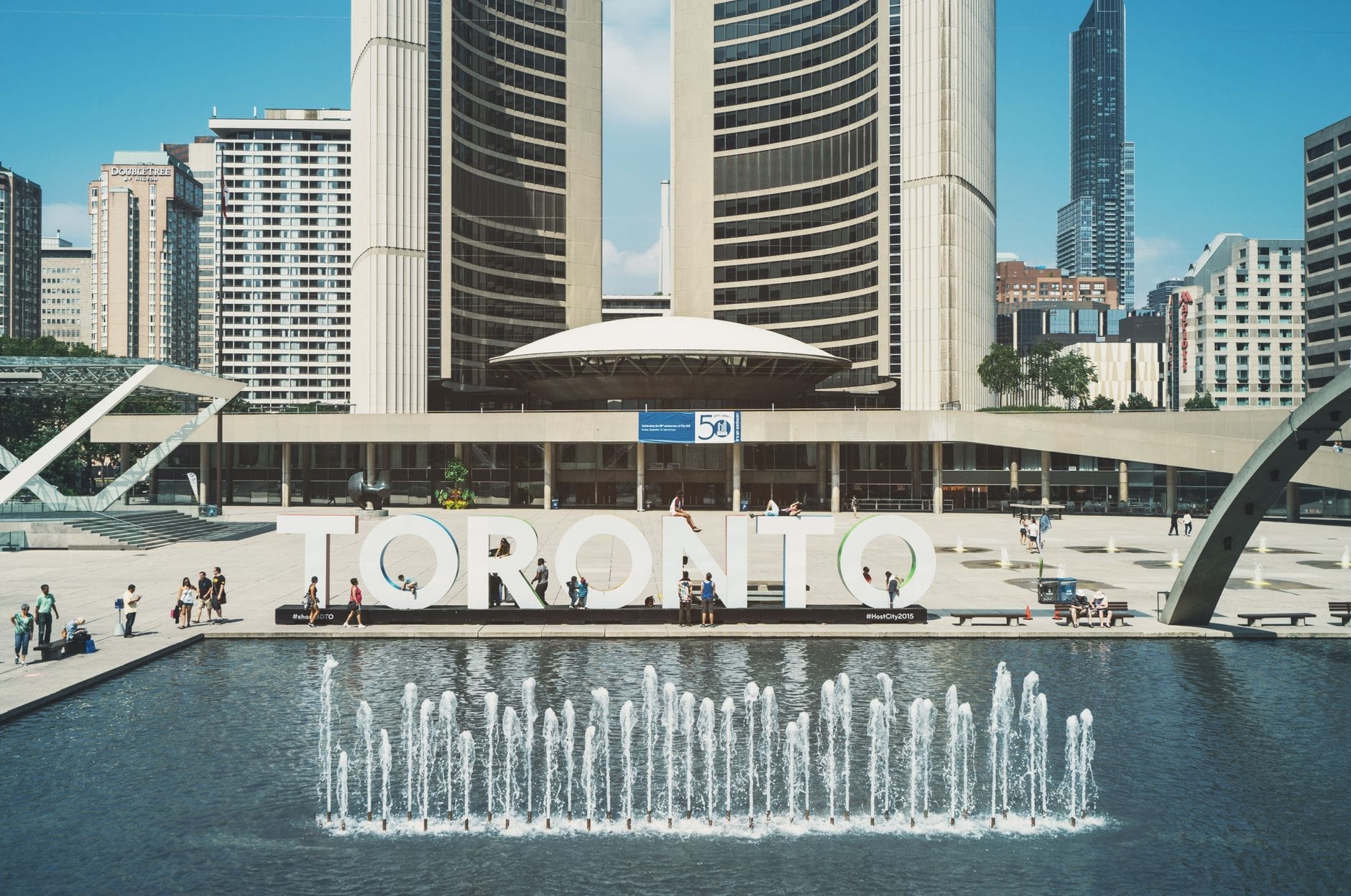
Nathan Phillips Square is a large open civic plaza in the heart of downtown Toronto, fronting the City Hall complex on Queen Street West. It is not a park in the green-space sense: the surface is largely paved, with a central reflecting pool that converts to a skating rink in winter, raised walkways, and the famous "Toronto" sign that has become the most photographed spot in the city. The surrounding architecture does most of the visual work.
The square forms the forecourt of Toronto City Hall, the landmark building designed by Finnish architect Viljo Revell and completed in 1965. The complex, with its two curved towers of unequal height cradling a domed council chamber, represented a decisive break from the conservative civic architecture that preceded it. Revell's design was selected through an international competition that drew entries from 42 countries. Standing in the square and looking directly at the towers gives you a clean understanding of why the building still matters architecturally. For more context on how it fits into the city's built environment, the Toronto architecture guide covers several nearby landmarks worth pairing with a visit.
The square is named after Nathan Phillips, who served as mayor of Toronto from 1955 to 1962. Phillips was instrumental in pushing forward the new City Hall project, and the plaza has carried his name since the complex opened. Both the square and City Hall have heritage designation, which means the structure and its public forecourt are protected from significant alteration.
How the Square Changes Through the Day and Year
Early weekday mornings are the quietest. By around 7:30 a.m., office workers cut through the square from Queen Station, coffees in hand, barely glancing at the reflecting pool. The sound at that hour is mostly pigeons and the low hum of the Queen streetcar a block away. The 'Toronto' sign is often lit but mostly uncontested for photos.
By midday, particularly in warmer months, the square fills noticeably. Food truck zones appear on the western edge, and office workers from the surrounding Financial District eat on the concrete steps. The reflecting pool catches light differently depending on cloud cover: on overcast days the surface goes flat and grey; on sunny afternoons the towers reflect broken and angular across it. From roughly 12 p.m. to 2 p.m. on weekdays from late spring through early fall, the square is at its most social without being overwhelmed.
Evenings vary entirely depending on what is scheduled. On nights without events, the square is atmospheric but not crowded. The City Hall towers are illuminated after dark, and the architectural lighting shifts for holidays and causes throughout the year. On event nights, whether a free concert, a civic ceremony, or New Year's Eve, the square can hold tens of thousands of people and the atmosphere shifts completely.
💡 Local tip
Winter transforms Nathan Phillips Square more than any other season. The reflecting pool becomes a free public skating rink, usually operational from late November through early March depending on temperatures. Skate rentals are available on-site. Arriving on a clear weekday evening, when the ice is freshly resurfaced and the crowd is manageable, gives a very different impression than a busy weekend afternoon.
Tickets & tours
Live prices and dates from our booking partner. If you book, we may earn a commission at no extra cost to you.
Toronto Old Town: Dark Side Exploration Game and Tour
From 12 €Instant confirmationFree cancellationLEGOLAND Discovery Centre Toronto tickets
From 16 €Instant confirmationFree cancellationToronto 'Little Canada' entrance tickets
From 27 €Instant confirmationFree cancellationNiagara Falls evening tour with boat, dinner and Illumination Tower
From 77 €Instant confirmationFree cancellation
The 'Toronto' Sign: Honest Assessment
The large illuminated 'Toronto' sign installed near the reflecting pool is genuinely iconic in the sense that it appears on more social media posts from this city than virtually any other single object. It is also, on busy weekend afternoons and during events, surrounded by lineups of people waiting for unobstructed photos. If that photo matters to you, arrive before 9 a.m. or after 9 p.m.
The sign itself has no great historical depth; it was introduced as a promotional installation and later became permanent. Its value is functional rather than architectural: it orients photos, provides a sense of scale against the City Hall towers behind it, and on winter nights with snow on the ground and skaters in the background, it is genuinely striking. Treat it as a backdrop rather than a destination in its own right and you will not be disappointed.
Events and Seasonal Programming
The City of Toronto uses Nathan Phillips Square as its primary outdoor civic event space. The programming across a calendar year is substantial. In summer, the square hosts free concerts, cultural festivals, film screenings, and public celebrations. The Toronto Caribbean Carnival (Caribana) route and associated events draw large crowds to the downtown core during late July and early August, with the square serving as a focal gathering point.
In the weeks leading up to Christmas, the Toronto Christmas Market in the nearby Distillery District pulls a lot of attention, but Nathan Phillips Square runs its own winter programming centered on the skating rink, which tends to be more accessible and free of admission charges. New Year's Eve celebrations at the square draw large crowds and include fireworks.
Event schedules are published by the City of Toronto and change each year. Before visiting with a specific event in mind, check the official City of Toronto events calendar. The square is also used for political rallies and public demonstrations; these are a legitimate and historically consistent use of the space, though they can affect access to certain areas.
Practical Walkthrough: Getting There and Around
The most direct transit approach is via the TTC Line 1 subway to Queen Station, which puts you on Queen Street West. From the station exit, the square is visible within a short walk west along Queen. Osgoode Station, one stop west on Line 1, deposits you closer to the western edge of the square and is slightly less crowded during peak hours. Both walks are straightforward and flat.
The Queen streetcar (Route 501) runs along Queen Street West and stops directly adjacent to the square, which is useful if you are coming from the east near the Distillery District or from the west near Trinity Bellwoods. For visitors oriented around the waterfront, the square is about a 15-minute walk north from Harbourfront.
The square is wheelchair accessible, with barrier-free routes connecting the plaza surface to City Hall and the surrounding sidewalks on Queen Street West and Bay Street. The concrete surface is level across most of the plaza, though the raised walkway sections around the perimeter involve gradients. Winter conditions with ice and snow require extra care near the skating rink perimeter.
ℹ️ Good to know
Adjacent to the square on its eastern side stands the former City Hall (now called Old City Hall), a Richardson Romanesque building from 1899 that currently houses the Ontario Court of Justice. The visual contrast between the 1899 and 1965 structures facing each other across Bay Street is one of the more instructive urban moments in downtown Toronto.
Photography Notes and Viewing Angles
The best elevated view of the square and City Hall together comes from the second-floor walkway on the south side of the plaza, which puts you level with the lower portions of the towers and gives a sense of the spatial relationship between the curved structures and the open forecourt. Ground level is fine for the 'Toronto' sign but compresses the towers.
The reflecting pool, when calm and free of skaters, mirrors the towers in a way that rewards patience. Wind disrupts the reflection within minutes. Early morning in spring or fall, before crowds arrive and before the surface is disturbed, gives the cleanest results. In winter, the rink surface itself photographs well under artificial lighting at dusk, especially when skaters are present but not densely packed.
Wide-angle lenses help when shooting from within the plaza; the towers are too close and too tall to capture comfortably with a standard focal length. For shots of the full facade including the dome, crossing Queen Street to the south and shooting from the opposite sidewalk gives more working distance.
Who Should Consider Skipping This
Visitors primarily interested in natural landscapes, waterfront walks, or neighborhood character will get more from their time elsewhere. Nathan Phillips Square is concrete, urban, and civic in nature. There are no gardens to speak of, no waterside access, and no quiet retreats. If your interest is green space, the city's parks and ravine network is a better investment of time.
If you have already seen City Hall and the square on a previous visit, the marginal return on a repeat trip is low unless a specific event is scheduled. The square also sits in a part of downtown that can feel anonymous to visitors without a plan: combine it with nearby attractions like the Art Gallery of Ontario to the northwest or St. Lawrence Market to the east to anchor a worthwhile morning or afternoon in the core.
Insider Tips
- The Henry Moore sculpture 'The Archer' stands on the northwest edge of the plaza and is easy to walk past without noticing. It was acquired by the city in 1966 amid considerable public controversy about spending, and Moore himself contributed personally to help fund the purchase. It is worth a close look before you leave.
- Weekday lunch hours from late May through September bring food trucks to the square's perimeter. The lineup quality and variety changes year to year, but arriving around 11:45 a.m. before the main office crowd hits gives you first choice.
- The skating rink operating season depends on sustained cold temperatures and can be shortened in mild winters. Check the City of Toronto's skating rink page directly before making a special trip in late November or early March.
- For New Year's Eve, the square is one of Toronto's main celebration spots. Arrive well before midnight if you want a position with sightlines. The area around Queen and Bay fills up earlier than most visitors expect, often by 9 p.m.
- The Peace Garden, a small contemplative space within the square dedicated in 1984 as part of the 40th anniversary of D-Day, is tucked away and consistently overlooked. It includes an eternal flame and is worth a minute if you want a quieter corner of the plaza.
Who Is Nathan Phillips Square For?
- First-time visitors to Toronto wanting to orient themselves in the civic core
- Architecture enthusiasts interested in mid-century modernism and urban design
- Families with children looking for free winter skating in a central location
- Visitors who want to combine a plaza stop with nearby cultural institutions
- Travelers who enjoy understanding how a city's residents use public space
Nearby Attractions
Other things to see while in Downtown Toronto:
- Allan Gardens Conservatory
Allan Gardens Conservatory is a free, year-round botanical conservatory at 160 Gerrard Street East in downtown Toronto. Housed in six glass display houses anchored by a 1910 Edwardian Palm House, it holds about 1,500 m² of tropical palms, cacti, orchids, and seasonal blooms. One of the oldest parks in Toronto, it remains one of the city's most underrated green spaces.
- Art Gallery of Ontario
The Art Gallery of Ontario is one of North America's largest art museums, housing over 90,000 works inside a landmark Frank Gehry-renovated building in downtown Toronto. From Indigenous Canadian art to European masters and contemporary photography, the AGO rewards focused visitors and casual explorers alike.
- Brookfield Place (Allen Lambert Galleria)
The Allen Lambert Galleria inside Brookfield Place is a free, publicly accessible arcade designed by architect Santiago Calatrava between 1987 and 1992. Its arching steel-and-glass canopy, rising between two of downtown Toronto's tallest towers, is one of the most impressive interior spaces in Canada.
- Campbell House Museum
Built in 1822 for Upper Canada's Chief Justice, Campbell House Museum is the oldest surviving residence from the original Town of York. Moved to its current downtown corner in 1972 and opened as a museum in 1974, it offers an intimate, unhurried window into early colonial Toronto — a sharp contrast to the glass towers surrounding it.
Planning a trip? Discover personalized activities with the Nomado app.