Distillery Winter Village: Toronto's Premier Holiday Market
Each winter, the cobblestone lanes of the Distillery Historic District fill with holiday cabins, glowing lights, and the smell of mulled wine. The Distillery Winter Village is Toronto's original and world-famous Christmas market, drawing large crowds across its season from mid-November to early January.
Quick Facts
- Location
- 55 Mill Street, Distillery Historic District, Toronto, ON M5A 3C4
- Getting There
- TTC King streetcar to Parliament St or Cherry St, then a short walk south to the Mill St entrances
- Time Needed
- 2 to 3 hours for a relaxed visit; longer if dining or attending evening events
- Cost
- Free entry daily before 4 p.m.; CA$15+HST general admission on ticketed periods (Fridays, Saturdays, Sundays after 4 p.m., Thursdays in December after 4 p.m., and December 15–31 after 4 p.m.); children 9 and under always free
- Best for
- Holiday atmosphere, Victorian architecture, seasonal food and drink, evening photography
- Official website
- www.thedistillerywintervillage.com
What the Distillery Winter Village Actually Is
The Distillery Winter Village is a seasonal holiday event held annually in the Distillery Historic District, a pedestrian-only precinct of preserved 19th-century industrial buildings on the eastern edge of downtown Toronto. It typically runs from mid-November through early January. The 2025-26 season spans Thursday, November 13, 2025 through Sunday, January 4, 2026.
The event began in 2010 as a 10-day European-style Christmas market and has expanded considerably since. In 2020, it was rebranded as The Distillery Winter Village, reflecting a broader winter programming identity beyond the original market format. Now in its 16th year, the event attracts large crowds each season, making it one of the most popular holiday events in Toronto.
The venue itself is part of the story. The Distillery Historic District occupies the site of the former Gooderham and Worts Distillery, once the largest distillery in the British Empire. The Victorian-era industrial architecture — red brick warehouses, cast-iron facades, narrow laneways — creates a backdrop that few purpose-built Christmas markets can replicate.
💡 Local tip
Tickets are required on Fridays, Saturdays, and Sundays after 4 p.m., on Thursdays in December after 4 p.m., and daily from December 15 to 31 after 4 p.m. Ticketing is online only — there is no box office on site. Book before you go.
The Setting: Victorian Brickwork Meets Holiday Lights
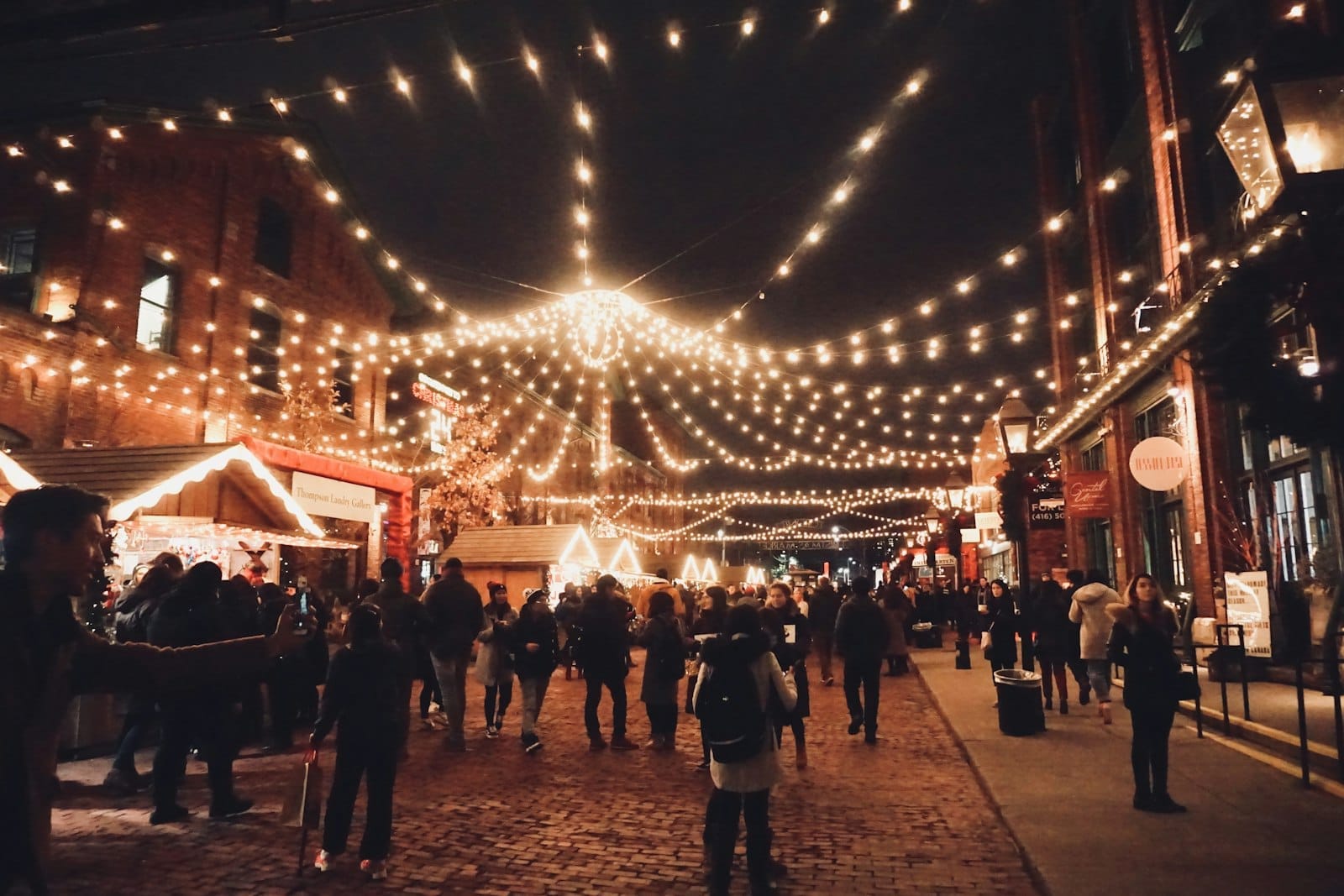
Walking into the Distillery Historic District in winter is a specific sensory experience. The cobblestones underfoot are uneven and old, worn smooth in places, and often dusted with frost or a thin layer of snow after a cold night. The brick buildings rise two and three stories on either side, their mortar lines darkened with age. At street level, the wooden market cabins are wedged into the laneways, their counters displaying ornaments, scarves, jewelry, and seasonal food.
The smell changes depending on where you stand. Near the food stalls, it is roasted nuts and mulled wine. Closer to the artisan vendors, it shifts to pine and cedar. On cold evenings, wood smoke drifts across the plaza from fire features positioned throughout the district. The combination of these textures and smells, set against the Victorian industrial facade, is genuinely unlike most other Canadian holiday events.
During daylight hours, the architectural details of the district are easier to read. The Gooderham and Worts buildings have plaques and interpretive signage, and the proportions of the old cooperage, pump house, and malt house are visible against the winter sky. After dark, the entire district is strung with overhead lights and the building facades are often illuminated, which shifts the atmosphere entirely. The architecture recedes and the market takes over visually.
Tickets & tours
Live prices and dates from our booking partner. If you book, we may earn a commission at no extra cost to you.
Toronto Old Town: Dark Side Exploration Game and Tour
From 12 €Instant confirmationFree cancellationLEGOLAND Discovery Centre Toronto tickets
From 16 €Instant confirmationFree cancellationToronto 'Little Canada' entrance tickets
From 27 €Instant confirmationFree cancellationNiagara Falls tour with local winery visit from Toronto
From 70 €Instant confirmationFree cancellation
Timing Your Visit: Daytime vs. Evening
The experience varies considerably depending on when you arrive. Weekday mornings and early afternoons are the quietest windows. Retailers open at 10:00 a.m. and outdoor shopping cabins and food vendors open at 12:00 p.m. During these hours, the market has a much more relaxed pace. You can browse cabins without being pressed against other visitors, find seating at outdoor food stalls, and actually have a conversation with vendors.
Weekend evenings after 4 p.m. are a different situation entirely. This is peak attendance, which is why ticketed entry exists for those periods. The laneways become very crowded and movement slows to a shuffle in the busiest sections near the central plaza. The lights and atmosphere are at their best during these hours, but the crowd density is a real factor. If you are sensitive to tight spaces, have mobility limitations, or are visiting with very young children in a stroller, a weekday afternoon visit will be far more comfortable.
⚠️ What to skip
The Distillery District's cobblestone streets are genuinely difficult to navigate in a wheelchair or with a stroller. The stones are uneven and there are few smooth-surface alternatives within the main market area. Plan accordingly, and consider visiting during off-peak hours when the crowds are thinner.
Late-evening tickets (listed at CA$30 for a 7 p.m. to midnight window on the official site) are marketed for adults seeking a more atmospheric, less family-oriented visit. These time slots tend to attract a different crowd than the earlier evening slots and the experience leans more toward the food, drink, and light installations than shopping.
What to Do and See Inside
The market cabins are concentrated along Trinity Street and the central lanes of the district. Vendors change each season, but the mix typically includes handmade jewelry, knitted goods, holiday ornaments, art prints, leather goods, and imports from European Christmas market traditions. This is not a big-box retail experience. The majority of vendors are independent makers and small businesses, which means pricing reflects that.
Food and drink are central to the visit. Mulled wine and hot apple cider are sold at multiple points. Raclette, bratwurst, perogies, and specialty hot chocolates appear regularly in the food cabin rotation. The restaurants and bars in the permanent Distillery District buildings are also open and provide a warm refuge from the cold. The Boiler House, El Catrin, and other established venues are all accessible during the market season.
There is usually a large Christmas tree installation in the main plaza, along with a Ferris wheel or other seasonal ride structures, depending on the year. Programming often includes live music on weekends, carol performances, and occasional special evening events. Check the official website for the current season's programming schedule, as it changes each year.
For visitors using the market as a starting point, the surrounding area rewards exploration. The St. Lawrence Market is a 15-minute walk west, and the Corktown Common park is a short distance to the east. For a broader sense of what makes the Distillery District worth visiting beyond the holiday season, the Toronto architecture guide covers the heritage significance of these Victorian industrial buildings in more detail.
Practical Details: Getting There, What to Wear, Photography
The Distillery Historic District sits east of downtown Toronto, centred at Mill Street and Parliament Street, with Cherry Street to the east and just south of Front Street East. The most reliable transit approach is the TTC streetcar on King Street East, exiting near Parliament or Cherry Street, followed by a 5 to 10 minute walk south to Mill Street. During the market season, signage directs visitors from the streetcar stops.
Driving to the Distillery Winter Village is possible but not particularly practical on peak evenings. Street parking in the surrounding area fills quickly, and the closest lots fill well before the 4 p.m. transition to ticketed hours on busy nights. Transit is the more reliable option for evening visits.
Dress for genuine Ontario winter conditions. Temperatures in November and December in Toronto routinely sit around -5 to 5 degrees Celsius, and the market is almost entirely outdoors except for the permanent restaurants. Wind cuts across the open plaza in the centre of the district. Waterproof boots with grip are strongly advisable given the cobblestones, which can be icy after freezing rain. The market runs rain or shine, and tickets are non-refundable, so check the forecast before you go.
For photography, the best conditions are either in the late afternoon before sunset for a mix of natural light and the illuminated strings, or after full dark when the lights reflect off wet cobblestones. A wide lens captures the narrow laneways with their overhead lighting. The main plaza, with the central Christmas tree and the brick facades behind it, is the most photographed composition. Arrive 20 minutes before dusk on a weekday to get that shot without crowds in the frame.
Honest Assessment: Is It Worth It?
The Distillery Winter Village is Toronto's most visually compelling holiday event, primarily because the venue is extraordinary. No other holiday market in the city has architecture like this. That said, the peak evening experience can feel more like crowd management than a relaxed market browse. If your expectation is the unhurried, walk-at-your-own-pace atmosphere of a European Christmas market, a weekday afternoon visit is the version that delivers that.
The CA$15 general admission on ticketed evenings is reasonable for a timed-entry event in a heritage district, but it is worth knowing that a weekday daytime visit is free. The market has become very popular with out-of-town visitors and large groups, and the indoor-outdoor mix of permanent restaurants and market cabins means spending can escalate quickly once food and drinks are included.
Visitors primarily interested in shopping rather than atmosphere may find the selection feels limited compared to a full indoor market. Travelers who want a broader overview of Toronto's holiday options can compare this with Nathan Phillips Square, which hosts a skating rink and its own winter programming in a very different urban setting. For those building a full seasonal itinerary, the Toronto in winter guide covers the full range of cold-weather activities across the city.
Who should skip it: visitors who struggle with large crowds, anyone expecting extensive product variety across dozens of vendor categories, and families with infants in strollers who are not prepared for cobblestone navigation. The market is not ideal for people who dislike cold weather and have no interest in the outdoor component, since the indoor alternatives within the district are the permanent restaurants, not additional market space.
Insider Tips
- Weekday visits between noon and 3 p.m. offer the same visual experience as weekend evenings without the ticket requirement or the crowd density. If your schedule is flexible, this is the version to choose.
- The cobblestones ice over quickly after freezing rain or overnight frost. Boots with actual grip (not fashion boots) make a material difference to how much you enjoy the visit.
- The permanent Distillery District restaurants accept reservations independently of the market ticketing system. If you plan to have dinner, booking a table at El Catrin or another district venue means you have a warm, guaranteed seat regardless of outdoor conditions.
- Photography is best about 20 to 30 minutes after sunset when the sky still has deep blue tones and the string lights are fully on. This window is brief and not well-known — arrive early on a weekday to take advantage of it without crowds.
- The outdoor market cabins do not open until 12 p.m., even though retailers open at 10 a.m. If you arrive at 10, you will find the permanent shops open but the food vendors and most seasonal cabins still closed. Factor this into your planning if the market experience itself is the priority.
Who Is Distillery Winter Village (Toronto Christmas Market) For?
- Couples looking for a seasonal evening out with atmosphere and food options
- Visitors interested in Victorian industrial architecture who want to see the Distillery District in its most dramatic setting
- Photographers seeking a strong winter light subject in an urban heritage context
- Families with older children who can manage cobblestones and cold temperatures
- Travelers building a Toronto holiday itinerary who want a distinctly local event rather than a generic mall-based experience
Planning a trip? Discover personalized activities with the Nomado app.