Corktown Common: Toronto's Best Urban Park You Haven't Spent Enough Time In
Corktown Common is an 18-acre public park on remediated industrial land in Toronto's West Don Lands, opened in 2013. It combines a children's splash pad, constructed wetlands, an open-air fireplace pavilion, and sweeping downtown skyline views, all for free. Whether you're cycling the Don Valley Trail, chasing toddlers through water jets, or simply finding a quiet bench at dusk, this park consistently rewards.
Quick Facts
- Location
- 155 Bayview Avenue, Toronto, ON M5A 0G4 (West Don Lands / Corktown)
- Getting There
- TTC 504 King streetcar to Lower River St, then walk south to Bayview Ave entrance
- Time Needed
- 45 minutes to 2 hours depending on season and activities
- Cost
- Free (CAD $0 admission year-round)
- Best for
- Families with young children, cyclists, picnickers, sunset photography
- Official website
- www.waterfrontoronto.ca/our-projects/corktown-common
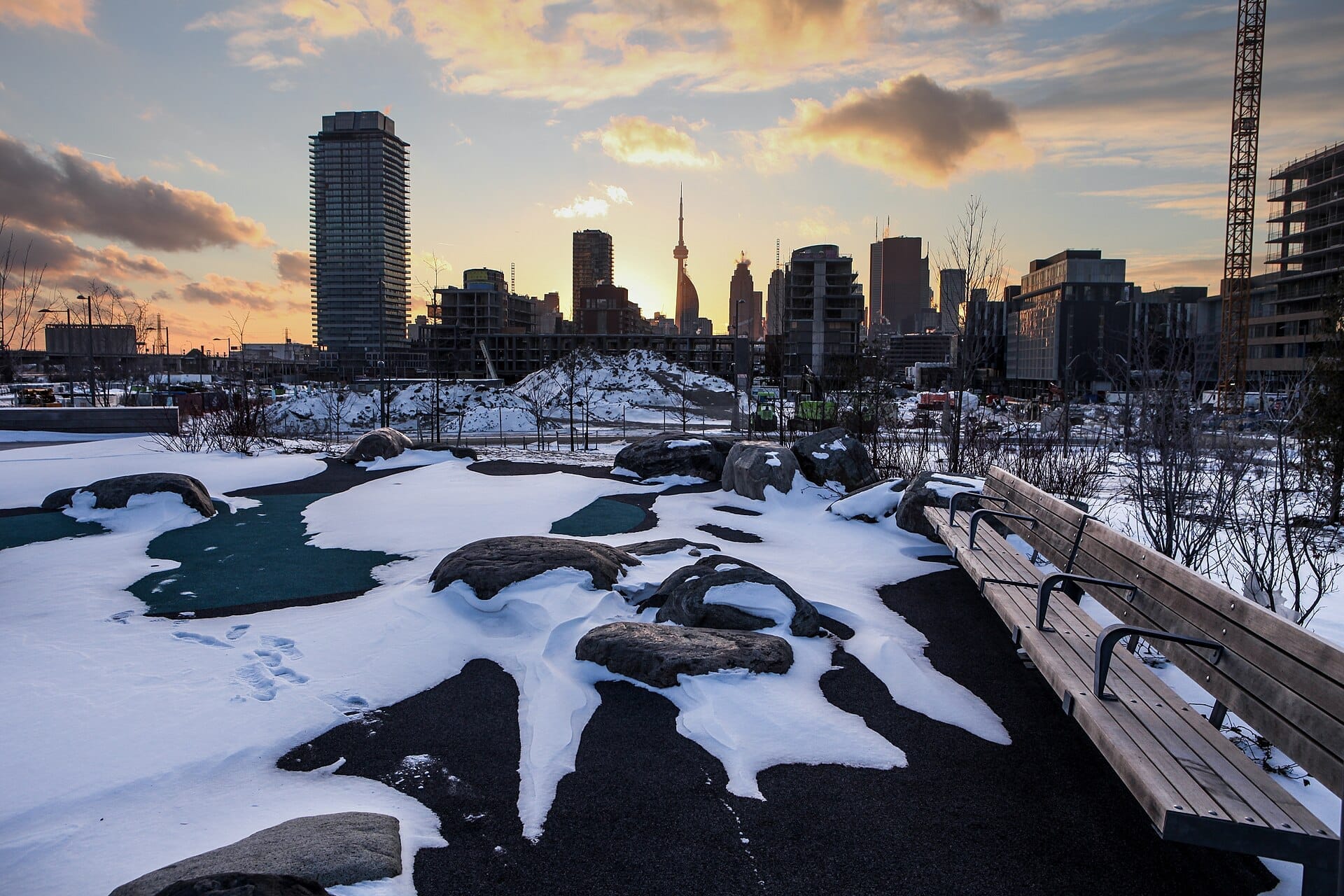
What Corktown Common Actually Is
Corktown Common is a 7.3-hectare (18-acre) public park that opened in 2013 on land that spent most of the 20th century as contaminated industrial ground in Toronto's West Don Lands. The name came from a public contest, replacing the working title Don River Park. Designed by landscape architecture firm Michael Van Valkenburgh Associates, the park was built to do two things simultaneously: give a new residential neighbourhood a genuine civic gathering space, and serve as a flood-protection landform helping shield over 500 acres of the surrounding city from the Don River.
The result is a park that feels more considered than most. There is a constructed wetland planted with native species, a large children's splash pad beneath a canopy structure, an open-air pavilion with a wood-burning fireplace used for winter skating gatherings, a dog off-leash area, and a small rectangular reflecting pond that has in the past doubled as a skating rink in January and February. Grass berms slope gently upward at the park's perimeter, providing informal seating and the elevated sight lines that make the downtown skyline visible from almost anywhere inside.
ℹ️ Good to know
No parking on site, and no car access. Come by TTC 504 King streetcar (alight at Lower River St), by bicycle via the Don Valley Trail through the Bala Underpass, or on foot from the Distillery District, which is about a 10-minute walk north.
The Park at Different Times of Day
Early mornings, roughly 7am to 9am on weekdays, the park belongs to dog walkers and solo runners. The off-leash area is active, the wetland is quieter, and the light hitting the CN Tower from the grass berms is genuinely excellent for photography. There is almost no crowd noise at this hour; you mostly hear the creak of a nearby rail bridge and water moving through the constructed marsh.
By mid-morning on summer weekdays, families with strollers arrive in earnest, and the splash pad fills up fast once temperatures push past 24°C. The sound shifts entirely: shrieking children, water jets cycling on and off, the smell of sunscreen. On summer weekends, the whole park can feel genuinely packed by 11am, with every picnic blanket spot on the main lawn occupied and the splash pad queueing informally. If you want the splash pad with young children and minimal chaos, weekday mornings in June or early September are the window.
Late afternoon, particularly from 4pm onward, is the most photogenic time. The low western light catches the wetland grasses and the skyline simultaneously. This is also when cyclists coming off the Martin Goodman Trail or the Don Valley Trail tend to stop through. In autumn, the native plantings in the wetland turn bronze and copper, and the park is substantially quieter than summer, making it one of the better places in the inner city to walk without a plan.
Tickets & tours
Live prices and dates from our booking partner. If you book, we may earn a commission at no extra cost to you.
Toronto Old Town: Dark Side Exploration Game and Tour
From 12 €Instant confirmationFree cancellationLEGOLAND Discovery Centre Toronto tickets
From 16 €Instant confirmationFree cancellationToronto 'Little Canada' entrance tickets
From 27 €Instant confirmationFree cancellationNiagara Falls evening tour with boat, dinner and Illumination Tower
From 77 €Instant confirmationFree cancellation
The Wetland and Ecological Design
The constructed wetland is the most underappreciated feature of Corktown Common. It occupies a meaningful portion of the park's eastern edge and is planted entirely with native Ontario species: cattails, sedges, and various rushes that provide habitat for birds and insects in a part of the city that was, not long ago, gravel and contaminated soil. In spring, red-winged blackbirds take over the cattail stands. By August the dragonfly population is noticeable.
The wetland is not just decorative. It forms part of the flood-protection infrastructure for the West Don Lands, managing stormwater and reducing peak flow during heavy rain events. Toronto's lower Don River corridor has flooded repeatedly throughout the city's history, and this park is one component of a larger remediation and flood mitigation effort. Understanding that context makes the design feel less like ornamentation and more like serious urban infrastructure wearing a pleasant face.
If the ecological engineering angle interests you, it connects naturally to a broader story about how Toronto has been rethinking its relationship with the Don River. The Evergreen Brick Works to the north, set in the Don Valley itself, operates as a cultural and sustainability hub and makes for a logical pairing with a visit here.
The Splash Pad, Pavilion, and Winter Use
The splash pad sits at the heart of the park beneath a distinctive canopy structure and operates seasonally, typically from late spring through early fall, though exact opening and closing dates vary by year based on City of Toronto schedules. It is free, walk-up, and has no time limits. The ground surface drains quickly, which means even if a cloud passes over and children scatter briefly, the pad is ready again within minutes.
The pavilion adjacent to the splash pad serves a different function in winter. The City of Toronto has in the past activated an outdoor skating rink on the reflecting pond, with the pavilion's wood-burning fireplace as the social anchor. On a clear January afternoon, with the skyline visible through bare trees and the smell of woodsmoke mixing with cold air, this corner of the park is one of the more unexpectedly pleasant winter experiences in Toronto.
💡 Local tip
In winter, check the City of Toronto's skating rink schedule before visiting, as ice conditions depend on temperature and maintenance. The reflecting pond rink is small, better suited for families with young skaters than for long laps.
Getting There and Accessibility
The main barrier-free entrance is on Bayview Avenue, and this is the practical default for anyone arriving by TTC, on foot from the Distillery District, or with a stroller. Take the 504 King streetcar to Lower River Street, walk south, and the Bayview Avenue gate puts you directly into the main lawn. The journey from King Street takes about 10 minutes on foot.
Cyclists and runners coming from the Don Valley Trail access the park through the Bala Underpass, but this route involves stairs and is not barrier-free. There is no car access and no public parking on site. This is one of those parks that genuinely rewards arriving without a car: the 504 King streetcar is one of the busiest routes in the TTC network, and the walk through the eastern edge of Corktown to the park entrance passes through a neighbourhood in active transition, with new residential towers alongside older low-rise streets.
For context on navigating Toronto's transit network to reach parks and attractions across the city, the getting around Toronto guide covers TTC fares, routes, and practical tips for visitors.
The Neighbourhood Context
Corktown Common sits within the West Don Lands, a large-scale urban redevelopment area adjacent to the historic Corktown neighbourhood and a short walk from the Distillery Historic District to the north. The area around the park is still mid-transformation: as of the mid-2020s, construction cranes are a near-constant presence, and the streets immediately surrounding the park have an unfinished, slightly raw quality that contrasts with the polish of the park itself.
That rawness is worth knowing about before you visit. This is not a park surrounded by cafes and boutiques. The Distillery District to the north has restaurants and galleries and is a natural before-or-after destination, but the immediate park perimeter is largely residential construction and surface roads. Bring food if you plan to picnic.
Corktown Common also connects to the broader conversation about Toronto's parks and green corridors. The best parks in Toronto guide places it in context alongside High Park, Trinity Bellwoods, and the ravine system, each of which offers a different character and scale.
Photography and Practical Notes
The park's grass berms, positioned at the western and southern edges, offer clean elevated views of the downtown skyline including the CN Tower. The best light for skyline shots is late afternoon in any season, and the wetland grasses in the foreground add texture that flat plaza viewpoints lack. The splash pad canopy makes for an interesting architectural subject against the sky on summer mornings, but the crowds from late morning onward mean you will have people in almost every frame.
The reflecting pond in summer offers mirrored skyline reflections in the early morning before wind picks up. In winter, the same pond becomes a skating rink, and the combination of skaters, woodsmoke from the pavilion fireplace, and the downtown skyline in the background is one of the more genuinely cinematic urban winter scenes in Toronto.
⚠️ What to skip
On hot summer days, the splash pad area can become very crowded from mid-morning through mid-afternoon, especially on weekends. If you have mobility considerations or are pushing a stroller, arrive before 10am or after 3pm for a noticeably easier experience.
Who Should Skip This
Corktown Common is a neighbourhood park that has been designed exceptionally well. It is not a destination attraction in the way that the CN Tower or the Royal Ontario Museum are. Visitors with limited time in Toronto who are oriented toward cultural institutions, food markets, or historic sites will probably not find enough here to justify a special trip from, say, Yorkville or the waterfront. It works best as part of a half-day that also includes the Distillery District, or as a rest stop on a longer Don Valley Trail ride.
Travellers hoping to see panoramic city views should note that the skyline views from the berms, while genuinely nice, are not as comprehensive as the elevated perspectives available from other spots. The best views in Toronto guide covers the full range of options if that is the priority.
Insider Tips
- The reflecting pond in summer collects the downtown skyline as a mirror reflection best photographed in the 30-minute window after sunrise, before any breeze disturbs the surface.
- The wood-burning fireplace in the pavilion is active on winter weekends during the skating season. Arrive early on a Saturday morning (before 11am) for the rare combination of empty ice, a working fire, and no crowd.
- The Don Valley Trail entrance at the Bala Underpass involves stairs, which most mapping apps do not flag. If you are cycling from the trail and carrying a loaded bike, use the Bayview Avenue entrance instead and approach from King Street.
- Native wildflowers along the wetland edge bloom in succession from May through September. The late-July to mid-August window is when the wetland plantings are at peak density, and dragonfly activity makes the eastern boardwalk genuinely absorbing for children who tire of the splash pad.
- The park has no food vendors on site and the surrounding streets have limited cafe options. The Distillery District, about a 10-minute walk north, has multiple coffee options and is a natural pairing for a half-day out.
Who Is Corktown Common For?
- Families with children under 10 visiting Toronto in summer for the free splash pad
- Cyclists using the Don Valley Trail looking for a scenic break point with skyline views
- Photographers interested in urban landscape shots combining wetland ecology and downtown skyline
- Winter visitors wanting an outdoor skating experience that is smaller and less hectic than Nathan Phillips Square
- Travellers combining a visit with the Distillery District who want a quieter outdoor counterpoint
Nearby Attractions
Other things to see while in Leslieville & Riverside:
- Riverdale Park East
Riverdale Park East is an 18-hectare public park perched on a west-facing slope above the Don Valley, delivering some of the most unobstructed views of the Toronto skyline outside a rooftop bar. Free to enter and open year-round, it draws dog walkers, tobogganers, sports players, and anyone who needs a patch of green that feels genuinely removed from the city grid.
Planning a trip? Discover personalized activities with the Nomado app.