Riverdale Park East: Toronto's Hilltop Park with Skyline Views and Surprising Depth
Riverdale Park East is an 18-hectare public park perched on a west-facing slope above the Don Valley, delivering some of the most unobstructed views of the Toronto skyline outside a rooftop bar. Free to enter and open year-round, it draws dog walkers, tobogganers, sports players, and anyone who needs a patch of green that feels genuinely removed from the city grid.
Quick Facts
- Location
- 550 Broadview Ave, Toronto, ON M4K 2N6 — Riverdale neighbourhood
- Getting There
- Broadview Station (TTC Line 2), approx. 10-minute walk south along Broadview Ave
- Time Needed
- 45 minutes to 2 hours depending on activity
- Cost
- Free general access; seasonal recreation programs may have fees in CAD
- Best for
- Skyline photography, toboganning, off-leash dog walks, casual sport, sunset watching
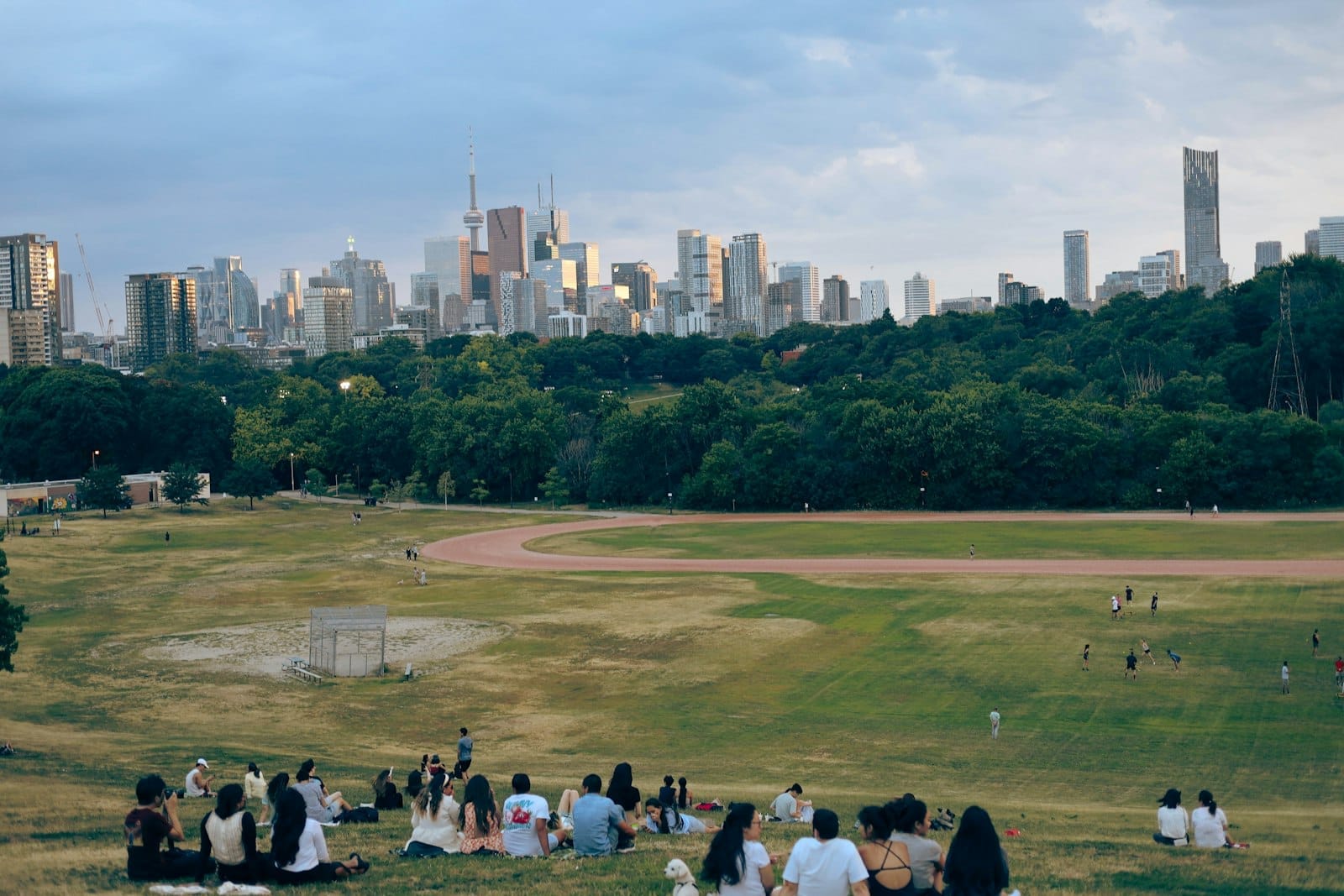
What Riverdale Park East Actually Is
Riverdale Park East is a municipal park operated by the City of Toronto, covering approximately 18 hectares on a broad, west-facing hillside above the Lower Don Valley. It is the eastern half of the larger Riverdale Park complex, which totals roughly 44 acres. The Don Valley Parkway, built in the 1960s, physically severed the original parkland in two, and the two halves are now reconnected by a green pedestrian bridge north of Bridgepoint Hospital.
The park contains multi-use sports fields, a seasonal outdoor rink, a seasonal swimming pool, a well-used off-leash dog area, and the long open slope that gives Riverdale Park East its defining character: a grass hill that drops steeply westward toward the valley, framing a panoramic view of downtown Toronto's skyline. That slope is the park's main attraction, whether you are coasting down it on a sled in January or spreading out on the grass on a warm September evening.
💡 Local tip
The view from the top of the hill is best captured in the late afternoon, when the light catches the glass towers of the downtown core directly in front of you. Arrive before golden hour for the strongest photography results.
The View: What You See from the Hill
Stand at the crest of the hill near the top of Broadview Avenue and you have an uninterrupted line of sight across the Don Valley to the Toronto skyline. The CN Tower anchors the left side of the panorama; the office towers of the Financial District fill the centre; and on clear days, the horizon stretches far enough that you can make out cranes and residential towers under construction to the west. There is nothing between you and the city except the valley itself, which means no trees, no buildings, and no infrastructure cluttering the foreground.
This is one of a small number of elevated vantage points in Toronto where the skyline reads as a complete composition rather than a fragment glimpsed between buildings. Photographers who have scouted the city know this spot. On clear winter mornings especially, when the deciduous trees in the valley below have shed their leaves, the depth and scale of the view becomes sharper than in summer.
If you are building a list of high-quality viewpoints across the city, this park belongs alongside the others covered in the best views in Toronto guide. Unlike rooftop or elevated paid observation decks, this one costs nothing and rewards early arrivals with total solitude.
Tickets & tours
Live prices and dates from our booking partner. If you book, we may earn a commission at no extra cost to you.
Toronto Old Town: Dark Side Exploration Game and Tour
From 12 €Instant confirmationFree cancellationLEGOLAND Discovery Centre Toronto tickets
From 16 €Instant confirmationFree cancellationToronto 'Little Canada' entrance tickets
From 27 €Instant confirmationFree cancellationNiagara Falls evening tour with boat, dinner and Illumination Tower
From 77 €Instant confirmationFree cancellation
How the Park Changes Through the Day and Seasons
Early mornings are the quietest. On weekdays before 8 AM, the park is mostly dog walkers moving in loose circuits around the off-leash area, and the occasional runner using the slope for interval training. The light over the skyline is soft and the air carries the slightly damp smell of grass and river valley. At this hour, the park feels closer to a rural hill than a city park.
By mid-morning on weekends, families start arriving. Children use the hill freely since there are no formal paths cutting across the main slope, which gives it an open, unstructured quality. Sports fields on the flatter northern sections fill up with soccer and baseball games through the afternoon. The overall noise level is moderate even when the park is busy: the valley acts as a natural acoustic buffer against street traffic.
Winter transforms the park completely. The hill becomes one of Toronto's better-known toboggan runs, drawing crowds of children and adults from across the neighbourhood on snowy weekends. The outdoor skating rink operates seasonally on the flatter ground below the slope. On overcast winter afternoons, the grey-blue skyline sitting above a snow-dusted hill has its own stark appeal, and the park can feel unexpectedly atmospheric.
ℹ️ Good to know
The outdoor rink and swimming pool operate on seasonal schedules set by the City of Toronto's Parks, Forestry and Recreation division. Check current hours on the City website before visiting specifically for these facilities, as they are not open year-round.
History: From Landfill to Toboggan Hill
The land that makes up Riverdale Park East originally belonged to John Scadding, one of Upper Canada's early settlers. In 1880, the City acquired the Scadding property for use partly as the grounds of the Don Jail and partly as public parkland. For decades following that split, parts of the area were used as a landfill. Conversion to parkland occurred in the early 20th century after portions of the site had been used for waste disposal, meaning areas of today’s hill overlie former landfill. The City has not publicised significant ongoing contamination concerns, but the industrial past is worth knowing.
The Don Valley Parkway construction in the 1960s cut through the middle of the original Riverdale Park, leaving the east and west halves disconnected. The pedestrian bridge that now links them north of Bridgepoint Hospital was added later, restoring a foot-traffic connection while the parkway itself remains a barrier to anything else.
In the 1970s, the City considered Riverdale Park as a potential site for a large multi-purpose stadium. That stadium eventually became what is now Rogers Centre, located on the downtown waterfront. Had the stadium been built here, the park and much of the surrounding Riverside neighbourhood would look fundamentally different today.
Getting There and Moving Around the Park
The most straightforward route is by TTC. Take Line 2 to Broadview Station, then walk south along Broadview Avenue for roughly 10 minutes. The park entrance at the top of the hill sits directly on Broadview, and the view opens up almost immediately as you turn in. If you are coming by streetcar, the 504 King and 505 Dundas routes run through the surrounding Riverside and Leslieville area and have stops within reasonable walking distance depending on your starting point.
By car, street parking is available on adjacent residential streets, though it can be competitive on sunny weekends and during winter tobogganing days. The park itself has no dedicated parking lot.
Within the park, the main hill is entirely open grass with no paved paths crossing the central slope. The flatter upper area near Broadview and the sports fields on the northern end are more accessible, with hard surfaces. Anyone with limited mobility should be aware that the defining feature of this park, the long west-facing hill, involves a steep gradient, and significant parts of the grounds are not paved.
Riverdale Park East connects well to the broader network of east-end parks and ravines. For a longer outing, the pedestrian bridge leads to Riverdale Park West and the Don Valley trail network below, which is part of the Toronto ravines hiking network. You can easily extend a park visit into a half-day walk along the valley floor.
The Surrounding Neighbourhood
Riverdale Park East sits at the meeting point of several distinct neighbourhoods. Directly to the east is Leslieville and Riverside, a dense residential strip known for independent cafes, restaurants, and a mix of Victorian rowhouses and newer infill. Danforth Avenue is a short walk north, with its strong concentration of Greek restaurants and everyday retail.
The park's location means you can reasonably pair a visit here with a meal on Danforth or a coffee in the Riverside strip along Queen Street East. The neighbourhood has enough density and variety that lingering after a park visit is genuinely worthwhile, not an afterthought.
💡 Local tip
If you are visiting in summer, the Broadview Hotel rooftop bar is a short walk north and offers a completely different (elevated, urban) perspective on the same skyline you just viewed from the hill. The contrast makes the park visit feel even more grounded.
Who Should Reconsider This Visit
Visitors who need paved, flat, accessible routes throughout will find Riverdale Park East limiting. The central hill is the main draw, and there is no accessible path that replicates that experience. The view is available from the top of the slope near Broadview Avenue, which is reachable from the street, but the full park experience assumes you can handle grass slopes and uneven ground.
Travellers with very limited time in Toronto who are prioritising iconic paid attractions may find this park a lower priority. The park's value is in the quality of the experience: the open air, the view, the low-key neighbourhood energy. If you are working through a dense one-day itinerary of major landmarks, this works better as an early morning addition than a standalone destination.
For a more structured comparison of how Toronto's parks stack up for different types of visits, the best parks in Toronto guide covers the full range of options across the city.
Insider Tips
- The best skyline photography window is roughly 30 to 60 minutes before sunset on a clear day. Position yourself near the top of the hill slightly south of centre to get the CN Tower in frame without the hill's tree line interrupting the foreground.
- In winter, arrive on a weekday after a fresh snowfall if you want the toboggan hill without weekend crowds. Saturday afternoons after a snowstorm are extremely busy.
- The pedestrian bridge north of Bridgepoint Hospital connects to Riverdale Park West and the valley trail below. If you cross it, you can loop back up through the west side and return via the Gerrard Street Bridge, making a proper circuit rather than an out-and-back.
- The off-leash dog area is at the southern end of the park. If you are not a dog person, the northern sports fields and hilltop area are largely separate and rarely overlap with the dog zone.
- On foggy mornings in autumn, the valley below fills with mist while the skyline towers remain visible above it. It is one of the more unusual urban landscape conditions you will encounter in Toronto, and worth the early alarm if the forecast shows low cloud.
Who Is Riverdale Park East For?
- Photographers hunting free, wide-angle skyline shots without crowds or entrance fees
- Families looking for a large open hill for tobogganing in winter or unstructured outdoor play in summer
- Dog owners wanting a proper off-leash run with space rather than a fenced courtyard
- Runners and fitness users who want an outdoor hill for interval training with scenery
- Visitors to the Leslieville or Greektown area who want to combine a neighbourhood walk with a genuine green space
Nearby Attractions
Other things to see while in Leslieville & Riverside:
- Corktown Common
Corktown Common is an 18-acre public park on remediated industrial land in Toronto's West Don Lands, opened in 2013. It combines a children's splash pad, constructed wetlands, an open-air fireplace pavilion, and sweeping downtown skyline views, all for free. Whether you're cycling the Don Valley Trail, chasing toddlers through water jets, or simply finding a quiet bench at dusk, this park consistently rewards.
Planning a trip? Discover personalized activities with the Nomado app.