Evergreen Brick Works: Toronto's Industrial Past Meets Green Future
Evergreen Brick Works occupies a former 19th-century brick factory in Toronto's Don Valley ravines, transformed into Canada's first large-scale community environmental centre. Free to enter, it combines heritage architecture, a year-round Saturday farmers market, wetland trails, and rotating programming across restored heritage buildings.
Quick Facts
- Location
- 550 Bayview Avenue, Toronto, ON M4W 3X8 — in the Don Valley ravine system
- Getting There
- TTC Bus 28 (Bayview) from Davisville Station (Line 1); free shuttle from Broadview Station. Cycling via Don Valley Trail.
- Time Needed
- 1.5 to 3 hours depending on market day and trail interest
- Cost
- Free general admission; paid parking on site; some special events ticketed
- Best for
- Farmers market visitors, architecture enthusiasts, trail walkers, families, photographers
- Official website
- www.evergreen.ca/evergreen-brick-works
What Evergreen Brick Works Actually Is
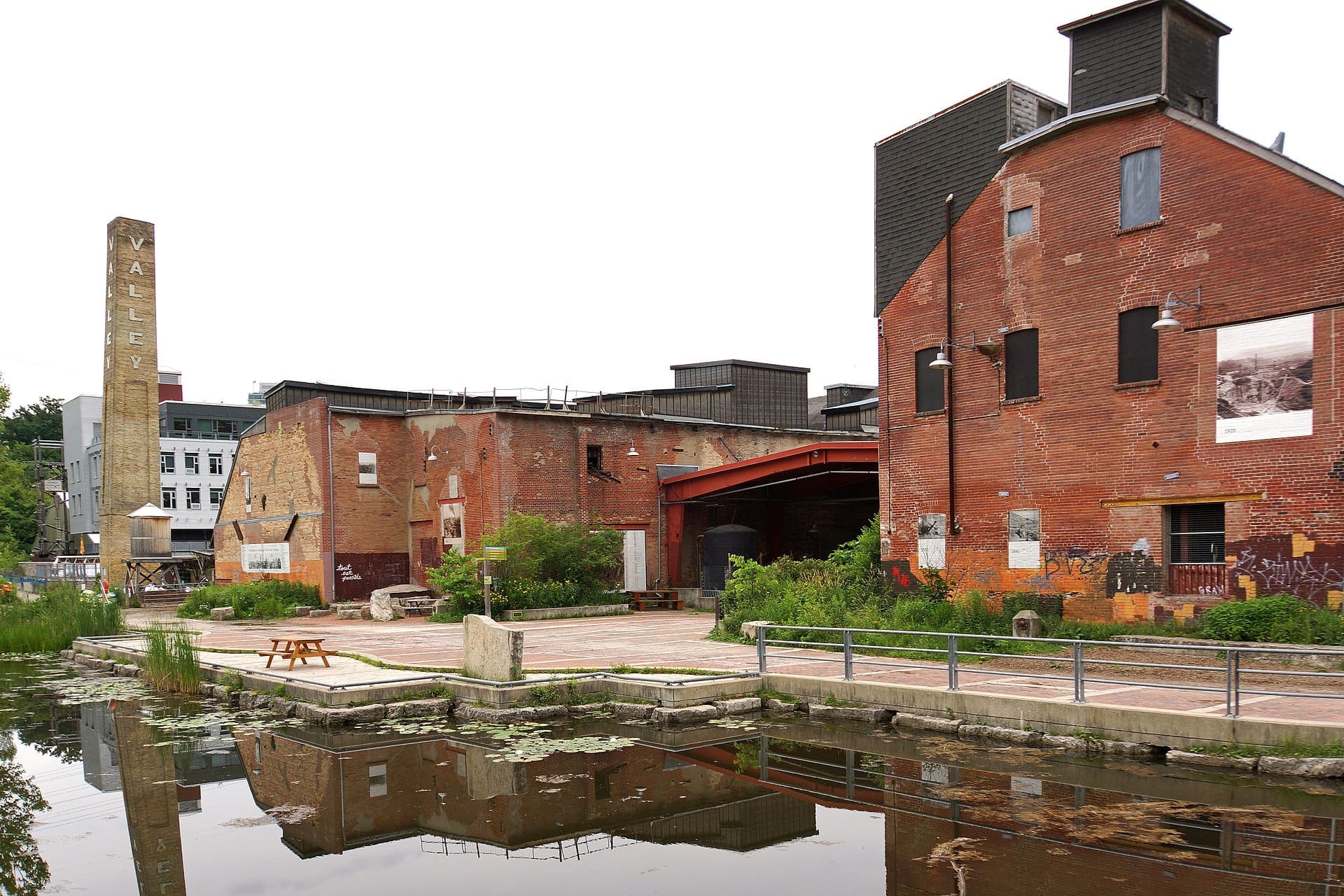
Evergreen Brick Works is a repurposed industrial complex at 550 Bayview Avenue, sitting inside the Don Valley ravine system on the eastern edge of Toronto's urban core. The site was originally the Don Valley Brick Works factory, which opened in 1889 and grew to become one of Canada's largest brick manufacturers. For a full century its kilns and quarry supplied the material for many of the city's signature buildings. The factory closed in 1989, and after years of neglect, the charity Evergreen began revitalizing the grounds in 2002. By 2010, the major transformation was complete, making it Canada's first large-scale community environmental centre.
What you arrive at today is a hybrid place: part heritage site, part farmers market, part ecological park, part events venue. The industrial bones are still highly visible. Massive brick kilns, quarry walls layered with geological strata, and factory sheds with saw-tooth rooflines dominate the central precinct. These structures have been stabilized and adapted rather than sanitized, which gives the site a rawness that distinguishes it from more polished urban redevelopments.
💡 Local tip
General admission is free. Parking costs extra. If you can arrive by bike via the Don Valley Trail or on the TTC, you skip the parking fee and arrive with a more immediate connection to the ravine setting.
The Saturday Farmers Market: The Heart of the Weekly Visit
The Evergreen Brick Works Farmers Market runs every Saturday, year-round, and is consistently the busiest time to be here. Vendors occupy the central heritage building and spill into the adjacent courtyard. The market offers locally grown produce, artisan bread, cheese, prepared foods, honey, and specialty preserves. In summer, the smell of wood smoke from food stalls mixes with freshly cut herbs and damp stone from the quarry walls. In January, that same courtyard is brisk and quiet between stalls, with vendors stamping their feet and shoppers moving with more purpose.
The market has earned a serious reputation among Toronto food communities for its vendor quality and its commitment to regional sourcing. It draws a wide crowd: families with strollers, cyclists who have ridden in from the trail, and regulars who treat it as their main weekly grocery stop. Saturday mornings, especially between 9:00 and 11:00, are the most animated but also the most crowded. If you want first pick of the best produce, arrive close to opening. If you want breathing room and a slower browse, come after noon.
The market fits naturally into a broader morning in the area. Combining it with a walk along the Martin Goodman Trail or a loop through the Don Valley trail network makes for a full half-day without spending anything beyond food.
Tickets & tours
Live prices and dates from our booking partner. If you book, we may earn a commission at no extra cost to you.
Niagara Falls night boat tour with fireworks cruise
From 123 €Instant confirmationFree cancellationToronto Old Town: Dark Side Exploration Game and Tour
From 12 €Instant confirmationFree cancellationLEGOLAND Discovery Centre Toronto tickets
From 16 €Instant confirmationFree cancellationToronto 'Little Canada' entrance tickets
From 27 €Instant confirmationFree cancellation
The Industrial Architecture: What to Look At and Why It Matters
The heritage buildings at Evergreen Brick Works are not just backdrops. They are the reason the site holds its authority. The quarry face to the north is one of the most unusual geological exposures accessible in any city in Canada. The layered sediment and clay visible in the quarry walls represent thousands of years of Don Valley geology, and the site is documented as containing evidence of glacial Lake Iroquois, the precursor to Lake Ontario. Standing at the edge of the quarry pond and looking up at those walls is a genuinely unusual urban experience.
The main industrial buildings, designed with expertise by ERA Architects as part of the adaptive reuse, preserve the kiln structures, loading bays, and chimney stacks while inserting contemporary glazing and infrastructure. The result is architecture that reads as honest about its own history rather than performatively nostalgic. Look for the exposed brick detailing inside the main event hall, the original trolley tracks embedded in the floor, and the chimney stacks that frame the skyline to the east.
If this kind of industrial heritage architecture interests you, Toronto has other examples worth comparing: the Distillery Historic District in the eastern downtown is the other major Victorian industrial complex that survived and was repurposed, though its character as a pedestrian retail village is very different from Brick Works.
ℹ️ Good to know
Photography is excellent here in the early morning before market crowds fill the central courtyard. The low angled light through the saw-tooth skylights inside the main shed can be striking between roughly 8:00 and 10:00 on clear days.
The Trails and Wetlands: The Part Many Visitors Miss
Beyond the market and buildings, Evergreen Brick Works has integrated a series of wetland ponds and restored natural areas within the former quarry footprint. These ponds sit below the quarry walls and have been colonized by frogs, ducks, and various wetland plants. In spring, the chorus of frogs from these ponds is audible from the main courtyard. In summer, dragonflies work the water surface. In autumn, the quarry edges turn amber and rust in ways that echo the colour of the original brickwork.
The site connects directly to the Don Valley trail network, which links northward toward Sunnybrook Park and southward into the broader ravine system. This means Evergreen Brick Works can serve as either a destination or a trailhead. Cyclists regularly park bikes at the market racks while they shop. Hikers arrive mid-route and take a break at the on-site cafe before continuing.
For anyone with a serious interest in Toronto's ravine network, the trails here connect into a broader system. The guide to hiking Toronto's ravines covers the Don Valley routes in more detail and helps situate this site within the larger trail geography.
How the Site Changes by Time of Day and Season
On weekday mornings, Evergreen Brick Works is genuinely quiet. The site opens at 9:00 Monday through Friday (with some variation by season), and before 10:00 you can walk through the courtyard and along the quarry paths with almost no one else around. The industrial buildings are partially accessible depending on scheduled programming, and the wetland area is at its most peaceful during these hours. This is the version of the site that rewards slow attention rather than an event-driven visit.
Sunday hours are shorter than Saturday, with the site generally opening at 10:00, and the atmosphere is noticeably calmer than the Saturday market rush. Some weekend food and drink vendors are present but the full market scale is Saturday only. On summer weekday evenings, the site sometimes hosts outdoor events, concerts, or fitness programming. Always check the Evergreen website before a visit if your schedule is specific to programming rather than the base site.
Seasonally, winter visits have their own character. Snow settles in the quarry hollows, and the brick and stone surfaces develop frost patterns that are photogenic but cold. Dress for it. The farmers market continues through winter, which is either a selling point or an endurance test depending on your tolerance for shopping in near-zero temperatures. Spring is when the wetlands are loudest and most ecologically active. Summer brings the densest programming and largest crowds. Autumn may offer the best balance of pleasant temperatures and visual interest from the changing vegetation.
⚠️ What to skip
Some outdoor trail surfaces within the quarry area become muddy and slippery after rain or during spring thaw. Sturdy footwear is worth wearing even if you plan primarily to visit the market. Flip-flops are a poor choice here.
Getting There and Practical Navigation
The address is 550 Bayview Avenue, in the Don Valley ravine corridor east of Rosedale. By car, on-site parking exists but fills quickly on Saturday mornings, especially by 9:30. Arriving before 9:00 on market days is the reliable strategy if driving. Paid parking rates should be confirmed on the Evergreen website before your visit.
By public transit, the most consistent route is TTC Bus 28 (Bayview) from Davisville Station on Line 1 (Yonge-University). The bus follows Bayview Avenue and the stop for Brick Works is on Bayview near the site entrance. Journey time from Davisville is under 10 minutes. A free shuttle operates between Broadview Station and the site; verify current service details on the Evergreen website.
By bicycle, the Don Valley Trail provides a direct and pleasant approach from both the south (downtown) and north. Bike racks are available on site. This is one of the more rewarding cycling arrivals of any attraction in the city, particularly if you are coming from the waterfront end of the trail.
For visitors planning a broader day in the area, the guide to getting around Toronto covers TTC passes, cycling infrastructure, and navigation across the city in practical detail.
Who Will Not Enjoy This Place
Evergreen Brick Works requires engagement. Visitors who arrive expecting a polished museum experience, clear interpretive signage at every turn, or a purely entertainment-driven visit may find it underwhelming outside of market days and special events. The site's power is in its textures and accumulation of detail, not in any single headline attraction.
Visitors with significant mobility limitations should review the accessibility information on the Evergreen website carefully before visiting. The quarry paths and trail sections are uneven, and some surfaces are unpaved. The market and main courtyard area are more navigable, but the full site experience involves terrain that is not uniformly accessible.
Anyone on a very tight schedule who cannot allocate at least 90 minutes may feel rushed. The site rewards walking slowly, doubling back to look at things a second time, and sitting by the quarry pond for a few minutes. It is not efficiently consumable in 30 minutes.
Insider Tips
- Saturday market crowds peak between 10:00 and noon. Arriving at or before 9:00 gets you first access to vendors and a quieter experience inside the main shed before the courtyard fills.
- The quarry pond area to the north of the main buildings is where the ecological interest concentrates. Most casual visitors stay near the market buildings and miss the wetlands entirely. Walk north past the kilns and down toward the pond level.
- On weekday mornings, the cafe on site opens and the building interiors are more accessible for simply exploring the architecture. This is the easiest time to photograph the interior details without people in every frame.
- If you are cycling in via the Don Valley Trail from the south, the trail entrance to the site is near the base of the ravine. Follow the signed trail connections directly into the site.
- In winter, the Evergreen Garden Market inside the main heritage building is a warmer alternative to the outdoor portions of the Saturday market. Vendor selection differs slightly from the outdoor summer layout, so check which vendors are operating if you have specific priorities.
Who Is Evergreen Brick Works For?
- Farmers market regulars looking for a year-round Saturday market with serious vendor quality
- Architecture and heritage enthusiasts interested in adaptive reuse of industrial buildings
- Cyclists and trail walkers using the Don Valley network who want a food and rest stop
- Families with children who respond to open outdoor space, water features, and hands-on programming
- Photographers seeking industrial textures, geological formations, and seasonal light
Nearby Attractions
Other things to see while in Downtown Toronto:
- Allan Gardens Conservatory
Allan Gardens Conservatory is a free, year-round botanical conservatory at 160 Gerrard Street East in downtown Toronto. Housed in six glass display houses anchored by a 1910 Edwardian Palm House, it holds about 1,500 m² of tropical palms, cacti, orchids, and seasonal blooms. One of the oldest parks in Toronto, it remains one of the city's most underrated green spaces.
- Art Gallery of Ontario
The Art Gallery of Ontario is one of North America's largest art museums, housing over 90,000 works inside a landmark Frank Gehry-renovated building in downtown Toronto. From Indigenous Canadian art to European masters and contemporary photography, the AGO rewards focused visitors and casual explorers alike.
- Brookfield Place (Allen Lambert Galleria)
The Allen Lambert Galleria inside Brookfield Place is a free, publicly accessible arcade designed by architect Santiago Calatrava between 1987 and 1992. Its arching steel-and-glass canopy, rising between two of downtown Toronto's tallest towers, is one of the most impressive interior spaces in Canada.
- Campbell House Museum
Built in 1822 for Upper Canada's Chief Justice, Campbell House Museum is the oldest surviving residence from the original Town of York. Moved to its current downtown corner in 1972 and opened as a museum in 1974, it offers an intimate, unhurried window into early colonial Toronto — a sharp contrast to the glass towers surrounding it.
Planning a trip? Discover personalized activities with the Nomado app.