Fort York National Historic Site: Toronto's Military Origin in the Modern City
Fort York National Historic Site preserves the military post founded in 1793 that gave rise to the city of Toronto. Spread across 43 acres in the downtown core, it contains the largest collection of original War of 1812 buildings in Canada, and general admission is free for individual visitors.
Quick Facts
- Location
- 250 Fort York Blvd., Toronto, ON M5V 3K9 (Downtown Toronto)
- Getting There
- 509 Harbourfront or 511 Bathurst streetcar to Fleet St. & Fort York Blvd., then walk north on the west side of Fort York Blvd. to the Visitor Centre
- Time Needed
- 1.5 to 2.5 hours for a thorough visit
- Cost
- Free general admission; groups of 15 or more are charged a fee. Some special events have separate pricing.
- Best for
- History enthusiasts, architecture walkers, families, and anyone curious about Toronto's origins
What Fort York Actually Is
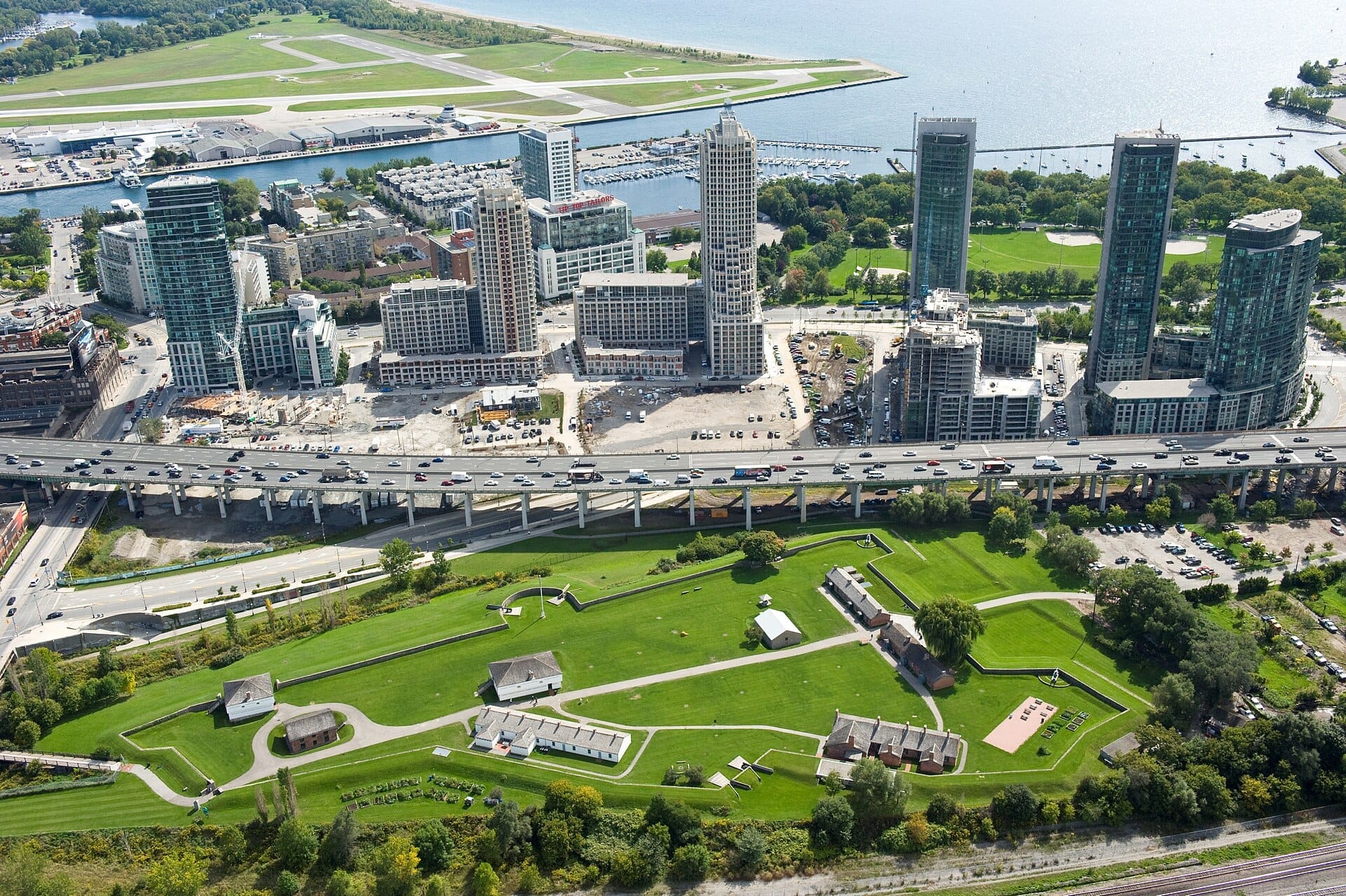
Fort York National Historic Site is not a reconstruction or a theme park interpretation of history. The buildings standing on this 43-acre site are original structures, most of them erected beginning in 1814 after American forces burned the earlier fort during the War of 1812. That makes this one of the most intact clusters of early 19th-century military architecture anywhere in Canada, and the largest collection of surviving War of 1812 buildings in the country.
The fort itself predates all of that. Lieutenant Governor John Graves Simcoe ordered its construction in 1793 as a garrison to defend the newly established town of York, which would later grow into the city now known as Toronto. What you are walking through, in other words, is the physical starting point of Canada's most populous city, sitting within view of the CN Tower and the downtown skyline.
The site was designated a National Historic Site of Canada in 1923, among the earlier such designations in the country. It sits within downtown Toronto, tucked between the Gardiner Expressway and Fort York Boulevard, which means first-time visitors sometimes drive past it without realizing. Once inside the earthwork walls, however, the highway noise fades in a way that catches most people off guard.
ℹ️ Good to know
General admission is free for visitors. The site is open Wednesday to Sunday, 11:00 a.m. to 5:00 p.m. Hours may vary seasonally or during special programming, so check the City of Toronto website before visiting.
How the Site Feels on the Ground
The approach from the streetcar stop along Fleet Street gives little indication of what is inside. The earthen ramparts rise gradually as you walk north toward the Visitor Centre, and the transition from the surrounding urban noise to the open parade ground inside is more abrupt than the modest exterior suggests.
The buildings are low, brick or wooden, and grouped closely together: officer's quarters, soldiers' barracks, a stone magazine, a blockhouse. The scale is deliberately military-utilitarian, and the interiors have been furnished to reflect garrison life in the early 1800s, with period artifacts, weapons, and domestic objects that give a sense of how cramped and practical life here would have been. Natural light comes through small windows; the wood-floored rooms smell faintly of aged timber and interpretation materials. It is a sensory contrast to the slick surfaces of the nearby museums along the lakeshore.
The parade ground at the centre of the fort is grass, open to the sky, and wide enough to make the surrounding buildings feel appropriately small. On weekday mornings the site is quiet enough that you can hear wind off Lake Ontario. On summer weekends, particularly when historical demonstrations are scheduled, the atmosphere shifts considerably, with costumed interpreters loading muskets and explaining drill formations to groups of visitors. Neither version of the visit is better, just different in tone.
Tickets & tours
Live prices and dates from our booking partner. If you book, we may earn a commission at no extra cost to you.
Toronto Old Town: Dark Side Exploration Game and Tour
From 12 €Instant confirmationFree cancellationLEGOLAND Discovery Centre Toronto tickets
From 16 €Instant confirmationFree cancellationToronto 'Little Canada' entrance tickets
From 27 €Instant confirmationFree cancellationNiagara Falls evening tour with boat, dinner and Illumination Tower
From 77 €Instant confirmationFree cancellation
The History Behind the Earthworks
The Battle of York in April 1813 is the pivotal event in Fort York's story. American forces crossed Lake Ontario, defeated the British garrison, and occupied the town for several days, during which the fort's powder magazine was detonated, either accidentally or as a deliberate act during the retreat. The explosion killed dozens of soldiers on both sides. The British rebuilt the fort almost immediately after recapturing York, which is why the standing structures date largely to 1813 to 1815 rather than to the original 1793 construction.
The broader significance is that Fort York's garrison effectively shaped where Toronto's street grid was laid out, where the waterfront developed, and where the first civic institutions were built. The fort remained an active military installation well into the 19th century, and soldiers were stationed here as late as 1880. By the time it was recognized as a national historic site in 1923, urban development had already pressed in on all sides.
If the architectural history of the city appeals to you, Fort York pairs well with the broader Toronto architecture guide, which covers how the city's built form evolved from these early colonial roots through to its current skyline.
Time of Day and Seasonal Considerations
Mornings, particularly mid-week, offer the most contemplative experience. The site currently opens at 11:00 a.m., and in the first hour or two the parade ground can be almost empty, which allows you to take in the layout and the architecture without navigating tour groups. The light in summer mornings is also flattering for photography, coming low over the earthworks from the east.
Afternoons in summer bring more visitors, especially on weekends when living history demonstrations are scheduled. These events, which include musket firing demonstrations, cooking demonstrations in the historic kitchen, and period military drill, are genuinely informative and worth planning around if your schedule allows. Check the City of Toronto events calendar before you go, as the schedule changes seasonally.
Winter visits are possible but the experience is quieter and some programming may be limited. The site is described as open year-round, though hours can vary, and the open parade ground is exposed to wind coming off Lake Ontario. Dress accordingly. Snow on the earthworks and the stone magazine makes for striking photography if you are willing to visit in colder months.
💡 Local tip
Living history demonstrations with costumed interpreters and musket firing are typically scheduled on summer weekends. These are free with admission and add significant depth to the visit. Confirm the schedule on the City of Toronto website before planning your day around them.
Getting There and Getting Around the Site
The most straightforward way to reach Fort York by transit is the 509 Harbourfront or 511 Bathurst streetcar to Fleet Street and Fort York Boulevard, followed by a short walk north to the Visitor Centre entrance. The walk takes roughly five minutes from the stop. If you are arriving by car, the Gardiner Expressway is the primary approach: eastbound traffic uses the Jameson exit, westbound uses the Spadina exit. Parking is available at the Visitor Centre at 250 Fort York Boulevard, with additional Green P parking near Fleet Street and Strachan Avenue.
For visitors doing a longer day along the water, Fort York connects reasonably well with the Toronto waterfront to the south. The Harbourfront area is walkable from the site, making it practical to combine both in a single afternoon.
The site is partially accessible. The Visitor Centre building and some outdoor areas are accessible, but the historic earthworks and some original building interiors present challenges for visitors with mobility limitations. The City of Toronto recommends calling 416-392-6907 or emailing fortyork@toronto.ca ahead of your visit to confirm specific accessibility arrangements.
Photography and Practical Notes
Fort York offers something photographically unusual in Toronto: the chance to frame 19th-century military buildings against the glass towers of the financial district rising just to the north. The juxtaposition is deliberate in a way, a visual argument for why the site was preserved at all. The best angles for this shot are from the eastern side of the parade ground, looking north toward the skyline above the low roofline of the officers' quarters.
Inside the buildings, light levels are low and natural, so a phone camera will struggle in some rooms. The brick magazine and the soldiers' barracks have the most atmospheric interiors. Tripods are generally not permitted inside historic buildings; confirm with staff on the day.
The site is not large enough to require significant planning in terms of physical navigation. Most visitors cover it end to end in under two hours at a comfortable pace. There is no requirement to take a guided tour, though the interpretation panels throughout the site are thorough and cover the key historical beats without being overwhelming.
⚠️ What to skip
Fort York is surrounded by elevated roadways and under-development zones. The walking route from the streetcar stop, while short, passes through an area that feels transitional rather than scenic. First-time visitors occasionally underestimate how urban-industrial the immediate surroundings are.
Who This Site Is Not For
Visitors expecting a large-scale, highly produced museum experience comparable to the Royal Ontario Museum or a destination with extensive indoor galleries will find Fort York modest by comparison. The value here is in the authenticity of the structures and the outdoor setting, not in exhibition production values. If genuine historical fabric matters less to you than polished presentation, this may not justify the detour.
The site is also not particularly suited to visitors with very young children who need constant indoor engagement. The open parade ground is good for running around, but the historic building interiors require quiet and careful movement, and some of the interpretation is text-heavy.
Insider Tips
- The stone magazine near the centre of the fort is one of the oldest surviving buildings on the site. Most visitors walk past it quickly, but the construction details, particularly the way the stone was laid to reduce the risk of sparks near stored gunpowder, are worth examining closely. Ask a staff interpreter about the engineering if one is available.
- If you are visiting on a hot summer day, the interior of the soldiers' barracks is noticeably cooler than the open parade ground. The thick masonry walls hold cold from the previous night well into the afternoon.
- The fort's earthworks themselves are climbable at certain points and offer an elevated view back over the parade ground and the surrounding skyline. This is one of the better free viewpoints at ground level in the downtown core.
- Fort York has hosted holiday and seasonal markets, but the Toronto Christmas Market itself takes place in the Distillery District area and other seasonal events at various times of year. It also hosts the Garrison Ball, a period-costume event, and occasional archaeological open days where excavation findings are explained. Check the events calendar seasonally.
- Combine your visit with a walk along the Martin Goodman Trail, which runs near the fort along the waterfront. The full loop from the fort down to the lakeshore and back along the water adds about 30 to 45 minutes and gives useful geographic context for why the fort was positioned where it was, between the lake and the garrison creek.
Who Is Fort York National Historic Site For?
- History and military history enthusiasts who want authentic original structures rather than reconstructions
- Architecture walkers interested in early 19th-century colonial building methods and how they contrast with the modern city
- Budget travelers and families looking for a free, substantive cultural experience in central Toronto
- Photographers drawn to the contrast between heritage buildings and the contemporary downtown skyline
- Visitors doing a longer waterfront day who want a culturally grounding stop between the lakeshore and the city core
Nearby Attractions
Other things to see while in Downtown Toronto:
- Allan Gardens Conservatory
Allan Gardens Conservatory is a free, year-round botanical conservatory at 160 Gerrard Street East in downtown Toronto. Housed in six glass display houses anchored by a 1910 Edwardian Palm House, it holds about 1,500 m² of tropical palms, cacti, orchids, and seasonal blooms. One of the oldest parks in Toronto, it remains one of the city's most underrated green spaces.
- Art Gallery of Ontario
The Art Gallery of Ontario is one of North America's largest art museums, housing over 90,000 works inside a landmark Frank Gehry-renovated building in downtown Toronto. From Indigenous Canadian art to European masters and contemporary photography, the AGO rewards focused visitors and casual explorers alike.
- Brookfield Place (Allen Lambert Galleria)
The Allen Lambert Galleria inside Brookfield Place is a free, publicly accessible arcade designed by architect Santiago Calatrava between 1987 and 1992. Its arching steel-and-glass canopy, rising between two of downtown Toronto's tallest towers, is one of the most impressive interior spaces in Canada.
- Campbell House Museum
Built in 1822 for Upper Canada's Chief Justice, Campbell House Museum is the oldest surviving residence from the original Town of York. Moved to its current downtown corner in 1972 and opened as a museum in 1974, it offers an intimate, unhurried window into early colonial Toronto — a sharp contrast to the glass towers surrounding it.
Planning a trip? Discover personalized activities with the Nomado app.