Toronto Chinatown: Food, History, and Street Life on Spadina
Centred at Spadina Avenue and Dundas Street West, Toronto's Downtown Chinatown is one of the oldest continuously active Chinese neighbourhoods in Canada, with roots traced to 1878. It's an open, free-to-enter urban district where the real draw is the street-level mix of produce markets, Cantonese and Taiwanese restaurants, herbal medicine shops, and the energy of a neighbourhood that hasn't been polished for tourism.
Quick Facts
- Location
- Spadina Avenue & Dundas Street West, downtown Toronto, Ontario, Canada
- Getting There
- TTC Line 1 to Spadina Station, then 510 Spadina streetcar south to Dundas; or 505 Dundas streetcar to Spadina
- Time Needed
- 1.5 to 3 hours for a thorough walk; longer if dining
- Cost
- Free to enter; individual restaurants and shops charge their own prices in CAD
- Best for
- Food lovers, cultural explorers, street photography, budget dining
- Official website
- www.destinationtoronto.com/neighbourhoods/westside/chinatown
What Chinatown Actually Is
Toronto's Downtown Chinatown, also called West Chinatown, is not a themed district or a festival-only draw. It is a working urban neighbourhood that has been continuously inhabited and commercially active since the late 19th century. Destination Toronto traces its establishment to 1878, which makes it one of the oldest neighbourhoods in the city by any measure.
The neighbourhood's present layout is partly the result of displacement. Toronto's original Chinatown was centred near Elizabeth Street, closer to what is now Nathan Phillips Square. Beginning in the late 1950s, that community was pushed westward by the construction of the new City Hall complex. The community rebuilt itself along Spadina Avenue and Dundas Street West, and that intersection remains the core today.
The district sits at the western edge of Kensington Market, and the two neighbourhoods bleed into each other without a clear boundary. Walking west from Spadina along Kensington Avenue, the Chinese produce stalls give way to Caribbean food shops and vintage clothing stores. It's a transition worth making, since the combined area gives you one of the most genuinely diverse street-level environments in Toronto.
The Streetscape: What You See at Ground Level
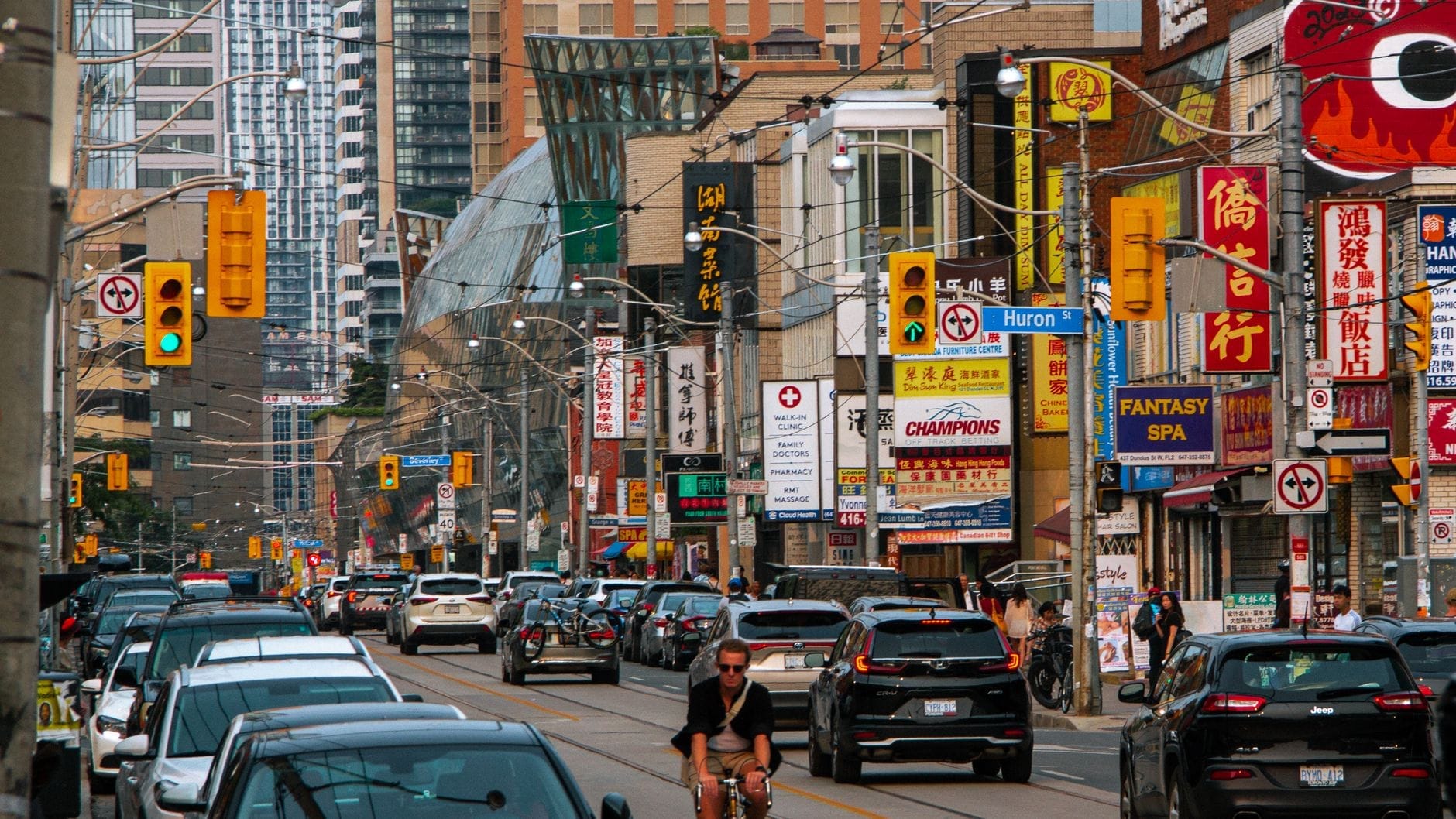
Dundas Street West and Spadina Avenue are the two main axes. Dundas runs east-west and carries the heavier mix of restaurants, bubble tea shops, and small grocery stores. Spadina runs north-south with produce vendors who set up stalls on the sidewalk, displaying daikon, bitter melon, bok choy, and live seafood in plastic tanks. The smell shifts depending on where you stand: roasting duck fat near the BBQ shops, then dried seafood and herbs near the traditional medicine stores a block away.
Signage is predominantly in Chinese characters alongside English, and many older businesses carry only Chinese text. The building stock is largely two- and three-storey commercial buildings from the early to mid-20th century, with ground-floor retail and apartments or offices above. There's no grand gateway arch or formal entrance to mark the neighbourhood's boundary; it simply begins.
💡 Local tip
The freshest produce and the longest selection at outdoor stalls are typically available in the morning, before 11 a.m. If you plan to shop for ingredients, arrive early. By mid-afternoon, some vendors begin selling down remaining stock.
Several shops specialize in traditional Chinese herbal medicine and sell dried ingredients by weight from large wooden bins or glass jars: goji berries, dried chrysanthemum flowers, various funghi, and roots whose names require a knowledgeable pharmacist to translate. These shops are worth browsing even if you have no intention of buying; the interiors often look unchanged from decades past.
Tickets & tours
Live prices and dates from our booking partner. If you book, we may earn a commission at no extra cost to you.
Toronto Kensington Market and Chinatown walking tour
From 67 €Instant confirmationFree cancellationToronto Old Town: Dark Side Exploration Game and Tour
From 12 €Instant confirmationFree cancellationLEGOLAND Discovery Centre Toronto tickets
From 16 €Instant confirmationFree cancellationToronto 'Little Canada' entrance tickets
From 27 €Instant confirmationFree cancellation
How the Neighbourhood Changes Through the Day
Early mornings on Spadina, around 7 to 9 a.m., belong to older residents: people doing grocery runs, café owners rolling up shutters, and delivery vehicles stacking crates on the sidewalk. The pace is unhurried and the crowd is almost entirely local. This is the best window if you want to experience the neighbourhood as it functions for the people who actually live there.
By late morning and into the lunch hour, the density increases significantly. Office workers, students from the nearby University of Toronto, and visitors arrive for dim sum and noodle lunches. Lineups form outside popular dim sum restaurants on weekends, sometimes extending onto the pavement. If dim sum is your goal on a Saturday or Sunday, plan to arrive before 11 a.m. or accept a wait.
Evening brings a different energy. The produce stalls have mostly closed, but restaurants stay open late, and the lit storefronts, hanging lanterns, and foot traffic give the streets a comfortable density. It does not feel unsafe after dark by Toronto standards, though as with any urban neighbourhood, basic awareness applies. The streets are well-lit and populated throughout the evening.
ℹ️ Good to know
Chinatown has no gates, no set opening hours, and no admission fee. It is a public neighbourhood accessible around the clock. Individual businesses set their own hours; most restaurants and shops operate from mid-morning to late evening, with some restaurants staying open past midnight.
Eating: What to Prioritize and What to Skip
The food here is the main reason most visitors come, and it largely delivers. Cantonese cuisine is the historical anchor: roast duck and BBQ pork displayed in restaurant windows, dim sum served from trolleys or on order sheets, and congee shops that stay open well into the night. More recently, Taiwanese and Sichuan options have expanded the range considerably, and bubble tea shops occupy almost every block.
Prices are low relative to the rest of downtown Toronto. A bowl of hand-pulled noodles or a plate of rice with roast meat typically costs well under $15 CAD. For context on how this fits into the broader dining landscape, see the Toronto food guide, which covers Chinatown alongside other key eating neighbourhoods.
What to manage expectations on: some of the most prominently located restaurants on Dundas, especially those with large English-language menus posted outside and photos of every dish, are oriented toward tourist volume rather than culinary precision. The better meals are often found one block off the main strip or in spots where the menu is primarily in Chinese. If you see a queue of Chinese-Canadian families on a weekend morning, follow it.
Getting There and Getting Around
The most direct transit route from downtown is the TTC Line 1 Yonge-University subway to Spadina Station, then the 510 Spadina streetcar southbound to Dundas Street West. Alternatively, the 505 Dundas streetcar runs east-west along Dundas and stops directly at Spadina. Both routes are straightforward and run frequently during daytime hours.
On foot, Chinatown is about a 20-minute walk west from the Art Gallery of Ontario, which sits at the eastern edge of the Dundas Street corridor. Combining both into a half-day is an efficient use of time.
Cycling is feasible; nearby streets such as Richmond, Adelaide, and Wellington have dedicated cycle tracks that connect close to Spadina. Driving and parking is possible but not recommended during peak hours, as Spadina carries significant streetcar and vehicle traffic simultaneously and street parking fills quickly. Paid lots exist on side streets.
⚠️ What to skip
Accessibility varies by block and by individual business. Sidewalks are generally in reasonable condition, but outdoor market stalls can narrow pedestrian lanes significantly. Visitors using wheelchairs or mobility aids should note that some smaller shops have steps at the entrance. TTC accessible vehicles operate on both the 505 and 510 routes; confirm current status on specific stops via the TTC website before travel.
Photography, Weather, and Practical Considerations
Chinatown is photogenic in a specific way: it rewards street-level detail rather than panoramic shots. The hanging whole ducks and lacquered pork in BBQ windows, the stacked produce in open-air bins, the layered Chinese and English signage, the cluttered pharmacy windows filled with bottled remedies. A standard lens or a phone camera works well here. Wide angles are less useful given the relatively narrow sidewalks and close building frontages.
Weather affects the experience more than at indoor attractions. Summer visits, roughly June through August, bring the most outdoor activity and the fullest street life. Toronto's summers can be humid with temperatures occasionally exceeding 32 degrees Celsius, so carry water. Winter visits are valid but quieter; many produce stalls operate reduced hours or close in very cold snaps, and the outdoor dimension of the neighbourhood shrinks considerably. The covered indoor markets and restaurants remain active year-round.
Spring and early fall, specifically May, June, September, and October, offer the most comfortable conditions for walking the neighbourhood. For broader seasonal planning, the best time to visit Toronto guide covers the tradeoffs across the full year.
Who Should Reconsider This Visit
Chinatown is not for everyone. If you are looking for a polished, curated cultural experience with interpretive signage and a clear narrative arc, this neighbourhood will frustrate you. There is no visitor centre, no guided loop, and no tidy presentation of history. The neighbourhood is a functioning commercial and residential district, not a museum.
Visitors with limited mobility should approach with a plan, since sidewalk congestion and uneven surfaces near market stalls can be difficult to navigate at peak hours. Travellers who are not comfortable in crowds will find weekday mornings far more manageable than weekend afternoons, when Dundas and Spadina can become genuinely packed.
Insider Tips
- The bakeries along Dundas often sell baked BBQ pork buns and egg tarts for under $2 CAD each. These make for an excellent, cheap breakfast while walking the neighbourhood before the lunch crowd arrives.
- Several traditional herbal medicine shops will answer basic questions about ingredients if approached respectfully and the shop is not busy. It's a more interesting education about Chinese pharmacopoeia than most guidebooks offer.
- Kensington Market begins immediately west of Spadina. Rather than treating them as separate stops, walk Dundas to Spadina, then cut north into Kensington via Augusta Avenue. The transition between the two neighbourhoods is one of the more interesting five-minute walks in the city.
- For dim sum on weekends, the standard Toronto advice is to arrive before 11 a.m. to avoid long waits at the most popular spots. Bring cash as a backup: some of the smaller traditional restaurants do not accept cards or have unreliable card terminals.
- The neighbourhood looks strikingly different at night. Evening light on the hanging lanterns and neon signs above the restaurant windows creates a very different photographic scene from the daytime street market atmosphere. A second visit after dark is worth the extra time.
Who Is Chinatown For?
- Food travellers looking for affordable, genuinely good Cantonese and Taiwanese cooking without downtown price inflation
- Photographers interested in layered urban street scenes and commercial signage rather than landmark shots
- Travellers who want to combine two distinct neighbourhoods in one walk, pairing Chinatown with adjacent Kensington Market
- Budget-conscious visitors: browsing the produce, bakeries, and street stalls costs nothing and provides significant cultural texture
- Anyone with an interest in Toronto's immigration and urban history, since the neighbourhood's displacement and reconstruction story is a significant chapter in the city's development
Nearby Attractions
Other things to see while in Kensington Market:
- Kensington Market Street Food & Shops
A National Historic Site of about 27 hectares in downtown Toronto, Kensington Market is an open, walkable neighbourhood where independent food shops, vintage clothing stores, and street food vendors crowd narrow streets that have welcomed successive waves of immigrants since the early 20th century. There is no admission fee, no single front door, and no two visits that feel quite the same.
Planning a trip? Discover personalized activities with the Nomado app.