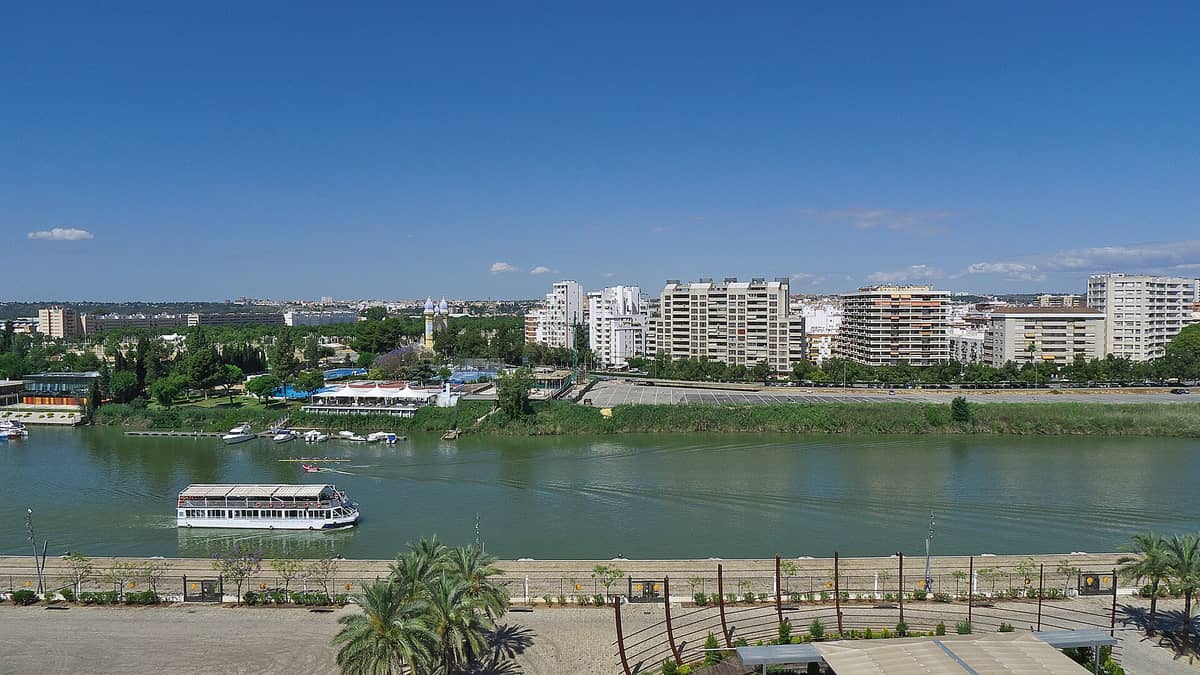
Los Remedios is a planned, affluent residential district in southwest Seville, built in the mid-20th century with wide boulevards and orderly apartment blocks. It borders Triana to the north and the Guadalquivir River to the east, putting it within easy reach of the historic center while feeling like a genuinely local neighborhood. Every spring, the district transforms when the Real de la Feria de Abril opens on its southern edge.
Los Remedios is where Seville lives when it isn't performing for tourists. Wide, shaded avenues, neighborhood bars that fill with locals after work, and the annual spectacle of the Feria de Abril fairgrounds on its southern edge give this southwest district a character that no other part of the city quite replicates.
Orientation
Los Remedios sits on the west bank of the Guadalquivir River, directly across the water from Seville's historic center. Administratively, it is one of the city's eleven districts, occupying the southwest of the municipality. Its boundaries are straightforward once you know the landmarks: Triana lies to the north, the Guadalquivir River and the districts of Casco Antiguo, Sur, and Bellavista-La Palmera border it to the east, the Real de la Feria de Abril fairgrounds and Tablada stretch to the south, and the Ronda Urbana Sur ring road marks the western edge toward the Aljarafe plateau.
The district was built primarily in the mid-20th century as a planned expansion of the city, which explains why it feels so different from the medieval street patterns of Santa Cruz or La Macarena. There are no winding alleys here. Instead, the grid is generous: broad avenues, proper pavements, and apartment blocks of four to eight stories that house a predominantly middle-class Sevillian population. Avenida de la República Argentina is the commercial spine of the neighborhood, running roughly north to south and lined with cafés, fashion boutiques, and everyday shops catering to residents rather than visitors.
The district connects to the rest of the city across the Guadalquivir via several bridges. The most historically significant crossing is the Puente de Triana to the north, which leads directly into Triana and then onward toward the historic center. Walking from the northern tip of Los Remedios to the Cathedral takes roughly 25 to 30 minutes on foot, crossing through Triana or over the Puente del Generalísimo. For a broader look at how the neighborhoods of Seville fit together, the where to stay in Seville guide maps out the options clearly.
Character & Atmosphere
The first thing a visitor notices in Los Remedios is the quiet. Not silence, but the kind of low-level urban hum that comes from people going about their actual lives. Mornings bring the sound of metal shutters rolling up on bakeries, the clatter of coffee cups at the counter, and the occasional schoolchild on a bicycle. The streets are clean and well-lit, the trees planted along the central medians of the wider avenues provide real shade by mid-afternoon, and there is almost no street-level tourism infrastructure to speak of.
By early evening, the neighborhood shifts gear. Locals spill out of office buildings and apartments around 7pm, the bars on Avenida de la República Argentina start filling up, and the terraces do steady business through the long Andalusian dusk. In summer, when temperatures in Seville regularly exceed 35°C during the day, Los Remedios only really comes alive after 9pm: families walking the river promenade, couples at outdoor tables, children playing in the plazas long after dark. This is one of the most authentically local rhythms left in the city.
The contrast with the neighboring districts is instructive. Cross north into Triana and the streets narrow, the ceramics shops multiply, and the tourist foot traffic picks up. Cross east over the river and you are in the Casco Antiguo, where every second business caters to visitors. Los Remedios has largely avoided that commercial transformation, partly because it lacks the medieval monuments that draw crowds and partly because its planned layout and residential character make it less photogenic in the way travel accounts tend to reward.
ℹ️ Good to know
Los Remedios is consistently ranked among the safest districts in Seville. General precautions still apply at night, but the district's low crime rate is one of the practical reasons families and longer-stay visitors choose it.
The one exception to Los Remedios' quiet character is the Feria de Abril. Each spring, usually in late April, the Real de la Feria on the southern edge of the district becomes the site of Seville's most famous week-long festival. The fairgrounds fill with hundreds of casetas (private and public marquee tents), flamenco dresses, horses, and sevillana music that can be heard from the residential streets well into the small hours. For that one week, Los Remedios is ground zero for Seville's most intense annual event.
What to See & Do
The primary attraction on the calendar is the Feria de Abril, held on the Real de la Feria fairgrounds at the southern end of the district. Attending the fair is one of those experiences that requires some preparation: most of the larger casetas are private (accessible only by invitation), but there are public casetas where anyone can join. Arriving in the afternoon gives you the processions of horse-drawn carriages and riders in traditional dress; arriving after midnight gives you the dancing. Both are worth it.
Outside of fair week, the Guadalquivir riverfront is the district's main draw. The promenade along the eastern edge of Los Remedios offers views back across the water to the Torre del Oro and the skyline of the historic city. At sunrise, the light on the river is exceptional. Cyclists and joggers use this stretch consistently throughout the day, and the benches fill up on weekend afternoons.
Los Remedios is also a practical base for exploring the districts immediately adjacent to it. Triana is a 10-minute walk to the north, and its Mercado de Triana is one of the best food markets in the city. The Iglesia de Santa Ana, the oldest church in Seville still in use, is also just over the neighborhood boundary in Triana. These are all easily walkable from a base in Los Remedios.
Feria de Abril at the Real de la Feria fairgrounds (late April, dates vary annually)
Guadalquivir riverfront promenade, particularly the northern stretch toward Triana
Avenida de la República Argentina for local commercial life and people-watching
Day trips by foot or bike into Triana for ceramics, the covered market, and river views
Cycling south along the river toward the Parque de María Luisa
💡 Local tip
If you are visiting during the Feria de Abril, book accommodation in Los Remedios as early as possible. The district is adjacent to the fairgrounds, and proximity makes a significant practical difference for late-night arrivals back at your hotel. Prices across the city usually spike sharply during fair week.
Eating & Drinking
The food scene in Los Remedios is built for locals, which is a genuine advantage. Prices at neighborhood bars and restaurants here tend to run lower than the equivalent in Santa Cruz or the Casco Antiguo, and the clientele is predominantly Sevillian, which tends to keep quality honest. There is no single market hall within the district itself, but Avenida de la República Argentina and the surrounding grid of streets have enough cafés, tapas bars, and restaurants to fill several evenings.
Tapas in Los Remedios follow the traditional Sevillian pattern: small plates of jamón ibérico, espinacas con garbanzos (spinach with chickpeas), solomillo al whisky (pork loin in whisky sauce), and pescaíto frito (fried fish). Many bars still offer a free tapa with each drink ordered, a custom that has largely disappeared from the more tourist-facing neighborhoods. The standard drink of choice is cold draught beer (una caña) or a glass of local fino sherry, served cold and dry.
For a broader overview of what to eat across Seville, the guide to Sevillian food covers the regional specialties in detail. If you want to combine eating with exploring the market culture, the nearby Mercado de Triana in the adjacent neighborhood is a short walk across the district boundary and worth a morning visit for fresh produce and bar counter breakfasts.
Breakfast in Los Remedios follows the Andalusian ritual: tostada con aceite y tomate (toasted bread with olive oil and crushed tomato) and a café con leche at a neighborhood bar. This is not a neighborhood for brunch menus or avocado toast. The bars open early, fill with working locals before 9am, and the pace is fast and unpretentious. Evening dining starts late by northern European standards: 9pm is early, and the peak of dinner service runs from 10pm to midnight.
Getting There & Around
Los Remedios is straightforward to reach from the city center and from across the river in Triana. On foot from the historic center, the most logical route Los Remedios is straightforward to reach from the city center and from across the river in Triana. On foot from the historic center, the most logical route crosses the Guadalquivir via the Puente de Triana or, further north, the Puente de Triana, then follows the riverside promenade south into the district. The walk from the Cathedral to the northern edge of Los Remedios takes around 25 to 30 minutes at a normal pace., then follows the riverside promenade south into the district. The walk from the Cathedral to the northern edge of Los Remedios takes around 25 to 30 minutes at a normal pace.
For public transport, TUSSAM urban buses connect Los Remedios with the city center and with the Santa Justa railway station. Several bus lines stop along Avenida de la República Argentina. The MetroCentro tram line does not extend into Los Remedios directly, but it connects Plaza Nueva in the center with San Bernardo, from where onward connections are available. The broader Seville transit network is covered in the getting around Seville guide, which includes current fare information and route advice.
Cycling is genuinely practical here. The district's wide, flat avenues and dedicated cycle lanes make it one of the more bike-friendly parts of Seville, and the Guadalquivir riverside path connects Los Remedios northward through Triana and southward toward the Parque de María Luisa without requiring any significant road cycling. Seville has a public bicycle hire scheme (SEVICI) with docking stations throughout the neighborhood.
From Seville Airport (SVQ), which sits approximately 9 to 10 km to the northeast of the city, the most practical option is the EA airport bus to central stops including Puerta de Jerez, from where a taxi or bus connection to Los Remedios adds around 10 minutes. A direct taxi from the airport to Los Remedios typically costs in the range of €25 to €35, subject to supplements and current municipal tariffs. Verify fares before travel as these figures change.
💡 Local tip
Seville's bicycle hire scheme, SEVICI, has docking stations throughout Los Remedios. A short-term pass gives you access to bikes for rides of up to 30 minutes at a time, which is plenty for crossing into Triana, reaching the Parque de María Luisa, or cycling the riverfront. Verify current pricing and registration requirements on the SEVICI website before your visit.
Where to Stay
Los Remedios is not Seville's primary hotel district, but it has a steady supply of mid-range hotels, apartment rentals, and a handful of more upmarket options along the main avenues. The accommodation here skews toward the practical and residential: fewer boutique hotels with rooftop pools, more four-star business hotels and well-appointed apartment blocks. For families or couples on longer stays (five nights or more), the relative calm of the streets and the lower price pressure compared to Santa Cruz can make Los Remedios a genuinely comfortable base.
The best location within the district for most visitors is the northern half, closest to the river and the bridges into Triana. From here, the walk to the Casco Antiguo is manageable, the riverfront is immediate, and the main commercial strip of Avenida de la República Argentina is within easy reach. The further south you go toward the fairgrounds area, the quieter it gets outside of Feria week, which suits some travelers and feels isolated to others.
For travelers who want the full range of accommodation options across the city weighed up alongside each other, the complete Seville accommodation guide covers all the major neighborhoods with honest trade-offs. Los Remedios is positioned in that guide as the choice for travelers who prioritize local atmosphere and safety over proximity to the headline monuments.
⚠️ What to skip
During Feria de Abril week, Los Remedios accommodation books out months in advance and prices rise sharply across the board. If your trip overlaps with the fair, plan accommodation well ahead of time. If you want to visit the fair without the price premium, consider staying elsewhere in the city and commuting to the fairgrounds by foot or bus, as the site is accessible from most central neighborhoods.
Honest Assessment: Who Should Stay Here
Los Remedios is not the right choice for every visitor to Seville. If your priority is waking up steps from the Cathedral, being able to walk to flamenco shows at night without crossing a bridge, or staying somewhere with the visual texture of whitewashed historic streets, then Santa Cruz, El Arenal, or the Casco Antiguo will serve you better. Los Remedios asks you to trade proximity to the monuments for a quieter, more genuinely residential experience.
What it offers in return is significant: consistent safety, lower prices for equivalent accommodation, a food and bar scene where you are the only non-local at the counter, and a pace of daily life that reflects what Seville is like for the people who actually live here. For families traveling with children, for couples on extended stays, and for anyone visiting specifically for the Feria de Abril, it is one of the most logical bases in the city. Those interested in the broader picture of Seville's neighborhoods will also find it useful to read through the Seville nightlife guide and the Seville on a budget guide to understand how Los Remedios fits into the wider city.
TL;DR
Los Remedios is a planned, mid-20th century residential district on the west bank of the Guadalquivir, directly accessible from Triana and the historic center via several river bridges.
Consistently ranked among Seville's safest neighborhoods, with wide avenues, local bars, and a food scene priced for residents rather than tourists.
The Real de la Feria de Abril fairgrounds on the southern edge of the district make this the closest base to Seville's most famous annual festival, held each spring.
Best suited to families, longer-stay visitors, budget-conscious travelers, and anyone who wants an authentic local experience rather than a hotel in the tourist core.
Not ideal for first-time visitors who want to be walking distance from the Cathedral and main monuments without crossing a river.
Three days is enough time to cover Seville's greatest landmarks, explore its best neighbourhoods, and eat and drink well without rushing. This day-by-day itinerary gives you practical routes, current ticket prices, and the kind of logistical detail that makes the difference between a smooth trip and a frustrating one.
Seville makes an ideal home base for a week in Andalusia. With high-speed rail to Córdoba in under 45 minutes and buses to Granada in 3 hours, you can cover the region's highlights without changing hotels. This guide breaks down exactly how to structure 7 days, what to prioritize, and what to skip.
The journey from Barcelona to Seville covers roughly 830 km across Spain. This guide breaks down every transport option, from the high-speed AVE train to budget flights, with practical tips on cost, comfort, and what awaits you in Andalusia's capital.
Seville's skyline is defined by bell towers, domes, and gilded facades accumulated over eight centuries of Christian, Moorish, and Renaissance building. This guide covers the city's finest religious architecture, from UNESCO-listed giants to intimate neighbourhood churches that most visitors walk straight past.
Seville delivers more than its size suggests when it comes to museums. From world-class fine art and Moorish palaces to ceramics, naval history, and flamenco, this guide covers the best museums in Seville across every interest and budget.
Seville's climate is one of the most extreme in Western Europe for a major city. This guide breaks down every month by temperature, rainfall, crowds, and events so you can choose the timing that actually fits your trip.
Seville rewards those who look up and climb high. This guide covers the city's best panoramic viewpoints, from iconic tower climbs to riverside vantage points and rooftop terraces with sweeping skyline views.
Seville sits at the heart of Andalusia, putting some of Spain's most compelling destinations within easy reach. This guide breaks down the best day trips from Seville by travel time, transport options, and what you actually get for the effort — including which ones are genuinely worth the journey and which ones need an overnight.
Seville's Feria de Abril is one of Europe's great street festivals: six days of flamenco dresses, horses, sherry, and late nights on a purpose-built fairground. This guide covers everything from how to get in without an invitation to what things actually cost, when to go, and what to wear.
Seville is the spiritual home of flamenco, and navigating its shows requires more than a hotel concierge recommendation. This guide breaks down the best tablaos, what to expect, how much to pay, and how to avoid the tourist traps, so you leave with a genuine experience of one of Spain's most powerful art forms.
Seville is one of Europe's most rewarding cities to explore on a tight budget. Many of its greatest sights offer free entry on specific days, and its parks, plazas, churches, and neighbourhoods reward hours of walking without spending a cent.
Seville is one of southern Spain's most walkable cities, but knowing which transport option to use, and when, can save you real time and money. This guide covers everything from landing at SVQ airport to hopping trams through the historic centre.
Seville is the capital of Andalusia and one of Spain's most architecturally rich cities, but it's not right for every traveller or every season. This guide breaks down what the city genuinely delivers, where it falls short, and exactly when and how to visit to get the most from it.
The Madrid to Seville route is one of Spain's most travelled corridors, and three competing high-speed rail operators now make it faster and cheaper than ever. This guide breaks down every option, from budget OUIGO tickets to overnight buses, with practical tips on timing, pricing, and what to expect on arrival.
Seville's Semana Santa is one of the most intense religious spectacles in the world, drawing hundreds of thousands of visitors each spring. This guide covers the full schedule, the key brotherhoods, how to secure Carrera Oficial seats, when to go for smaller crowds, and everything else you need to experience Holy Week properly.
Attending a Sevilla FC home match is one of the most authentic experiences Seville, Spain offers. This guide covers how to buy tickets, get to the stadium, pick the right seat, and make the most of match day — without the rookie mistakes.
Seville rewards those who look beyond the Cathedral and Alcázar. These 18 off-the-beaten-path experiences reveal aristocratic palaces, forgotten Roman cities, local markets, and baroque masterpieces that most visitors walk straight past.
Autumn is arguably Seville's most underrated season. Temperatures drop from summer extremes, crowds thin out after peak season, and the city's streets become walkable again. This guide breaks down exactly what to expect each month, from weather data to practical tips.
Spring is Seville's most dramatic season, combining mild weather with two of Europe's biggest festivals. This guide breaks down exactly what to expect each month, when to book, and how to navigate the crowds.
July and August in Seville mean scorching temperatures regularly above 35°C, occasional heatwaves above 40°C, and almost zero rain. This guide gives you the strategies, timing, and specific attractions to make summer work in your favor rather than against you.
Seville in winter is mild, uncrowded, and genuinely good for sightseeing. This guide covers the real weather, the seasonal events worth planning around, what to pack, and how to make the most of Andalusia's capital between December and February.
Seville nightlife runs on Andalusian time: dinner at 22:00, bars at midnight, clubs after 02:30. This guide covers the best neighborhoods, rooftop bars, nightclubs, flamenco shows, and practical details on dress codes, pricing, and the noise regulations that shape the scene.
Seville (Sevilla) is one of southern Spain's most rewarding city breaks, and it doesn't have to be expensive. This guide breaks down real daily costs, free entry windows at major monuments, the cheapest ways to get around, and the exact seasons when prices drop significantly.
Seville is lined with tens of thousands of bitter orange trees, yet almost no one eats the fruit. This guide explains the history, seasonality, and surprising uses of the Seville orange, plus what visitors actually experience walking beneath these famous trees.
Seville rewards shoppers who know where to look. This guide covers the best shopping streets, markets, and authentic products to buy in Sevilla, from azulejos and flamenco accessories to olive oil and vintage finds at El Jueves.
The journey from Seville to Córdoba is one of Andalusia's easiest and most rewarding travel connections. This guide covers every option: high-speed trains that take under an hour, budget buses, and guided day trips, with practical tips on costs, booking, and what to do once you arrive.
The journey from Seville to Málaga is one of the most popular routes in Andalusia, with trains taking as little as 2 hours. This guide breaks down every option — train, bus, and car — with real prices, scheduling advice, and the honest tradeoffs between each.
Both Seville and Granada rank among Spain's most compelling cities, but they offer very different experiences. This guide breaks down the key differences across sightseeing, atmosphere, budget, logistics, and timing so you can choose the right destination or plan both.
From a world-class aquarium and a theme park with a water area to horse-drawn carriage rides and riverfront parks, Seville rewards families who plan well. This guide covers the top kid-friendly attractions, current pricing, seasonal timing, and practical logistics so you can skip the guesswork.
Seville, the capital of Andalusia, packs more history, architecture, and street life into a walkable city than almost anywhere in Spain. This guide covers the essential things to do in Seville, with accurate ticket prices, seasonal advice, neighborhood breakdowns, and clear assessments of what's worth your time.
Seville is one of the most walkable cities in southern Spain, with its major monuments clustered within a compact historic core. This guide covers the best self-guided walking routes by neighbourhood, current entry prices for the Alcázar and Cathedral, seasonal timing advice, and the practical details most visitors overlook.
Seville has one of Spain's most distinctive food cultures: paid tapas ordered gradually, cold soups in summer, and markets that close by mid-afternoon. This guide covers the dishes you need to try, where to find them, how much to pay, and what to skip.
Choosing where to stay in Seville shapes your entire trip. This guide breaks down every major neighbourhood by location, atmosphere, price range, and who it suits best — so you can book with confidence.