Mercado de Triana: Where Seville's Oldest Neighborhood Does Its Shopping
Mercado de Triana sits at the Triana end of the historic Isabel II bridge, serving as the beating heart of a neighborhood that has always done things its own way. Free to enter, genuinely local, and Free to enter, genuinely local, and home to a small archaeological space in its basement, it rewards visitors who show up early and stay for a coffee., it rewards visitors who show up early and stay for a coffee.
Quick Facts
- Location
- C. San Jorge, 6, 41010 Sevilla — Triana neighborhood, near Plaza del Altozano on the west bank of the Guadalquivir
- Getting There
- Walk across the Puente de Isabel II (Triana Bridge) from the city center; TUSSAM buses serve nearby stops around Plaza del Altozano and C. San Jorge
- Time Needed
- 45–90 minutes for a thorough visit; shorter if you are just browsing
- Cost
- Free entry; individual stalls and bars charge standard market prices
- Best for
- Food lovers, slow-travel visitors, photography, and anyone wanting to see how Triana residents actually live
- Official website
- mercadodetrianasevilla.com
What Mercado de Triana Actually Is
Mercado de Triana is a covered municipal market, or plaza de abastos, occupying the corner where the Triana Bridge meets the west bank of the Guadalquivir. The building is impossible to miss: a neat, two-story structure whose ground floor is given over to fresh produce, meat, fish, and deli stalls, while bars and small restaurants fill the upper level and the inner courtyard. Entry is free, and the atmosphere shifts noticeably depending on when you arrive.
The market sits in the Triana neighborhood, a district with a distinct identity on the western bank of the Guadalquivir. Triana has long been associated with ceramics, river trade, and flamenco, and the market reflects that self-contained character: its regulars are local families doing the weekly shop, not day-trippers looking for souvenirs.
💡 Local tip
Opening hours: most sources agree on Monday to Saturday, opening at 9:00 AM, though closing times vary by source and by stall type. Check the official site at mercadodetrianasevilla.com before visiting, especially on Sundays and public holidays when hours differ by area.
The Market at Different Times of Day
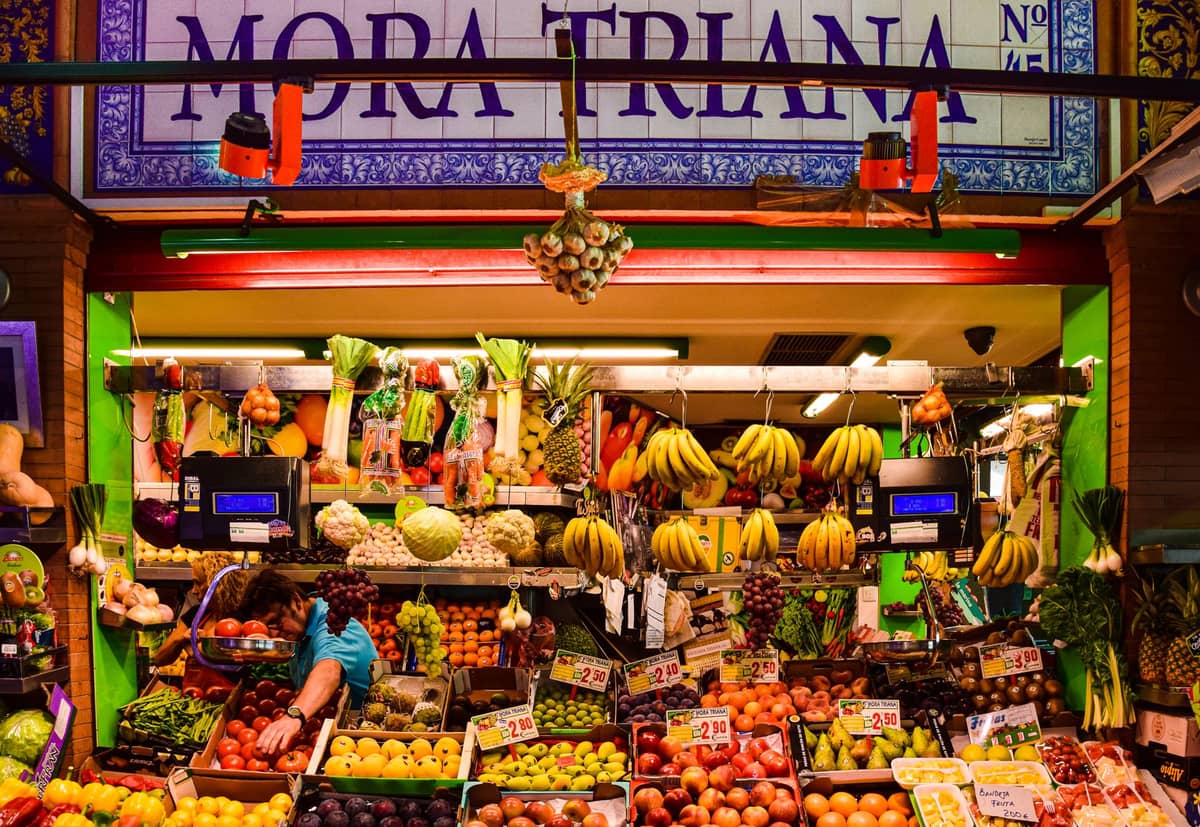
Arrive before 10:00 AM on a weekday and the market is at full operational tempo. Fishmongers are arranging glistening displays of fresh Atlantic and Mediterranean catch, vegetable vendors are stacking crates of tomatoes, peppers, and oranges (including the famous bitter Seville oranges in winter), and the smell of fresh bread drifts from a corner bakery stall. The sound at this hour is dominated by the clatter of hand trucks and the rapid, clipped exchanges between vendors and regulars who clearly know each other by name.
By late morning, the upper-level bars start filling with workers from the surrounding streets taking a mid-morning break over coffee and a small tapa. This is one of the most relaxed times to sit, order a café con leche and a tostada with local olive oil, and watch the market floor below without feeling rushed. The light comes in from the courtyard at a useful angle for photography between about 10:30 and 11:30 AM.
After 1:00 PM the atmosphere tips toward lunch, with the bar stools filling quickly. If you want a seat for a proper meal of fresh grilled fish or a simple raciones spread, arrive by 1:15 PM. Late afternoon on weekdays is noticeably quieter, with some stalls beginning to close or consolidate their displays. Saturday mornings are the busiest single session of the week.
Tickets & tours
Live prices and dates from our booking partner. If you book, we may earn a commission at no extra cost to you.
Tapas tour in the Triana neighborhood
From 65 €Instant confirmationFree cancellationTriana historical quarter with Guadalquivir river walking tour
From 20 €Instant confirmationFree cancellationCity Sightseeing Hop-on Hop-off Bus Tour Of Seville
From 31 €Instant confirmationFree cancellationCity Sightseeing Hop-on Hop-off Bus Tour Of Seville
From 40 €Instant confirmationFree cancellation
The Archaeological Layer Underneath
One detail that separates Mercado de Triana from a generic food market is what lies beneath it. During renovation works, excavations revealed the foundations of the Castillo de San Jorge, a medieval fortress that One detail that separates Mercado de Triana from a generic food market is what lies beneath it. During renovation works, excavations revealed the foundations of the Castillo de San Jorge, a medieval fortress that served as the headquarters of the Spanish Inquisition in Seville for centuries. These remains are now accessible as a small archaeological space within the market building itself.. These remains are now accessible as a small archaeological space within the market building itself.
The interpretive displays cover the history of the Inquisition in Andalusia, and the physical space, though compact, gives genuine weight to what can otherwise feel like an abstract piece of history. It is not a large museum, and a thorough visit takes around 20 to 30 minutes, but it adds a meaningful dimension to the market visit that most first-time visitors do not expect. Check current pricing and hours at the entrance or on the official market website before visiting. check current pricing and hours at the entrance or on the official market website before visiting.
What to Buy and What to Eat
The ground floor is a working food market first. The best stalls for visitors are the fishmongers, where you can see the variety of seafood that passes through Seville's kitchens, including whole fish, clams, langostinos, and salted cod. The fruit and vegetable stalls reflect the season honestly: in spring you get strawberries from Huelva and fresh broad beans; in autumn, the persimmons and pomegranates that fill Andalusian markets.
Upstairs, the bar and restaurant level is where most visitors end up spending the most time. Options include straightforward tapas bars serving local staples alongside stalls with a more specific focus. Prices are consistent with a neighborhood market rather than a tourist-oriented food hall, which is a meaningful distinction in central Seville.
If you are building a broader picture of Seville's food culture, the Mercado Lonja del Barranco on the opposite bank of the river offers a very different experience: a converted 19th-century iron pavilion with a curated roster of gourmet food stalls. It is worth visiting once, but Mercado de Triana is the one that feels real.
Getting There and Moving Around
The most satisfying way to arrive is on foot across the Puente de Isabel II, the old iron bridge that connects the historic center directly to Calle San Jorge and the market entrance. The walk from the cathedral district takes about 15 minutes and passes through the riverside stretch near the Torre del Oro. Several TUSSAM bus lines also serve stops within a short walk of the market along Calle Betis and Avenida de la República Argentina.
The market is listed as wheelchair accessible. The address is C. San Jorge, 6, which puts it directly at the Triana approach of the Puente de Triana. There is no parking immediately adjacent; if you are driving, street parking in Triana on weekday mornings is limited.
ℹ️ Good to know
The market is at its most photogenic on weekday mornings when the stalls are fully stocked and the courtyard light is clean. On Sunday, hours are reduced and many food stalls may be closed or operating with limited stock.
Triana Beyond the Market
Mercado de Triana works best as part of a longer exploration of the neighborhood rather than a standalone stop. From the market, the tile-fronted streets of central Triana stretch south and west, leading toward the Centro Cerámica Triana, which documents the neighborhood's centuries-old tradition of azulejo tile production. The riverside promenade along Calle Betis, running north and south from the bridge, offers some of the best views back across the Guadalquivir toward the historic center.
For a half-day itinerary, start at the market around 10:00 AM, visit the archaeological space, take a coffee upstairs, then walk south along the river toward Iglesia de Santa Ana, the oldest parish church in Seville, before doubling back through the ceramic-shop-lined streets toward the bridge. This circuit covers the most important parts of Triana without feeling rushed.
Who Should Skip This
Visitors with only one or two days in Seville and a list of major monuments to cover may find Mercado de Triana a lower priority than the Cathedral, Alcázar, or Plaza de España. It is not a spectacular architectural set piece, and if you have no interest in fresh-food markets or neighborhood-scale observation, the 30-minute walk from the historic center may not feel worthwhile. It is also not the place for souvenir shopping: the ground floor is a working market for residents, not a retail experience for tourists.
In peak summer heat, arriving after noon makes the market uncomfortable: the indoor market manages heat reasonably well, but the surrounding streets and the walk from the bridge become genuinely unpleasant above 36 degrees Celsius. Early-morning visits are strongly preferable from June through August.
Insider Tips
- The archaeological space in the basement documenting the Castillo de San Jorge and the Inquisition is overlooked by most visitors who come only for the food stalls. Budget an extra 25 minutes and go down before you do anything else, while energy is still high.
- The upper-level bars each have a slightly different focus. Walk the full circuit before sitting down: some specialize in fried fish, others in jamón and cheese boards. The one you want depends on what you are in the mood for.
- Saturday mornings between 10:00 and 11:30 AM are the most lively but also the most crowded. If you want to see the market at full energy but still find a bar stool easily, arrive on a weekday morning instead.
- The views back across the Guadalquivir from just outside the market entrance toward the Torre del Oro are underrated. This is one of the cleaner angles of that view in the city, and it works well in morning light before the sun swings around.
- Bring cash for the food stalls on the ground floor. Many vendors accept cards, but smaller stalls, especially at busy periods, prefer cash for small transactions.
Who Is Mercado de Triana For?
- Food-focused travelers who want to see what Sevillanos actually eat and buy
- Slow travelers building a neighborhood-level understanding of Triana
- History visitors interested in the Inquisition-era archaeological remains beneath the market
- Photographers looking for authentic market scenes away from the main tourist circuit
- Families who want a relaxed, free-entry stop with food options and something to see
Nearby Attractions
Other things to see while in Triana:
- Centro Cerámica Triana & Ceramics Workshops
Built on the ruins of an old tile factory, Centro Cerámica Triana traces the centuries-long story of Triana's ceramics industry through kilns, tools, and glazed tilework. At €2.10 entry, it rewards curious visitors with context that makes every tiled surface in Seville suddenly meaningful.
- Iglesia de Santa Ana (Triana)
Founded under Alfonso X in the late 13th century, Santa Ana is often described as the oldest parish church built new in Seville after the Christian reconquest. Tucked into Triana's residential streets, it holds a stunning 16th-century altarpiece by Pedro de Campaña and remains an active place of worship, giving it an authenticity that more touristed churches have lost.
- Puente de Triana (Puente de Isabel II)
Completed in 1852, the Puente de Isabel II, widely known as the Puente de Triana, is Spain's oldest surviving iron bridge. Spanning the Guadalquivir between the historic city centre and the working-class district of Triana, it offers some of the most compelling river views in Andalusia, and it costs nothing to cross.
Planning a trip? Discover personalized activities with the Nomado app.