Puente de Triana: The Bridge That Unites Two Sevilles
Completed in 1852, the Puente de Isabel II, widely known as the Puente de Triana, is Spain's oldest surviving iron bridge. Spanning the Guadalquivir between the historic city centre and the working-class district of Triana, it offers some of the most compelling river views in Andalusia, and it costs nothing to cross.
Quick Facts
- Location
- Puente de Isabel II, connecting Calle Reyes Católicos and Plaza del Altozano, 41010 Seville, Andalusia, Spain
- Getting There
- Multiple TUSSAM bus routes serve Calle Reyes Católicos (city side) and Plaza del Altozano (Triana side); short walk from Real Maestranza bullring
- Time Needed
- 15–30 minutes to cross and photograph; longer if you linger at either end
- Cost
- Free – open public bridge, no admission charge
- Best for
- River views, photography, connecting the city centre to Triana on foot
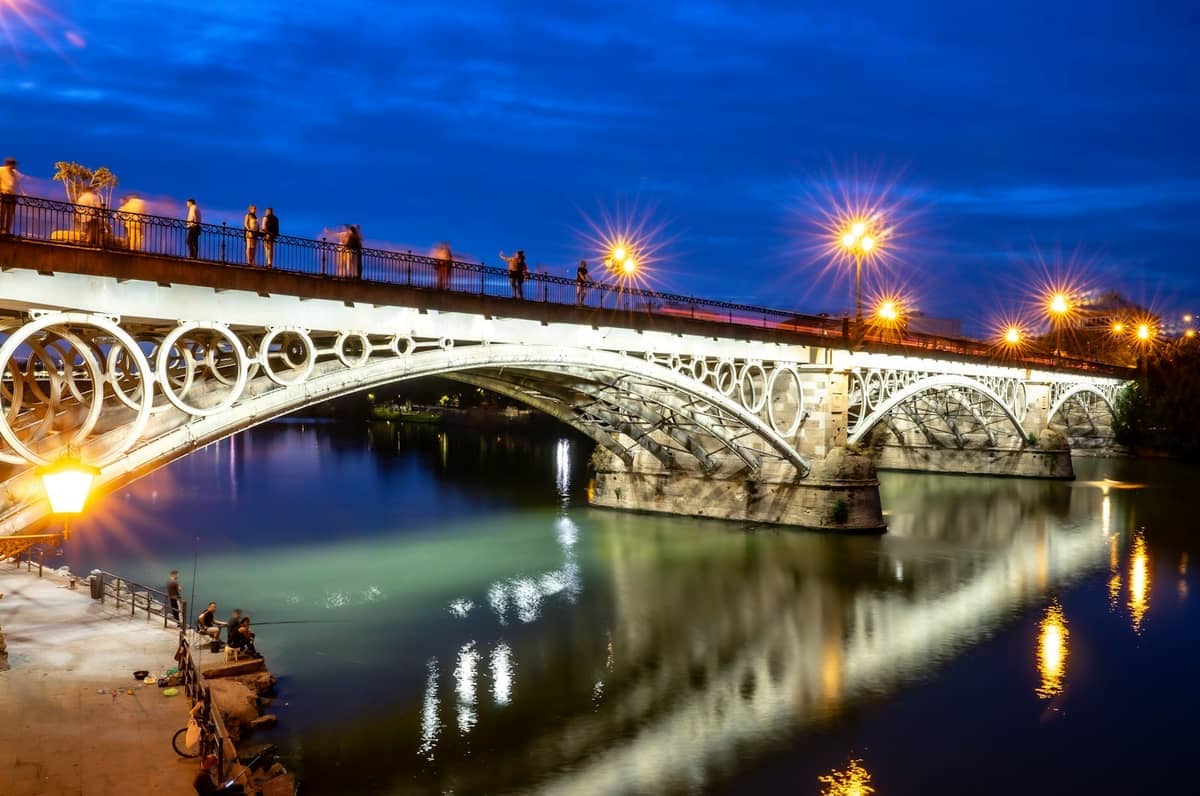
What the Puente de Triana Actually Is
The Puente de Triana, officially named the Puente de Isabel II, is a wrought-iron arch bridge completed in 1852. At roughly 149 metres in length and supported on three metal arches, it was the first permanent fixed bridge to cross the Guadalquivir in Seville, replacing a floating pontoon structure that had served the city for centuries. The name most people use, Puente de Triana, comes from the neighbourhood it feeds into on the west bank: Triana, Seville's historically distinct district associated with ceramics, flamenco traditions, and river culture.
It is a working road bridge with pedestrian footpaths on both sides, open 24 hours a day, every day of the year, at no cost. You will share the crossing with cyclists, locals pushing shopping trolleys home from the Mercado de Triana, and tourists pausing mid-span to photograph the Torre del Oro downstream. That mix of everyday function and historical weight is precisely what makes it worth your time.
💡 Local tip
Use the south-facing footpath when crossing from the city side. You get a cleaner sightline toward the Torre del Oro and the riverside promenade without pedestrian traffic backing up behind you.
A Bridge With Real History Behind It
Construction took place between 1845 and 1851 and the bridge was inaugurated in February 1852 under Queen Isabella II, whose name the bridge officially carries. The engineering reflected 19th-century industrial confidence: wrought iron was still a relatively new material for large civic infrastructure in Spain, and the bridge's three arched spans represented a significant departure from the timber and stone techniques that had defined Sevillian construction for centuries. Its designers drew on contemporary French bridge engineering, and the result had a lightness of form that the heavy stone pontoon bridges of northern Europe lacked.
Before the Puente de Isabel II existed, crossing the Guadalquivir between Seville's city centre and Triana meant using a pontoon bridge, essentially a line of boats lashed together with a wooden deck laid across them. That arrangement was unreliable during flood season and a constant source of friction for trade, since Triana was a major centre for ceramic production, fishing, and river commerce. The new iron bridge changed the relationship between the two sides of the city in practical and symbolic terms. Triana remained culturally separate, with its own rhythms and identity, but the physical connection became dependable.
The bridge anchors the western edge of the city's historic core. Walk five minutes east from the city-side entrance and you reach the Real Maestranza bullring and the old El Arenal district. Cross to the Triana side and you are immediately in front of Plaza del Altozano, the informal heart of the neighbourhood, with the Mercado de Triana a short walk away.
Tickets & tours
Live prices and dates from our booking partner. If you book, we may earn a commission at no extra cost to you.
Tapas tour in the Triana neighborhood
From 65 €Instant confirmationFree cancellationTriana historical quarter with Guadalquivir river walking tour
From 20 €Instant confirmationFree cancellationCity Sightseeing Hop-on Hop-off Bus Tour Of Seville
From 31 €Instant confirmationFree cancellationCity Sightseeing Hop-on Hop-off Bus Tour Of Seville
From 40 €Instant confirmationFree cancellation
What It Looks and Feels Like to Cross
The bridge is not dramatic from the approach. You turn off a busy city-centre street, the iron parapet comes into view, and then the Guadalquivir opens up below you. The river at this point is wide and slow, its green-brown surface reflecting the sky and the low riverside buildings of both banks. In summer the light off the water is intense by mid-morning, and the heat radiates up from the iron deck. In winter, with low cloud over the river, the whole scene softens: the Torre del Oro glows honey-coloured downstream, and the air smells of cold water and diesel from the tourist boats.
The footpaths on either side of the vehicle lane are reasonably wide. There is no glass barrier and no cage, so the view is unobstructed in both directions. Looking south, downstream, you have the Torre del Oro on the left bank and the long green strip of the riverside promenade. Looking north, the river curves away under a sequence of modern bridges. Mid-span, with traffic rumbling across the iron deck, there is a low vibration underfoot that reminds you this is a functioning piece of infrastructure, not a pedestrianised monument.
The bridge connects directly with the Triana neighbourhood on the west side. Plaza del Altozano, the open square at the Triana end, has a statue of Juan Belmonte, the famous bullfighter born in Triana, and small café terraces that fill up from mid-morning. It is a natural stopping point after the crossing.
How the Experience Changes by Time of Day
Early morning, before 8 a.m., the bridge belongs to joggers and dog walkers. The light is golden and low, raking across the iron structure and turning the river surface copper. Photographers will find this the most rewarding window: minimal pedestrian obstruction, soft shadows across the arches, and the Torre del Oro lit from behind.
By mid-morning, tourist foot traffic builds steadily. The bridge is a natural crossing point for anyone walking from the cathedral area toward Triana's market or ceramics shops, and groups tend to stop mid-span for photos, narrowing the footpath. Weekend mornings between 10 a.m. and noon are the most congested the bridge gets.
Late afternoon and evening are when the bridge earns its best atmospheric reputation. As the sun drops toward the west, the Triana bank is silhouetted against the orange sky, and the iron arches cast long shadows on the water. By dusk, the street lamps along the railing come on and the Torre del Oro is lit. Locals cross in both directions, the pace slows, and it feels less like a tourist route and more like a city corridor. This is the hour for lingering.
ℹ️ Good to know
The bridge is open and accessible at all hours. There is no lighting restriction or closure at night. After dark, the reflected lights of both banks make for a different kind of photograph entirely.
Practical Walkthrough: Getting There and What to Bring
From the city centre, the most direct approach is along Calle Reyes Católicos from the vicinity of the Archivo de Indias. The walk from the cathedral takes roughly ten minutes on flat ground. There are no significant gradients on the bridge itself, and the pedestrian footpaths are level and step-free on both sides, making it accessible to most visitors including those with pushchairs. As a historic 19th-century bridge, there is no elevator or enclosed viewing structure.
By public transport, several TUSSAM city bus routes stop near the bridge on both the El Arenal side and the Triana side at Plaza del Altozano. Checking current route maps on the TUSSAM website or a transit app before travelling is advisable, as routes and stop locations can change. Taxis and ride-hailing services (including Uber and Cabify, which operate in Seville) can drop you on either bank.
There is nothing to carry and nothing to book. Bring a camera if you want photographs of the river; a wide or standard lens works better than a telephoto for capturing the arches and the riverscape together. Comfortable flat shoes are fine. In summer, cross early or late: the iron deck absorbs heat and the exposed mid-river stretch offers no shade.
⚠️ What to skip
In summer, the bridge surface gets very hot underfoot between around 11 a.m. and 5 p.m. If you are visiting with young children or anyone sensitive to heat, cross early morning or wait for the evening.
The Bridge as a Gateway: What to Do on Either Side
The Puente de Triana is rarely the only reason someone comes to this part of the city. On the city-centre side, the Torre del Oro is a five-minute walk downstream along the riverside promenade. On the Triana side, the Mercado de Triana is two minutes on foot from Plaza del Altozano, and the neighbourhood's main ceramics shops line Calle San Jacinto heading south.
Triana is one of Seville's most characterful areas to explore on foot. The Centro Ceramica Triana documents the neighbourhood's long history of tile and pottery production, and the Iglesia de Santa Ana, the oldest church in Seville, is a short walk from the bridge. The riverside path on the Triana bank, the Calle Betis strip, is lined with bars that fill up from early evening.
If this is your first visit to Seville, the bridge works well as an orientation point. Standing mid-span, you can see the city's relationship with its river clearly: the historic centre pulled back slightly from the water, Triana pressed right up against it. For a broader look at how to structure your time, a three-day Seville itinerary typically routes through the bridge as a linking element between the cathedral district and an afternoon in Triana.
Is It Worth Your Time? An Honest Assessment
The Puente de Triana is not a destination in the way that the Alcázar or the cathedral is. You do not plan your day around it. What it offers is one of those unremarkable-looking crossings that turns out to be genuinely good: a free, unhurried, visually rewarding way to move between two distinct parts of the city, with enough historical and architectural interest to justify pausing rather than just walking through.
Visitors who expect a grand spectacle comparable to the Bridge of Sighs or a purpose-built viewing platform may find it understated. The iron structure is elegant rather than imposing, and the surrounding environment is urban and lived-in rather than manicured. That is part of the point. This bridge has been carrying Seville's daily life across the Guadalquivir for over 170 years, and it looks and feels like it.
If you are trying to decide how to spend limited time in the city, the bridge works best as a connector within a larger route that includes Triana's market, ceramics culture, and riverside bars. For context on the wider neighbourhood, see the things to do in Seville guide, which covers how Triana fits into the broader city experience.
Insider Tips
- For the cleanest downstream shot of the Torre del Oro, position yourself on the south-facing footpath about two-thirds of the way across from the city side, just before the final arch. The angle aligns the tower with the river bend.
- The Triana-side approach along Calle Betis (the riverside road running parallel to the Guadalquivir) gives you the best external view of the bridge's full iron arch structure. Most people only see it from the deck; walking the Betis strip in the evening shows the bridge properly lit and framed against the sky.
- If you are in Seville during Semana Santa, the bridge is a key processional route for brotherhoods crossing from Triana into the city. Crowds along the railing are dense but the atmosphere is unlike anything else in the city.
- The small ceramic plaques embedded into the Triana-side approach walls and nearby buildings are typical of the neighbourhood's craft tradition. Look for them at street level as you enter Plaza del Altozano from the bridge.
- Avoid mid-afternoon on weekends in high season (April–October) if you want a relaxed crossing. The combination of tourist groups and local foot traffic between noon and 4 p.m. makes the footpaths genuinely narrow.
Who Is Puente de Triana (Puente de Isabel II) For?
- Walkers using the bridge as a route between the historic centre and Triana
- Photographers seeking Guadalquivir river views, especially at golden hour
- History enthusiasts interested in 19th-century iron bridge engineering
- Visitors wanting a free, low-effort orientation point in the city
- Anyone building a half-day Triana neighbourhood itinerary
Nearby Attractions
Other things to see while in Triana:
- Centro Cerámica Triana & Ceramics Workshops
Built on the ruins of an old tile factory, Centro Cerámica Triana traces the centuries-long story of Triana's ceramics industry through kilns, tools, and glazed tilework. At €2.10 entry, it rewards curious visitors with context that makes every tiled surface in Seville suddenly meaningful.
- Iglesia de Santa Ana (Triana)
Founded under Alfonso X in the late 13th century, Santa Ana is often described as the oldest parish church built new in Seville after the Christian reconquest. Tucked into Triana's residential streets, it holds a stunning 16th-century altarpiece by Pedro de Campaña and remains an active place of worship, giving it an authenticity that more touristed churches have lost.
- Mercado de Triana
Mercado de Triana sits at the Triana end of the historic Isabel II bridge, serving as the beating heart of a neighborhood that has always done things its own way. Free to enter, genuinely local, and Free to enter, genuinely local, and home to a small archaeological space in its basement, it rewards visitors who show up early and stay for a coffee., it rewards visitors who show up early and stay for a coffee.
Planning a trip? Discover personalized activities with the Nomado app.