Real Maestranza de Caballería de Sevilla: What to Know Before You Visit
The Real Maestranza de Caballería de Sevilla is one of the oldest and most architecturally significant bullrings in Spain, standing on the Guadalquivir riverfront since the 18th century. Whether you follow bullfighting or not, the arena offers a serious window into Andalusian history, art, and civic identity. This guide covers the visit in honest detail.
Quick Facts
- Location
- Paseo de Colón, 12, 41001 Sevilla — El Arenal district, riverfront
- Getting There
- Walk from Plaza Nueva (10 min) or Puerta de Jerez tram stop; buses run along Paseo de Colón
- Time Needed
- 1 to 1.5 hours for the guided tour
- Cost
- Paid admission; verify current ticket price at realmaestranza.com before visiting
- Best for
- Architecture lovers, history enthusiasts, cultural curiosity about Andalusia
- Official website
- www.realmaestranza.com/
What Is the Real Maestranza de Caballería?
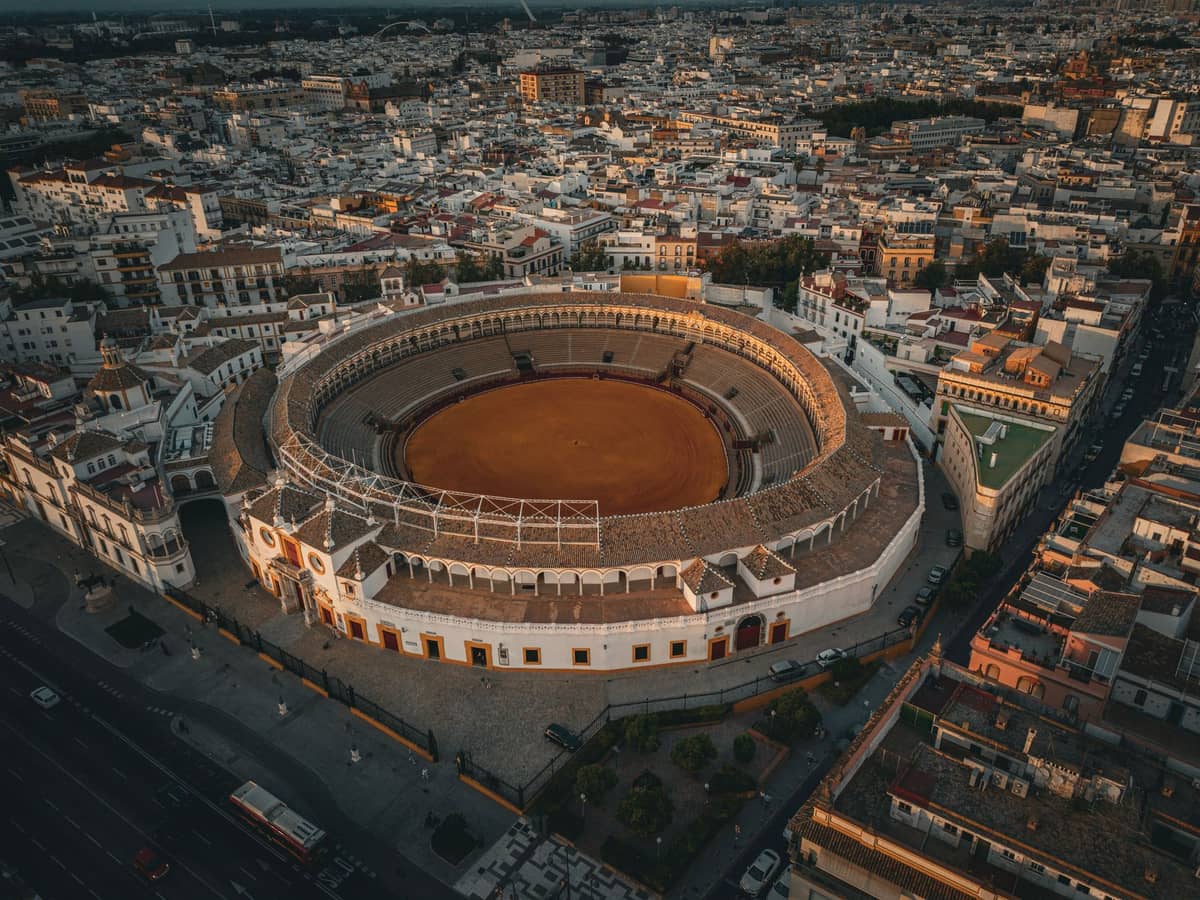
The Real Maestranza de Caballería de Sevilla is not simply a sports venue with a gift shop attached. It is the headquarters of one of Spain's oldest equestrian corporations, founded in 1670, and the bullring built under its auspices ranks among the most important examples of 18th-century civil architecture in Andalusia. The institution predates the current arena, whose construction began in 1749 and continued in phases across several decades, resulting in the horseshoe-shaped sandstone structure you see today on Paseo de Colón.
For visitors unfamiliar with bullfighting, or for those who approach it with ambivalence, that framing matters. The Maestranza functions year-round as a cultural and heritage site. The bullfighting season runs from Easter Sunday through October, but outside of fight days, the arena is open for guided tours that cover the ring itself, the bullpens, the chapel, the infirmary, and the on-site museum. The experience is structured around history and architecture as much as spectacle.
ℹ️ Good to know
Opening hours are seasonal: 9:30–19:00 from 1 November to 31 March, and 9:30–21:00 from 1 April to 31 October. On fight days, public tours end early in the afternoon. Always check the official website before planning your visit.
The Architecture and the Space
Approaching from the Guadalquivir riverfront, the Maestranza announces itself through its ochre and white baroque facade, a deliberate contrast to the water and the palm-lined promenade. The Prince's Gate, the main entrance reserved for ceremonial use, faces the river directly. Its decorative stonework is detailed enough to reward a slow look before you even enter.
Inside, the arena holds roughly 12,500 spectators in tiered stone seating that curves around the sand ring below. The combination of white-painted ironwork balustrades, red wooden barriers, and sandy ochre tones is immediately striking in bright afternoon light. At midday in summer, the heat in the sun-facing sections is considerable; the shaded tendido sections stay noticeably cooler. On a quiet morning tour, without crowds and without event preparation underway, the silence in the ring itself is unexpectedly affecting.
The design evolved over roughly a century of construction. Architects faced the practical challenge of building on uneven ground near the riverbank, which explains some of the irregularities in the seating bowl when you look carefully from the ring floor. The result is a structure that feels organic rather than perfectly engineered, and that quality contributes to the atmosphere more than any single decorative element.
The Maestranza sits in the El Arenal district, the riverside quarter that was historically Seville's port zone. The location is deliberate: this was the civic and commercial heart of the city in the centuries when Seville controlled Atlantic trade with the Americas. Walking to the arena from the old town takes you past the Torre del Oro, the medieval watchtower on the Guadalquivir, which gives useful historical context for how this part of the city developed.
Tickets & tours
Live prices and dates from our booking partner. If you book, we may earn a commission at no extra cost to you.
Guided tour of Real Alcazar of Seville, Cathedral and Giralda
From 50 €Instant confirmationSeville walking tour with tickets to the Reales Alcazares and Saint Mary cathedral
From 60 €Instant confirmationSeville cathedral ticket with audio guide and augmented reality
From 30 €Instant confirmationGuided tour of the white villages of Andalusia: Ronda, Grazalema and Zahara
From 79 €Instant confirmationFree cancellation
The Museum and Interior Spaces
The tour circuit moves through areas not normally associated with a standard stadium visit. The chapel, located inside the arena walls, is where bullfighters have traditionally prayed before entering the ring. It is small, densely decorated, and lit primarily by candles during active use. The devotional paintings and silver votives accumulated over centuries make it feel less like a tourist stop and more like a functioning religious space, which it still is.
The infirmary nearby served as the medical facility for injured fighters and preserves its original period equipment alongside documentation of what happened here on significant occasions. For visitors interested in the medical history of early modern Spain, or in how athletic medicine developed in this context, the room has more to offer than its modest size suggests.
The museum component covers the history of the Maestranza corporation, the development of bullfighting in Seville, and the artistic culture that grew around the corrida. The collection includes paintings, posters, costumes, and equipment. The quality of individual objects varies, but the aggregated picture of how a specific urban tradition produced its own visual language over three centuries is genuinely interesting. Labels are generally available in Spanish and English.
💡 Local tip
Guided tours run throughout the day and are included with general admission. If you want commentary in English, confirm availability when you arrive. Spanish-language tours tend to run more frequently.
Visiting on a Fight Day vs. a Tour Day
The experience of the Maestranza divides sharply depending on whether a corrida is scheduled. On fight days, particularly during the Feria de Abril season in April and May, Paseo de Colón fills with people in traditional dress arriving for the evening event. The atmosphere outside the arena is theatrical and loud, the scent of horses in the nearby stables drifts out, and the whole neighborhood takes on an intensity that regular tour days do not replicate.
Attending an actual bullfight is a decision that involves ethical, cultural, and personal considerations. The Maestranza's season runs from Easter Sunday, which aligns with Semana Santa, through October. Ticket prices and availability vary considerably by fight and seating section. If you attend, arriving early allows you to examine the ring preparation and the ceremonial entry before the event begins.
For those who would rather not attend a fight but still want to understand what the space means to Seville, a morning tour on a non-fight day is the better option. The ring is quiet, the staff are unhurried, and you can spend time in the museum without the energy of an event crowd.
Time of Day and Practical Logistics
Morning visits, particularly between 10:00 and 12:00, tend to be the least crowded. The light is also more photogenic in the arena at this time, entering from the east and catching the white balustrade ironwork without the harsh midday flatness. By early afternoon, cruise and tour groups sometimes arrive in larger numbers, which makes the museum rooms feel congested.
The Maestranza is roughly ten minutes on foot from Plaza Nueva, walking south along the riverfront. The walk is flat, shaded in parts by the colonnade of the nearby buildings, and passes the Torre del Oro. The MetroCentro tram's southern terminus at Puerta de Jerez drops you a few minutes' walk away, which is useful if you are coming from Santa Justa station or the northern part of the city center.
Wear comfortable shoes; the stone floors throughout the tour circuit are uneven in places, particularly in the older sections of the building. There is no significant climbing involved. The arena sand is not accessible to visitors during standard tours.
⚠️ What to skip
On bullfight days, the public tour closes several hours before the event. Check the official schedule at realmaestranza.com before planning a same-day visit, especially during April and May when events are most frequent.
Cultural Context: Why This Place Matters in Seville
Seville is the city most associated with bullfighting in Spain, and the Maestranza is the arena that anchors that association. This is not merely local pride: the institution's history runs parallel to Seville's role as the gateway to the Americas, to the development of Andalusian baroque art, and to the civic culture of a city that has repeatedly been at the center of Spanish national identity. Understanding the Maestranza helps explain parts of Seville that are otherwise opaque, including aspects of the Feria de Abril and the city's approach to public ceremony.
It is also worth noting that bullfighting is a contested subject in contemporary Spain, with significant opposition and ongoing legal and cultural debate. Visiting the Maestranza as a heritage site does not require endorsement of the corrida, and the institution itself presents its history in a way that acknowledges its place in a long tradition without demanding that visitors share a particular view. For a broader picture of Seville's cultural identity, the Museo del Baile Flamenco offers a complementary perspective on how Andalusian performance traditions developed alongside and separate from the bullring.
Who Should Skip This
Visitors who are strongly opposed to bullfighting as a practice may find that even the museum and architectural tour feel uncomfortable, since the entire space exists to celebrate the tradition. The tour does not dwell on graphic content, but the context is unavoidable. If your interest is purely in baroque architecture, Seville has several churches and palaces that offer that experience without the surrounding cultural weight.
Visitors traveling with young children should consider the pacing: the tour involves a lot of standing and reading, and the content is primarily adult-oriented. Families with children who need more active engagement might find the Seville with kids guide useful for planning a different afternoon in this part of the city.
Insider Tips
- The Prince's Gate on the river side is only opened for ceremonial entries on fight days. If you visit during the season, position yourself on Paseo de Colón about 45 minutes before a corrida to watch the procession through this gate — it is one of the more distinctive pre-event rituals in Spanish public life.
- The museum's poster collection is one of the strongest parts of the visit for design-oriented travelers. Bullfighting posters from the late 19th and early 20th centuries are significant artifacts of Spanish graphic art and worth examining carefully even if you have no interest in the subject matter.
- If you are visiting Seville during April, the proximity of the Maestranza to the Torre del Oro and the riverfront means you can combine both into a single morning without rushing. Start at the Torre del Oro when it opens, then walk to the Maestranza for the mid-morning tour.
- Photography inside the arena is generally permitted during tours. The best angle for showing the full scale of the seating bowl is from the ring floor looking back toward the president's box, which faces the afternoon sun from the west.
- The Maestranza bookshop near the exit sells specialist publications on the history of the arena and the institution. Some of these are not available elsewhere and make serious alternatives to standard tourist souvenirs.
Who Is Real Maestranza de Caballería de Sevilla (Bullring) For?
- Architecture and heritage travelers interested in 18th-century Andalusian baroque construction
- Visitors who want to understand Seville's cultural identity beyond the Cathedral and Alcázar
- Travelers attending the Feria de Abril who want the historical background for what they will see during the festival season
- History and museum visitors with an interest in how civic institutions shaped urban culture in early modern Spain
- Photographers looking for a distinctive interior with strong light, color contrast, and geometric scale
Nearby Attractions
Other things to see while in El Arenal:
- Iglesia de la Magdalena
The Real Parroquia de Santa María Magdalena stands as one of Seville's great Baroque achievements, a richly decorated 18th-century church tucked into the El Arenal district just minutes from Plaza Nueva. Entry is free, crowds are thin, and the interior rewards anyone who takes the time to look up.
- Mercado Lonja del Barranco
Housed in a 19th-century iron fish market beside the Guadalquivir, Mercado Lonja del Barranco brings together over 20 food and drink stalls under one beautifully restored roof. Entry is free, the hours run late, and the location next to the Triana Bridge makes it one of the most atmospheric food stops in central Seville.
- Museo de Bellas Artes de Sevilla
The Museo de Bellas Artes de Sevilla holds one of Spain's finest collections of Golden Age painting, housed in a former Baroque convent at Plaza del Museo. Admission is just €1.50 for non‑EU visitors, and EU citizens enter free. Here is everything you need to visit well.
- Torre del Oro
Standing 36 metres tall on the bank of the Guadalquivir River, the Torre del Oro is one of Seville's most photographed landmarks. Built around 1220–1221 as a military watchtower, it now houses a small naval museum and offers some of the most dramatic riverfront views in Andalusia. Admission costs just €3, with €1.50 concessions, making it one of the best-value monuments in the city.
Planning a trip? Discover personalized activities with the Nomado app.