Museo de Bellas Artes de Sevilla: What to Expect, What to See, and Whether It's Worth Your Time
The Museo de Bellas Artes de Sevilla holds one of Spain's finest collections of Golden Age painting, housed in a former Baroque convent at Plaza del Museo. Admission is just €1.50 for non‑EU visitors, and EU citizens enter free. Here is everything you need to visit well.
Quick Facts
- Location
- Plaza del Museo, 9, 41001 Sevilla — central Seville, north of El Arenal
- Getting There
- 10-minute walk from the Cathedral; TUSSAM city buses serve nearby stops on Calle Alfonso XII and Marqués de Paradas
- Time Needed
- 1.5 to 2.5 hours for a thorough visit; 45 minutes if you focus on the Golden Age rooms
- Cost
- €1.50 general admission for non‑EU visitors; free for EU citizens with accredited ID, ICOM members, and on 28 Feb, 18 May, 27 Sep, and 4 Dec
- Best for
- Art history enthusiasts, architecture lovers, and anyone seeking a cool, uncrowded alternative to Seville's headline monuments
- Official website
- www.museosdeandalucia.es/web/museodebellasartesdesevilla
Why This Museum Deserves More Attention Than It Gets
The Museo de Bellas Artes de Sevilla is ranked second only to the Prado among Spain's fine arts museums, yet on any given Tuesday morning it is possible to stand alone in front of a monumental Murillo canvas without another visitor in sight. That contrast, between the collection's genuine importance and the relative quiet of its galleries, is what makes this one of the most rewarding places to spend a few hours in Seville.
The building itself sets the tone before you see a single painting. The museum occupies the Convento de la Merced Calzada, a 17th-century Baroque convent whose construction began around 1612. Three courtyards, a grand staircase lined with azulejo tilework, and a former church transformed into a picture gallery give the visit a sense of scale and beauty that purely purpose-built museums rarely achieve.
💡 Local tip
EU citizens enter free with a national ID card or passport confirming EU citizenship — no booking needed. Non‑EU visitors pay just €1.50, making this one of the most underpriced cultural experiences in Andalusia.
The Building: A Convent Turned Gallery
Walking through the entrance portal on Plaza del Museo, you pass from the noise of the street into the first cloister almost immediately. The stone underfoot is worn smooth in places, and the proportions of the arcaded courtyard, with orange trees at the centre, establish a pace that is unhurried by design. This was a working religious community for two centuries before the 19th-century Ecclesiastical Confiscations transferred the property to state control.
The three courtyards progress in scale and formality as you move deeper into the building. The second cloister, with its Baroque fountain and painted plaster details, is often as photogenic as anything hanging inside. Light enters differently in each space depending on the time of day, with the morning sun throwing long shadows across the lower arcade that gradually shorten and disappear by early afternoon.
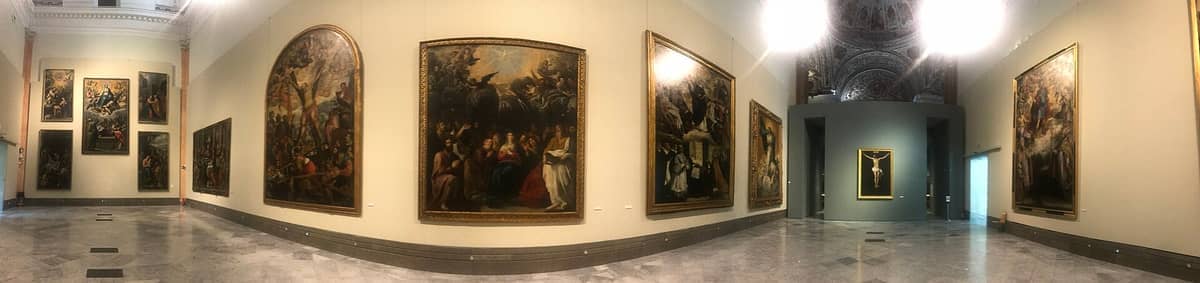
The former church, now known as Sala V, is the architectural centrepiece of the visit. The vaulted nave was converted into a permanent picture gallery in the 19th century, and the scale of the space was clearly conceived with large-format religious paintings in mind. The ceiling frescoes by Domingo Martínez, dating from the 18th century, remain intact above the paintings on the walls, creating a layered effect that rewards looking up as much as looking straight ahead.
The building sits in the El Arenal neighbourhood, a few minutes' walk from the riverside and the Torre del Oro. If you are planning a morning in this part of the city, the museum pairs naturally with a walk along the Guadalquivir promenade.
Tickets & tours
Live prices and dates from our booking partner. If you book, we may earn a commission at no extra cost to you.
Seville Heritage Guided Tour with Macarena Quarter, Moorish Churches and Palaces
From 39 €Instant confirmationFree cancellationJewish quarter walking tour with tasty tapas and drinks in Seville
From 54 €Instant confirmationFree cancellationLive flamenco show and entrance tickets to Seville Flamenco Dance Museum
From 29 €Instant confirmationFree cancellationGuided visit of Seville Museum of Fine Arts
From 15 €Instant confirmationFree cancellation
The Collection: What You Will Actually See
The permanent collection spans medieval panel paintings through to 20th-century works, but the museum's reputation rests overwhelmingly on its Golden Age holdings, covering roughly the late 16th through the 17th century. Seville was the economic capital of Spain's Atlantic trade during this period, and the city's prosperity funded an extraordinary concentration of artistic patronage. Much of what was produced for Seville's churches and convents eventually ended up here after the Confiscations.
Bartolomé Esteban Murillo is represented more comprehensively here than anywhere else in the world. His large devotional canvases, including the Immaculate Conception known as the Inmaculada de los Venerables and several scenes from the life of Saint Francis, demonstrate the emotional directness and warm tonality that made him the most internationally famous Spanish painter of his era. Sala V is where the major Murillo works hang, and the room's scale suits them.
Francisco de Zurbarán's monastic figures are equally compelling, though in an entirely different register. Where Murillo is luminous and accessible, Zurbarán is austere, his monks and saints emerging from near-total darkness with an almost sculptural solidity. His series of figures from the life of Saint Bonaventure, produced for the Franciscan College of Seville, is among the most technically disciplined painting in the collection. Spend time with individual figures rather than trying to absorb whole canvases at speed.
Juan de Valdés Leal, the third of the great Seville Golden Age painters represented here, offers a markedly more agitated sensibility. His work has a nervous energy that contrasts sharply with Zurbarán's stillness, and seeing all three painters in the same building clarifies why 17th-century Seville produced such a distinctive and varied school.
ℹ️ Good to know
The museum also holds significant medieval sculpture and Gothic altarpieces in the earlier rooms, which many visitors rush past to reach the Golden Age paintings. The 15th-century ceramics and early devotional panels provide important context for how Seville's artistic tradition developed.
How the Experience Changes by Time of Day
The museum opens at 09:00 Tuesday through Saturday (and also at 09:00 on Sundays and public holidays), and the first hour is consistently the quietest. School groups, which are a regular feature of mid-morning visits, tend to arrive between 10:00 and 11:00. If you want unhurried access to the Murillo room and the courtyard light at its most theatrical, aim to arrive within the first 30 minutes of opening.
Late afternoon, from around 17:00 onward, offers a second quiet window before the 21:00 close on Tuesdays through Saturdays. The low western sun does not penetrate the interior galleries directly, but it does create a warm diffused light in the second and third courtyards that makes the architecture particularly pleasant to linger in. Many visitors to Seville do not realize the museum stays open until 21:00 on weekdays, which makes it an unusually good option for the long summer evenings when temperatures outside remain above 30°C.
Sunday hours are shorter, closing at 15:00, and Sunday mornings can be noticeably busier, partly because admission is free for accredited EU visitors and partly because the museum is one of few major sites in this area open on Sunday mornings without advance booking requirements.
⚠️ What to skip
In August, the museum operates reduced hours of 09:00 to 15:00 on all open days (Tuesday to Sunday and public holidays). If you are visiting Seville in summer, plan your museum morning accordingly and arrive early, both for the hours and for the air conditioning.
Practical Walkthrough: Getting There and Getting Around Inside
Plaza del Museo is easy to reach on foot from most central accommodation. From the Cathedral and Giralda, the walk takes around 10 minutes heading northwest along Calle Sierpes or through the shopping streets toward Plaza de la Campana, then turning left. TUSSAM buses serve stops on the surrounding streets, and the MetroCentro T1 tram stops at Plaza Nueva, roughly a 7‑minute walk away.
Inside, the galleries are numbered and follow a roughly chronological sequence from medieval works in the earlier rooms to 19th and 20th century painting in the later ones. Signage is in Spanish throughout, with some English-language information panels in selected rooms. An audio guide is available for rent at the ticket desk, and the museum's official website provides additional information in Spanish.
The layout across multiple levels and courtyards means that visitors with mobility limitations should check accessibility in advance, as the historic building involves changes in floor level and some stairways. The museum's official contact details are available at the Museos de Andalucía website. Comfortable, flat shoes are advisable given the stone floors and the amount of standing involved.
Photography without flash is generally permitted in the permanent galleries, making this a good location for interior architectural shots. The second cloister in particular photographs well in diffuse morning light. If you are planning a full day of Seville's cultural highlights, consider pairing the museum with nearby Real Maestranza bullring or a walk along the riverside, both within easy reach of Plaza del Museo.
Honest Assessment: What Works and What Does Not
The collection's depth in 17th-century Seville painting is genuinely world-class, and the admission price makes this one of the best-value cultural experiences in southern Spain. The building is beautiful. The crowds are manageable. For anyone with a serious interest in Golden Age painting or Spanish Baroque art, a visit here is not optional.
The limitations are real, though. Spanish-only signage in many rooms will frustrate visitors without some language knowledge or an audio guide. The collection's medieval rooms can feel sparse and under-contextualized compared to the richness of the later galleries. And if your primary interest is contemporary art, the museum offers very little: this is emphatically a pre-20th-century collection, and the 19th-century academic paintings in the final rooms are a significant step down in quality from the Golden Age core.
Visitors who have just spent a day at the Real Alcázar or the Seville Cathedral and feel saturated by ornament and grandeur will find the museum's quieter, more contemplative atmosphere a relief. Those looking for interactive exhibits, technology-driven displays, or anything aimed primarily at children will be less satisfied. The Museo de Bellas Artes rewards slow looking, not quick impressions.
For context on how this museum fits into Seville's broader cultural offering, the best museums in Seville guide covers the full range of options across the city.
Insider Tips
- The free admission dates, 28 February, 18 May, 27 September, and 4 December, are worth noting if your dates align, but the museum is rarely crowded enough on regular days to make paid entry feel like a burden at €1.50.
- Sala V, the former church nave, is the room most visitors remember. Stand near the far end of the nave and look back toward the entrance wall: the combination of ceiling frescoes, natural light from high windows, and the scale of the Murillo canvases is strongest from that vantage point.
- The plaza outside the museum, Plaza del Museo, has benches under large trees and is a genuine local rest spot rather than a tourist staging area. Arriving slightly before opening and sitting in the plaza for a few minutes is a pleasant way to start the visit.
- The museum shop near the exit carries reasonably priced art-history publications focused on the Seville school and Murillo in particular, including academic catalogue editions that are difficult to find elsewhere in the city.
- If you are visiting Seville in the evening during spring or autumn, the museum's 21:00 closing time on Tuesdays through Saturdays makes it one of the few major cultural venues where you can combine dinner at 21:30 with a substantive museum visit beforehand, rather than having to choose between them.
Who Is Museo de Bellas Artes de Sevilla For?
- Art history enthusiasts, especially those with interest in 17th-century Spanish painting and the Seville school
- Travelers seeking a serious cultural experience without large crowds or high admission costs
- Architecture lovers drawn to Baroque convent design and Andalusian courtyard spaces
- Visitors to Seville during summer who want an air-conditioned mid-morning activity with genuine substance
- Anyone building a broader Andalusian itinerary who wants to understand the artistic context of the region
Nearby Attractions
Other things to see while in El Arenal:
- Iglesia de la Magdalena
The Real Parroquia de Santa María Magdalena stands as one of Seville's great Baroque achievements, a richly decorated 18th-century church tucked into the El Arenal district just minutes from Plaza Nueva. Entry is free, crowds are thin, and the interior rewards anyone who takes the time to look up.
- Mercado Lonja del Barranco
Housed in a 19th-century iron fish market beside the Guadalquivir, Mercado Lonja del Barranco brings together over 20 food and drink stalls under one beautifully restored roof. Entry is free, the hours run late, and the location next to the Triana Bridge makes it one of the most atmospheric food stops in central Seville.
- Real Maestranza de Caballería de Sevilla (Bullring)
The Real Maestranza de Caballería de Sevilla is one of the oldest and most architecturally significant bullrings in Spain, standing on the Guadalquivir riverfront since the 18th century. Whether you follow bullfighting or not, the arena offers a serious window into Andalusian history, art, and civic identity. This guide covers the visit in honest detail.
- Torre del Oro
Standing 36 metres tall on the bank of the Guadalquivir River, the Torre del Oro is one of Seville's most photographed landmarks. Built around 1220–1221 as a military watchtower, it now houses a small naval museum and offers some of the most dramatic riverfront views in Andalusia. Admission costs just €3, with €1.50 concessions, making it one of the best-value monuments in the city.
Planning a trip? Discover personalized activities with the Nomado app.