Seville Cathedral (Catedral de Sevilla): What to Know Before You Go
The Catedral de Sevilla is one of the largest churches on earth by volume, a Gothic colossus built on the footprint of a 12th-century Almohad mosque. This guide covers what to expect inside, when to visit, how to climb the Giralda, and whether it lives up to the scale of its reputation.
Quick Facts
- Location
- Avenida de la Constitución s/n, Santa Cruz, Seville 41004
- Getting There
- Tram T1 (Archivo de Indias stop); multiple TUSSAM bus lines on Avenida de la Constitución
- Time Needed
- 2 to 3 hours for cathedral + Giralda climb
- Cost
- €13 online / €14 at door (general); free for children up to 13; free Sunday afternoon slots 16:30–18:00 (limited, book online)
- Best for
- Architecture lovers, history enthusiasts, anyone visiting Seville for the first time
- Official website
- www.catedraldesevilla.es/en
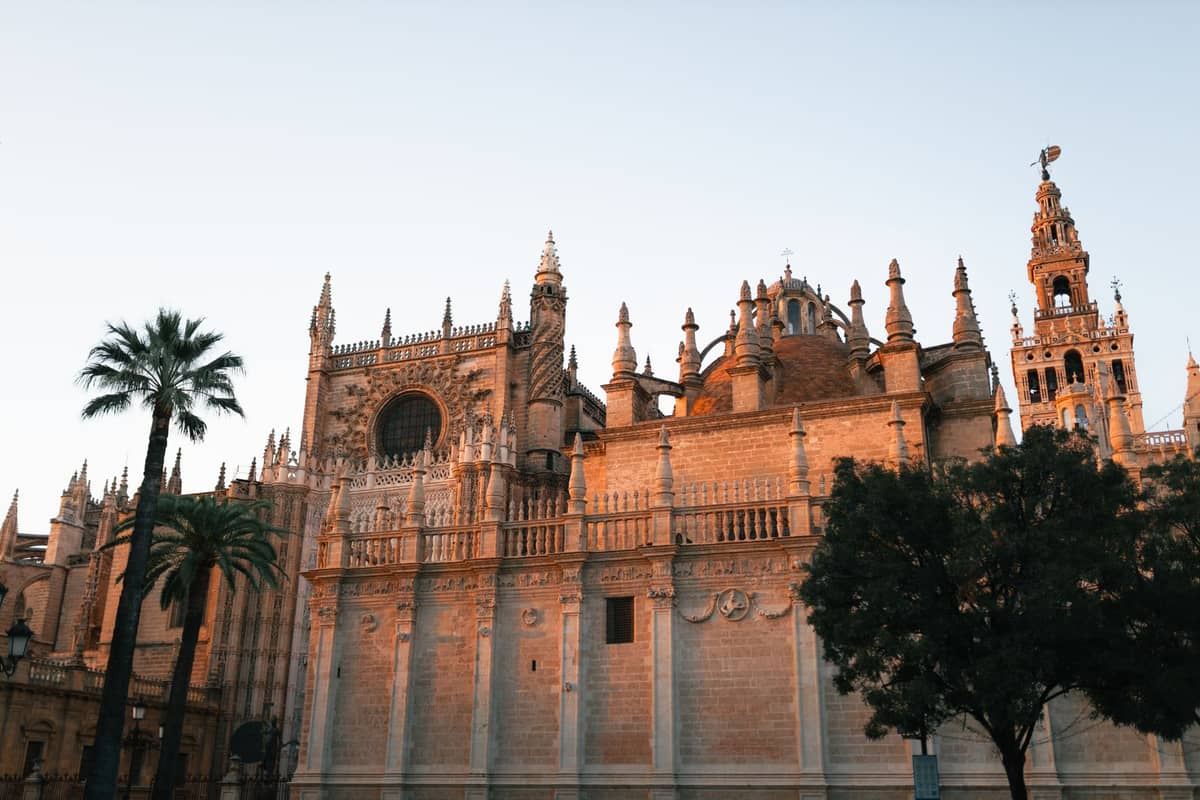
What the Catedral de Sevilla Actually Is
The Catedral de Sevilla, formally known as the Santa Iglesia Catedral Metropolitana de Sevilla, is not simply a large church. It is widely regarded as one of the largest Christian churches in the world by interior volume and the largest Gothic cathedral, a distinction often mentioned alongside other giants such as Saint Peter's Basilica in Rome and Saint Paul's Cathedral in London. That scale is not just a statistic — it is the first thing you feel when you step through the doors and the nave opens up above you like a stone canyon.
Construction began in the early 15th century, traditionally dated to 1401, on the site of Seville's Great Mosque, built by the Almohad dynasty in the 12th century. The canons who commissioned the new cathedral reportedly wanted something so large that future generations would think they were mad to attempt it. What they built took over a century to complete and still stands as one of the defining achievements of late Gothic architecture. The Giralda tower, the cathedral's bell tower and one of Seville's most recognizable silhouettes, began its life as the minaret of that mosque. Its lower two-thirds are original 12th-century Almohad masonry; the upper section, including the Renaissance belfry, was added by Spanish architects in the 16th century.
💡 Local tip
Book tickets online at catedraldesevilla.es before you arrive. You save €1 per ticket compared to the door price, and more importantly, you avoid queuing at the ticket office — which on busy mornings in spring can stretch well past the Puerta del Perdón and separate free-visit access times.
The Interior: Scale, Light, and What to Look For
The cathedral is divided into five naves, with the central nave rising to around 42 metres at its highest point. Walking from the main entrance toward the high altar, the sheer height of the side chapels is disorienting in the best possible way — each one is effectively its own room, with altarpieces, paintings, and sculpture packed into them. There are around 80 chapels in total. You will not see all of them carefully in a single visit, and that is fine. Most visitors spend the bulk of their time in the central nave, the Capilla Mayor, and the Royal Chapel.
The Capilla Mayor contains what is widely regarded as the largest altarpiece in the world: a gilded retablo of carved walnut and cedar that, according to tradition, took a Flemish sculptor and his team around 80 years to complete, from the late 15th century to the mid‑16th century, with roughly 45 carved panels depicting scenes from the life of Christ and the Virgin. Bring binoculars if you have them; the upper panels are too distant to appreciate without help.
Light behaves differently depending on the hour. In the mid-morning, the southern transept windows throw wide shafts of colored light across the stone floor. By early afternoon that light has moved and softened. The interior always smells faintly of old stone, incense, and the particular cool air that massive masonry holds even in summer. On a 38-degree July afternoon outside, the cathedral interior hovers around a noticeably cooler temperature — not air-conditioned, but genuinely refreshing.
Near the southern transept, you will find the tomb of Christopher Columbus, held aloft by four pallbearer figures representing the kingdoms of Castile, León, Aragon, and Navarra. Whether or not his remains are actually those of Columbus (there is a long academic dispute on this point) is almost beside the point — the monument itself is theatrical and worth examining. The cathedral sits in the heart of Santa Cruz, Seville's former Jewish quarter, and just steps from the Archivo General de Indias, which holds the original documents of Spain's New World expeditions — making the Columbus connection feel considerably less abstract.
Tickets & tours
Live prices and dates from our booking partner. If you book, we may earn a commission at no extra cost to you.
Climbing the Giralda: What the Ascent Is Really Like
Admission to the cathedral includes access to the Giralda tower, and it would be a significant oversight to skip it. The ascent is unusual: there are no steps. The tower was originally designed so that the muezzin could ride a horse to the top to deliver the call to prayer, and the interior is composed of 34–35 ramps rather than stairs. The incline is gentle but continuous, and the roughly 104‑metre climb to the viewing gallery takes about 10 to 15 minutes at a comfortable pace.
The view from the top is one of the most complete panoramas of central Seville available without purchasing a separate ticket. You can see the roofline of the cathedral below you, the terracotta and ochre cityscape spreading in every direction, and on clear days the flat Guadalquivir flood plain stretching south. The belfry level is noisy when the bells ring — which they do on the hour — so timing your ascent to avoid that is worth considering.
ℹ️ Good to know
The Giralda ramps are wheelchair accessible in principle, but the gradient and length make it physically demanding and current policy often restricts tower access for wheelchairs; the cathedral's free wheelchair loan service covers the interior, so verify up‑to‑date Giralda access conditions at the ticket office on arrival.
For other elevated views over Seville, the Mirador de la Torre de los Perdigones offers a 360-degree perspective from a different part of the city. The Giralda, however, puts you directly above the historic centre in a way nothing else replicates.
When to Visit: Crowds, Light, and Season
The cathedral is busy for most of the year, but peak congestion follows a clear pattern. The worst time to arrive without a ticket is between 10:00 and 13:00 on any day from March through October. Tour groups tend to cluster in this window, and the ticket office queue can add 30 to 45 minutes to your visit before you have even entered. Booking online eliminates most of this friction.
Sunday afternoons offer a free public visit from approximately 16:30 to 18:00, but capacity is limited and slots must be reserved online in advance. This is a genuine opportunity for budget travelers, though the cathedral will be at its most crowded during this window. If you want a quieter interior experience, Monday to Wednesday mornings in November, January, or February are about as calm as it gets — the crowds thin significantly in winter, and the light through the stained glass on a clear winter morning is exceptional.
Summer visits (July and August) are manageable inside the cathedral thanks to the cool interior, but the approach from the street in 38-degree heat is taxing. Wear light clothing and carry water. For broader advice on managing Seville in different seasons, the guides on visiting Seville in summer and the best time to visit Seville are worth reading before you plan your trip.
Practical Walkthrough: Getting There and Getting In
The cathedral is located at Avenida de la Constitución s/n in the Santa Cruz neighborhood. The closest tram stop is Archivo de Indias on the T1 MetroCentro line, which runs between Plaza Nueva and San Bernardo. From the stop, the main facade is visible within two minutes on foot. Several TUSSAM bus lines serve the nearby Jardines del Cristina stop just off Avenida de la Constitución.
The cathedral has multiple entrances. The primary visitor entrance for cultural visits is typically through Puerta del Perdón on Avenida de la Constitución. Entrance for religious services uses different doors, so if you arrive early and see queues forming before opening time, check whether the entrance point has been adjusted on that day. Opening hours for cultural visits run Monday to Saturday 11:00 to 18:00 (last admission 17:00) and Sunday 14:30 to 19:00 (last admission 18:00). The cathedral is closed to cultural visits on January 1, January 6, Good Friday, and December 25, with reduced hours on several other dates.
⚠️ What to skip
Opening hours and ticket prices are managed by the Cabildo Catedralicio and do change. Always verify current information at catedraldesevilla.es before your visit. The hours listed here reflect 2026 information but should be confirmed.
Dress code is enforced: shoulders and knees must be covered. If you arrive in shorts or a sleeveless top in summer, staff at the entrance will ask you to cover up. Disposable covers are sometimes available but are not guaranteed — bring a light layer or scarf rather than risk being turned away.
Is It Worth Your Time? An Honest Assessment
For anyone with an interest in architecture, medieval history, or the intersection of Islamic and Christian heritage in Spain, the Catedral de Sevilla is genuinely extraordinary. The scale is difficult to comprehend from photographs, and the density of artistic content — the retablo, the chapels, the treasury collection, the paintings by Murillo and Zurbarán displayed in situ — gives it substance well beyond a single monument.
That said, it is not for everyone. Travelers who find large churches formulaic or who have already visited multiple Gothic cathedrals in Spain and France may find the interior overwhelming in quantity rather than moving in quality. The visit requires sustained attention and comfortable footwear; the floors are hard stone and the circuit is longer than most visitors expect. If you have limited time and must choose between the cathedral and the Real Alcázar next door, the Alcázar often wins for visual variety — but ideally, you would do both on the same day.
A combined visit to the cathedral, the Archivo General de Indias, and the Real Alcázar covers the three UNESCO World Heritage-listed monuments that share this corner of Santa Cruz. Most visitors can manage all three in a full day, though it is a long one. For a broader itinerary, the 3 days in Seville guide explains how to pace this area without burning out.
Insider Tips
- The Treasury (Sacristía Mayor) is often rushed or skipped entirely by visitors following the main circuit arrows. It contains Zurbarán's 'Santa Teresa' and a monstrance that reportedly contains around 24 kilograms of gold. Give it 15 minutes separately.
- The online booking system occasionally shows no availability even when slots exist — try switching between individual ticket types rather than assuming the day is sold out. The general admission and reduced admission pools are managed separately.
- If you are visiting during Semana Santa or around Easter, the cathedral takes on a completely different atmosphere as a functioning religious center rather than a tourist monument. Some visit modalities are suspended during Holy Week; verify in advance.
- Photography is permitted throughout most of the interior without flash. The best light for interior shots is in the southern transept between 10:30 and 12:30 when sunlight hits the stained glass directly.
- The Patio de los Naranjos (Courtyard of the Orange Trees), the preserved courtyard of the original mosque, is part of the visit route and is easy to rush through. Pause here — the fountain, the geometric garden layout, and the Almohad arches above give you a clearer sense of what the site looked like before 1401 than anything inside the cathedral itself.
Who Is Seville Cathedral (Catedral de Sevilla) For?
- First-time visitors to Seville who want to understand the city's layered history in a single site
- Architecture and Gothic art enthusiasts who want genuine depth, not just scale
- Travelers interested in the overlap of Islamic and Christian heritage in Andalusia
- Families with older children who can handle a two-hour walking visit on hard floors
- Budget travelers who can time a Sunday afternoon free visit and book the limited slots early
Nearby Attractions
Other things to see while in Santa Cruz:
- Archivo General de Indias
Standing beside the Cathedral on Avenida de la Constitución, the Archivo General de Indias holds one of the most significant collections of colonial-era documents in the world. Entry is free, the building is architecturally remarkable, and most visitors leave having completely underestimated what's inside.
- Casa de Pilatos
Casa de Pilatos is a 16th-century palace in Seville's historic centre that quietly outshines many better-known landmarks. Its central courtyard, azulejo-lined rooms and classical statuary collection reward visitors who take the time to look closely.
- Hospital de los Venerables
Built in the late 17th century as a refuge for elderly priests, the Hospital de los Venerables is one of Seville's most rewarding architectural and artistic stops. Its church ceiling, Baroque courtyard, and Focus-Abengoa Foundation art collection combine in a space that feels both intimate and historically weighty.
- Iglesia de San Salvador
Standing on the site of Seville's former Great Mosque, the Iglesia del Divino Salvador is the city's second largest church and one of its most rewarding visits. With soaring Baroque nave, layers of Islamic and Christian history, and far fewer crowds than the Cathedral, it earns more attention than most itineraries give it.
Planning a trip? Discover personalized activities with the Nomado app.