Real Alcázar de Sevilla: What to Expect Before You Go
The Royal Alcázar of Seville is one of Europe's oldest continuously used royal palaces, a UNESCO World Heritage Site where Moorish tilework, Gothic vaulting, and Renaissance gardens exist within the same walls. Here is everything you need to plan a visit that actually delivers.
Quick Facts
- Location
- Patio de Banderas s/n, Santa Cruz, Seville, Spain
- Getting There
- Puerta de Jerez (MetroCentro tram stop), short walk via Avenida de la Constitución
- Time Needed
- 2 to 3 hours minimum; allow 4 hours if visiting the Cuarto Real Alto
- Cost
- General entry approx. €15.50; reduced approx. €8; free entry on Mondays in the final hour before winter closing (advance booking required, €1 fee)
- Best for
- Architecture lovers, history enthusiasts, photography, and anyone with a serious interest in Andalusian heritage
- Official website
- alcazarsevilla.org
What the Real Alcázar Actually Is
The Real Alcázar de Sevilla, known in English as the Royal Alcázar of Seville, is not a museum in the conventional sense. It is a working royal palace, still used by the Spanish royal family when in Seville, which means portions of the upper floors are periodically off-limits for that reason alone. That detail matters because it sets the tone: this is not a static monument but a living building with more than a thousand years of layered history compressed into a single site.
The complex began as an Islamic fortress in the 10th century, expanded under the Almohads, and was transformed in the 14th century when King Pedro I of Castile commissioned a Mudéjar palace drawing heavily on Islamic design traditions. What you see today is the product of centuries of additions, restorations, and adaptations by successive rulers, each leaving a distinct architectural fingerprint without entirely erasing the last.
In 1987, the site was inscribed as part of the UNESCO World Heritage Site titled "Cathedral, Alcázar and Archivo de Indias in Seville." The Alcázar shares this designation with the Cathedral directly to its north and the Archive of the Indies a short walk away, forming a heritage triangle at the heart of the city. Together, they represent Spain's imperial and religious ambitions in one concentrated block.
ℹ️ Good to know
Ticket prices and opening hours change periodically. Always verify on the official website at alcazarsevilla.org before visiting. The information here reflects reported 2026 figures.
Opening Hours and Tickets
The Alcázar operates two seasonal schedules. From 1 April to 30 September, the palace opens daily from 09:30 to 19:00. From 1 October to 31 March, hours shorten to 09:30 to 17:00. The site closes completely on 1 January, 6 January, Good Friday, and 25 December.
General admission is approximately €15.50 for adults. A reduced rate of around €8 applies to students and retirees. The Cuarto Real Alto, the Royal Upper Rooms that give access to staterooms not included in the general ticket, carries a supplement of approximately €5.50. Entry is free for Seville-born and Seville-resident adults, children under 16 accompanied by an adult, people with a disability rating of 33% or higher, and unemployed residents of the Province of Seville, all with appropriate documentation.
There is a free entry slot on Mondays in winter, timed to the final hour before closing: typically 16:00 to 17:00. This sounds generous but requires mandatory advance booking online and carries a €1 booking fee. These slots fill quickly. If you plan to use them, book several days ahead, not the morning of your visit.
💡 Local tip
Book tickets online before you arrive in Seville. Walk-up queues at the Puerta del León can be substantial from mid-morning onwards, especially in spring and autumn when the city is at its busiest.
Tickets & tours
Live prices and dates from our booking partner. If you book, we may earn a commission at no extra cost to you.
Guided tour of Real Alcazar of Seville, Cathedral and Giralda
From 50 €Instant confirmationSeville walking tour with tickets to the Reales Alcazares and Saint Mary cathedral
From 60 €Instant confirmationSevilla Alcazar guided tour with priority access tickets
From 32 €Instant confirmationFree cancellationTour with VIP Early Access to the Seville Royal Alcazar
From 79 €Instant confirmationFree cancellation
Getting There
The Alcázar's entrance is through the Puerta del León on the Patio de Banderas, a small square tucked between the palace walls and the back of the Cathedral. From the Puerta de Jerez MetroCentro tram stop, the walk takes around five minutes along Avenida de la Constitución toward the Cathedral and the edge of the Santa Cruz neighbourhood. From the city centre's Plaza Nueva, it is a ten-minute walk south along Avenida de la Constitución, past the Cathedral facade.
TUSSAM urban buses serve stops near Puerta de Jerez. If you are arriving from further afield by metro, the nearest Metro de Sevilla station is at a greater distance, making the tram or a direct taxi more practical for most visitors. The surrounding streets of Santa Cruz are largely pedestrianized, so allow time to navigate the narrow lanes on foot from wherever you drop off.
What You See Inside: A Practical Walkthrough
Entry takes you through the Puerta del León into the Patio del León and then the Patio de la Montería, a large courtyard that frames the Mudéjar facade of the Palacio de Don Pedro. That facade alone justifies the visit: its tilework dado, interlocking geometric plasterwork, and inscriptions in Arabic calligraphy sit beneath an overhanging carved wooden cornice, all created in the 1360s. The scale is intimate enough to study closely, which makes it more affecting than photographs suggest.
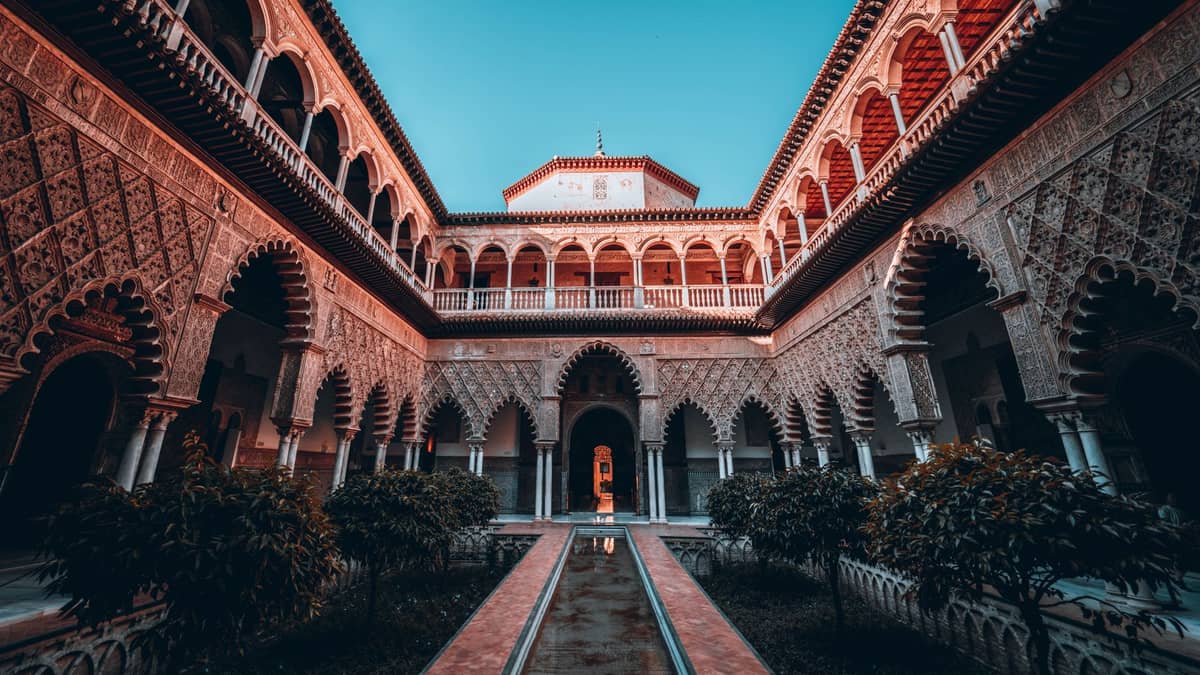
Inside the palace, the Patio de las Doncellas is the architectural centrepiece. Its arcade of paired arches, sunken central garden planted with low box hedges and ornamental pools, and encircling tile panels represent Mudéjar craftwork at its most refined. The Salón de Embajadores, the Ambassadors' Hall, adjoins this courtyard and is notable for its gilded half-orange dome, a form derived from Islamic timber geometry and applied here with an almost excessive density of colour. The light in this room shifts noticeably across the day; it is cooler and more diffuse in the morning, warmer and more dramatic in the afternoon.
The Cuarto del Almirante, the Admiral's Quarter, occupies a wing used historically in connection with Spain's New World expeditions. This section includes the Sala de Audiencias, where a large altarpiece depicting the Virgin of the Navigators, painted around 1535 by Alejo Fernández, still hangs in its original setting. It is one of the earliest known paintings to depict the Americas and shows Columbus, Amerigo Vespucci, and a group of indigenous figures sheltering under the Virgin's mantle.
The Gothic Palace, an earlier structure integrated into the complex, houses the Charles V rooms added in the 16th century. These rooms feel markedly different from the Mudéjar sections: broader, colder in tone, and decorated with large tapestry cycles and Flemish-influenced stonework. The contrast between these rooms and the Pedro I palace next to them illustrates how sharply the political and aesthetic priorities of the Spanish crown changed over just two centuries.
💡 Local tip
If you add the Cuarto Real Alto supplement, you access the Royal Apartments and the upper terrace above the Patio de las Doncellas. Places are limited and timed. Book this at the same time as your main ticket, not on arrival.
The Gardens: Scale, Layout, and What to Expect
The gardens of the Real Alcázar cover a significant area and are more formally arranged than most visitors anticipate. The main circuit moves from walled enclosures directly adjacent to the palace, where the oldest garden sections feature hedged parterres, ceramic fountains, and an ornamental pool, out toward larger open grounds and the English Garden, added in the 19th century.
In summer, the gardens provide shade under mature orange trees, palms, and cypresses, and the stone-paved paths stay relatively cool in the morning. By midday, the open sections become genuinely hot. The enclosed garden rooms, with their fountain spray and dense planting, are the most pleasant at this hour. The smell in late spring is significant: orange blossom from the ornamental trees combines with jasmine on the walls in a way that is particular to Seville in April and May.
The gardens are fully included in the general ticket price and are the most accessible part of the complex for visitors with mobility limitations. Much of the main garden circuit is step-free, though some elevated terraces require steps with no ramp alternative. Note that the Cuarto Real Alto is accessible by stairs only, with no lift available. For more on navigating Seville's major sights, including accessibility considerations, see the guide to things to do in Seville.
Best Time to Visit and Crowd Patterns
The Alcázar is one of the most visited monuments in Spain, and its indoor spaces can feel crowded during peak hours regardless of season. The first entry slot at 09:30 consistently offers the lightest crowds, particularly on weekdays. By 11:00, groups have arrived in volume and the Patio de las Doncellas, in particular, becomes difficult to photograph without other visitors in frame.
Seasonally, spring and autumn bring the largest tourist numbers to Seville overall. The city's temperatures in those months, typically 18 to 25 degrees Celsius, are comfortable for a long visit that combines the palace with the surrounding neighbourhood. Summer visits are practical if you arrive at opening time and prioritize indoor sections before the gardens. July and August afternoons regularly exceed 35 degrees Celsius in Seville, and the open parts of the gardens offer little relief after noon. For a broader perspective on how the city's climate affects sightseeing, the best time to visit Seville guide covers each season in detail.
The free entry hour before closing is often cited as a workaround for the ticket price, but it is not a workaround for the crowds. Late-afternoon visitors are numerous, and the reduced time window means you will be moving quickly through spaces that reward slow observation. It works best for visitors who have already seen the Alcázar before and want a focused return to specific rooms or the gardens at dusk.
Photography and Practical Details
Photography for personal use is permitted throughout, including in the palace interiors. The Salón de Embajadores is most photogenic in afternoon light when the warm tone of the dome is amplified. The Patio de las Doncellas requires a wide-angle lens to capture the full arcade and the reflection pool, which is narrow but elongated. The gardens photograph well in the early morning when low-angle light catches the water features and the narrow lanes between hedges.
Bring water if visiting in summer. The Alcázar has limited refreshment facilities inside, and the combination of sun in the open gardens and dense crowds in the indoor rooms can be physically taxing. Comfortable shoes are essential: floors throughout are stone or tile, some sections involve uneven surfaces, and the palace grounds cover considerable ground if you walk the full circuit.
The Alcázar sits immediately adjacent to the Seville Cathedral and the Archivo General de Indias. Many visitors combine all three in a single day. That is achievable but tiring. A more satisfying approach is to give the Alcázar its own morning and pair the Cathedral and Archive on a separate afternoon.
⚠️ What to skip
The Cuarto Real Alto is closed when members of the Spanish royal family are in residence, which happens without public notice in advance. If this section is a priority, check availability on the official site as close to your visit date as possible.
Insider Tips
- The Cuarto Real Alto slots are released in limited batches and sell out quickly. Book them at the exact same time you purchase your main ticket, not as an afterthought.
- The least-photographed section of the palace is the Gothic rooms of the Charles V quarters. Most visitors move quickly through these to reach the gardens, which means you often have the tapestry halls almost to yourself.
- The ornamental pool at the base of the Patio de las Doncellas was hidden under a raised floor for centuries and was only excavated and restored in the early 2000s, around 2002–2004. The current sunken garden reflects the original Nasrid design more accurately than the raised parterre it replaced.
- If you are visiting in late April during Feria de Abril, note that demand for Alcázar tickets spikes sharply across that entire week. Book well in advance or plan your visit for the days immediately before or after the fair.
- The exit from the gardens toward the Apeadero and Patio de Banderas is easy to miss. If you want to exit via the same route you entered, follow the signs toward Puerta del León rather than taking the garden exit that deposits you on a different street.
Who Is Real Alcázar de Sevilla For?
- Architecture and design enthusiasts interested in Mudéjar, Gothic, and Renaissance styles within a single complex
- History-focused travelers who want to understand the layered Islamic, Christian, and imperial heritage of Andalusia
- Photographers looking for interior tilework, geometric plasterwork, and garden compositions
- Visitors with children who can explore the garden maze and open grounds after the palace rooms
- Anyone wanting context before or after visiting the Seville Cathedral, the Archive of the Indies, or the wider Santa Cruz neighbourhood
Nearby Attractions
Other things to see while in Santa Cruz:
- Archivo General de Indias
Standing beside the Cathedral on Avenida de la Constitución, the Archivo General de Indias holds one of the most significant collections of colonial-era documents in the world. Entry is free, the building is architecturally remarkable, and most visitors leave having completely underestimated what's inside.
- Casa de Pilatos
Casa de Pilatos is a 16th-century palace in Seville's historic centre that quietly outshines many better-known landmarks. Its central courtyard, azulejo-lined rooms and classical statuary collection reward visitors who take the time to look closely.
- Hospital de los Venerables
Built in the late 17th century as a refuge for elderly priests, the Hospital de los Venerables is one of Seville's most rewarding architectural and artistic stops. Its church ceiling, Baroque courtyard, and Focus-Abengoa Foundation art collection combine in a space that feels both intimate and historically weighty.
- Iglesia de San Salvador
Standing on the site of Seville's former Great Mosque, the Iglesia del Divino Salvador is the city's second largest church and one of its most rewarding visits. With soaring Baroque nave, layers of Islamic and Christian history, and far fewer crowds than the Cathedral, it earns more attention than most itineraries give it.
Planning a trip? Discover personalized activities with the Nomado app.