Archivo General de Indias: Seville's Archive of the Americas
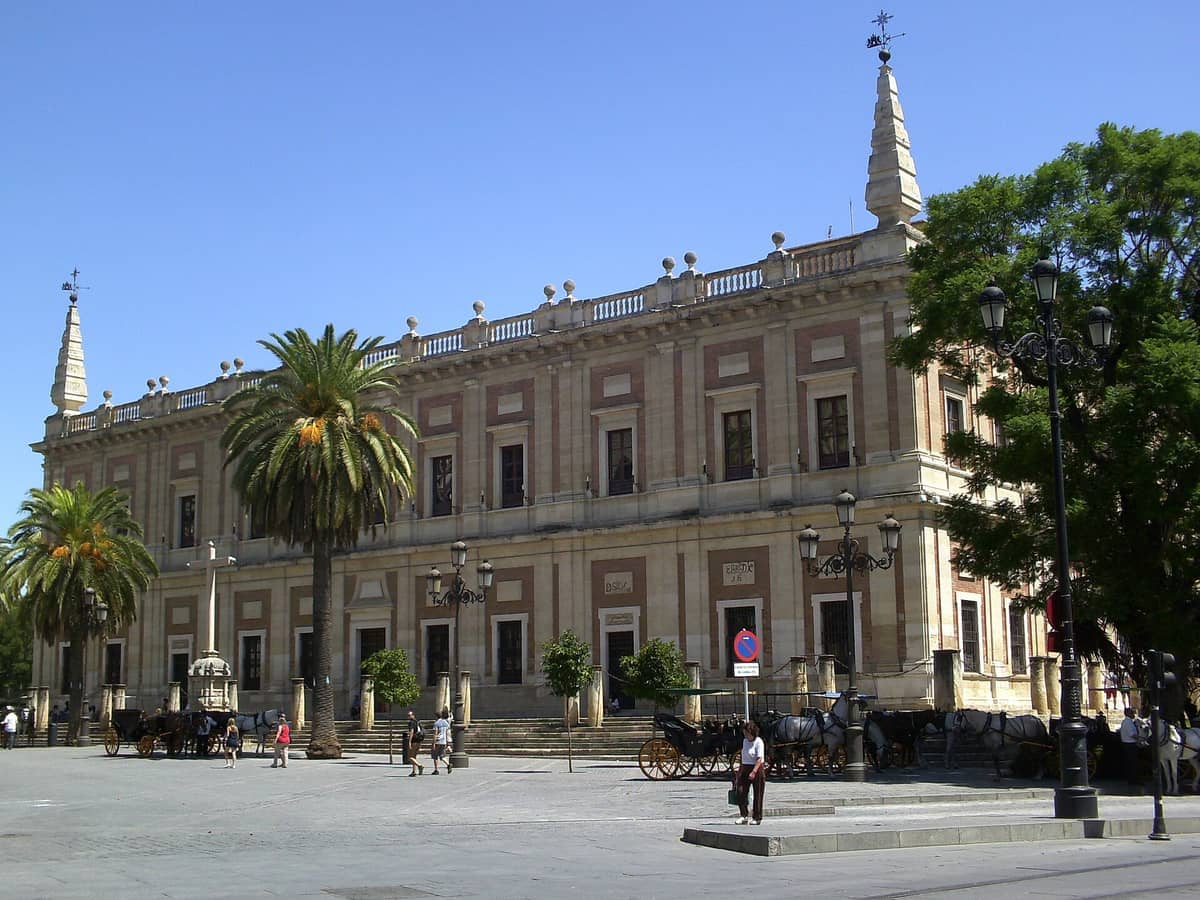
Standing beside the Cathedral on Avenida de la Constitución, the Archivo General de Indias holds one of the most significant collections of colonial-era documents in the world. Entry is free, the building is architecturally remarkable, and most visitors leave having completely underestimated what's inside.
Quick Facts
- Location
- Avenida de la Constitución 3, Seville
- Getting There
- Walk from Puerta de Jerez tram stop; the building faces the Cathedral's south side
- Time Needed
- 45–90 minutes for the tourist visit
- Cost
- Free (tourist visit to the monumental area)
- Best for
- History lovers, architecture fans, anyone pairing it with the Cathedral or Alcázar
What the Archivo General de Indias Actually Is
The Archivo General de Indias (General Archive of the Indies) is a UNESCO World Heritage Site that shares its listing with the Seville Cathedral and the Real Alcázar. That designation alone signals its weight. The archive holds roughly 80 million pages of documentation (around 43,000 legajos) covering Spain's colonial presence in the Americas and the Philippines, from the late 15th century through to the 19th. These are not reproductions or summaries. They are original manuscripts: letters signed by Christopher Columbus, maps drawn by early cartographers, administrative records of entire viceroyalties. The scale of what sits inside this building is genuinely difficult to absorb.
For most visitors, the experience is split between two things: the building itself, which is one of the finest Renaissance structures in Andalusia, and the rotating display cases in the main galleries, where selected documents from the collection are exhibited. You do not need to be a scholar to find it compelling. But if you arrive expecting a conventional museum with explanatory panels and interactive displays, you may need to recalibrate. This is a working archive that opens its doors to the public. The atmosphere is quieter and more contemplative than the nearby Cathedral.
ℹ️ Good to know
Tourist visits are free and require no advance booking. Opening hours: Tuesday–Saturday 09:30–17:00 (last entry 16:30); Sundays and public holidays 10:00–14:00 (last entry 13:30). Closed Mondays and on 1 and 6 January, Maundy Thursday, Good Friday, and 24, 25, and 31 December.
The Building: A Merchants' Exchange Turned Archive
The structure was not built as an archive. It was the Casa Lonja de Mercaderes, Seville's merchants' exchange, constructed between 1584 and 1598 to a design by Juan de Herrera, the same architect responsible for El Escorial near Madrid. Herrera's signature style is immediately recognizable: clean granite facades, restrained ornamentation, a severe and almost geometric confidence. The building was designed to consolidate the commercial life of a city that was, at the time, the most important port in the Spanish world.
By the late 18th century, Seville's commercial dominance had declined and the building sat underused. In 1785, King Charles III issued a royal decree creating the Archivo General de Indias, and the former exchange was repurposed to centralize documentation from Spain's overseas territories in a single, dedicated repository. The decision to house it here was partly symbolic: Seville had been the administrative heart of colonial trade for nearly three centuries, and the Lonja building occupied the city's symbolic centre, between the Cathedral and the Alcázar.
Stepping inside, the ground floor reveals a double arcade of stone columns around a central courtyard. The geometry is precise and calming. Natural light filters down from the upper loggia, and the stone underfoot has the worn smoothness that comes from several centuries of foot traffic. The main staircase, built in marble, leads to the upper floor gallery rooms where documents are displayed. It is one of the more quietly impressive interior spaces in Seville, and it receives far fewer visitors than the Cathedral directly opposite.
Tickets & tours
Live prices and dates from our booking partner. If you book, we may earn a commission at no extra cost to you.
Destileria Puerto de Indias premium tour with gin tasting and cocktail
From 25 €Instant confirmationFree cancellationDestileria Puerto de Indias basic guided tour with gin tasting
From 15 €Instant confirmationFree cancellationGuided Tour of the Archive of the Indies in Seville
From 14 €Instant confirmationSeville Archive of Indies, Torre del Oro and Salvador Church tour
From 16 €Instant confirmationFree cancellation
What You See on the Tourist Visit
The public tour route moves through the main halls on the upper floor, where glass-topped display cases hold a selection of documents rotated from the collection. On any given visit, you might find an original letter from Columbus reporting his first voyage to the Spanish Crown, a hand-drawn map of the Caribbean from the early 1500s, or administrative correspondence from a colonial governor in Peru. The labels are in Spanish, though some key items have English descriptions. If you read Spanish, the experience is considerably richer.
The rooms themselves are worth attention beyond the cases. The painted ceiling vaults and the carved wooden shelving installed to store the archive's legajos (bound document bundles) are original fittings from the archive's early decades. The scale of the shelving running along the walls gives a physical sense of the collection's volume: an estimated 43,000 legajos, each containing hundreds of documents and together amounting to around 80 million pages. You are not seeing the collection, you are seeing a fragment of it made visible.
💡 Local tip
If you want to read about the broader significance of what the archive contains before or after your visit, the official Ministry of Culture website (cultura.gob.es) provides detailed background in Spanish. The UNESCO citation for the joint World Heritage listing also provides a useful summary in English.
How the Visit Changes by Time of Day
The Archivo General de Indias sits on one of Seville's most visited streets, directly between the Cathedral's south facade and the Alcázar's ticket entrance. The pavement outside is heavily trafficked between 10:00 and 13:00, particularly during the spring and early autumn high seasons. Despite this, the archive itself rarely feels crowded. Most visitors to Seville do not add it to their itinerary, which means that even on busy days, the interior galleries are occupied by only a handful of people at any one time.
The early morning slot, from opening until around 11:00, offers the best light in the ground-floor courtyard. The upper floor galleries are lit largely by artificial light and do not change significantly through the day. Visiting on a Sunday morning when the opening hours are shorter (10:00–14:00) is worth considering: the area around the Cathedral tends to be quieter before midday on Sundays, and the archive feels particularly unhurried. Avoid the hour before closing, as staff begin to signal the end of the visit fairly firmly.
Practical Details and Getting There
The archive is at Avenida de la Constitución 3, which puts it in the heart of Seville's historic center, roughly 40 seconds on foot from the Cathedral's south door and about two minutes from the main Alcázar entrance. If you are coming by tram, Puerta de Jerez is the closest stop on the MetroCentro T1 line, a short walk north along the avenue, which connects here with Plaza Nueva and San Bernardo.
On foot from most central hotels in Santa Cruz, the archive takes under ten minutes. It pairs naturally with both the Cathedral and a visit to the Real Alcázar on the same morning, since all three share the same block. If you plan to do all three in a day, start with the archive when it opens, move to the Cathedral mid-morning, and save the Alcázar for the afternoon when your ticket time slot allows.
The building is listed as wheelchair accessible with accessible restrooms. However, the formal courtyard and some transitions between areas involve uneven stone surfaces typical of a 16th-century structure. Visitors with specific mobility requirements are advised to check current conditions on the official website before visiting, as temporary access limitations occasionally apply during conservation or maintenance work.
⚠️ What to skip
The archive is closed on Mondays. It is also closed on specific public holidays: 1 and 6 January, Maundy Thursday, Good Friday, and 24, 25, and 31 December. If your Seville visit falls around Easter week, check the official schedule carefully, as Semana Santa closures affect most major sites.
Photography, Context, and Who Should Skip It
Photography is generally permitted in the tourist areas, though without flash. The courtyard offers the most architecturally satisfying shots: the arcade of columns, the marble staircase, and the upper loggia framed against the interior sky. The document cases are challenging to photograph well through glass, but the surrounding rooms with their original shelving are worth capturing for the sense of scale they convey.
The exterior facade facing Avenida de la Constitución is one of the most photographed in Seville, often appearing in the same frame as the Giralda tower. For guidance on the best vantage points and times to photograph the area, see this overview of the best viewpoints in Seville.
Visitors who struggle with unaccompanied browsing of historical material, or who are specifically looking for an interactive, multimedia museum experience, may find the archive underwhelming. There are no audio guides available for the general tourist visit (verify on arrival, as this occasionally changes), and explanatory text is minimal and predominantly in Spanish. The archive rewards visitors who come prepared with some background knowledge of the colonial period, or who are drawn by the architecture alone. For families with young children, the absence of hands-on elements makes this a hard sell unless the children already have a strong interest in history.
If you are assembling a broader day in this part of the city, the Seville Cathedral and the Real Alcázar are the natural complements. Both require paid entry and advance booking is recommended, particularly in spring and autumn. The archive, being free and walk-in, provides a calmer counterpoint to those busier sites.
Historical Weight and Why It Matters
Seville's position in the history of European expansion is not incidental. From 1503 onwards, the city housed the Casa de Contratación, the institution that regulated all trade and communication between Spain and its colonial territories. For nearly two centuries, every ship sailing to or from the Americas was licensed, taxed, and documented through Seville. The Archivo General de Indias is the physical accumulation of that administrative reality: the paperwork of empire, preserved in one place.
The decision to create the archive in 1785 was itself a statement of Enlightenment-era rationalism, an attempt to organize and preserve the documentary record of what was then the largest empire in history. The documents here have been used by historians, linguists, legal scholars, and governments across Latin America seeking records of land ownership, population movements, and colonial administration. Some nations have requested access to specific documents as part of efforts to understand their pre-independence histories. Visiting the archive is not just a tourist exercise; it is a chance to stand in the same rooms where that record is kept. For more context on Seville's role in Andalusian history, a broader guide to Seville's major attractions sets the archive within the wider city.
Insider Tips
- Visit on a weekday morning between 09:30 and 10:30 to have the upper gallery rooms largely to yourself. By 11:00 the Cathedral tour groups begin spilling over into the surrounding streets.
- The ground-floor courtyard is freely visible even before you ascend to the main exhibition rooms. Spend a few minutes here before going upstairs: the proportions of the Herrerian arcade are best appreciated at ground level and most visitors rush past.
- If you read Spanish, look for the explanatory panels near the staircase that describe the structure of the legajos system. They give a better sense of how the archive is organized than anything in the display cases.
- The building's exterior north corner, facing the Cathedral's south transept, offers one of the clearest sightlines to the Giralda with relatively little foot traffic compared to the main avenue side. Good for photographs in early morning light.
- For researchers (rather than tourist visitors), access to the reading room requires accreditation and a separate appointment system through the Ministry of Culture. The tourist visit and the research visit are entirely distinct experiences with different access routes.
Who Is Archivo General de Indias For?
- Travelers with a specific interest in Latin American, Spanish colonial, or early modern history
- Architecture enthusiasts drawn to Renaissance civic buildings and Herrerian style
- Visitors completing the UNESCO triangle of Cathedral, Alcázar, and Archive in a single day
- Anyone seeking a quiet, uncrowded space in the middle of Seville's most visited neighborhood
- Budget travelers: free entry with no booking requirement makes it one of the most accessible major sites in the city
Nearby Attractions
Other things to see while in Santa Cruz:
- Casa de Pilatos
Casa de Pilatos is a 16th-century palace in Seville's historic centre that quietly outshines many better-known landmarks. Its central courtyard, azulejo-lined rooms and classical statuary collection reward visitors who take the time to look closely.
- Hospital de los Venerables
Built in the late 17th century as a refuge for elderly priests, the Hospital de los Venerables is one of Seville's most rewarding architectural and artistic stops. Its church ceiling, Baroque courtyard, and Focus-Abengoa Foundation art collection combine in a space that feels both intimate and historically weighty.
- Iglesia de San Salvador
Standing on the site of Seville's former Great Mosque, the Iglesia del Divino Salvador is the city's second largest church and one of its most rewarding visits. With soaring Baroque nave, layers of Islamic and Christian history, and far fewer crowds than the Cathedral, it earns more attention than most itineraries give it.
- La Giralda
La Giralda began as the minaret of a 12th-century Almohad mosque and was later transformed into the bell tower of the largest Gothic cathedral in the world. At 104 metres tall, it dominates the Seville skyline and rewards visitors with a ramp-based ascent unlike any other tower climb in Spain.
Planning a trip? Discover personalized activities with the Nomado app.