Hospital de los Venerables: Seville's Baroque Masterpiece in Santa Cruz
Built in the late 17th century as a refuge for elderly priests, the Hospital de los Venerables is one of Seville's most rewarding architectural and artistic stops. Its church ceiling, Baroque courtyard, and Focus-Abengoa Foundation art collection combine in a space that feels both intimate and historically weighty.
Quick Facts
- Location
- Plaza de los Venerables 8, Santa Cruz, Seville 41004
- Getting There
- Walk from the Real Alcázar (5 min) or Seville Cathedral (8 min); no direct metro stop — the Santa Cruz quarter is a pedestrian zone
- Time Needed
- 45–90 minutes
- Cost
- Approx. €12 adults; reduced rates around €10 for students, seniors, and under-18s; free for under 12s (verify current pricing before visiting)
- Best for
- Baroque architecture, Spanish Golden Age painting, quiet cultural stops away from the main cathedral crowds
- Official website
- losvenerables.es
What Is the Hospital de los Venerables?
The Hospital de los Venerables Sacerdotes is a late 17th-century Baroque complex tucked into a small plaza in Seville's Santa Cruz quarter. Originally commissioned as a charitable institution for elderly and infirm priests (venerables), it was built between 1675 and 1695 to designs attributed to the architect Juan de Valdés Leal and later Leonardo de Figueroa, two of the defining names in Seville's Baroque tradition. The building has functioned as a cultural center and exhibition space under the Focus-Abengoa Foundation since the 1990s, giving it a dual identity as both an architectural monument and a living art institution.
The complex is organized around a central courtyard flanked by two-story arcaded galleries, with the church occupying the north side. What makes the Hospital de los Venerables genuinely worthwhile for the culturally curious traveler is the quality of the church interior: a ceiling fresco by Juan de Valdés Leal and his son Lucas Valdés, and an altarpiece program that has survived largely intact. The Focus-Abengoa Foundation also maintains a permanent display centered on works associated with Diego Velázquez, Seville's most celebrated painter.
💡 Local tip
Opening hours: Monday to Saturday 10:00–19:00, Sunday 10:00–15:00. Hours can vary seasonally, so check the official website before you go. Admission prices have fluctuated between sources; expect roughly €12 for adults and around €10 for students, seniors, and teenagers.
The Courtyard: Where You'll Spend the First Few Minutes
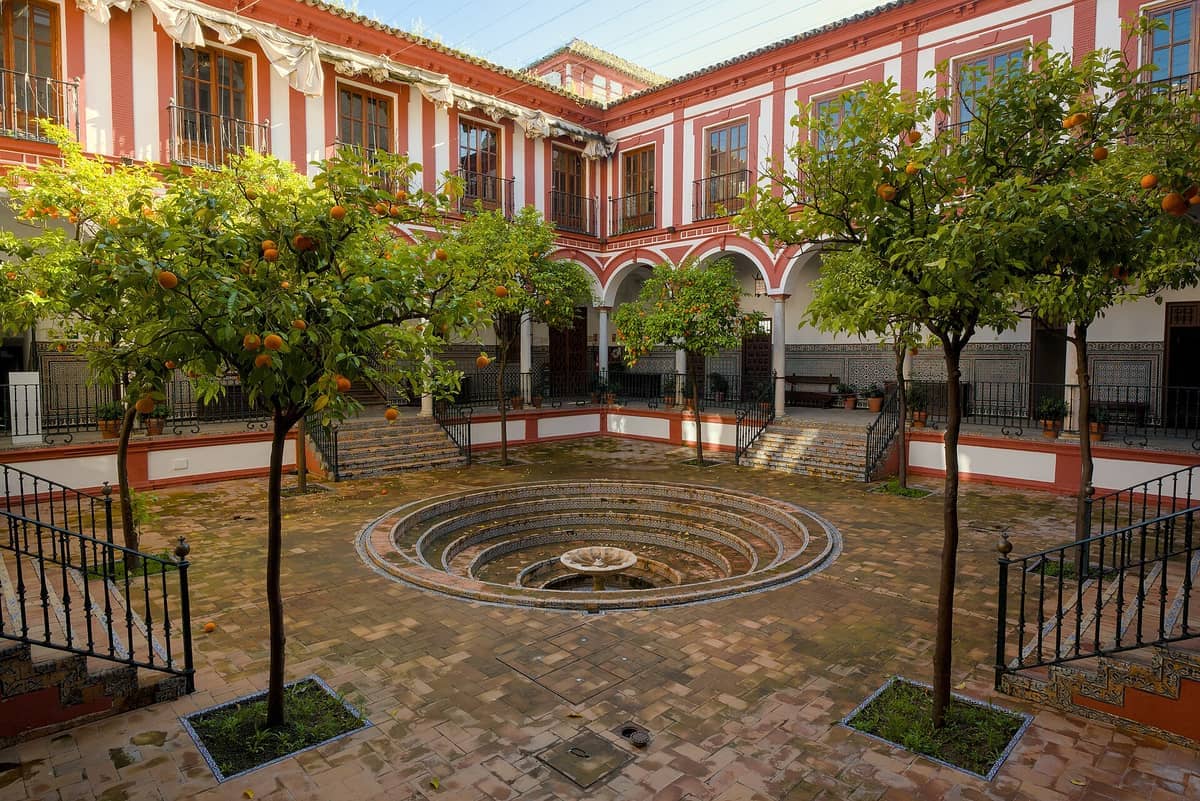
The entrance courtyard is the architectural heart of the complex, and it rewards a slow look. Two tiers of semicircular arches rest on marble columns, and the proportions have an unhurried elegance typical of Sevillian late Baroque: nothing is excessive, but nothing is plain. A central fountain provides the gentle sound that makes the space feel removed from the lane traffic just outside the gate, even in midsummer.
In the mornings, especially on weekdays, the courtyard receives a slanted light that falls across the stonework and makes the texture of the columns legible in a way that flash photography cannot replicate. By early afternoon the light is harsher and more even, better for overall architectural photography but less atmospheric. If you are visiting in July or August, the courtyard also provides natural shade that is genuinely useful after walking the sun-exposed streets between the Alcázar and the cathedral.
Tickets & tours
Live prices and dates from our booking partner. If you book, we may earn a commission at no extra cost to you.
Alcazar of Cordoba skip-the-line tickets and guided tour
From 19 €Instant confirmationFree cancellationAlcazar of the Christian Monarchs guided tour in Cordoba
From 19 €Instant confirmationFree cancellationCultural Cordoba
From 10 €Instant confirmationFree cancellationAlcazar de los Reyes Cristianos guided tour
From 14 €Instant confirmationFree cancellation
The Church Interior and Its Ceiling Frescoes
The church is a single nave with a barrel vault covered almost entirely by frescoes painted by Juan de Valdés Leal and his son Lucas between 1686 and 1704. The subject is the glorification of the Church, with angels, saints, and architectural trompe l'oeil receding into fictive vaults above the painted cornice. The quality is uneven across the surface but reaches genuine brilliance in the central panels, where figures are rendered with a confidence that outpaces what you might expect from an institution of this scale.
Valdés Leal is known in Seville primarily for his two disturbing vanitas paintings at the Hospital de la Caridad, a short walk west. The work here is tonally different: exuberant rather than morbid, and deliberately theatrical in the Baroque manner. If you have already seen the Caridad paintings, the contrast is instructive. If you have not, the Venerables frescoes are an excellent introduction to the painter's technical range.
The altarpiece of the high altar retains its gilded framework and figural sculpture. Photography is permitted in the church, but the low light and curved ceiling make handheld shots difficult without a camera that performs well at high ISO. The Museo de Bellas Artes, a 15-minute walk away, offers broader context for Seville's Baroque painting tradition if the Venerables sparks your interest.
The Velázquez Room and the Focus-Abengoa Collection
The Foundation's permanent collection occupies rooms on the upper floor and includes works attributed to Velázquez's Seville period, when he was active in the city before his move to Madrid and the royal court. The display is modest in scale but curated with clear intent: to situate Velázquez within his Sevillian formation rather than simply as a court painter. Explanatory panels are in Spanish and English.
The collection also includes works by other painters active in 17th-century Seville. The rooms themselves, with their original tile dados and whitewashed walls, provide an appropriate frame. This is not a major museum in the sense of overwhelming volume, but for travelers with genuine interest in Spanish Golden Age painting it is a coherent, concentrated experience.
ℹ️ Good to know
The Focus-Abengoa Foundation historically used the Hospital de los Venerables for temporary exhibitions and cultural events, though recent changes mean its presence in the building is now more limited. Check the official website for any current programming that might affect access to parts of the building.
When to Visit and How It Changes Through the Day
The Hospital de los Venerables draws far fewer visitors than the cathedral or the Alcázar, which means crowd management is rarely an issue. That said, the complex does receive tour groups, typically between 11:00 and 13:00 on weekday mornings. If you want the church and courtyard largely to yourself, arrive at opening (10:00) or after 16:00.
In spring, the Santa Cruz streets leading to Plaza de los Venerables are at their most photogenic: orange blossom scent hangs in the alleys, and the light is warm without being brutal. In summer, the interior of the building offers meaningful relief from midday heat, making it a logical stop between 13:00 and 16:00 when outdoor sightseeing becomes uncomfortable. Winter visits are quiet and unhurried; the church interior is cool but not cold.
If you are planning your time in the neighborhood, the Real Alcázar is five minutes on foot and should be booked in advance. The Hospital de los Venerables requires no advance reservation and is well-suited as a natural follow-on after the Alcázar, when your ticket queue stress is behind you.
Getting There and Practical Notes
The address is Plaza de los Venerables 8, 41004 Seville. The plaza is in the heart of the Santa Cruz pedestrian quarter and is not accessible by car or bicycle. The most straightforward approach on foot is from the Puerta del Perdón of the Seville Cathedral or from the Alcázar's main exit: walk east through the narrow streets, following signs toward the plaza. Allow ten minutes.
There is no metro stop in Santa Cruz. The closest public transport options are the MetroCentro tram, with a stop at Archivo de Indias and another at Puerta de Jerez on its single line, or TUSSAM buses serving Puerta de Jerez and Avenida de la Constitución, both around a 10-minute walk. Taxis can drop you at the edge of the pedestrian zone on Calle Rodrigo Caro.
Accessibility information for visitors with reduced mobility was not available in official sources at the time of writing. The courtyard has a level stone floor, but the building's historic structure may present limitations on upper-floor access. Contact the foundation directly via losvenerables.es to confirm before visiting.
⚠️ What to skip
Admission prices listed in this guide are approximate and have varied across sources. Always verify current pricing at losvenerables.es or on arrival. Sunday closing time of 15:00 catches some visitors off guard — plan accordingly.
Is It Worth Your Time? An Honest Assessment
The Hospital de los Venerables is a rewarding stop for anyone with a genuine interest in Baroque architecture or Spanish Golden Age painting. The church ceiling alone justifies the ticket price for that audience. For travelers on a tight schedule who are prioritizing Seville's headline monuments, it is a second-tier stop rather than an essential one, and the entry cost should factor into that calculation.
Travelers who find themselves overstimulated by the cathedral crowds or the Alcázar queues often describe the Hospital de los Venerables as a relief: smaller, quieter, and genuinely beautiful without demanding three hours of your afternoon. It fits naturally into a three-day Seville itinerary on the afternoon of day one, after the major monuments, or as a standalone morning stop when the cathedral is too crowded to enter comfortably.
Travelers who should probably skip it: those with no appetite for Baroque religious art, families with very young children looking for interactive experiences, or anyone who has already exhausted their museum budget for the day. The experience is contemplative and still, not kinetic.
Insider Tips
- Arrive at 10:00 on a weekday to have the courtyard and church almost entirely to yourself before tour groups arrive around 11:00.
- The church ceiling is best appreciated from the rear of the nave near the entrance, where you can take in the full barrel vault without craning your neck. Most visitors crowd the front near the altar and miss the compositional unity of the whole.
- If the light through the courtyard arcades looks good when you enter, photograph it immediately. By the time you finish the church and upper rooms, the angle will have shifted significantly.
- Combine this visit with the Archivo General de Indias, a five-minute walk away and free to enter. The contrast between the two buildings, one sacred and lavish, the other civic and austere, is instructive about the range of Seville's 17th-century architecture.
- Sunday afternoon closings at 15:00 are firm. Several visitors per day attempt to enter between 15:00 and 16:00 expecting the same hours as on weekdays.
Who Is Hospital de los Venerables For?
- Travelers interested in Spanish Baroque architecture and its regional Sevillian character
- Golden Age painting enthusiasts, particularly those following Velázquez's early career
- Visitors seeking a quiet, uncrowded alternative to the cathedral and Alcázar on the same afternoon
- Photographers looking for courtyard light and interior architectural detail
- Travelers wanting a cultural stop that fits comfortably within 90 minutes
Nearby Attractions
Other things to see while in Santa Cruz:
- Archivo General de Indias
Standing beside the Cathedral on Avenida de la Constitución, the Archivo General de Indias holds one of the most significant collections of colonial-era documents in the world. Entry is free, the building is architecturally remarkable, and most visitors leave having completely underestimated what's inside.
- Casa de Pilatos
Casa de Pilatos is a 16th-century palace in Seville's historic centre that quietly outshines many better-known landmarks. Its central courtyard, azulejo-lined rooms and classical statuary collection reward visitors who take the time to look closely.
- Iglesia de San Salvador
Standing on the site of Seville's former Great Mosque, the Iglesia del Divino Salvador is the city's second largest church and one of its most rewarding visits. With soaring Baroque nave, layers of Islamic and Christian history, and far fewer crowds than the Cathedral, it earns more attention than most itineraries give it.
- La Giralda
La Giralda began as the minaret of a 12th-century Almohad mosque and was later transformed into the bell tower of the largest Gothic cathedral in the world. At 104 metres tall, it dominates the Seville skyline and rewards visitors with a ramp-based ascent unlike any other tower climb in Spain.
Planning a trip? Discover personalized activities with the Nomado app.