Casa de Pilatos: Seville's Finest Palace You're Probably Underestimating
Casa de Pilatos is a 16th-century palace in Seville's historic centre that quietly outshines many better-known landmarks. Its central courtyard, azulejo-lined rooms and classical statuary collection reward visitors who take the time to look closely.
Quick Facts
- Location
- Plaza de Pilatos, 1, 41003 Seville (Santa Cruz / Historic Centre)
- Getting There
- Best reached on foot from the Cathedral (10–15 min walk east). TUSSAM buses serve the historic centre; nearest stops vary by line.
- Time Needed
- 1.5 to 2.5 hours for ground floor and gardens; add 45–60 min for upper floor guided tour
- Cost
- Ground floor: approx. €10. Upper floor (guided): approx. €5 extra. Children under 11–12 free. Free entry Monday afternoons (approx. 15:00–18:00, EU citizens, limited capacity). Verify current prices at fundacionmedinaceli.org.
- Best for
- Architecture lovers, history enthusiasts, anyone seeking a quieter alternative to the Real Alcázar
- Official website
- fundacionmedinaceli.org/en/monuments/house-of-pilate
What Casa de Pilatos Actually Is
Casa de Pilatos is a Renaissance-Mudéjar palace in the heart of Seville's historic centre, developed primarily during the 16th century by the Enríquez de Ribera family, later associated with the Dukes of Medinaceli. It is still privately owned and managed today by the Fundación Casa Ducal de Medinaceli, which gives it a lived-in, non-museumified quality that is increasingly rare among Seville's major monuments.
The palace blends three architectural traditions in a way that feels coherent rather than confused: Gothic structural elements, Mudéjar decorative craftsmanship, and Renaissance proportions all appear within the same building. The result is a style that defines Seville's architectural identity during the era when the city became the gateway to Spain's American empire. Walk through the main entrance arch and you step from the narrow streets of the old city into one of the most elaborate courtyard complexes in Andalusia.
The palace sits a 10 to 15 minute walk east of the Seville Cathedral and the Real Alcázar. Because most visitors exhaust themselves at those two sites first, Casa de Pilatos receives a fraction of the foot traffic it deserves. The contrast in crowd levels is significant.
💡 Local tip
If you are visiting the Real Alcázar in the morning, save Casa de Pilatos for the early afternoon. By 14:00 the crowds thin considerably, and the light in the main courtyard is excellent for photography.
The Main Courtyard: The Centrepiece
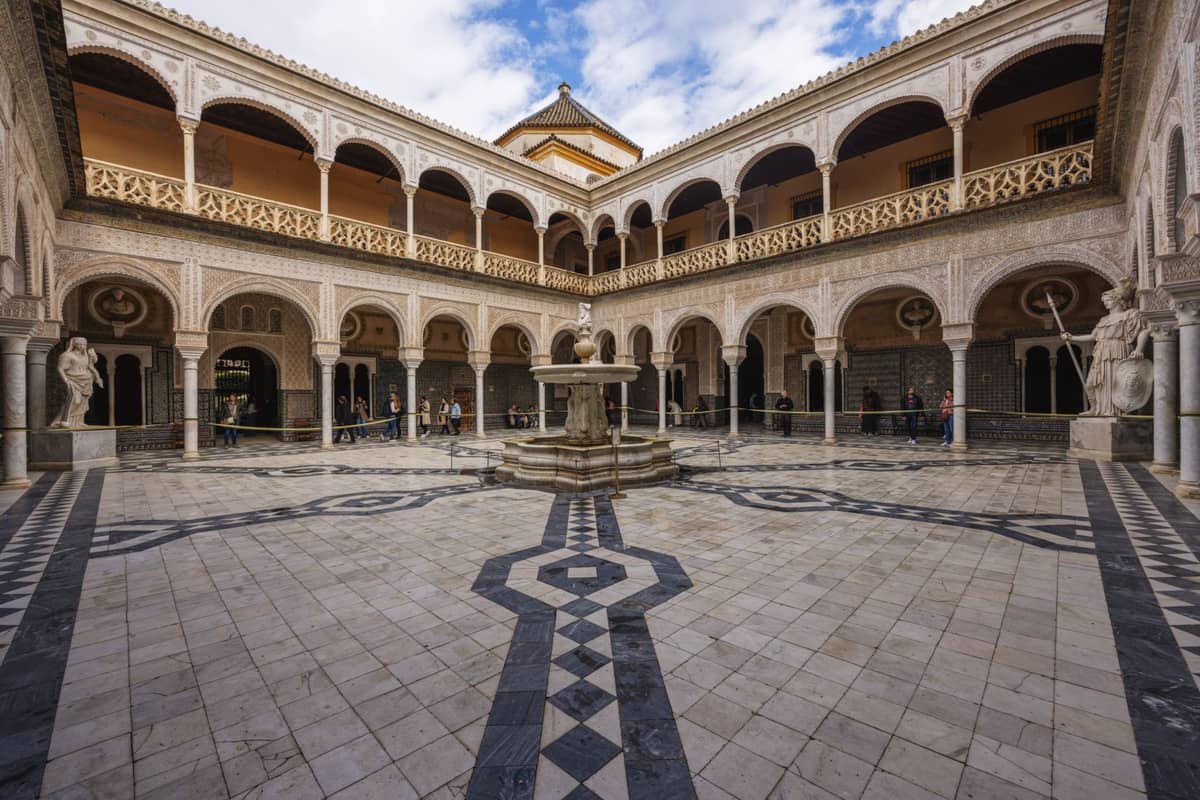
The central patio, known as the Patio Principal, is the first thing visitors encounter after the entrance vestibule, and it sets the tone immediately. Marble columns support delicate arches decorated with plasterwork in geometric Mudéjar patterns. The lower walls are covered in azulejos, the hand-painted tin-glazed tiles that are synonymous with Seville's decorative arts, arranged in complex repeating designs in ochre, cobalt, white and green. The effect, especially in morning light when sun enters from the east, is of controlled exuberance.
Around the perimeter of the patio, niches hold a collection of classical Roman and Greek statuary, including busts of emperors and mythological figures. Several pieces are considered genuinely significant, not decorative reproductions. The juxtaposition of Roman antiquity with Andalusian tile-work is not accidental: the Enríquez de Ribera family deliberately cultivated a humanist, Renaissance identity, and the collection was assembled as a statement of cultural ambition.
In the morning, before 11:00, the patio is quiet enough to hear water from the central fountain. The stone stays cool underfoot. Groups arrive in force from around 11:30, so if you want that rare chance to stand in the courtyard with minimal interruption, arrive early. By midday in summer the open-air patio is warm but shaded on its north side, and most visitors drift through quickly. The carved plaster friezes above the arches reward close attention: the detail at eye level is exceptional, but the upper register, above the gallery balustrade, is just as intricate.
Tickets & tours
Live prices and dates from our booking partner. If you book, we may earn a commission at no extra cost to you.
Gardens and Secondary Patios
Beyond the main courtyard, the palace opens into a sequence of secondary patios and, eventually, formal gardens that most visitors underestimate. The gardens are divided into two main zones: the lower garden, accessible from the ground floor, and the upper garden reached via a ramp. Box hedges, orange trees, and a central fountain create an atmosphere that is entirely different from the cool stone interior. The smell of orange blossom in spring is particularly strong here, and even in summer the shade and irrigation keep the temperature noticeably lower than the street outside.
A small pavilion with a coffered ceiling sits at one end of the upper garden. It is easy to miss if you follow the main crowd route and exit early. Spending a few minutes here, away from the tour groups, gives a sense of how the palace would have functioned as a private residence rather than a public monument.
If you enjoy the interplay between Moorish-influenced architecture and formal garden design, the Real Alcázar gardens offer a larger but more crowded version of the same experience. Casa de Pilatos provides a more contemplative, less managed alternative.
The Upper Floor: A Guided Visit Worth Taking
The upper floor (planta alta) is only accessible with a guided tour and costs an additional fee on top of the main entrance. The tour covers rooms that were actually inhabited by the Medinaceli family into the 20th century, and the guides draw attention to furniture, paintings and personal objects that give the palace a biographical dimension absent from most heritage sites.
The staircase leading to the upper floor is itself notable: a grand arched structure covered in azulejos with a gilt coffered ceiling at the landing. Photography from this staircase captures one of the most architecturally complex single views in the building. The upper rooms have lower ceilings and more intimate proportions than the ceremonial spaces below, and several contain paintings from the Spanish school that would be significant in any mid-sized European museum.
ℹ️ Good to know
Upper floor tours typically run at set times and have limited capacity. Check availability when you purchase your ground floor ticket, or book the combined ticket in advance. If you arrive at 09:00, you can often secure a morning upper floor slot before groups fill the available spaces.
Historical Context: Why It Exists and What the Name Means
The popular name, Casa de Pilatos, reflects a 16th-century tradition that connected this palace to the biblical house of Pontius Pilate in Jerusalem. Don Fadrique Enríquez de Ribera, who completed much of the current structure after returning from a pilgrimage to Jerusalem in 1519, is said to have measured the distance from his palace to the church of San Esteban as approximately equal to the Via Dolorosa. Every Good Friday, a procession called the Stations of the Cross has historically begun here. Whether or not the architectural connection to Pilate's praetorium was ever seriously intended, the name has endured for five centuries.
The palace's full official name, the Palacio de los Adelantados Mayores de Andalucía, refers to the hereditary title held by the Enríquez de Ribera family: Adelantado Mayor, a kind of royal governor of Andalusia. The palace was, in other words, a seat of regional power, not merely a wealthy merchant's home. That civic weight explains the scale of the ceremonial spaces and the deliberate accumulation of classical antiquities. It was built to impress ambassadors and rivals, not just family guests.
For context on how Seville's noble families shaped the city's architectural landscape, the Palacio de las Dueñas offers a comparable noble residence from the same era, with a different character and fewer tourists.
Practical Details: How to Visit Well
Casa de Pilatos opens daily, typically from 09:00 to 18:00 in winter and 09:00 to 19:00 in summer. Ground floor admission is approximately €10; the upper floor guided tour costs approximately €5 on top of that. Children under about 11 to 12 enter free. On Monday afternoons, typically from around 15:00 to 18:00, EU citizens can enter free of charge, subject to capacity limits. This free window fills quickly and should not be relied upon without checking in advance at the official foundation website.
The ground floor and gardens are described as wheelchair accessible, though the historic layout means some areas involve uneven surfaces. The upper floor has limited accessibility due to the original staircase structure. Visitors with accredited disabilities receive discounted or free entry depending on the degree of disability: a 50% discount applies for disabilities over 50%, and free entry for those over 65% disability accreditation when properly documented. Verify current terms at the official website before visiting.
⚠️ What to skip
Admission prices, free-entry days, and tour availability change periodically. All figures in this guide are drawn from 2024–2026 sources and should be confirmed at fundacionmedinaceli.org before your visit.
Casa de Pilatos sits in the Santa Cruz area of the historic centre. The surrounding streets are narrow, quiet, and largely free of the souvenir shops that crowd the Cathedral zone. It is a pleasant area to walk before or after the palace visit. If you are planning a full day in the historic core, the 3-day Seville itinerary places Casa de Pilatos effectively alongside the major monuments.
Photography Tips
The main patio photographs best in diffuse morning light, before 10:30, when direct sun has not yet reached the floor and shadows on the tile work are softer. The staircase to the upper floor is best shot from the landing looking down, or from the ground floor looking up toward the gilt ceiling. A wide-angle lens is useful in the confined secondary patios. Flash photography is generally not permitted in the interior rooms.
Who Should Probably Skip This
If you have already spent a full morning at the Real Alcázar and your time in Seville is limited to a single day, adding Casa de Pilatos risks diminishing returns. The architectural vocabulary is related, and visiting both in quick succession can make them blur together in memory. On a short visit, it is more satisfying to see one palace with attention than two at a rushed pace. Similarly, visitors with young children may find the guided upper floor tour and the emphasis on visual detail less engaging than outdoor attractions like the Parque de María Luisa.
Insider Tips
- The free Monday afternoon sessions are real but fill up fast, especially in spring and autumn. If you plan to use this option, arrive at least 20 minutes before the free window opens and bring EU identification.
- The tile work in the smaller rooms off the main courtyard is often more unusual than the famous patio panels. Look for the transitional rooms where Mudéjar geometric patterns give way to early Renaissance grotesque ornament: this shift in styles within a few metres is architecturally significant and rarely noted in standard tours.
- The garden's upper terrace has a wooden-ceilinged pavilion that is almost always empty even when the palace is moderately busy. It is a good spot to sit quietly for ten minutes and process what you have seen.
- If you intend to take the upper floor tour, mention this when you buy your entry ticket, not after walking the ground floor. Tour slots can sell out by mid-morning on busy days in March, April and October.
- The palace is roughly 400 metres from the Archivo General de Indias and the Cathedral. Building a walking loop that hits all three in one morning is physically easy and covers an extraordinary range of Seville's imperial and noble history in a compact area.
Who Is Casa de Pilatos For?
- Architecture and art history enthusiasts who want to understand how Mudéjar, Gothic and Renaissance styles merged in 16th-century Andalusia
- Travellers who have already visited the Real Alcázar and want a less crowded but equally detailed alternative
- Photography-focused visitors looking for elaborate tile work and courtyard compositions with manageable crowd levels
- Visitors with a half-day in the historic centre who want substance beyond the Cathedral circuit
- Anyone interested in the social history of Seville's aristocratic families and the city's role as the capital of Spain's Atlantic empire
Nearby Attractions
Other things to see while in Santa Cruz:
- Archivo General de Indias
Standing beside the Cathedral on Avenida de la Constitución, the Archivo General de Indias holds one of the most significant collections of colonial-era documents in the world. Entry is free, the building is architecturally remarkable, and most visitors leave having completely underestimated what's inside.
- Hospital de los Venerables
Built in the late 17th century as a refuge for elderly priests, the Hospital de los Venerables is one of Seville's most rewarding architectural and artistic stops. Its church ceiling, Baroque courtyard, and Focus-Abengoa Foundation art collection combine in a space that feels both intimate and historically weighty.
- Iglesia de San Salvador
Standing on the site of Seville's former Great Mosque, the Iglesia del Divino Salvador is the city's second largest church and one of its most rewarding visits. With soaring Baroque nave, layers of Islamic and Christian history, and far fewer crowds than the Cathedral, it earns more attention than most itineraries give it.
- La Giralda
La Giralda began as the minaret of a 12th-century Almohad mosque and was later transformed into the bell tower of the largest Gothic cathedral in the world. At 104 metres tall, it dominates the Seville skyline and rewards visitors with a ramp-based ascent unlike any other tower climb in Spain.
Planning a trip? Discover personalized activities with the Nomado app.