Palacio de las Dueñas: Seville's Most Intimate Aristocratic Palace
The Palacio de las Dueñas is the historic Seville residence of the House of Alba, a family whose name is woven through five centuries of Spanish history. Built around a series of sunlit courtyards and fragrant gardens, this Renaissance and Gothic-Mudejar palace sits quietly in the La Macarena district, offering a rare glimpse into aristocratic life that feels personal rather than monumental.
Quick Facts
- Location
- Calle Dueñas 5, 41003 Seville
- Getting There
- A short walk from Plaza de la Encarnación / Metropol Parasol; TUSSAM buses serve nearby Calle Feria and Plaza de la Encarnación
- Time Needed
- 1.5 to 2 hours
- Cost
- Approx. €13 adults (with audioguide); reduced rate €10; under 6 free; free entry Mondays (non-public holidays) from 16:00
- Best for
- History lovers, architecture enthusiasts, travellers seeking a quieter alternative to the Alcázar
- Official website
- www.lasduenas.es/en
What Is the Palacio de las Dueñas?
The Palacio de las Dueñas is one of Seville's great aristocratic residences, built in its current form during the 15th and 16th centuries and long associated with the House of Alba, one of Spain's most prominent noble families. Unlike the city's more famous landmarks, it carries no queue-management system and no timed-entry slots. You arrive, pay, and wander.
The building blends Gothic, Renaissance, and Mudejar architectural traditions in a way that feels organic rather than designed. Pointed arches meet Italianate loggias. Intricate ceramic tile dadoes line walls beneath exposed brick. Carved stone details appear where you least expect them. The overall effect is less curated showcase, more inhabited history.
The palace sits in the La Macarena district, the northern section of Seville's historic core, a neighbourhood better known for its medieval walls and the famous basilica than for international tourism. That relative quietness is part of what makes a visit here feel different from the city's more trafficked sights.
The Architecture: Three Styles in One Building
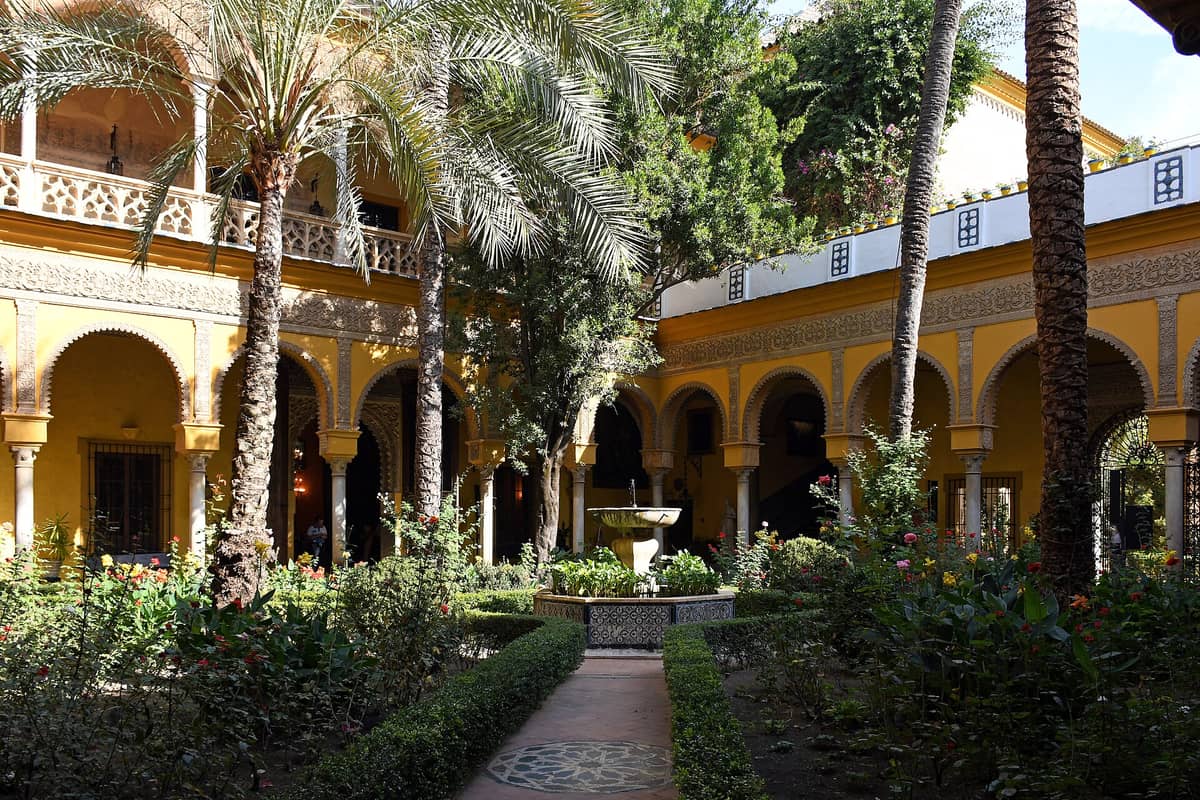
The palace is arranged around several courtyards, the largest of which is the main patio. Arcaded galleries run along two levels, their columns slender and their arches horseshoe-shaped in the Mudejar manner. The stonework on the capitals is fine enough that it rewards close inspection: floral and geometric motifs, worn smooth in places by centuries of hands.
The Gothic chapel at one end of the complex is a quiet space with pointed vaulting and coloured light filtering through small windows. Elsewhere, a Renaissance loggia opens onto a garden courtyard where orange trees and roses grow in neat beds. The scent on a warm morning, when the blossom is out, is one of the more unexpected sensory rewards of the visit.
The ceramic tile work throughout the ground-floor rooms and corridors is exceptional. Much of it dates from the 16th century and follows the geometric patterning of the Triana tile tradition, the same craft heritage still visible across the river. Running your eye along a dado and picking out the repeating geometric units is a pleasantly absorbing way to slow down.
💡 Local tip
Look up as well as down. The painted wooden ceilings (artesonado) in several rooms are among the finest surviving examples in any private Sevillian palace and are easy to walk past while focused on the floor tiles.
Tickets & tours
Live prices and dates from our booking partner. If you book, we may earn a commission at no extra cost to you.
Palacio de Duenas Guided Tour
From 25 €Instant confirmationFree cancellationSeville 3 top picks MegaPass Classic with Alcazar, Cathedral and River Cruise
From 63 €Instant confirmationTablao Palacio Andaluz flamenco show with cava
From 54 €Instant confirmationFree cancellationFlamenco Show entrance tickets at El Palacio Andaluz
From 32 €Instant confirmationFree cancellation
The House of Alba and Five Centuries of History
The palace's connection to the House of Alba gives it a human dimension that purely architectural sites often lack. The dukes and duchesses of Alba were for centuries among the wealthiest and most politically connected families in Spain, with ties to the Spanish crown, to the arts, and to events across European history. Their presence in this building left behind a collection of paintings, furniture, personal objects, and family portraits that the visitor route gradually reveals.
The poet Antonio Machado was born in the palace in 1875, a fact that resonates for Spanish literature enthusiasts. A room is dedicated to his memory, with documents and photographs. This layer of literary history adds something genuinely unexpected for visitors who arrive expecting only architecture.
For broader context on aristocratic Seville, the Casa de Pilatos offers a useful comparison: it is larger, better known, and represents a different noble family's taste, but visiting both in the same trip reveals how varied the city's palatial architecture actually is.
How the Experience Changes Through the Day
Morning visits, particularly in the first hour after opening, tend to be the quietest. The light falls directly into the main patio between roughly 10:00 and 11:30, catching the orange tree canopy and the carved stone of the upper gallery. Photography is straightforward at this hour without other visitors in every frame.
By midday, especially in the warmer months, visitor numbers increase noticeably, though the palace rarely reaches the point of genuine crowding. The gardens provide shade and somewhere to pause when the interior rooms feel warm. In summer, the thick walls of the older parts of the building hold the cool reasonably well, but some of the smaller display rooms can become stuffy by early afternoon.
Late afternoon visits in autumn and winter, when the palace stays open until 18:00, benefit from low golden light entering the courtyards from the west. The pace of other visitors also slows perceptibly. The free Monday afternoon entry from 16:00 attracts a local audience: families, older residents, and architecture students, rather than the international tourist group dynamic of peak morning hours.
ℹ️ Good to know
Opening hours vary seasonally. April to September: 10:00–20:00, last entry 19:15. October to March: 10:00–18:00, last entry 17:15. Closed 1 January, 6 January, and 25 December. Free entry every Monday (non-public holiday) from 16:00 until closing, with last free admission 45 minutes before closing.
Practical Walkthrough: What to Expect
The entrance on Calle Dueñas 5 is easy to miss on first approach. The street is narrow and the facade relatively understated compared to what lies inside. Tickets can be purchased at the door or in advance online. An audioguide is typically included in the general admission price and is available in multiple languages. It is worth using: the rooms are not heavily labelled in situ, and the audioguide provides the contextual detail that makes individual objects legible.
The visitor route is broadly linear with some flexibility in the courtyard and garden areas. Ground-floor rooms, the main patio, the garden courtyard, the chapel, and a series of rooms displaying family portraits and personal objects are all included. Upper-level access is limited due to preservation requirements and the historic structure of the building. Visitors with reduced mobility will find the ground-floor circuit largely accessible, but should contact the palace in advance to confirm current conditions, as some thresholds and uneven surfaces exist.
The palace is about a 15-minute walk from the Metropol Parasol and the Plaza de la Encarnación. Several TUSSAM bus routes stop near Calle Feria and the surrounding streets. Walking is the most practical approach for most visitors staying in the historic centre.
⚠️ What to skip
The palace is a private residence as well as a visitor attraction. Photography is permitted in most areas but tripods and professional lighting equipment are generally not. Check current photography policy at the ticket desk on arrival.
Is It Worth Your Time? An Honest Assessment
The Palacio de las Dueñas is not trying to compete with the Real Alcázar or the cathedral. It is smaller, the collections are more personal than encyclopedic, and the experience rewards visitors who arrive curious and unhurried. If you approach it expecting a world-class museum experience, you may find it underwhelming. If you arrive wanting to understand how a great Sevillian noble family actually lived, surrounded by the architecture they built and the objects they accumulated over centuries, it is genuinely absorbing.
For visitors whose Seville itinerary is already anchored by the major sights, the Palacio de las Dueñas works well as an afternoon addition, particularly when combined with a walk through La Macarena to visit the Basílica de la Macarena and the nearby section of the medieval city walls.
Visitors who are primarily interested in Seville's Moorish heritage, who find aristocratic portrait galleries unengaging, or who have only a single day and need to prioritise iconic landmarks, may reasonably choose to skip it. The palace does not appear on most short-stay itineraries for good reason: it is a specialist pleasure rather than a universal one.
Insider Tips
- Monday free entry (from 16:00, non-public holidays) is the best deal in Seville for a sight of this quality. Arrive at 15:45 and you will be near the front of the queue when the doors open.
- The garden courtyard in the centre of the palace is the least photographed and most peaceful space on the circuit. Spend more time here than the audioguide suggests and you will leave with a clearer sense of what the building actually felt like to inhabit.
- The Machado room is small and easy to rush past. If you have any interest in Spanish poetry or literature, pause here: the documents and photographs provide rare personal context for one of the 20th century's most important Spanish writers.
- The palace is on Calle Dueñas, a street that does not appear on all maps under that name. Navigate to the junction of Calle Dueñas and Calle Gerona rather than searching for a landmark entrance.
- Combine the visit with a walk along Calle Feria toward the Alameda de Hércules for one of Seville's most authentic neighbourhood experiences, far from the tourist circuits of Santa Cruz.
Who Is Palacio de las Dueñas For?
- Architecture enthusiasts interested in the intersection of Gothic, Renaissance, and Mudejar styles in a single building
- Spanish history and literature lovers, particularly those with an interest in the House of Alba or Antonio Machado
- Travellers on return visits to Seville who have already covered the major landmarks
- Anyone visiting on a free Monday afternoon looking for substance without spending money
- Visitors who want to spend time in La Macarena and need an anchor attraction for the neighbourhood
Nearby Attractions
Other things to see while in La Macarena:
- Alameda de Hércules
Dating to 1574, the Alameda de Hércules is a long tree-lined promenade in Seville's historic centre, anchored by two ancient Roman columns topped with statues of Hercules and Julius Caesar. Free to enter as a public square, it functions as a family park by day and a lively social hub by night.
- Basílica de la Macarena
The Basílica de la Macarena is Seville's most emotionally charged religious site, home to the beloved image of Nuestra Señora de la Esperanza Macarena. Entry to the basilica is free, the attached museum costs €5, and the experience is unlike anything else in Andalusia's religious calendar.
- Calle Feria & El Jueves Market
Every Thursday morning, Calle Feria in the La Macarena district transforms into one of Seville's oldest and most atmospheric street markets. Known locally as El Jueves, it's a free, open-air bazaar of antiques, second-hand curiosities, and neighbourhood life that draws both locals and curious visitors.
- Convento de Santa Paula
One of Seville's most atmospheric religious sites, the Convento de Santa Paula is a Hieronymite convent founded in the late 15th century that still houses an active community of nuns. Its small museum preserves an unexpectedly rich collection of religious art, tucked inside a quarter of La Macarena that rewards slow exploration.
Planning a trip? Discover personalized activities with the Nomado app.