Setas de Sevilla (Metropol Parasol): Viewpoint, Ruins, and Seville's Most Striking Structure
The Metropol Parasol, known locally as Setas de Sevilla, dominates Plaza de la Encarnación with its sweeping wooden canopy. It combines a panoramic walkway above the rooftops, a subterranean Roman archaeological museum, a fresh produce market, and a nightly light show in a single five-level complex at the heart of the city.
Quick Facts
- Location
- Plaza de la Encarnación, s/n, 41003 Sevilla — historic centre
- Getting There
- MetroCentro tram T1 (currently limited to Archivo de Indias; from there it’s ~15-min walk); TUSSAM buses 27 and 32 serve the plaza directly
- Time Needed
- 1.5–2.5 hours (longer if you linger at sunset or visit the Antiquarium)
- Cost
- General admission approx. €16, including viewpoint + 'Feeling Sevilla' film; reduced rates for seniors, minors; free under 5. Verify current prices at official site.
- Best for
- City panoramas, architectural curiosity, history lovers, evening atmosphere
- Official website
- setasdesevilla.com/en
What Is the Metropol Parasol?
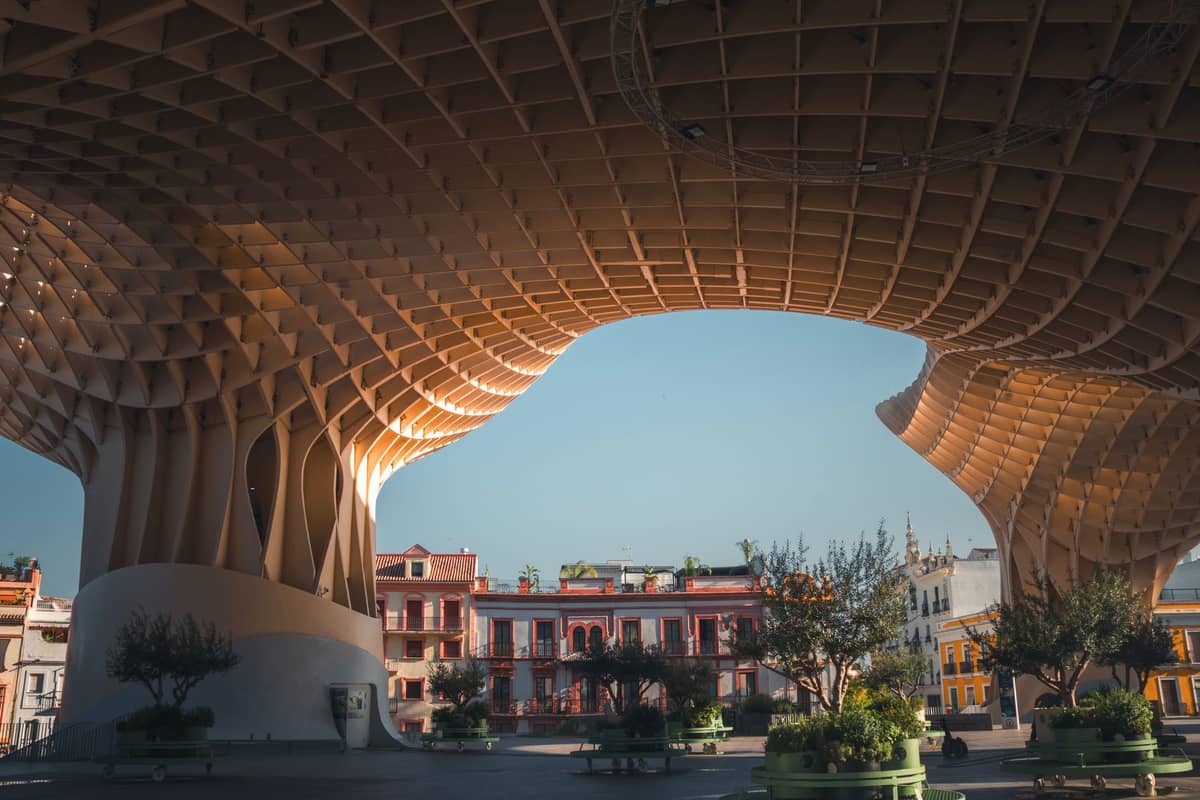
The Metropol Parasol, universally called Setas de Sevilla (literally 'Seville's Mushrooms'), is one of the most structurally ambitious urban projects built anywhere in Europe in the 21st century. It occupies the entire Plaza de la Encarnación in the historic centre, rising on six giant undulating columns to form a canopy of interlocking waffle-like wooden vaults that shade the square below. The structure was designed by German architect Jürgen Mayer H. and completed in 2011 after years of construction delays and local controversy.
It is frequently cited as one of the largest wooden structures in the world. The material is not raw timber but bonded timber panels (glulam), sealed and protected to withstand Seville's intense summer heat. Up close, the lattice surface has an almost biological texture, like the underside of a vast leaf. From street level on a clear afternoon, the white geometry catches the light and casts geometric shadows across the pavement below.
Architecturally, it fits nowhere in Seville's established visual vocabulary. The Cathedral and Giralda a few streets south are stone and history. The Setas are wood and provocation. Whether that contrast reads as inspired or jarring depends on the traveler. What is undeniable is that the structure functions as more than a landmark: the five levels include an underground archaeological museum (the Antiquarium), a covered fresh produce market on the ground floor, a raised public terrace, the famous panoramic walkway, and a bar-restaurant at the top.
💡 Local tip
Book tickets online before arriving. Timed entry slots sell out on weekends and holiday evenings. The official site (setasdesevilla.com) is the only place to buy direct. Third-party resellers charge markups.
The Panoramic Walkway: What You Actually See
The walkway is the main draw, and it earns its reputation. The elevated path winds along the top of the mushroom forms at around 28 metres above the plaza, offering an unobstructed 360-degree view across the city's rooftops. You can see the Giralda tower, the dome of the Basílica de la Macarena to the north, the Guadalquivir river glinting to the west, and on clear days, the faint outlines of hills beyond the urban sprawl.
The walkway surface is a narrow path of wooden decking, mostly flat, with low railings on the outer edge. Visitors with a fear of heights should be aware: the sense of exposure is genuine. The outer sections have nothing between you and the open air except a low metal bar. On busy days, the path can feel congested, particularly at the narrower bends. Move at your own pace and let faster visitors pass at the wider platforms.
Morning visits (opening time is 09:30) give you near-empty walkways, sharp light on the city's terracotta roofscapes, and cooler temperatures. In summer, this matters enormously since by midday the unshaded sections of the walkway become genuinely uncomfortable. Photography-wise, the morning light comes from the east and illuminates the Cathedral quarter beautifully. Telephoto lenses let you isolate the Giralda against the skyline.
💡 Local tip
For sunset views, aim to arrive at least 30 minutes before the sun drops. The sky over Triana and the river turns deep orange in autumn and winter, making it one of the better elevated sunset vantage points in the city. In summer, sunset is late (after 21:00) so this aligns with the cooler part of the day.
Tickets & tours
Live prices and dates from our booking partner. If you book, we may earn a commission at no extra cost to you.
The Antiquarium: Roman Ruins Beneath Your Feet
One of the more surprising aspects of the Setas is what lies below the plaza, not above it. When construction workers broke ground for the new structure in the early 2000s, they uncovered extensive Roman and Moorish-era remains. The site was subsequently excavated, preserved, and converted into the Antiquarium, a basement-level archaeological museum that now forms Level 0 of the complex.
The ruins include sections of Roman mosaic floors, storage rooms, and the remnants of what was a substantial urban settlement from Hispalis (the Roman name for Seville). Glass walkways allow visitors to move over the ruins while looking down at the preserved floor surfaces. The lighting is atmospheric rather than clinical: spotlights pick out the mosaics against a dark background, and explanatory panels provide context in Spanish and English.
Access to the Antiquarium is included with the general ticket. Budget an extra 30–40 minutes if you plan to read the panels. The Antiquarium pairs well with a broader interest in Seville's layered pre-medieval history; visitors who also visit the Real Alcázar or the Archivo General de Indias will find this underground layer adds another dimension to how the city accumulated over centuries.
The Market, the Bar, and the Evening Light Show
At ground level, the Mercado de la Encarnación operates under the Setas canopy as a working covered market selling fresh produce, meat, fish, and local groceries. It opens in the morning and is quietest before 09:00, when local vendors are still setting up. This is not a tourist food hall. It is a functioning neighbourhood market used by residents, which makes it worth a short walk-through even if you are not buying anything.
The Level 1 terrace functions as a public space and hosts a bar-restaurant, which is convenient if you want to sit with a drink after the walkway. Prices are higher than the surrounding streets but not outrageously so. The terrace catches afternoon shade from the canopy above, making it a reasonable stopping point on a hot day.
After dark, the structure transforms. The Aurora light show, included in the evening general ticket, projects colour and movement across the underside of the canopy. It runs in loops throughout the evening. The effect is more ambient than spectacular, but the lit canopy reflected in the wet tiles after rain is genuinely photogenic. The plaza fills with a social crowd in the evening, particularly on weekends, when families and young groups gather below the glowing structure.
ℹ️ Good to know
Opening hours are approximately 09:30–00:00 Sunday to Thursday and 09:30–00:30 Friday and Saturday, but seasonal variations and special events can affect this. Check the official website before planning your visit.
Getting There and Getting In
Plaza de la Encarnación sits in the historic centre, roughly ten minutes on foot north of the Cathedral. It is one of the more walkable major sights in the city. The MetroCentro tram (T1 line) currently terminates at Archivo de Indias; from there it is a straightforward 15-minute walk through pedestrian streets. TUSSAM buses 27 and 32 stop closer to the plaza itself. If you are arriving from the Santa Justa railway station, a taxi or ride-hailing app (Uber and Cabify both operate in Seville) takes around 10–15 minutes depending on traffic.
The Setas are easy to combine with nearby attractions on the same day. The Iglesia de San Salvador is a five-minute walk south. The Casa de Pilatos is around fifteen minutes on foot to the east. For a full day in the historic core, the 3-day Seville itinerary places the Setas logically within a morning circuit.
Accessibility is well-considered. Lifts connect the basement Antiquarium level with the walkway above, and approximately 90% of the walkway is wheelchair-accessible. Strollers can also navigate most of the structure. Some outer walkway sections have low railings that may feel exposed for visitors with significant acrophobia. Accessible toilets are available at both ground and walkway levels.
Is It Worth Your Time? An Honest Assessment
The Metropol Parasol is a legitimate highlight for visitors with an interest in architecture, city panoramas, or the contrast between ancient and contemporary. The combination of Roman archaeology underground, a working market at street level, and a walkway above the roofline is genuinely unusual: few urban structures layer historical strata this explicitly.
That said, travelers whose time is limited and who prioritise Seville's historic monuments should be clear about the trade-off. The ticket price (approximately €15–16) is comparable to what you pay for the Cathedral or the Alcázar, but the cultural depth is different. The Setas is a 21st-century architectural feat, not a heritage site. If your itinerary is already dense with the Cathedral, Alcázar, and Triana, you may find the Setas works better as a late-afternoon add-on than as a headline destination.
Visitors who specifically want panoramic views of Seville have an alternative worth considering: the Giralda tower offers height with historical weight, though its view is more directional. The Setas walkway gives a cleaner 360-degree sweep. For anyone compiling a short list of the best viewpoints in Seville, both deserve consideration on their own terms.
⚠️ What to skip
The walkway is entirely open to the elements. In summer, temperatures on the upper deck can feel significantly hotter than street level due to sun exposure and reflected heat from the wooden surface. Bring water and sun protection, and consider a morning visit between late June and early September.
Insider Tips
- The basement Antiquarium is often skipped by visitors focused on the walkway. Arrive at opening time (09:30), spend 30 minutes with the Roman mosaics when the space is quiet, then take the lift straight up to the walkway before the crowds build.
- The best sunset photography position on the walkway faces west-northwest, toward the Guadalquivir river and Triana. In autumn and winter, the low sun catches the water and the church towers of Triana in the same frame.
- If you are visiting in the evening for the Aurora light show, the view from the plaza below the canopy can be as interesting as the walkway itself. The crowd gathers spontaneously and the illuminated underside of the structure reflects in any surface moisture on the tiles.
- The Mercado de la Encarnación at ground level opens earlier than the ticketed attractions. Arriving just after the market opens lets you see the space as a working local market before tour groups arrive.
- The walkway narrows considerably at several bends. If you are with young children or a group that walks slowly, start at opening time to avoid bottlenecks. On busy weekend afternoons, the path can feel uncomfortably crowded at the pinch points.
Who Is Setas de Sevilla (Metropol Parasol) For?
- Architecture and design enthusiasts who appreciate contemporary urban projects
- Travelers seeking panoramic rooftop views of the Seville skyline without a strenuous climb
- History-curious visitors who want to see Roman mosaic ruins in a modern setting
- Evening visitors looking for an atmospheric place to spend the transition from sunset to nightfall
- Families with strollers or wheelchair users, given the lift access and mostly flat walkway
Nearby Attractions
Other things to see while in Santa Cruz:
- Archivo General de Indias
Standing beside the Cathedral on Avenida de la Constitución, the Archivo General de Indias holds one of the most significant collections of colonial-era documents in the world. Entry is free, the building is architecturally remarkable, and most visitors leave having completely underestimated what's inside.
- Casa de Pilatos
Casa de Pilatos is a 16th-century palace in Seville's historic centre that quietly outshines many better-known landmarks. Its central courtyard, azulejo-lined rooms and classical statuary collection reward visitors who take the time to look closely.
- Hospital de los Venerables
Built in the late 17th century as a refuge for elderly priests, the Hospital de los Venerables is one of Seville's most rewarding architectural and artistic stops. Its church ceiling, Baroque courtyard, and Focus-Abengoa Foundation art collection combine in a space that feels both intimate and historically weighty.
- Iglesia de San Salvador
Standing on the site of Seville's former Great Mosque, the Iglesia del Divino Salvador is the city's second largest church and one of its most rewarding visits. With soaring Baroque nave, layers of Islamic and Christian history, and far fewer crowds than the Cathedral, it earns more attention than most itineraries give it.
Planning a trip? Discover personalized activities with the Nomado app.